This site is supported by our readers. We may earn a commission, at no cost to you, if you purchase through links.
A single cobra bite delivers a molecular cocktail—hundreds of toxins engineered for rapid paralysis, tissue destruction, and inflammation. Conventional antivenoms, despite their storied history, often leave you exposed to residual neurotoxins and catastrophic dermal necrosis. If you’ve ever seen a patient’s skin blacken within hours of envenomation, you know the stakes.
Cobra species antivenom research now pivots toward precision-engineered nanobodies and recombinant solutions, using structural biology and proteomics to outmaneuver venom diversity. With new trials promising broader protection and faster rescue, the field’s momentum is unmistakable—your toolkit for neutralizing Naja toxins is about to expand dramatically.
Table Of Contents
- Key Takeaways
- Cobra Venom Targets for Antivenom Research
- Why Traditional Antivenoms Struggle
- Nanobody Discovery Against Cobra Toxins
- Cobra Species and Venom Variation
- Recombinant Antivenom Research Breakthroughs
- Frequently Asked Questions (FAQs)
- Can nanobody recombinant antivenom be used for cobra bites?
- Is there a human scFv antibody for Iranian cobra venom?
- Does cobra venom cause necrosis?
- Is there antivenom for cobras?
- Is snake antivenom species specific?
- What animal is immune to a cobra bite?
- Is python immune to cobra venom?
- How does cobra venom kill?
- Are there natural antidotes to cobra venom?
- How long does venom take to kill?
- Conclusion
Key Takeaways
- Traditional horse-derived antivenoms often fail to fully neutralize cobra venom due to low active antibody content, batch variability, and high risk of severe immune reactions.
- Nanobody-based and recombinant antivenoms, engineered through advanced immunization and phage display methods, offer rapid and precise neutralization of diverse cobra toxins, including both neurotoxins and cytotoxins.
- Significant regional and species-specific differences in cobra venom composition demand antivenom solutions that account for proteomic diversity and cross-species efficacy.
- Innovations like multivalent VHH cocktails, microbial manufacturing, and structural-guided toxin targeting are driving the development of next-generation antivenoms with broader protection, faster action, and improved safety.
Cobra Venom Targets for Antivenom Research

When you’re developing antivenom for cobra species, pinpointing the right toxin targets is essential. You need to think about not just the types of toxins present, but also how they interact and vary across different species. Let’s look at the main factors that guide your research focus.
For example, regional differences in venom strength—like those noted in coral snake neurotoxicity and yield variations—can influence which toxins take priority in antivenom development.
Key Cobra Toxin Families
Cobra venoms present a complex mixture, but three-finger toxins dominate, folding into compact, disulfide-rich structures that target neural or cellular receptors. Specifically, alpha-cobratoxin functions by targeting nicotinic acetylcholine receptors to disrupt neuromuscular signals.
Cytotoxins—another critical group—disrupt phospholipid membranes, driving dermal necrosis. Phospholipase A2 enzymes act in concert, amplifying myotoxicity and inflammation. Snake venom metalloproteases further degrade extracellular matrices, intensifying local tissue destruction and complicating antivenom design.
Alpha-Neurotoxin Receptor Blockade
When alpha-neurotoxins infiltrate the bloodstream, they target the acetylcholine binding site on muscle-type receptors. This occlusion halts ion channel activation at the neuromuscular junction, precipitating flaccid paralysis. High-affinity binding and slow dissociation kinetics create prolonged blockades. Nanobody therapies promise rapid toxin neutralization, offering faster rescue from cobra venom-induced neurotoxicity than traditional antivenoms.
- Life hangs by a molecular thread
- Precision binding means hope, not guesswork
- Rescue is measured in minutes, not hours
- Small molecules outrun old therapies
- A new era: paralysis reversed, breath restored
Cytotoxins and Tissue Damage
Unlike neurotoxins, cytotoxins act as membrane-destroying agents, binding to phospholipids and forming pores that trigger ion imbalance and rapid cell death. They cleave the extracellular matrix, loosening tissue structure, and disrupt mitochondrial ATP production, amplifying necrosis.
By destabilizing the cytoskeleton and recruiting inflammatory cells, these three-finger toxins drive dermonecrosis and persistent, irregular wound healing in venom-exposed tissues.
PLA2 Lethality Contributions
You’ll encounter phospholipase A2 (PLA2) as a linchpin in cobra venom lethality—these enzymes, strictly calcium-dependent, hydrolyze cell membranes, accelerating myotoxicity. Synergizing with neurotoxins, PLA2 doesn’t just boost paralysis but triggers rapid edema and necrosis. Isoform variability defines tissue tropism and severity, so PLA2 activity measurement helps with:
- Predicting clinical risk
- Guiding antivenom selection
- Monitoring therapy
- Benchmarking nanobody efficacy
Species-Specific Venom Profiles
Venomics reveals striking biogeographical toxin clines within the Naja genus; for example, African spitting cobras express higher cytotoxin ratios, while Southeast Asian lineages favor PLA2 and three-finger neurotoxins.
If you’re curious about how these venom profiles compare across other snake species, this detailed guide to snake venom types by species offers a helpful overview.
Ecological niche and prey diversity drive individual venom repertoires, so even within a species, proteomic shifts alter lethality profiles—meaning antivenom selection must account for regional and intraspecific variation.
Why Traditional Antivenoms Struggle

If you’re wondering why current antivenoms fall short, you’re not alone. There are several fundamental challenges that limit their effectiveness and safety. Let’s look at the main reasons traditional treatments struggle.
Horse-Derived Antibody Production
You’re looking at a process shaped by tradition and necessity: horses are immunized with cobra venom antigens, then monitored for rising antibody titers. When levels peak, technicians collect hyperimmune plasma, fractionate it to isolate immunoglobulin-rich sections, and remove Fc fragments to cut serum sickness risk.
Strict animal welfare protocols make sure equine health throughout—veterinary oversight, humane collection, and post-procedure monitoring.
Low Active Antibody Content
Precision is compromised when low active antibody content plagues traditional antivenoms. You’re faced with diluted neutralizing power—often less than 10% functional IgG—so cobra venom toxins linger, prolonging morbidity.
Dose optimization becomes guesswork, as inactive fractions inflate volume requirements. If storage or purification introduces denaturation, potency drops further, complicating clinical management and leaving patients vulnerable to ongoing venom neutralization failures.
Batch-To-Batch Variation
You’re dealing with a landscape where batch-to-batch variation undermines venom neutralization. Material impurity shifts (1–4%), temperature setpoint drift (up to 5°C), and equipment wear effects—like mixing blade shear changes—alter recombinant antivenom performance.
Analytical assay noise (2–6%) compounds uncertainty, so immunological cross-reactivity and venom composition are unpredictable, complicating clinical efficacy and patient safety.
Severe Immune Reaction Risks
You’re facing fatal anaphylaxis risk every time you administer traditional antivenom—horse antibodies prompt immediate hypersensitivity. Complement activation cascades worsen inflammation, escalating airway compromise and vascular shock. Past exposure heightens immunological crossreactivity, so sensitized patients are a ticking clock.
Every dose of traditional antivenom risks triggering fatal anaphylaxis and rapid immune reactions, making sensitized patients a ticking clock
Continuous monitoring is non-negotiable; you must have epinephrine protocols ready. Serum sickness emerges days later: fever, rash, joint pain—demanding intervention.
Poor Local Damage Control
If you’re relying on horse antivenom, local damage control remains a glaring blind spot. Cobra venom’s cytotoxins drive dermonecrosis and cutaneous necrosis—traditional antivenom barely touches these. Delayed dosing lets tissue injury advance, while systemic stabilization masks ongoing bite-site deterioration. Without supportive care, wound assessment, or frequent monitoring, you’ll miss progressive swelling and necrosis.
- Inadequate wound assessment
- Systemic versus local effects
- Delayed dosing consequences
- Supportive care gaps
- Monitoring reassessment failures
Nanobody Discovery Against Cobra Toxins

If you’re curious about how nanobodies are changing the game in cobra antivenom research, here’s where the story begins. You’ll see the key steps that turn animal immunization into precise toxin targeting. Let’s walk through each stage that shapes this creative approach.
Alpaca and Llama Immunization
Immunizing alpacas and llamas via subcutaneous neck injections—often paired with aluminum hydroxide adjuvant—maximizes B cell exposure and yields strong antibody titers. Routine boosting every 1–3 weeks sustains high VHH production.
Animal welfare protocols minimize stress and monitor for adverse reactions. Serum screening for antigen-specific IgG confirms neutralizing activity, allowing you to isolate stable nanobodies suitable for cobra venom targeting.
Phage Display Library Screening
Once you’ve isolated high-titer sera, phage display technology lets you explore billions of VHH variants. Screening involves biopanning stringency—immobilizing cobra venom toxins, then amplifying only strong binders. Subtractive panning techniques remove non-target clones, while high-throughput sequencing tracks motif enrichment.
Surface plasmon resonance quantifies kinetic constants, pinpointing nanobodies with rapid, specific binding to threefinger toxins for recombinant antivenom.
High-Affinity VHH Selection
Once motif-enriched VHHs are identified, affinity maturation accelerates your progress. CDR mutations can boost binding up to twentyfold, while library diversification targets framework residues for enhanced solubility. Off-rate optimization—trapping millisecond-to-second residence times—ensures reliable neutralization. High-affinity VHHs bind recessed epitopes on threefinger toxins, outperforming conventional antibodies. You’ll see these benchmarks in:
- Nanomolar affinity thresholds
- Deep groove paratope contacts
- Low aggregation risk
- Rapid kinetic profiling
Structural Toxin Binding Insights
You’ll find nanobody-antitoxin interfaces exploit receptor mimicry mechanisms—VHHs map precisely onto the surface loop regions of threefinger alpha-neurotoxins, blocking their high-affinity acetylcholine receptor contacts. Structural biology reveals disulfide structural stability maintains both toxin and nanobody integrity, while lipid membrane perturbation by cytotoxins is thwarted through selective epitope targeting. Here’s how these interactions align visually:
| Mechanism | Nanobody Effect |
|---|---|
| Receptor mimicry | Blocks AChR interface |
| Lipid membrane targeting | Disrupts cytotoxin entry |
| Conformational flexibility | Captures toxin movements |
| Disulfide-rich scaffolds | Ensures stability |
Cobra Species and Venom Variation
Cobra venoms aren’t one-size-fits-all—each species brings its own molecular quirks and clinical challenges. You’ll see how these differences shape the effectiveness of antivenom strategies. Let’s dive into what sets each group apart.
Naja Proteomic Diversity

You’re confronting a landscape shaped by regional toxin variation—Naja venomics reveal proteomic shifts driven by habitat and prey. Posttranslational protein modifications like glycosylation yield potent, antigenically distinct three-finger alpha-neurotoxins.
Low-abundance proteoforms, often overlooked, contribute to unique venom phenotypes. Proteomic profiling exposes intraspecific diversity, mapping how ecological pressures forge venom composition, influencing antivenom efficacy and clinical outcomes.
African Spitting Cobra Cytotoxins
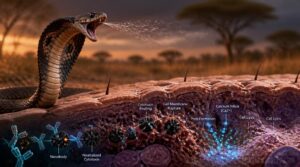
Cytotoxicity defines the clinical challenge posed by African Spitting Cobra envenomation. High concentrations of A2 and A4 cytotoxin isoforms initiate rapid membrane disruption—triggering pore formation and calcium influx that leads to cell lysis. Local necrosis, progressing from superficial dermal injury to deeper tissue loss, creates persistent morbidity. Nanobody-based approaches, targeting diverse cytotoxin isoforms, offer promise for improving tissue morbidity management.
- Membrane disruption via cytotoxins
- Isoform diversity amplifies cytotoxicity
- Calcium influx triggers cell death
- Nanobodies counteract local necrosis
Asiatic Cobra Neurotoxins
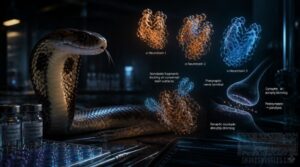
Precision in neurotoxin architecture drives synaptic transmission blockade in Asiatic cobras. Both short- and long-chain alpha neurotoxins—members of the three-finger toxin family—bind nicotinic acetylcholine receptors, initiating rapid neuromuscular paralysis.
Sequence variation and posttranslational modifications dictate cross-neutralization potential, challenging antivenom efficacy. Nanobody strategies use conserved structural motifs, targeting neurotoxicity across diverse venom profiles for more effective therapeutic outcomes.
Regional Naja Naja Differences
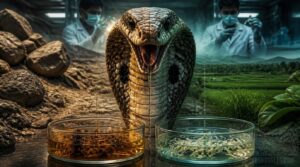
You’re facing a landscape where regional venom fingerprints in Naja naja aren’t just a curiosity—they dictate survival. Western populations show dominant cytotoxins and strong PLA2 activity, causing marked tissue destruction, while eastern snakes favor short neurotoxins for rapid neuroparalysis.
Local prey selection and habitat fragmentation drive this proteomic diversity, creating immunity gaps and posing a challenge for recombinant antivenom design.
Cross-Species Neutralization Challenges

Cross-species antibody failure isn’t just a technical hiccup—it’s a systemic bottleneck. You’re contending with epitope drift, receptor binding diversity, and immune escape: each cobra’s venom mixes unique neurotoxins, cytotoxins, and minor classes. VHH cocktails falter as manufacturing stability lags behind heterogeneity. If you want broad-spectrum rescue, you’ll need recombinant antivenom with true crossreactivity—no shortcuts.
- Epitope drift weakens neutralization
- Receptor diversity thwarts antibody binding
- Immune escape reshapes toxin surfaces
- Venom heterogeneity overwhelms single-target agents
- Manufacturing constraints reduce efficacy
Recombinant Antivenom Research Breakthroughs

Recent advances are reshaping how you approach antivenom development for cobra species. Several innovations are making treatment safer, more effective, and easier to produce. Here’s what you need to know about the latest breakthroughs.
Multivalent VHH Cocktail Design
Imagine a single recombinant antivenom molecule, architected for broadly neutralizing antibodies: you get three or more VHHs linked by optimized tandem sequences, each mapped to a unique cobra toxin epitope.
By using avidity versus affinity and scaffolding nanoparticle delivery, you improve both coverage and tissue penetration. Modular production scalability lets you swap VHHs rapidly, future-proofing polyvalent recombinant antivenom platforms.
Broad Elapid Protection Results
Centi 3FTX D09 demonstrates durable in vivo protection against elapid neurotoxicity, binding whole venom from 18 of 20 species and mimicking the toxin-receptor interface for broad neutralization.
When combined with a PLA2 inhibitor, synergistic venom neutralization extends survival and mitigates tissue damage. Recombinant antivenom cocktails achieve cross-species binding and complete protection in multi-species panels, outperforming legacy antivenoms.
Delayed Rescue Treatment Models
Delayed rescue treatment models foreground the impact of recognition failure risks during snakebite envenoming, where rapid response activation hinges on staff identifying clinical deterioration trajectories in real time. Continuous monitoring system backstops serve as safety nets, yet escalation policy effectiveness varies. With recombinant antivenom and VHH, timely intervention remains essential—your rescue model’s outcomes depend on these operational factors:
- Early deterioration detection
- Rapid pathway activation
- Effective escalation
Microbial Manufacturing Advantages
Microbial platforms underpin rapid production cycles, letting you iterate recombinant antivenom variants in days. You can engineer VHHs with modular constructs; process robustness means predictable yields, even under environmental stress.
Lower capital costs and simple media slash overhead—fermentation scales from milliliters to thousands of liters. Sustainable feedstock use and efficient waste handling shrink your carbon footprint, making biotechnology both flexible and responsible.
Clinical Trial Readiness Barriers
Trial readiness often hits a bottleneck when enrollment speed can’t match the narrow clinical window after envenomation. You’ll find geographic incidence is uneven, so recruiting at one site won’t predict success elsewhere.
Baseline standardization remains elusive, especially when local follow-up care varies. Restrictive inclusion criteria—bite timing, severity grading—can undermine your ability to assess recombinant antivenom therapeutic efficacy and VHH immunogenicity.
Frequently Asked Questions (FAQs)
Can nanobody recombinant antivenom be used for cobra bites?
Skeptics might doubt efficacy, but nanobody recombinant antivenom demonstrates rapid binding to cobra neurotoxins, neutralizes dermonecrosis lesions, and combats respiratory paralysis.
Although experimental, its VHH cocktail shows broad venom coverage, promising safer future clinical adoption for snakebite management.
Is there a human scFv antibody for Iranian cobra venom?
Yes, human scFv antibodies have been isolated for Iranian cobra venom using phage display selection. These scFvs show binding specificity to neurotoxins and cytotoxins, offer improved safety, and enable recombinant production scalability for potential recombinant antivenom development.
Does cobra venom cause necrosis?
Cobra venom does cause necrosis. Cytotoxin-driven cell membrane disruption triggers dermonecrosis within 24–72 hours, often progressing to deep tissue loss requiring surgical debridement, even when antivenom is administered promptly.
Is there antivenom for cobras?
Antivenom for cobra envenoming does exist — both monovalent and polyvalent formulations — though effectiveness depends heavily on the specific Naja species involved and the geographic origin of the venom.
Is snake antivenom species specific?
Traditionally, yes — most antivenoms target specific venom pools used during production. However, paraspecific neutralization potential exists when venoms share conserved toxin epitopes, enabling partial cross-species efficacy against related species you might not expect.
What animal is immune to a cobra bite?
Nature’s closest thing to a biological shield is the Indian gray mongoose — its mutated acetylcholine receptors block neurotoxin binding. Honey badgers, opossums, hedgehogs, and pigs offer partial resistance, but no animal is fully immune to cobra venom.
Is python immune to cobra venom?
You won’t find complete immunity in pythons; their resistance stems from postsynaptic binding changes and charge repulsion, reducing neurotoxin effects. Partial immunity varies among species—it’s shaped by coevolution, ecological exposure, and local venom phenotypes.
How does cobra venom kill?
Cobra venom kills by blocking acetylcholine receptors at the neuromuscular junction, causing respiratory muscle paralysis. Cytotoxins induce cellular membrane lysis and necrosis, while enzymes disrupt coagulation, precipitating systemic organ injury and rapid multi-organ failure.
Are there natural antidotes to cobra venom?
As the saying goes, “necessity is the mother of invention”—and medicinal plants like Mimosa pudica and Prosopis cineraria offer partial antidote effects by inhibiting venom enzymes; however, standardizing herbal extracts remains a major challenge for clinical safety.
How long does venom take to kill?
Venom-induced lethality unfolds across a spectrum — minutes to days — shaped by species, dose, and patient physiology. Respiratory failure from neurotoxins can strike within 30 minutes; dry bites may delay envenomation entirely.
Conclusion
Venom evolves. Science answers. Your understanding of cobra species antivenom research deepens with every structural model decoded, every nanobody optimized, every recombinant cocktail that holds against a broader elapid profile.
The field doesn’t wait—and neither should your engagement with it. Each toxin family mapped, each clinical barrier cleared, each batch-variation flaw corrected brings the next envenomation patient closer to a genuine rescue.
Precision is the antidote. The work continues, and now, so do you.