This site is supported by our readers. We may earn a commission, at no cost to you, if you purchase through links.

Ball pythons are strict carnivores, and feeding them anything other than whole prey animals sets them up for nutritional failure. A single misjudged prey size or an off-schedule feeding can trigger chronic regurgitation, stalled growth, or a broken feeding response that takes months to repair.
Understanding what ball pythons eat in captivity goes beyond grabbing a bag of frozen mice. Prey type, portion size, warming temperature, and feeding intervals all shape your snake’s long-term health. Get these variables right, and you’ll have a snake that strikes reliably, grows steadily, and stays healthy for decades.
Table Of Contents
- Key Takeaways
- What Do Ball Pythons Eat in Captivity?
- How Big Should Ball Python Prey Be?
- How Often Should Ball Pythons Eat by Age and Weight?
- Is Frozen-Thawed or Live Prey Better?
- How Do You Feed a Ball Python Safely?
- Frequently Asked Questions (FAQs)
- How to tell if a ball python is starving?
- What is a ball python’s favorite food?
- What is the biggest food a ball python can safely eat?
- What food can ball pythons eat?
- Can a ball python eat fruit?
- Should I feed my ball python in its tank?
- Can ball pythons eat insects as treats?
- How to safely store frozen prey?
- Do ball pythons need specific feeding times?
- Is gut loading prey necessary for nutrition?
- Conclusion
Key Takeaways
- Ball pythons thrive exclusively on whole prey rodents — mice and rats — and no fruit, vegetable, insect, or commercial pellet can meet their nutritional needs.
- Match prey diameter to your snake’s widest mid-body point (70–85% for adults, 50–60% for juveniles) to prevent regurgitation, stalled growth, and a broken feeding response.
- Feeding frequency should decrease as your snake ages — every 5–7 days for hatchlings, every 10–14 days for adults — and weekly weigh-ins help you fine-tune the schedule before problems develop.
- Frozen-thawed prey is safer than live feeding because it eliminates bite injuries and parasite risk, but it must be warmed to body temperature before offering to reliably trigger a strike.
What Do Ball Pythons Eat in Captivity?

Ball pythons are strict carnivores that eat whole prey animals — no fruits, vegetables, or commercial pellets. In captivity, their diet centers on a few reliable staples, with room for occasional variety. Here’s what you can and can’t feed them.
Whole prey is essential to their health, as explored in these ball python feeding tips and best practices covering everything from prey size to feeding schedules.
Staple Prey Options
The backbone of a ball python’s diet is mice and rats. Frozen-thawed rodents are the best choice; they’re safer than live prey and widely available.
Start hatchlings on pinkie mice. As your snake grows past 100 g, shift to rat pups for their higher fat content. Alternating between the two each month keeps nutritional intake balanced and prevents prey bias.
Occasional Prey Variety
Beyond staple rodents, occasional prey variety keeps feeding responses sharp. Limit novelty items to twice monthly:
- Choose pinkies or hoppers to vary the whole prey diet without disrupting growth.
- Use a scenting technique: rub novel prey with a familiar item before prey presentation.
- Rotate prey selection to prevent scent adaptation.
Monitor for regurgitation and revert to staples if needed.
Foods to Avoid
Variety has limits. Some foods actively harm your snake, so knowing what to cut matters as much as what to rotate.
Foods like avocado, citrus, and certain insects are off the table entirely — check this safe and unsafe snake feeding guide to separate the beneficial variety from the genuinely risky choices.
| Food to Avoid | Why |
|---|---|
| Insects or vegetables | Can’t meet nutritional needs |
| Live rodents | Bite and infection risk |
| Commercial reptile pellets | Wrong nutrient profile |
Skip calcium dusting on whole prey too. Stick to frozen-thawed feeder rodents from reputable suppliers.
How Big Should Ball Python Prey Be?
Once you know what to feed, getting prey size right is where most mistakes happen. The girth match rule is straightforward: prey should match your Ball python’s widest body diameter at mid-length.
Ignoring this leads to real problems:
- A snake vomiting within 48 hours, stressed and reluctant to feed again
- Chronic weight loss despite a consistent schedule
- Dangerous strain during swallowing from oversized meals
- A broken feeding response that takes weeks to rebuild
Aim for prey that’s 70-85% of your snake’s girth for subadults and adults, dropping to 50-60% for juveniles. This applies whether you’re offering frozen-thawed rodents or fresh-killed. Use feeding tongs to hold prey steady and check its profile before it reaches your snake.
How Often Should Ball Pythons Eat by Age and Weight?
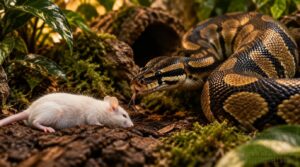
Generally, feeding frequency shifts as your ball python matures, and getting it right comes down to two things: age and current weight.
This ball python feeding schedule by age and weight breaks down exactly how those two factors interact as your snake grows from hatchling to adult.
- Hatchlings under 100 g: every 5–7 days; keep prey size small to match their girth
- Juveniles at 100–300 g: every 7–10 days, tightened if growth is lagging
- Adults over 300 g: every 10–14 days suits most individuals comfortably
- Reproductive females: extend to 14–21 days during vitellogenesis or after laying
Your juvenile grows fast and needs consistent, well-timed meals. Your adult doesn’t. Overfeeding a mature snake causes obesity far quicker than underfeeding causes a problem. Weigh your snake weekly and shift the interval by 2–3 days whenever body condition or growth rate starts to change.
Is Frozen-Thawed or Live Prey Better?

The debate around frozen-thawed vs live prey always comes down to risk management. Frozen-thawed rodents eliminate the most serious live prey risks, including painful bites, lacerations, and direct parasite transmission. A struggling rat or mouse can injure your snake’s mouth in seconds, and you often won’t catch it in time.
Frozen-thawed prey eliminates the bites, lacerations, and parasites that make live feeding a calculated risk
| Frozen-Thawed | Live |
|---|---|
| Low injury and bite risk | High bite and laceration risk |
| Minimal parasite exposure | Active parasite transmission possible |
| Storable and consistent portion size | Requires active sourcing each feeding |
Warm thawed prey thoroughly to body temperature before offering it on feeding tongs. That warmth mimics live prey and reliably triggers a feeding strike. Prey size still matters: it should match your snake’s widest girth point for safe swallowing. Most ball pythons adapt to frozen-thawed within a few feedings. If yours refuses, briefly scent the prey with a live rodent before committing to a full switch.
How Do You Feed a Ball Python Safely?
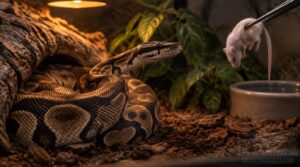
Feeding a ball python safely comes down to a handful of consistent steps that protect both you and your snake. Get the preparation wrong, and you risk bites, regurgitation, or a stressed-out snake that refuses to eat for weeks. Here’s exactly what to do across every stage of the feeding process.
Prepare and Offer Prey
Thaw prey in the fridge overnight, then bring it up to body temperature in a warm water bath right before the meal. This thawing technique keeps frozen-thawed prey both safe and far more enticing. A dedicated reptile prey thawing container makes it easy to maintain that ideal warm water temperature consistently throughout the process.
When you prepare and offer prey, always grip it firmly with feeding tongs. Never force anything, and let your snake’s natural strike response do the work.
Optimize Feeding Conditions
Picture your ball python coiled in a warm, dim enclosure, calm and alert. That’s your target.
Ambient temps of 78–88°F and a basking spot of 92–96°F support digestion. A reptile basking heat lamp thermostat keeps those temperatures locked in automatically, so your snake always has the stable warmth it needs to digest comfortably.
Fast your snake 24–48 hours before presenting prey, and keep the space quiet during the feeding. Minimal foot traffic and low light make acceptance far more likely.
Support Post-Feeding Digestion
After your ball python eats, don’t touch it. The 48-Hour PostFeeding Rule exists for a good reason: handling disrupts digestive recovery and can trigger regurgitation.
Maintain your temperature gradient so your snake thermoregulates efficiently. Cool enclosures slow digestion a lot. Keep fresh water available and stay hands-off.
Consistent postfeeding care and stressfree feeding conditions give every single meal its best chance.
Manage Fasting and Regurgitation
Occasional fasting is normal for ball pythons, so a skipped meal or two rarely signals a problem. But regurgitation does.
If your snake brings a meal back up, wait at least 2 weeks before offering food again, and then downsize the prey. Repeated regurgitation usually points to oversized prey, inadequate temperatures, or handling too soon after feeding.
Monitor Weight and Body Condition
Regurgitation recovery is a good prompt to start weighing consistently. Track body condition using trend data across multiple sessions, not single readings. A digital reptile gram scale makes it easy to capture precise readings session after session, giving your trend data real reliability.
- Use the same scale every time
- Weigh before the next scheduled feeding
- Note girth changes alongside weight
- Log each measurement with a date
- Adjust feeding frequency if weight trends down across three weigh-ins
Frequently Asked Questions (FAQs)
How to tell if a ball python is starving?
Track progressive weight loss over several weeks. Visible tail thinning and declining body condition are your clearest starvation signals. Consistent feeding refusal across multiple meal cycles confirms the real problem, not just one skipped meal.
What is a ball python’s favorite food?
Rats and mice top the list every single time. Whole prey rodents give complete nutrition and match their natural instincts. Frozen-thawed options are safer than live prey, making them the smart choice for most keepers.
What is the biggest food a ball python can safely eat?
Maximum safe prey diameter is roughly 2–5 times your snake’s midbody width. Anything thicker risks regurgitation or impaction. When in doubt, size down.
What food can ball pythons eat?
Despite being top predators, ball pythons are surprisingly simple to feed. Stick to whole prey rodents like mice or rats. Quail and chicks work occasionally. Always match prey size to your snake’s widest point exactly.
Can a ball python eat fruit?
Ball pythons are strict carnivores built entirely for a whole prey rodent diet, not fruit. It provides zero nutritional value, causes digestive upset, and spoils fast inside the enclosure. Keep fruit completely off the menu.
Should I feed my ball python in its tank?
Yes, feed your ball python right in its enclosure. Moving it before meals raises stress and regurgitation risk. Use feeding tongs to deliver prey calmly, keep the room quiet, and remove any uneaten prey promptly.
Can ball pythons eat insects as treats?
Technically, yes, but insects aren’t a meaningful staple. Ball pythons need rodents to truly thrive on a carnivorous diet. Crickets or mealworms offer minimal nutrition, may disrupt digestion, and can reduce normal rodent prey acceptance.
How to safely store frozen prey?
Many keepers assume any freezer storage is fine, but temperature fluctuations degrade prey quality fast. Keep frozen rodents in airtight, dated bags at 0°F, well away from human food, and never refreeze fully thawed prey.
Do ball pythons need specific feeding times?
Snakes don’t watch the clock, so exact times don’t matter. What counts is a consistent feeding schedule based on your snake’s age and size. Juveniles eat weekly; adults every one to two weeks. Stay consistent.
Is gut loading prey necessary for nutrition?
Gut loading isn’t strictly necessary since whole rodents already deliver complete nutritional profiles. But if your prey source is lower quality, a brief gut-loading period can meaningfully improve what your snake actually absorbs each meal.
Conclusion
Ball pythons can live over 30 years in captivity, but most never reach that goal because of preventable feeding errors that quietly compound over time.
The answer to what do ball pythons eat in captivity is simpler than most keepers expect: whole prey, the right size, on a consistent schedule.
Get those three variables right, and you’ll have a snake that strikes reliably, grows steadily, and thrives for decades. That’s not luck. That’s good husbandry.