This site is supported by our readers. We may earn a commission, at no cost to you, if you purchase through links.

Picture a snake swallowing a 35 kilogram deer whole. No chewing, no cutting it into pieces, just one slow, patient gulp. That’s not a myth. It’s documented fact, and it tells you everything about the insatiable appetite behind this species.
So what do Burmese pythons eat? The answer shifts with age and location, from pinky mice for hatchlings to pigs, rabbits, and even alligators for grown adults. In the Everglades, an empty prey list turns into an all-you-can-eat buffet since no native predator dares challenge them.
Ready to see how a hungry hatchling grows into a deer-swallowing giant? Let’s break down the full menu.
Table Of Contents
- Key Takeaways
- Burmese Python Diet by Age and Habitat
- What Do Burmese Pythons Eat?
- How Burmese Pythons Catch and Digest Prey
- How Burmese Python Feeding Affects Ecosystems
- What to Feed Captive Burmese Pythons
- Frequently Asked Questions (FAQs)
- Do Burmese pythons eat other snakes?
- What do pythons eat?
- Are Burmese pythons carnivores?
- How do Burmese pythons find food?
- What do Burmese pythons eat the most?
- What is the best food for Burmese python?
- What prey does Burmese python eat?
- What animal kills Burmese pythons?
- How long can Burmese pythons live without food?
- What is the usual feeding frequency for pythons?
- Conclusion
Key Takeaways
- Burmese pythons aren’t picky eaters—they go from tiny pinky mice as hatchlings to full-grown deer, pigs, and even alligators once they’re adults, swallowing prey whole thanks to insanely flexible jaws and powerful constriction.
- These snakes hunt using heat-sensing pits that detect temperature changes as small as 0.003°C, letting them ambush prey with pinpoint precision even in total darkness.
- In the Everglades, pythons have wrecked local wildlife populations—raccoons dropped nearly 99% and bobcats, rabbits, and deer have all taken major hits since there’s no natural predator keeping them in check.
- If you’re keeping a python as a pet, stick to frozen-thawed whole prey sized to your snake’s girth (not length) and follow age-based feeding schedules, since overfeeding or oversized meals can cause real health problems.
Burmese Python Diet by Age and Habitat

Imagine a snake’s menu changing completely as it grows up—and as it moves across the map. A hatchling in a nursery burrow and an adult roaming the Everglades aren’t hunting the same targets, not even close. Here’s how age and location shape what actually ends up on the plate.
Getting these age-based shifts right matters even more when shedding season hits, since this guide to feeding for healthy shedding cycles shows how diet and molting stay closely linked.
Hatchling and Juvenile Diets
Ever wonder how a snake smaller than your forearm survives on its own? Hatchlings start tiny, hunting newborn mice, rat pups, and small birds.
- Newborn mice and rat pups (5-15 grams)
- Nestling eggs and small birds
- Lizards and frogs as backup
Captive hatchlings thrive on pinky mouse meals every 5-7 days. That’s a solid feeding rhythm for steady growth!
Adult Burmese Python Diets
Fast forward a few years, and that pinky-eating hatchling becomes a heavyweight hunter. Adults chase large mammals like deer and pigs, with prey up to two to three times their own girth! Some documented cases even include the ingestion of a white-tailed deer weighing 35 kilograms.
No venom needed. Just raw constriction power. They swallow prey whole, then digest for days or weeks depending on the meal’s size.
Native Range Food Sources
Back home in Southeast Asia, the menu looks a bit different. Here’s what fuels a wild python:
- Deer and boar weighing 20-100 kg: pure protein jackpots!
- Rodents and small mammals for juveniles
- Bird species near water sources
- Reptiles in tropical forests, plus fish in wetlands
Talk about a buffet with options!
Everglades Food Sources
Swap continents, and the buffet changes completely.
The Everglades runs on sawgrass and algae: periphyton feeds tiny invertebrates, emergent grasses feed insects, and detritus fuels microbes. That base builds up to rabbits, birds, and rodents, python prey staples. No native predators here means feeding frequency stays high. Pythons just keep eating!
Opportunistic Carrion Feeding
When live prey’s scarce, a python won’t turn its nose up at a free meal. Dead deer, drowned hogs, roadkill: all fair game. Using scent cues, they sniff out fresher carcasses (tastier, easier digesting).
- Fresh roadkill near canals
- Flood-drowned livestock
- Storm-killed birds
- Hurricane debris zones
- Farmland carcass piles
This opportunistic feeding beats competing scavengers and squeezes extra calories from a tough season.
Even so, snakes can overdo it during a feeding frenzy, so it’s worth understanding how much is too much for a snake to eat before assuming bigger meals are always better.
What Do Burmese Pythons Eat?

So what’s actually on the menu? Turns out this snake isn’t picky—it eats whatever’s warm, moving, and roughly bite-sized (or way bigger). Here’s the full lineup, from tiny rodents to full-grown gators.
Mice, Rats, and Rodents
Rodents are basically a python’s fast food menu: easy to find, quick to catch, and always in supply. Mice and rats thrive anywhere humans do, which means rodent habitat overlap with pythons is huge near settlements.
Their insane breeding rate keeps populations booming, giving hungry pythons a reliable, protein-packed snack whenever constriction calls.
Birds and Bird Eggs
Picture a python scaling a tree, patient as ever, eyeing a nest full of eggs. That’s nest raiding behavior in action!
Bird species preference leans toward ground-nesters near settlements. Whole eggs get swallowed, shells and all, since eggshell digestion breaks down calcium carbonate easily.
It’s an efficient hunting strategy: low risk, decent reward, zero chasing required.
Rabbits, Raccoons, and Pigs
Ready for a size upgrade? Once a python outgrows rodents, it starts eyeing bigger, meatier prey.
- Rabbits: quick, easy energy
- Raccoons: common in the Everglades
- Pigs: a serious calorie payload
- All swallowed whole, no chewing
- Meals like this can fuel weeks of fasting
That’s the magic of a slow metabolism: hunt big, rest long, repeat!
Deer, Goats, and Livestock
Now we’re talking real firepower. A hungry python can take down a full-grown deer, goat, or farm animal, no problem.
- Deer: up to 87% population drops in invaded areas
- Goats and livestock: easy targets near human habitat overlap
- Prey size limit? Roughly twice its own body weight
An ambush predator with that kind of range? That’s not just impressive, it’s downright staggering!
Reptiles and Alligators
Two top predators, one swamp: who wins? Burmese pythons and alligators both prowl Florida’s wetlands, and pythons sometimes eat gators outright using constriction to overpower them.
That’s wild, since alligators are cold-blooded ambush predators themselves, built with tough osteoderms and their own killer instincts. When python meets gator, it’s not friendship, it’s competition for the same prey and territory.
How Burmese Pythons Catch and Digest Prey
Eating is one thing—catching and breaking down a meal is a whole different skill set. Burmese pythons have some seriously impressive tools for the job, from built-in heat sensors to jaws that stretch way beyond what seems possible. Here’s exactly how they pull it off, step by step.
Heat and Scent Detection

A pit-lined face is your python’s secret weapon. Those thermal pits along the jaw pick up heat differences as tiny as 0.003°C, basically a prey thermal signature glowing in the dark.
Meanwhile the tongue’s out flicking, scent trail following like a bloodhound.
Together? Heat-guided ambush precision:
- Detect warmth
- Track scent
- Align cues
- Strike blind
Ambush Hunting Tactics

Detection’s only half the game. Your python still needs the perfect spot to strike.
Ambush site selection matters most: dense brush, water edges, funnel points where prey naturally travels.
Then it’s patience. Stealth movement, wind control, staying downwind so scent doesn’t leak. Camouflage blends the coils into leaf litter.
One twitch too soon? Dinner’s gone. So it waits, motionless, letting prey wander straight into range.
Constriction and Prey Capture
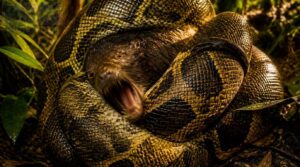
Patience pays off. That heat-guided strike lands fast, jaws snapping shut before prey even registers danger.
Coils follow instantly, wrapping tight. Coil pressure ramp up with every struggle, squeezing harder as the animal fights back.
Chest walls compress. Breathing stops. Blood flow cuts off. Within moments, prey immobilization is complete, no venom needed, just raw mechanical force doing the job.
Swallowing Prey Whole
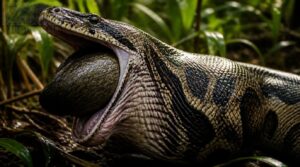
Prey’s down, now comes the wild part: swallowing it whole.
Jaw flexibility lets that mouth stretch wide open. Neck muscles push prey headfirst into the throat, while peristaltic motion (rhythmic squeezing) guides it down.
Here’s how it works:
- Jaws unhinge and widen
- Neck muscles thrust prey forward
- Esophageal expansion accommodates the bulk
- Peristalsis pulls everything downward
- Stomach enzyme release begins breakdown
Large-Meal Digestion

Once that meal hits the stomach, the real marathon begins. Gastric expansion lets the stomach balloon several times its size, while an enzyme surge and gut microbiota shift tackle digestion over 24-72 hours.
| Stage | Timeframe | What’s Happening |
|---|---|---|
| Peak digestion | 4-6 hrs | Acid breaks down tissue |
| Absorption | 6-24 hrs | Nutrient absorption peaks |
| Full process | 24-72 hrs | Energy storage begins |
How Burmese Python Feeding Affects Ecosystems

Here’s where things get serious. A python’s appetite doesn’t just fill its own belly—it reshapes everything around it. Let’s break down exactly how, one impact at a time.
Everglades Mammal Declines
Picture the Everglades before pythons: raccoons everywhere, rabbits darting through brush. Now? Nearly gone.
Raccoon population collapse hit almost 99%. Opossum sighting drops followed the same brutal path. Add a steep bobcat decline trend and eerie rabbit absence zones, and you’ve got real mammal diversity loss. Even deer numbers sank. This invasive species didn’t just eat mammals, it emptied a natural world.
Raccoons nearly vanished, bobcats declined, and deer numbers sank—pythons didn’t just eat mammals, they emptied a natural world
Pressure on Native Wildlife
Here’s the thing about wildlife management: you can’t fix what you can’t measure, and pythons are making that nearly impossible.
Prey depletion ripples outward. Mesopredators vanish, seed dispersal stalls, wetland nutrient cycling shifts. Endangered species already teetering now face extra pressure they never evolved to handle. This isn’t just decline, it’s full-blown natural balance disruption, rewriting survival rules for everything downstream.
Competition With Native Predators
Sharing a menu never ends well, does it? Burmese pythons and native hunters chase the same small mammals and birds, and that overlap breeds real tension.
Bobcats and other predators tip off prey through shared movement patterns, cutting python hunting efficiency. Competition also pushes pythons toward less-preferred prey, spikes stress responses, and shrinks foraging time in prime hunting zones.
- Bobcats and pythons both stalk the same rodents and birds
- Behavioral avoidance forces pythons into riskier, less familiar territory
Threats to Vulnerable Species
Some species just can’t catch a break. Small, isolated populations face double trouble: habitat fragmentation shrinks their range, then Burmese pythons show up hunting the same shrinking prey base.
Add in invasive predators and human-wildlife conflict, and vulnerable animals get squeezed from every angle. Population isolation makes recovery painfully slow, especially when prey availability keeps dropping year after year.
Food Web Disruption
Pull one thread and the whole web unravels. That’s trophic cascade effects in short: fewer mammals means mesopredator surge, less prey diversity, and shrinking environment stability. Native predator competition intensifies as options vanish.
The result? A slow-motion prey population collapse that ripples outward, leaving the Everglades’ food web disrupted in ways scientists are still racing to fully understand.
What to Feed Captive Burmese Pythons
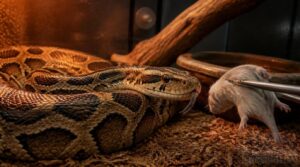
So you’ve got a pet python—now what do you actually feed it? Good news: it’s simpler than you’d think, but timing and sizing matter more than most owners realize. Here’s exactly what to know, from hatchling to full-grown adult.
Whole Prey by Life Stage
Picture a growing python’s menu as a staircase: hatchlings start with tiny frozen-thawed mice, juveniles level up to rats and small rabbits, and adults graduate to full-sized rabbits or poultry. That’s the golden rule of captive feeding, whole prey only, at every single stage.
No supplements needed! Whole prey packs everything your snake’s body craves, naturally.
Safe Prey Size Guidelines
Bigger isn’t better here. Your snake’s jaws can stretch to fit prey five times its head width, but that’s for headfirst swallowing, not a green light for oversized meals.
- Match prey to girth, not length
- Juveniles: 1-2x midbody width
- Adults: 1-1.5x widest point
- Skip anything longer than the snake
- Watch for sluggish digestion after meals
Age-Based Feeding Schedules
Getting the size right is half the battle. The other half? Timing.
| Life Stage | Feeding Frequency |
|---|---|
| Hatchling | Every 5-7 days |
| Juvenile | Every 7-10 days |
| Adult | Every 4-6 weeks |
Temperature dependent feeding shifts these windows too, cooler snakes eat less. Digestion period stretches longer as pythons age, so patience beats a packed feeding calendar every time!
Frozen-Thawed Versus Live Prey
Now for the big debate: frozen or live?
Frozen-thawed wins, hands down. Frozen mice, fuzzies, and pinkies cut injury risk, ditch parasite worries, and match live prey’s nutrition anyway.
Live prey? Riskier for you and your snake, plus pricier and seasonal.
Handfeeding mistakes happen fast, so use tongs. Safer feeding means a happier, healthier python long-term!
Fasting and Overfeeding Signs
Your python’s body talks, if you know how to listen. Fasting shows up as low activity, less movement, and shrinking girth. Overfeeding? Think weight gain, a puffy roll behind the head, or regurgitation.
Watch shed cycles too: stretched intervals often mean fasting. Get feeding frequency right, and appetite rebounds fast!
Frequently Asked Questions (FAQs)
Do Burmese pythons eat other snakes?
Yes, snakes are on the menu! Burmese pythons ambush and constrict other snakes, even venomous ones, swallowing them whole. In 2024, one gulped down a 10-foot reticulated python, proof their prey size limits stretch surprisingly far.
What do pythons eat?
Talk about having an appetite for anything! Pythons are true dietary generalists, hunting rodents, birds, lizards, and even pigs or antelope. Using heat sensing and constriction, they ambush prey, adjusting feeding frequency and prey size as they grow.
Are Burmese pythons carnivores?
No question about it: these snakes are obligate carnivores, built for a meat-only life. Every meal is vertebrate prey, mammals to birds, caught through constriction. No plants, no exceptions, just pure carnivorous instinct driving their diet.
How do Burmese pythons find food?
No eyes needed, no ears required: this ambush predator "sees" heat. Heat-sensing pits map warm bodies in total darkness, while its flicking tongue samples the air, tracking scent trails straight to dinner.
What do Burmese pythons eat the most?
For all their size, rodents and small mammals dominate the menu, think rats, raccoons, and rabbits. Birds and eggs round things out. Deer or gators? Rare treats, only when hunger and opportunity line up just right.
What is the best food for Burmese python?
Variety is the spice of life, and that’s true for pythons too. Whole rodents, rabbits, or poultry sized to your snake’s girth cover complete nutrition. Feed adults every 4-6 weeks, juveniles more often, always frozen-thawed for safety.
What prey does Burmese python eat?
Talk about an appetite with range! Rodents and birds top the menu, but rabbits, raccoons, and pigs aren’t safe either. Bold adults even go after deer, goats, and gators. Constriction seals the deal every time.
What animal kills Burmese pythons?
Even a giant snake has enemies. In wetland habitats, alligators are the top threat, killing juvenile pythons through interspecies combat. Cottonmouths and bobcats target eggs and hatchlings too, but humans remain the biggest predator overall.
How long can Burmese pythons live without food?
Picture going months without a single meal! Healthy adults can fast for several months, sometimes longer, thanks to a slowed metabolism, dormant digestion, and stored energy reserves that kick back into gear fast once feeding resumes.
What is the usual feeding frequency for pythons?
Your snake’s feeding schedule shifts with age: hatchlings eat every 5-7 days, juveniles every 7-14 days. Adults slow way down, going 4-6 weeks between meals as their metabolic rate drops and digestion stretches out.
For a closer look at how these changes play out month by month, snake feeding requirements by growth stage breaks down exactly how to adjust prey size and frequency as your snake matures.
For a fuller breakdown by life stage, this corn snake diet and nutrition guide also covers adult and senior feeding intervals.
Conclusion
Let’s just say these snakes have a "flexible appetite," a gentle way of admitting they’ll eat almost anything that moves. That’s the honest answer to what do Burmese pythons eat: opportunity, not preference.
A hatchling nibbling mice grows into a giant capable of downing a deer, and that journey shows raw survival instinct at work.
Respect that hunger, whether you’re managing captive care or hiking the Everglades. Understanding it keeps you safe, informed, and genuinely amazed by nature’s toughest eaters.