This site is supported by our readers. We may earn a commission, at no cost to you, if you purchase through links.
Your boa hisses, strikes the glove, and coils tight. Most keepers read that as meanness. It’s not, it’s a nervous young snake telling you exactly how it feels.
Boa constrictor snake personality traits run deeper than "calm" or "aggressive." Age, locality, and past handling all shape the animal in your hands, and a Colombian boa will greet the world very differently than a jumpy Corn Island.
Once you can read a slow, even breath versus a rigid S-coil, you stop guessing and start responding. Here’s how to decode your boa’s signals, fix what stresses it, and earn its trust.
Table Of Contents
- Key Takeaways
- Key Personality Traits of Boa Constrictors
- Boa Body Language: Relaxed, Defensive, or Ready to Feed?
- Why Boa Constrictor Temperament Varies Between Individuals
- How Enclosure Conditions and Stress Affect Boa Behavior
- Building Trust Through Safe, Gentle Boa Handling
- Frequently Asked Questions (FAQs)
- Are boas meaner than pythons?
- Is a boa a friendly snake?
- Do boas enjoy being held?
- Are boas aggressive to humans?
- How do boa constrictors communicate with each other?
- Do boa constrictors exhibit play behavior in captivity?
- What behaviors indicate curiosity in boa constrictors?
- How do boas react to changes in lighting?
- Are boa constrictors impacted by routine disruptions?
- How long do boa constrictors typically live in captivity?
- Conclusion
Key Takeaways
- Your boa’s hissing and striking usually signal fear, not meanness, so learn to tell a slow, even breath and loose posture from a rigid S-coil, rapid tongue flicks, and short breaths.
- Temperament depends on age, locality, and handling history, so a nippy juvenile or a jumpy Corn Island boa isn’t a flawed snake, while captive-bred Colombian boas and settled adults tend to be calmer.
- Most "personality problems" start in the enclosure, so check your temperature gradient (86-90°F basking, 75-80°F cool end), humidity (55-75%), and hides first, and change one thing at a time.
- You earn trust through short, calm, patient handling sessions, and big boas need a second person nearby plus full weight support, because the snake’s comfort and your safety grow together.
Key Personality Traits of Boa Constrictors
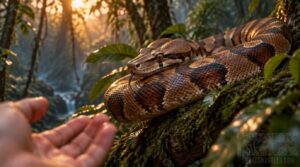
Most boas are calm, sedentary animals, and that’s the heart of their temperament. They’d rather sit still and conserve energy than go looking for trouble. That stillness isn’t boredom, but simply their baseline. Their nocturnal or crepuscular habits also help explain why they spend so much of the day resting quietly.
Some individuals run nippier, especially young ones. That’s not aggression so much as nerves, and it usually fades with stress reduction and patient trust building. Stay consistent.
Boa Body Language: Relaxed, Defensive, or Ready to Feed?
That calm baseline makes changes in body language easy to spot, so learn what normal looks like first.
A loose, unhurried posture and slow, easy tongue flicks are good signs, and this guide to reading snake mood shows how to tell relaxed curiosity from stress.
A relaxed boa breathes slowly and evenly. It moves with purpose, tongue flicking at an ordinary pace, and drapes over you like a tree branch. It holds on, but it doesn’t squeeze.
Defensive behavior looks different. Watch for a rigid, tight S-coil, rapid tongue flicks, short breaths, hissing, or a puffed throat. Gripping hard, jerking, or pushing away means your boa wants space.
A feeding response is another story. At night, a hungry boa leaves its hide, tongue flicks faster, and fixes on anything warm that moves. That’s why you skip handling for several hours before meals. Giving your boa a roomy large reptile hide box also helps, since a secure retreat lets it settle calmly between hunting urges and meals.
When you see tension, set the boa down and look at the enclosure. Stress reduction starts there.
If the hissing or refusal to eat keeps happening, check temperature gradients and hiding spots first, since this guide to signs of stress in a boa constrictor enclosure setup shows which setup flaws usually cause each behavior.
Why Boa Constrictor Temperament Varies Between Individuals
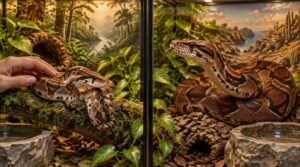
Two boas raised in the same room can act like completely different animals, and that’s not a flaw in your snake. Temperament comes down to age and background, not luck alone. Below, you’ll see how a boa’s life stage, locality, and past experiences each shape the way yours behaves.
Juvenile Vs. Adult Temperament
A baby boa isn’t mean, just small and edible. That’s why juvenile defensiveness shows up as hissing and quick strikes, and it usually fades with regular, gentle handling frequency. Nervous keepers can wear thin reptile handling gloves during early sessions, though bare hands help a baby boa learn your scent.
Adult calmness comes from size, not magic. Big boas feel less threatened, so their temperament settles into steadier, feeding-focused habits. Still, individual variation matters, so read each snake before you reach in.
Locality and Past Experiences
Individual variation doesn’t stop at size. Locality matters too. Colombian boas are generally calm, while Corn Island boas tend to be nervous and quick, so don’t assume every boa behaves alike.
If you’re weighing temperament before choosing a snake, this guide to how docile boa constrictors really are breaks down what to expect from different localities.
Wildcaught vs captivebred matters even more. Generations of captive breeding favor tolerance, and a rough handling history can keep a boa defensive at any age.
How Enclosure Conditions and Stress Affect Boa Behavior
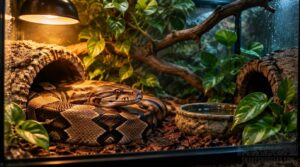
A boa that hides all day, strikes at the glass, or refuses meals isn’t necessarily moody. More often, it’s telling you something’s off in its enclosure setup.
Stress shows up as behavior long before it shows up as illness. Get the basics right, and many "personality problems" simply fade. Check these first: A digital thermometer hygrometer with probe lets you confirm both temperature and humidity at the basking spot and cool end, rather than guessing.
- Temperature gradient: 86-90°F basking spot, 75-80°F cool end.
- Humidity control: 55-75%, rising to 75-85% during shedding.
- Two or three snug hides, warm, cool, and mid-gradient.
- Moisture-holding substrate like cypress mulch or coconut fiber.
Fix one thing at a time and give your boa a couple of weeks to respond. That’s real behavior modification: not training the snake, but changing the conditions that shaped its reactions every single day.
Building Trust Through Safe, Gentle Boa Handling
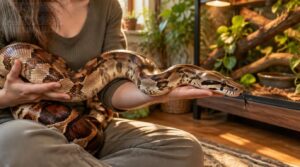
Trust isn’t something you demand from a boa, it’s something you earn one calm session at a time.
A boa’s trust can’t be demanded; it’s earned one calm, patient session at a time
Handling is where that trust either grows or falls apart, so it pays to get the basics right.
Below, you’ll find two practical points to follow: how to help your boa accept handling, and how to stay safe as it gets bigger.
Helping Your Boa Accept Handling
Patience beats persistence. Keep sessions under five minutes, move slowly, and let your boa read your calm. Watch its body language, and stop when it gets restless.
| Week | Session | Goal |
|---|---|---|
| 1 | 5 minutes | Trust |
| 2 | 10 minutes | Calm behavior |
| 3 | 15 minutes | Handling comfortably |
Every temperament moves at its own pace, so treat this as a guide, not a deadline.
Safety Precautions for Large Boas
Picture a keeper with a 9-foot boa draped over her shoulders, alone in the room. The snake startles, and a coil slides toward her neck. Nobody’s there to help.
Don’t let that be you. Large boas need a second person nearby, plus weight support across your arms. Keep handling sessions short, skip feeding days, and respect defensive behavior. Keeping a snake handling hook within reach also lets you gently redirect a nervous boa without putting your hands near its head.
Frequently Asked Questions (FAQs)
Are boas meaner than pythons?
Boas have a reputation for being meaner than every python on the planet, but that’s a myth. Their defensive behavior comes from fear, not malice, and a calm, well-handled boa is often more confident than a ball python.
Is a boa a friendly snake?
Friendly" isn’t quite the right word, since snakes don’t bond like dogs do. But a boa’s calm temperament often makes it tolerant, even relaxed, once socialization and gentle handling build trust, especially with adults.
Do boas enjoy being held?
Five minutes every few days is where handling starts. Some boas enjoy it, but many tolerate it.
Temperament sets the baseline, while trust, behavioral conditioning, and stress reduction techniques do the rest. Don’t ignore tension.
Are boas aggressive to humans?
Not by nature. Boas rely on camouflage, not confrontation, so aggression toward people is rare. What you’ll see is defensive behavior: hissing and striking, mostly from stressed juveniles. Steady handling and a proper setup usually settle it.
How do boa constrictors communicate with each other?
Boas mostly talk through scent. Your snake’s tongue flicking gathers chemical cues, and scent association tells it who’s nearby, male or female, young or mature. Touch and body language fill the gaps, especially during courtship.
Do boa constrictors exhibit play behavior in captivity?
You might swear your boa is playing when it winds around a branch, but that’s curiosity, not play. Enrichment activities like climbing and exploring meet real needs. No evidence shows captive boas play, even during handling.
What behaviors indicate curiosity in boa constrictors?
A curious boa will inspect your entire house given the chance. Watch its body language: slow tongue flick rate, calm enclosure exploration, and interest in new environmental enrichment.
Frantic flicking usually means food, not curiosity.
How do boas react to changes in lighting?
Boas aren’t fragile, but they do notice light. Sudden changes in lighting, like a bright bulb at night, can trigger defensive behavior. Keep a steady 13:11 photoperiod, offer total darkness, and watch your boa’s temperament.
Are boa constrictors impacted by routine disruptions?
Yes, they are. Boas thrive on predictable routine, so a missed meal, a rearranged enclosure, or rough handling pushes up stress and changes behavior. Consistent habits build habituation, and calm snakes strike less.
How long do boa constrictors typically live in captivity?
A boa is less a pet than a decades-long marriage. Expect a captive lifespan of 20 to 30 years.
Longevity depends on steady nutrition, low stress, and regular vet care, so your lifespan expectancy improves.
Conclusion
Picture a keeper who stopped flinching at the first hiss and waited, hand steady, until the snake’s coils loosened. That’s the whole game.
Boa constrictor snake personality traits aren’t fixed labels, but a conversation your snake keeps having with you. Read the breath, fix the stressors, and handle in short, calm sessions.
Do that, and trust builds slowly. One day the hiss disappears, and your boa slides across your arm like it owns the place.