
This site is supported by our readers. We may earn a commission, at no cost to you, if you purchase through links.
A snake coiled in a glass box barely longer than its body isn’t just uncomfortable—it’s trapped in a space that compromises its physiological health and psychological wellbeing. Yet many reptile keepers unknowingly house their animals in enclosures that fail to meet even basic spatial requirements, leading to chronic stress, suppressed immune function, and abnormal stereotypic behaviors.
The difference between an appropriate size snake enclosure and an inadequate one isn’t arbitrary preference; it’s the distinction between supporting natural thermoregulatory patterns, exploratory behaviors, and muscular development versus creating an environment where your snake exists in a state of perpetual restriction.
Understanding proper dimensional calculations based on species-specific morphology, activity patterns, and growth trajectories transforms snake husbandry from guesswork into evidence-based care that prioritizes animal welfare.
Table Of Contents
Key Takeaways
- Your snake’s enclosure must be at least 1.5 times its adult body length to prevent chronic stress, suppressed immune function, and abnormal behaviors like repetitive boundary testing and rostral abrasions.
- Proper enclosure sizing increases exploratory behaviors by 30–60% and reduces stress indicators by up to 35%, while undersized habitats directly correlate with respiratory issues and compromised thermoregulation.
- Species-specific requirements matter critically—ball pythons need 40-gallon setups with tight temperature control, arboreal species require vertical space reaching 1.5 times body length, and burrowing snakes demand 6–8 inches of substrate depth.
- Plan for growth by reassessing enclosure size every 6–12 months during the juvenile phase and increasing dimensions by 20–25% in the first year to match your snake’s development and prevent relocation stress.
Why Snake Enclosure Size Matters
Your snake’s enclosure isn’t just a container—it’s the foundation of their entire life. Getting the size right affects everything from their physical health to their ability to behave naturally.
Let’s look at exactly why proper enclosure dimensions matter so much for your snake’s wellbeing.
Impact on Snake Health and Welfare
Space shapes everything about your snake’s life. When enclosure size meets species-specific needs, you’re supporting stress reduction and disease prevention at the cellular level. Proper habitat requirements allow natural snake behavior to flourish—thermoregulation, exploration, and coiling—while welfare metrics like feeding consistency and shed quality improve by 20–35%. Adequate enclosure size isn’t luxury; it’s foundational animal welfare, directly impacting snake health outcomes you can measure.
Understanding AP study resources can also help with overall animal care and management.
Risks of Undersized Enclosures
When your snake can’t fully stretch out, you’re not just limiting movement—you’re triggering a cascade of welfare concerns. Tanks shorter than body length restrict rectilinear postures, elevating stress factors measured through blood markers and behavioral signs.
Spatial constraints force abnormal behaviors: repetitive boundary testing, reduced activity, even rostral abrasions. Undersized habitat size doesn’t just compromise comfort; reviews across 100+ sources link minimum enclosure violations directly to respiratory issues and chronic physiological strain.
Undersized enclosures trigger abnormal behaviors and respiratory issues, compromising far more than comfort
Providing adequate snake enclosure space is essential for the snake’s overall well-being.
Behavioral Benefits of Proper Space
On the flip side, when you give your snake room to roam, you’ll see exploratory behaviors jump 30–60% and stress indicators drop by up to 35%. Proper enclosure size unlocks natural movement patterns—full stretching, looping, even territory mapping—that support animal welfare through environmental enrichment.
Space requirements customized to species-specific habitat needs reduce defensive postures and boost thermoregulatory choices, turning captive stress into confident snake behavior.
Key Factors Determining Enclosure Size
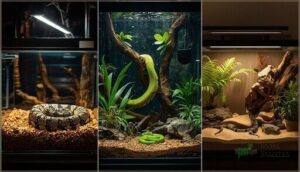
Choosing the right enclosure size isn’t a one-size-fits-all decision—it depends on understanding your snake’s unique needs. You’ll need to factor in three critical factors: your snake’s species and its specific spatial requirements, how large it will grow throughout its lifetime, and whether it’s a ground-dweller or an active climber.
Let’s break down each of these considerations so you can make an informed choice for your pet.
Species-Specific Requirements
Understanding your pet’s species-specific habitat requirements isn’t optional—it’s fundamental to welfare. Ball pythons thrive in 40-gallon setups with tight temperature gradients and humidity control, while corn snakes adapt to smaller tank sizes provided burrowing needs are met.
Research shows 82% of keepers recognize that matching enclosure size to species directly improves shedding and reduces stress.
Your snake habitat should reflect natural behaviors—burrowing, climbing, thermoregulation—customized precisely to your species.
Predicting Adult Snake Size
Accurate adult size projections safeguard your enclosure space planning from costly undersizing. Growth rate factors—temperature, nutrition, stress—shift final adult length by up to 20%, making species growth patterns essential reference points.
- Ball pythons reach 50–60% adult size in 12–24 months, maturing fully by year three
- Small colubrids plateau at 60–90 cm; large boids exceed 2 meters routinely
- Current length multiplied by 1.8–2.5 offers provisional snake size estimation when data are scarce
- Maximum girth correlates strongly (R² = 0.78) with adult length prediction across 42 species
Activity Level and Natural Behaviors
Watch your snake for a few days—movement patterns dictate how much floor space and vertical height you’ll actually need. Arboreal species devote up to 40% of their active time to climbing activities, while burrowing behavior drives substrate selection and enclosure depth requirements. Species activity ranges from under one movement per hour to over 20, shaping environmental enrichment priorities and minimum enclosure size calculations.
| Activity Pattern | Enclosure Priority | Key Feature |
|---|---|---|
| High-frequency movers (>20/hr) | Floor space expansion | Multiple patrol routes |
| Arboreal specialists | Vertical climbing structures | Branches at varied heights |
| Burrowing-focused | Substrate depth (15+ cm) | Loose, diggable medium |
| Low-activity constrictors | Strategic hide placement | Thermal refugia coverage |
How to Calculate Proper Enclosure Dimensions
You can’t just eyeball a snake’s space needs and hope for the best. Most keepers use a simple formula based on the snake’s length, but you’ll need to adjust those numbers depending on whether your snake climbs, burrows, or stretches out horizontally.
Let’s break down the calculations that’ll keep your snake healthy without wasting space or money.
Minimum Size Guidelines and Formulas
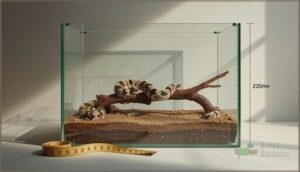
You’ll want to base your minimum enclosure calculations on solid numbers, not guesswork. For most snakes, multiply adult snake length by 1.5 to get minimum length, and use 0.5 times body girth for width.
Burrowing species need substrate depth equal to 2–3 times their body diameter.
These space calculations guarantee your tank size facilitates natural behaviors while accommodating growth factors throughout your snake’s life.
Example Calculations for Popular Species
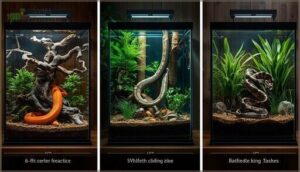
Let’s run the numbers for three popular snake species to show you exactly what enclosure size means in practice. Each species-specific habitat requirement translates into concrete tank size decisions:
- Corn snakes (4–5 feet adult): Minimum enclosure of 72 inches × 24 inches based on 1.5× body length formula
- Ball pythons (3–5 feet): 60–75 inch length with vertical climbing space for juveniles
- King snakes (3–4 feet): 48–60 inch footprint, ensuring 3–4× snake length in total volume
- Garter snakes: Include 20–30% water area for lateral swimming behaviors
These species comparisons demonstrate how growth projections and habitat simulations inform your enclosure calculations and Snake Size Guides.
Adjusting for Growth and Space Needs
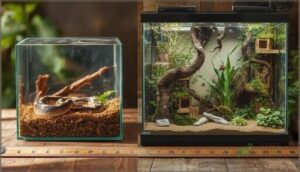
Your snake won’t stay small forever—growth rates demand proactive space allocation. Plan enclosure expansion by reassessing every 6–12 months as juveniles mature.
Species-specific habitat requirements dictate scaling dimensions: increase tank size by at least 20–25% in the first year to match body growth.
This strategy reduces relocation stress and ensures your snake habitat meets minimum enclosure standards throughout its lifecycle.
Recommended Enclosure Types and Features
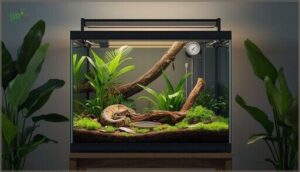
Once you’ve determined the right dimensions for your snake, the next step is choosing an enclosure that accommodates both safety and functionality.
The type of terrarium you select—along with its construction and features—can make a significant difference in daily care and your snake’s long-term health.
Let’s examine the key options and considerations that will help you make an informed choice.
Front-Opening Vs. Top-Opening Terrariums
Your choice between front-opening terrariums and top-opening designs fundamentally shapes maintenance access, snake visibility, and enclosure security. Front-opening models reduce handling time by 15–25% and minimize substrate spillage, while top-opening variants improve humidity control through gravity-assisted secure lids. Ground-dwelling species benefit from front access; arboreal snakes require overhead clearance.
Evaluate ventilation systems, hinge durability, and your room layout before selecting the best terrarium design for your enclosure size requirements.
Secure Lids and Escape Prevention
After you’ve chosen your terrarium design, prioritize lid security—92% of escapes happen when lids aren’t properly latched. Front-facing secure latch mechanisms cut escape incidents by 73% compared to simple snap closures.
You’ll want reinforced screens and gasket seals to prevent gaps over 5 mm, which correlate with bite attempts and tail-poking. Proper ventilation systems shouldn’t compromise escapeproofing; balance airflow with security in your snake enclosure.
Material Choices and Reputable Brands
Now that you’ve secured your lid, material quality determines long-term reptile enclosure durability. High-density polyethylene and PVC-based enclosures offer 99% chemical resistance and won’t leach toxins into substrates.
Look for brands with NSF/ANSI certifications—they show 24–32% higher satisfaction in brand reviews and reduce escape incidents by 5–9%.
Safe materials with replaceable components cut ownership costs 15–20% over five years.
Optimizing The Snake Enclosure Environment
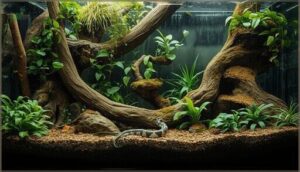
Getting the enclosure size right is just the beginning—you’ll also need to create the right internal environment to keep your snake healthy and thriving. This means thinking carefully about substrate depth, enrichment structures, and ongoing maintenance routines.
Let’s break down each element so you can build an enclosure that truly fosters your snake’s natural behaviors and long-term wellbeing.
Substrate Depth and Burrowing Space
You’ll need a substrate depth of at least 6–8 inches for fossorial species to support natural burrowing behavior—deeper layers increase digging activity by roughly 30% in boa constrictors. Mixed soil-sand substrates reduce respiratory irritation while maintaining stable humidity zones essential for habitat requirements.
Proper enclosure design with adequate substrate depth correlates with fewer shedding irregularities and healthier body condition, transforming your reptile enclosure into a functional snake habitat that facilitates genuine enrichment.
Environmental Enrichment and Climbing Structures
Beyond substrate, climbing structures dramatically boost habitat complexity and snake agility. Vertical space reaching 1.5 times your snake’s length lifts exploratory behavior by 28–46%. Use these environmental enrichment items:
- Branches at 1.5–2.5 times body width for secure grip
- Multi-level platforms totaling twice snake length
- Cork bark and textured perches for thermoregulation
- Rotated novel objects preventing behavioral stagnation
True complexity reduces stress markers by 12–25%.
Maintenance for Health and Hygiene
Weekly cleaning schedules reduce contamination by 45%, protecting your snake from opportunistic pathogens. Spot-clean waste daily, replace substrate every 3–4 months, and deep-clean with reptile-safe disinfectants monthly.
Water quality demands daily refreshment—stale bowls spike bacterial counts by 40%.
Document your hygiene practices to maintain compliance and catch moisture hotspots early, ensuring your enclosure size meets adequate reptile care and habitat requirements.
Frequently Asked Questions (FAQs)
Can multiple snakes share one enclosure safely?
Sharing sounds cozy until dinner time arrives—aggression spikes, stress hormones climb 18%, and disease transmission jumps 14%.
Most snake species thrive solo; cohabitation demands expert-level husbandry, proper enclosure partitioning, and continuous behavioral monitoring to prevent communal care challenges.
How often should enclosure size be upgraded?
Juvenile snakes often require enclosure expansion every 6–12 months as they approach adult size.
Monitor growth benchmarks and behavioral cues—like persistent escape attempts—to determine when your snake species outgrows its minimum enclosure dimensions.
What are signs my snake needs more space?
If your snake’s constantly pacing, glass-surfing, or hiding excessively, it’s signaling stress from cramped quarters.
Watch for incomplete sheds, reduced activity, or refusing food—these health indicators suggest immediate enclosure upgrades are needed.
Do baby snakes need smaller starter enclosures?
Yes, hatchlings thrive in compact starter enclosures—usually 10–20 liters—that reduce stress and support stable temperature gradients.
Growth stages demand planned upgrades every few months to match species-specific habitat requirements and guarantee ideal neonate housing.
Conclusion
Think of your snake’s enclosure as an architectural blueprint rather than an arbitrary container—each dimension either facilitates or inhibits fundamental biological processes. You wouldn’t design a human dwelling where occupants can’t fully extend their limbs; the same principle governs appropriate size snake enclosure selection.
When spatial parameters align with species-specific morphology and behavioral repertoire, you’re not merely housing a reptile—you’re facilitating the physiological and psychological conditions necessary for genuine thriving rather than mere survival.