This site is supported by our readers. We may earn a commission, at no cost to you, if you purchase through links.

A hatchling banana ball python can cost $100, while a designer banana combo can fetch $4,000 or more. Same species, same gentle temperament, wildly different price tags.
I’ve bred these snakes for years, and the pull is easy to understand. Bright yellow and orange scales blush with lilac, brown freckles multiply as the animal ages, and one co-dominant gene drives it all. That gene also means you can predict your clutch with surprising accuracy.
Whether you want a calm first pet or your next breeding project, you’ll find everything here, from genetics and care to lifespan and cost.
Table Of Contents
- Key Takeaways
- What is a Banana Ball Python? Morph Basics and Temperament
- Banana Ball Python Appearance: Colors, Freckles, and Popular Combos
- Banana Ball Python Genetics: Co-Dominant Gene and Male Makers
- Banana Ball Python Care: Enclosure, Temperature, and Humidity
- Banana Ball Python Feeding, Health, Lifespan, and Price
- Frequently Asked Questions (FAQs)
- How much does a banana ball python cost?
- Are banana ball pythons friendly?
- How rare are banana ball pythons?
- Is a banana ball python a good pet?
- What is a banana ball python morph?
- What is a banana ball python?
- Where can I buy banana ball pythons?
- Do ball pythons eat bananas?
- Are banana ball pythons rare?
- What makes a banana morph ball in python?
- Conclusion
Key Takeaways
- You can predict your clutch with confidence because the banana gene is co-dominant, so pairing a banana with a non-banana gives roughly 50% bananas, and pairing a super banana with a normal snake gives 100%.
- Male makers produce about 95% male banana babies and female makers about 95% female, so the sex of your banana parent matters if you’re planning a breeding project. Because that rare recombination can occasionally flip the expected pattern, it helps to review this banana ball python genetics breakdown before pairing your animals.
- Your banana’s price depends on the combo rather than the species, running about $100 to $300 for standard hatchlings and $4,000 or more for designer combos like Black Pastel or Pinstripe.
- You’ll have an easy, calm pet for 20 to 30 years if you keep the warm side near 88 to 92°F, humidity at 50 to 60%, and feedings on schedule without overfeeding.
What is a Banana Ball Python? Morph Basics and Temperament
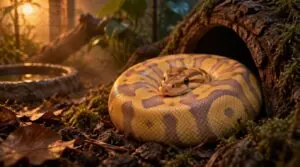
Banana ball pythons are one of the most recognizable morphs in the hobby, and they’re easier to live with than their flashy look suggests. A banana ball python is simply a captive-bred Python regius, not a separate species or subspecies. Breeders created the morph through selective breeding of wild-type snakes.
If you’re weighing one for your collection, this banana ball python care and morph guide covers the coloring, temperament, and husbandry basics worth knowing first.
The genetics are codominant, so pairing a banana with a non-banana gives you roughly 50% banana babies. Breeders have also documented a sex-linked inheritance pattern in which the sex of the banana parent influences whether male banana offspring come out mostly female or mostly male.
Temperament is where these snakes shine. Their behaviour matches any other ball python: calm, slow to defend, and quick to curl into a tight ball instead of biting. They’re crepuscular, so expect activity at dusk and overnight, and give them a snug, dark hide. Handle your snake gently and often for calmer adults.
Banana Ball Python Appearance: Colors, Freckles, and Popular Combos
Calm manners are only half the appeal, because the appearance of a banana ball python is what hooks most keepers.
Expect a bright yellow-to-orange base with lilac or purple blushing around the pattern, and fewer dark markings than a wild-type.
Even a strikingly colored morph can go off its food now and then, so it helps to know why a ball python might stop eating and how to coax it back.
Colour variations show up as your snake grows:
- Freckles: brown or tan spots that multiply with age
- Pattern: strong saddles and "alien head" marks on some, washed-out on others
- Head: light orange, faded, with little or no headstamp
- Juveniles: the brightest gold, with purple deepening over time
- Super banana: freckling stays subtle, dark tan or light purple
Designer combos change everything: Black Pastel boosts freckles, while Pinstripe adds a bold dorsal stripe. Ask breeders for adult photos of the line.
Banana Ball Python Genetics: Co-Dominant Gene and Male Makers
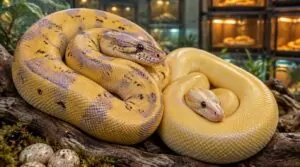
Once you understand how the banana gene works, you can predict what your pairings will produce. Below, I’ll walk you through what a super banana is and how male makers differ from female makers. Those two points will help you plan your breeding with confidence.
If you want to see how other codominant morphs behave in their single-gene and super forms, this guide to ball python codominant morph traits is a handy companion for planning pairings.
Super Banana Explained
Pair a super banana with a normal ball python and 100% of the babies come out visual Bananas. That’s the power of codominant genetics in a banana ball python.
Pair a super banana with a normal ball python, and codominant genetics guarantees every baby hatches as a visual banana
A super banana carries two copies of the gene, so it always passes one along. You’ll notice they look lighter, softer, and lack the freckles heterozygous morphs develop. A striking morph.
Male Maker Vs Female Maker
Super bananas aside, most banana ball pythons carry one codominant copy, and that’s where sex-linked genetics gets interesting.
Because that single copy influences everything from color to temperament, it helps to follow a good banana ball python care guide when setting up feeding, humidity, and housing for these snakes.
A male maker carries the gene on its Y chromosome, so its banana babies show a strong male sex bias, about 95%.
A female maker flips it: gene on the X, about 95% female bananas. Crossover occasionally breaks the pattern, about 5%.
Banana Ball Python Care: Enclosure, Temperature, and Humidity
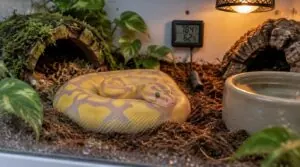
A proper enclosure is the foundation of good ball python care, and getting it right saves you headaches later. Adults do best in a 4’x2’x2′ setup, ideally PVC to hold humidity. Juveniles under 800g feel safer in a 30 to 40 gallon tank.
Keep the warm side at 88 to 92°F, with a basking spot of 90 to 95°F and a cool side around 76 to 80°F. Run every heat mat through a thermostat, and measure temperature at substrate level with a digital probe.
Aim for 50 to 60% humidity, raising it to 60 to 80% during shedding. Provide a damp sphagnum humid hide, a hide on each side, and a large water bowl. Solid reptile husbandry is mostly consistency.
Banana Ball Python Feeding, Health, Lifespan, and Price
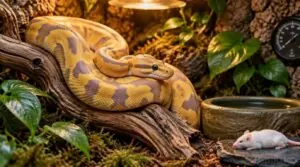
Usually, a banana ball python eats every 5 to 7 days as a hatchling, then slows to every 7 to 10 days as a juvenile and every 14 to 21 days as an adult. Match each prey item to the widest part of your snake’s body, and weigh your animal regularly.
Overfeeding is the biggest health issues trap. Watch for these:
- Fat rolls or a round, squishy body, which signal obesity.
- Bubbly saliva or rattling breaths, which point to a respiratory infection.
- Discolored or blistered belly scales, which suggest scale rot.
Keep the basking spot at 88-92°F and humidity at 50-60% to prevent most of them.
With good care, your snake’s lifespan runs 20 to 30 years, sometimes 40. Price varies: $100 to $300 for standard hatchlings, $4,000 or more for designer combos.
Frequently Asked Questions (FAQs)
How much does a banana ball python cost?
Like a ripe banana, this ball python morph’s worth the wait. A standard banana ball python costs $100 to $200, and females or strong combos push morph pricing higher. Your python price range starts there.
Are banana ball pythons friendly?
A banana ball python is a small golden lantern: steady and gentle.
They’re friendly; beginners find their behaviour easy to read. With consistent handling, most settle fast. Watch snake behavior, then rest them after meals.
How rare are banana ball pythons?
Walk into any reptile expo and you’ll spot a banana ball python within minutes. It’s a common morph, not a rare one. Genetics keep supply steady, though super bananas and unusual combos raise the price.
Is a banana ball python a good pet?
Yes, a banana ball python is a great pet. It’s calm, tolerates handling well, and forgives mistakes once your care routine is steady.
Plan for a 20-30 year lifespan, then check this morph guide for price.
What is a banana ball python morph?
Ever wondered what makes a Banana Ball Python special? This ball python morph carries a codominant gene: one copy gives bright yellow appearance, two create a super form. Colour variations and combo morph pairings abound.
What is a banana ball python?
You’ve never seen a snake glow like this. A Banana Ball Python is a morph of Python regius, and its genetics shift pigment toward vivid yellow, softening the contrast of its appearance. Care stays standard.
Where can I buy banana ball pythons?
Worried about buying a snake online? Don’t be. A banana ball python listed for sale on MorphMarket comes from vetted breeders, and live arrival guarantees protect you.
Expos let you inspect first. Price varies too.
Do ball pythons eat bananas?
No. Banana names a color, not a diet, so your ball python needs prey. Offer frozen-thawed mice or rats sized to its body. Fruit can’t support feeding or lifespan, whatever the morph guide or price.
Are banana ball pythons rare?
No, you won’t have trouble finding one. The banana morph used to be a rarity, but breeders now produce them in volume, so a single-gene banana usually runs $150 to $250 at expos and online. Genetics-heavy combos cost more.
What makes a banana morph ball in python?
A banana ball python gets its look from one codominant gene.
One copy shifts your ball python’s appearance toward yellow blotches, while two make a super banana. Coral glow is simply the same gene renamed.
Conclusion
A banana ball python is a sunrise you can hold, and it asks for very little in return. Keep the warm side near 90°F, hold humidity steady, and feed on schedule. The gene does the rest.
Whether you’re chasing a calm first pet or planning your first clutch, you now have the map. Start with a healthy hatchling, trust your setup, and enjoy the freckles as they multiply. Fair warning: you’ll be hooked for years.
- https://therackapp.io/blogs/news/the-science-behind-banana-ball-python-inheritance-why-male-makers-and-female-makers-exist
- https://www.zenhabitats.com/blogs/reptile-care-sheets-resources/most-popular-ball-python-morphs-top-10-must-see
- https://a-z-animals.com/blog/ball-python-morphs-discover-the-50-types