This site is supported by our readers. We may earn a commission, at no cost to you, if you purchase through links.
A single clutch of corn snake eggs can hatch into five completely different-looking snakes. That’s the strange magic of morphs, where one recessive gene strips out red pigment and another erases black entirely.
But here’s where most keepers get tripped up: not every striking snake is a true morph. Some are wild-type localities like the Okeetee, shaped by geography rather than genetics labs. Knowing the difference changes what you buy, what you breed, and what you pay.
This corn snake morph guide sorts colors, patterns, and rare variants into plain categories so you can identify your snake with confidence.
Table Of Contents
- Key Takeaways
- Corn Snake Morphs Vs. Localities and Hybrids
- How Corn Snake Morph Genetics Work
- Corn Snake Morph Guide to Popular Colors and Patterns
- Multi-Trait, Rare, and High-Value Corn Snake Morphs
- Corn Snake Morph Identification, Pricing, and Care
- Frequently Asked Questions (FAQs)
- How to tell what morph your corn snake is?
- What is the rarest morph of corn snake?
- What is the best corn snake morph?
- How many morphs do corn snakes have?
- What are the best corn snake color morphs?
- What does a corn snake morph look like?
- How many types of corn snake morphs are there?
- What is a stripe corn snake morph?
- Are corn snake morphs good?
- Where can I find cornsnake morphs?
- Conclusion
Key Takeaways
- Not every striking corn snake is a true morph—wild-type localities like Okeetee and Miami are shaped by geography, not genetics, and hybrids combine traits from different lineages, so knowing the difference affects what you buy, breed, and pay.
- Most classic morphs (Amelanistic, Anerythristic, Hypo, Lavender, Snow) are autosomal recessive, meaning carriers look normal, so pedigree records and genetic testing matter more than appearance alone when identifying or breeding.
- Multi-trait combos like Palmetto Tessera are the rarest and most valuable morphs, often requiring two to four generations of selective pairing plus documented lineages to stabilize and command premium prices.
- Basic single-gene morphs typically sell for $40–$100 while verified multi-trait animals can reach several hundred dollars, but care needs stay the same regardless of morph—warm side 88–92°F, cool side 78–82°F, and frozen-thawed prey.
Corn Snake Morphs Vs. Localities and Hybrids
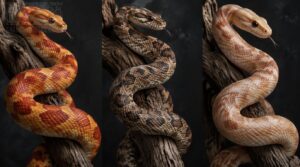
Not every corn snake with a unique look carries a genetic mutation. There are three distinct categories worth knowing: true genetic morphs, wild-type localities, and hybrid varieties. Each one affects color and pattern differently, and understanding the difference changes how you shop, breed, and identify snakes.
If you’re sorting a snake into one of these groups, a guide to corn snake morphs and temperament differences can help you match appearance traits with what to expect from the animal itself. Since a snake’s appearance tells you nothing about its care needs, a guide to corn snake enclosure temperatures covers the husbandry basics every morph requires.
A corn snake’s unique look isn’t always a genetic mutation—true morphs, localities, and hybrids each shape color and pattern differently
True Genetic Morphs
Across every corn snake lineage, true genetic morphs form the foundation of selective breeding. These are stable, heritable mutations, not color shifts from age or environment.
| Inheritance Type | Expression |
|---|---|
| Recessive | Needs two allele copies |
| Dominant | One copy shows the full trait |
| Polygenic | Multiple genes interact |
Pedigree records and allele testing confirm the true genetic origin, since phenotype alone can mislead.
Wild-Type Localities
show you natural Pantherophis guttatus variation that no breeding program creates. Geography and habitat isolation shape wildtype appearance across wild populations.
The Okeetee locality is prized for its deep-red saddles, and the Miami locality shows a high-contrast pale base.
| Locality | Trait |
|---|---|
| Okeetee | Bold red saddles |
| Miami | High contrast |
| Keys | Smaller body |
| Carolina | Muted coloring |
| Rosy | Pinkish ground color |
Hybrid Varieties
Locality snakes and morphs can both serve as your starting point for hybrid snake breeding. Crossing two distinct morphs or pairing a morph with a locality snake produces offspring with unique genetic combinations not seen in either parent.
Before committing to a pairing, it’s worth reviewing a guide on whether different snake species can breed, since intraspecific and interspecific crosses follow very different rules.
| Cross | Common Outcome | Stable By |
|---|---|---|
| Amel x Locality | Patchy melanin | F3+ |
| Anery x Hypo | Muted silver tones | F2+ |
Selective pairing over several generations helps stabilize those traits. Always document each cross, since unclear lineage lowers buyer confidence and market value.
How Corn Snake Morph Genetics Work
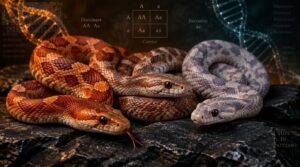
Once you understand the three categories, the genetics start to click.
Our guide to corn snake colors and patterns breaks down each morph with photos, so you can see exactly what sets them apart.
Most corn snake morphs come from mutations at gene loci that control pigment or pattern. Classic morphs are usually autosomal recessive, needing two allele copies to express the trait visually. Carriers look normal.
Here’s what shapes how a morph looks:
- Allele dosage determines if a trait expresses fully or partially.
- Zygosity levels affect shade intensity, with homozygous snakes often appearing more vivid.
- Epistatic interactions let one gene suppress or modify another locus entirely.
- Modifier genes shift color intensity without changing the primary allele. For a closer look at how modifier genes interact with specific alleles in practice, this guide to snake morphs and their genetics breaks down which combinations produce the most striking results.
- Polygenic combinations stack multiple loci to produce complex, layered phenotypes.
Combining two recessive morphs yields offspring ratios that follow Mendelian probabilities, though epistasis can alter outcomes.
Corn Snake Morph Guide to Popular Colors and Patterns
Corn snakes come in a wide range of colors and patterns, and knowing the most common ones makes identification and buying decisions much easier.
The morphs below cover everything from basic single-gene traits to a few standouts worth knowing by name. Each entry focuses on what the morph looks like and what produces it, so you can recognize them at a glance.
Amelanistic and Anerythristic
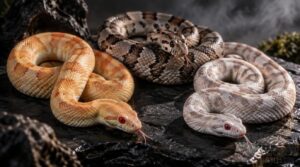
Amelanistic genetics knock out the tyrosinase gene, eliminating all melanin. You’ll get pale yellow to orange tones, red-orange eyes, and zero black or brown.
Anerythristic genetics take a completely different route, removing red pigment while leaving other colors mostly intact. That gives you muted creams and browns with strong pattern contrast. Combined, both traits create a high-contrast, nearly colorless snake.
Hypo and Lavender
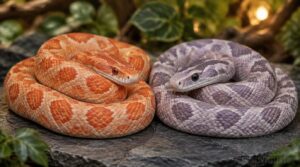
Among the subtler corn snake colors, Hypomelanistic individuals reduce dark pigment while keeping warm orange tones intact. The Lavender morph cools this further, shifting patterning toward pale bluish hues. Both follow autosomal recessive inheritance, so phenotype variation depends on what each parent’s carrying.
- Hypo eyes appear darker
- Lavender adds bluish tones
- Combined, they reduce pattern contrast
- Test parents before breeding
Snow and Palmetto
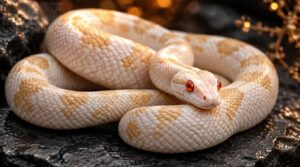
If you’ve ever seen a Snow-Palmetto corn in person, you already know exactly why they dominate collector wish lists.
Snow corns lose all melanin through two recessive alleles, leaving a near-white base with red eye caps. The Palmetto morph adds creamy tones and dorsal speckling.
Their corn snake genetics combine beautifully, producing offspring that command consistently strong rare morph pricing.
Tessera, Motley, and Stripe
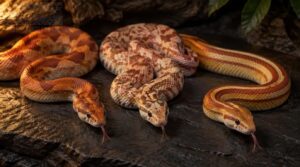
Picture a corn snake whose scales shift between light and dark like irregular patchwork tiles. That’s the Tessera morph in action.
The Motley morph fragments that base saddle pattern into irregular, overlapping blotches. Stripe, by contrast, collapses those dorsolateral markings into two narrow, continuous lateral lines. All three are true genetic morphs, each reliably passed down through distinct allele interactions.
Diffused, Terrazzo, and Aztec
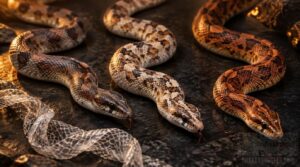
Pattern, not color, defines these corn snake morphs.
- Diffused morph stretches dark pigment into moody, irregular blotches
- Terrazzo scatters patchwork patches like broken tile across the body
- Aztec morph weaves a striking lattice crosshatch along the dorsal
- Phenotype shifts noticeably with every shed cycle
- Morph rarity and price both rise with sharper contrast
Reptile genetics drives all three distinct patterns.
Multi-Trait, Rare, and High-Value Corn Snake Morphs
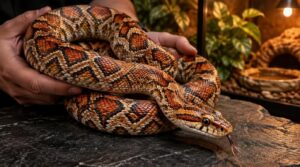
The rarest corn snakes aren’t just one trait done well. Multitrait morphs layer two or more distinct genetic traits into one animal, and the results can genuinely stop a crowd. An Aztec x Tessera cross, for example, combines geometric patterning with complex color layering, a pairing that draws serious attention at reptile shows.
Genetic complexity drives the premium. Co-dominant traits can shift pattern density or alter scale geometry, making each animal subtly unique. Getting a stable, show-quality result can take two to four breeding generations, which is part of why morph rarity commands such a wide price gap.
Investment-grade morphs rely on documentation. Verified pedigrees, DNA testing, and phenotype maps back up morph pricing and protect your long-term resale value.
Corn Snake Morph Identification, Pricing, and Care

Knowing what you have matters as much as having it. Morph identification starts with comparing your animal’s ground color, saddle shape, and scale texture against documented references in a reliable corn snake color morph guide. Single-gene traits are usually straightforward, but multi-trait animals can look deceptively similar to other combos, so lineage records are your best tool.
Morph pricing reflects rarity, documentation, and market demand. Basic single-gene corn snake morphs usually sell for $40 to $100, while verified multi-trait animals can reach several hundred or more.
For snake husbandry, keep your setup consistent. A warm side around 88-92°F, a cool side near 78-82°F, and frozen-thawed prey on a regular feeding schedule keeps any corn snake healthy regardless of its genetics. Sourcing quality frozen thawed mice for snakes makes feeding safer, since live prey can bite or stress your snake during meals.
Frequently Asked Questions (FAQs)
How to tell what morph your corn snake is?
Check your snake’s color, pattern, and belly checkering against visual identification guides, then compare with breeder records. Genetic testing confirms ambiguous cases, since lighting and age can distort apparent color morph identification.
What is the rarest morph of corn snake?
You might assume price equals rarity, but that’s not always true. The rarest corn snake morphs are multi-trait combos like Palmetto Tessera, where genetic complexity and tiny breeding stocks make verification nearly impossible.
What is the best corn snake morph?
There’s no single "best" morph; it depends on your goals. Beginners often love amelanistic or snow for striking looks and easy care. For breeding, investment-grade morphs like Blizzard Tessera combos offer higher value.
How many morphs do corn snakes have?
You’ll find dozens of named corn snake morphs, though exact counts vary by breeder and discovery date. Stable, heritable examples include Amelanistic, Anerythristic, Hypo, Lavender, Snow, Palmetto, Tessera, Motley, Stripe, and Terrazzo.
What are the best corn snake color morphs?
Lavender tops many lists with its pink base and soft blotching. Snow offers clean white beauty, Palmetto shows random color splashes, and Blood Red delivers deep drama. Each morph’s market value reflects rarity and genetic complexity.
What does a corn snake morph look like?
My first morph was an amelanistic: bright orange saddles, no black anywhere. A morph changes your snake’s visual aesthetics, from fiery reds to pale snows, with pattern types like stripes, motley, or blotches defining each look.
How many types of corn snake morphs are there?
Walk into any reptile expo and you’ll see it: hundreds of color variations under one roof. Today, over 800 recognized morphs exist, built from 5 wild-type localities and 28 genetic strains, yielding 500 million-plus breeding combinations.
What is a stripe corn snake morph?
It’s one of reptile genetics’ most striking transformations: a stripe corn snake morph trades normal blotches for one unbroken dorsal line from neck to tail. Pattern inheritance is codominant, and homozygotes show bolder, cleaner stripes.
Are corn snake morphs good?
Yes, corn snake morphs are great. You get stunning colors and patterns while keeping that gentle, beginner friendly temperament. Your choice depends on taste and budget, since morph rarity drives pricing more than personality.
Where can I find cornsnake morphs?
So where should you start looking? Check specialty reptile breeders, local pet stores, and reptile expos. Online, MorphMarket lists photos, pedigrees, and pricing, while breeder reputation helps you gauge morph market value.
Conclusion
That egg box full of surprises is really a genetics lesson waiting to hatch. Every clutch proves the point this corn snake morph guide has made: color comes from genes, not just geography.
Learn the difference between true morphs and localities, and you’ll buy smarter, breed with purpose, and price fairly. Pick up any hatchling now and you won’t just see a pretty snake. You’ll read its inheritance, trait by trait.