This site is supported by our readers. We may earn a commission, at no cost to you, if you purchase through links.
A snake that can’t warm up properly won’t digest its last meal—it’ll rot in its gut instead. That’s not dramatic; it’s basic reptile biology, and it’s why temperature control carries so much weight in captive care.
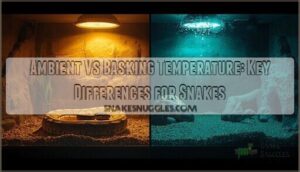
Most keepers set up a heat lamp and call it done, not realizing they’re actually managing two distinct thermal zones with different jobs. The difference between ambient and basking temperature determines whether your snake thrives or quietly deteriorates. Getting both right means understanding what each one does, where it matters, and how your snake uses them together.
Table Of Contents
- Key Takeaways
- What is Ambient Temperature?
- What is Basking Temperature?
- Key Differences Between Ambient and Basking Temperature
- Health Impacts of Incorrect Temperatures
- Tips for Monitoring and Adjusting Temperatures
- Frequently Asked Questions (FAQs)
- What should the ambient temperature be for a bearded dragon?
- What does ambient mean on my meat thermometer?
- What is the ambient 30 rule?
- Can reptiles share enclosures with different temperature needs?
- How does humidity interact with basking temperature?
- Do temperature needs change as snakes age?
- How do seasonal changes affect enclosure temperatures?
- What role does lighting play in temperature regulation?
- Conclusion
Key Takeaways
- Ambient temperature is the steady background warmth filling your entire enclosure, while basking temperature is the intense, focused heat at one specific spot—and your snake needs both to stay healthy.
- Without a proper basking spot, your snake can’t digest food correctly, leaving meals to rot in its gut and triggering serious health problems over time.
- Species matter: ball pythons need warmer ambient ranges (80–88°F) than corn snakes (75–82°F), so matching your setup to your specific snake isn’t optional—it’s the foundation of good care.
- Use an infrared thermometer for surface temps and a digital probe for ambient air, because the two readings can differ dramatically and guessing gets your snake sick.
What is Ambient Temperature?
Ambient temperature is simply the air temperature surrounding your snake throughout the entire enclosure, not just in one spot. It sets the baseline your snake lives in all day, and getting it right matters more than most beginners realize.
Keeping that ambient range steady (75–85°F) pairs naturally with solid handling habits, like those covered in this guide to corn snake handling techniques that help your snake stay calm and stress-free.
Here’s what you need to understand about ambient temperature and how it works in your snake’s habitat.
Definition and Role in Snake Enclosures
Ambient temperature is the background climate your snake actually lives in — the air filling the entire enclosure as it moves, hides, and rests. Ambient temperature is the foundation of your enclosure design and reptile care routine.
It facilitates reptile thermoregulation between basking sessions, keeping your snake’s core body temperature stable. Without proper temperature control, even a perfect basking spot can’t compensate.
Proper management of reptile enclosure temperatures is essential for facilitating healthy thermoregulation and overall well-being.
Typical Ambient Temperature Ranges
Not every snake needs the same warmth, and that’s where species variations really matter. Tropical snakes like ball pythons thrive with ambient temperature ranges between 80 and 88°F, while temperate species such as corn snakes stay comfortable closer to 75 to 82°F.
Understanding these climate zones helps you manage temperature fluctuations, humidity levels, and reptile thermoregulation without guesswork. The effectiveness of thermoregulation is directly influenced by thermal quality and habitat, which can vary for different snake species.
Creating an Ambient Temperature Gradient
Once you know your target ambient temperature range, the next step is building a proper thermal gradient. Place your heat source at one end of the enclosure so warm air collects there while the far end stays cooler. This gradient design facilitates natural thermoregulation, giving your snake full temperature control.
Good ventilation systems prevent heat from pooling uniformly, preserving distinct microclimate zones for effective temperature regulation.
What is Basking Temperature?
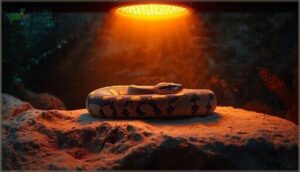
Basking temperature is the heat at the specific spot where your snake goes to warm up — measured at the surface, not the air above it. It’s more intense and focused than ambient temperature, and it plays a direct role in digestion, activity, and overall health.
Getting this right matters more than most people realize — check out this snake basking spot temperature guide to dial in the exact surface temps your snake needs to thrive.
Here’s what you need to know about basking temperature for snakes.
Definition and Importance for Snakes
Basking temperature is the focused, high heat available at one specific spot in your snake’s enclosure — and for reptile care, it’s non-negotiable. Here’s why it matters so much for snake health and thermoregulation:
- It drives digestion after feeding
- It promotes immune response and healing
- It facilitates full thermoregulation as an ectotherm
- It fulfills natural basking behaviour instincts
- It maintains the thermal gradient your snake depends on
Where and How Basking Temperatures Are Measured
To get an accurate surface temperature reading, you’ll want a temp gun aimed directly at your snake’s basking spot — the exact rock, branch, or shelf where it rests.
Thermometer placement matters more than most keepers realize, since ambient vs surface temperature can differ substantially.
Infrared measurement removes guesswork, giving you reliable data for heat source calibration and supporting proper thermoregulation throughout the enclosure.
Recommended Basking Temperatures for Common Species
Each species has its own basking guidelines, so don’t assume one setup works for all.
Ball pythons thrive with a basking spot around 88 to 95°F, while corn snakes prefer a cooler 84 to 90°F. Bearded dragons need 95 to 110°F to facilitate digestion.
Matching species temperature needs to your heat sources ensures a proper thermal gradient and promotes long-term reptile health and temperature stability.
Key Differences Between Ambient and Basking Temperature
Ambient and basking temperature aren’t just two numbers on a thermometer — they work in completely different ways inside your snake’s enclosure. Understanding where each one comes from, how it spreads, and what it does for your snake makes all the difference in setting things up right.
Here’s a closer look at the three key distinctions you need to know.
Air Temperature Vs. Surface Temperature

Think of air temperature and surface temperature as two different levers for thermoregulation. Ambient temperature shapes the overall climate your snake moves through, while surface temperatures — the warm rocks, hides, and substrate — directly drive heat transfer into its body.
Snake behavior shifts dramatically when either lever is off, so precise temperature control over both environmental factors is essential for reptile heating methods that actually work.
Distribution Within The Enclosure

Ambient temperatures spread across the entire reptile enclosure, while the basking spot stays deliberately small. A well-planned enclosure layout places your heat source at one end, letting a thermal gradient form naturally from warm to cool.
Vertical layering adds even more options — warmer air near the top, cooler near the floor. This temperature gradient shapes snake migration patterns between zones, supporting precise temperature regulation throughout the day.
How Each Supports Snake Thermoregulation

Your snake relies on ambient temperature as its daily safety net — the steady warmth that keeps basic body functions running no matter where it roams.
The basking spot, by contrast, delivers quick bursts of higher heat for digestion, immune response, and activity. Together, these two elements of temperature control give your reptile the full thermal gradient it needs for effective thermoregulation and long-term reptile health.
The basking spot delivers targeted heat bursts that, paired with stable ambient warmth, give reptiles the full thermal gradient essential for lasting health
Health Impacts of Incorrect Temperatures

Getting the temperature wrong in your snake’s enclosure isn’t just uncomfortable for them — it can cause real health problems.
Whether it’s too cold or too hot, the effects show up faster than most keepers expect.
Here’s what you need to watch for.
Risks of Low Ambient or Basking Temperatures
When your enclosure runs too cold, the consequences ripple through every system in your snake’s body. A low ambient temperature slows thermoregulation and metabolic slowing sets in fast — digestion stalls, shedding problems emerge, and the immune system can’t defend against everyday pathogens.
Without a proper basking spot, respiratory issues and cold stress follow, quietly degrading reptile health before visible symptoms even appear.
Signs of Overheating or Burns
Too much heat is just as dangerous as too little. Watch for these signs of heat stress and burn damage in your reptile:
- Breathing Changes — open-mouth gaping or rapid, shallow breaths
- Behavioral Cues — restless roaming, ataxia, or stargazing posture
- Digestive Distress — sudden regurgitation after elevated temperature exposure
- Burn Damage — reddened, blistered, or darkened scales from direct contact
These physiological responses to temperature signal urgent intervention.
Effects on Digestion and Activity Levels
Temperature doesn’t just affect comfort levels — it drives digestion speed and activity patterns directly. When ambient temperature drops too low, metabolic rates slow, and food can sit undigested for days longer than normal. A proper basking spot accelerates thermal regulation and keeps your snake moving, eating, and thriving.
| Temperature Condition | Effect on Reptile Health |
|---|---|
| Ideal ambient temperature | Fosters steady thermoregulation and normal activity |
| Low ambient temperature | Slows digestion, reduces activity patterns |
| Proper basking spot access | Boosts metabolic rates, speeds digestion |
| No basking access | Risk of regurgitation, prolonged gut retention |
| Consistent thermal gradient | Promotes thermoregulatory adaptations and overall health |
Tips for Monitoring and Adjusting Temperatures
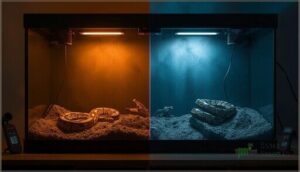
Getting the temperatures right in your snake’s enclosure isn’t guesswork—it comes down to having the right tools and knowing where to use them. A few straightforward habits can make all the difference between a thriving snake and one that’s quietly struggling.
Here’s what you need to monitor and adjust temperatures with confidence.
Tools for Accurate Temperature Measurement
For accurate thermoregulation, you’ll need the right heat sensors in your toolkit. A digital thermometer with temperature probes tracks ambient air continuously, while an infrared heat gun lets you check basking surface temps instantly.
Cross-check both regularly using thermometer calibration methods like the ice point test. Pair these with thermostats to keep digital thermometers honest and your snake’s environment safe.
Placement of Heat Sources and Thermometers
Once you’ve got the right tools, placement makes or breaks your readings. Mount overhead heat sources on the warm end so heat travels downward, mimicking natural sunlight. Fix your basking probe at the center of the heat beam, not the edge.
Keep ambient probes away from direct heat to avoid false readings. Good probe positioning facilitates accurate thermoregulation throughout the enclosure.
Maintaining Proper Temperature Gradients
Maintaining a stable temperature gradient comes down to smart enclosure design and consistent adjustments. Place your heat source at one end, let ambient temperature cool naturally toward the other, and use vertical layering — branches, shelves, hides — so your reptile can self-regulate at any level.
Check both ends regularly, because seasonal room shifts quietly disrupt even well-planned thermoregulation strategies. Small tweaks to your heating elements keep everything on track.
Frequently Asked Questions (FAQs)
What should the ambient temperature be for a bearded dragon?
Like the Australian outback at midday, your bearded dragon thrives in warmth. Keep ambient temperature between 75–90°F (24–32°C), with a warm side near 85–90°F and a cool side around 75–80°F.
What does ambient mean on my meat thermometer?
On a meat thermometer, ambient means the air temperature inside your oven, grill, or smoker — not the meat itself. It helps you monitor your cooking environment for better temperature control.
What is the ambient 30 rule?
The ambient 30 rule means keeping your reptile enclosure’s warm-side air temperature near 30 degrees Celsius, supporting stable reptile health, steady digestion, and natural snake behavior without relying solely on surface heat sources.
Can reptiles share enclosures with different temperature needs?
Two reptiles can share a space, yet both suffer for it.
Reptile cohabitation with different thermal needs usually forces at least one animal into chronic stress, making separate enclosures the safer choice.
How does humidity interact with basking temperature?
Humidity shapes how your snake experiences heat at the basking spot.
High humidity slows evaporative cooling, making temperatures feel warmer, while dry air accelerates skin degradation, raising respiratory risks and complicating enclosure management for overall reptile health.
Do temperature needs change as snakes age?
Yes, they do. As part of thermal maturation, juveniles need tighter habitat temperature control to support snake growth rates, while adults tolerate wider ranges through more stable age related thermoregulation.
How do seasonal changes affect enclosure temperatures?
Like a thermostat fighting the weather outside, your enclosure struggles with seasonal shifts.
Temperature fluctuations from cold winters or hot summers force heat source adjustments, demand enclosure insulation, and require smart climate control strategies to keep your reptile safe.
What role does lighting play in temperature regulation?
Lighting does more than brighten your enclosure. Overhead bulbs emit infrared spectrum heat, shaping your basking spot and gradient, while visible light promotes circadian rhythms.
Deep heat projectors and heating elements maintain stable ambient warmth without disrupting natural day-night cycles.
Conclusion
A thousand small details go into keeping a snake healthy, but few matter more than getting the difference between ambient temperature and basking temperature right. These two thermal zones aren’t interchangeable—they serve separate, essential roles in how your snake digests, moves, and regulates its own biology.
Nail both, and you’ve given your snake the foundation it needs to thrive. Miss either one, and you’re solving health problems that never needed to start.
- https://www.beardeddragon.org/threads/heating-help-ambient-vs-surface-temp.263614/
- https://www.reptiles.swelluk.com/help-guides/a-complete-guide-to-bearded-dragon-temperature-and-heating/
- https://piscespets.com/blogs/news/ambient-vs-surface-temperatures
- https://www.snakehaus.com/frontpage/education/climate-control/
- https://reptifiles.com/heterodon-hognose-snake-care/hognose-temperatures-humidity-lighting/