This site is supported by our readers. We may earn a commission, at no cost to you, if you purchase through links.

A 6-foot boa can turn a fresh layer of bedding into a swamp within a week, while the same bedding in a corn snake’s enclosure stays bone dry for a month. Same product, opposite results.
The gap comes down to humidity, depth, and how well your substrate bedding for large enclosures matches the animal living on it. Aspen molds when damp. Coconut fiber dries out in arid setups. Sand invites impaction, and large pythons punish every shortcut.
Six substrate types, three tested product picks, and the exact layering that keeps a big enclosure clean, stable, and safe are all ahead.
Table Of Contents
- Key Takeaways
- Best Substrate Types for Large Snake Enclosures
- Match Bedding to Species, Humidity, and Safety
- Top 3 Bedding Products for Large Enclosures
- Plan Substrate Quantity, Depth, and Bioactive Layers
- Clean and Replace Large-Enclosure Snake Bedding
- Frequently Asked Questions (FAQs)
- What is the best substrate for a terrarium?
- What is the best substrate for a snake enclosure?
- Can substrate affect a reptiles overall stress levels?
- How does enclosure size impact substrate temperature gradients?
- Which substrates work best for egg-laying species?
- Are bioactive substrates safe for juvenile reptiles?
- How do substrate choices differ for arboreal species?
- Can I mix different substrates in one enclosure?
- What substrates should never be used with snakes?
- How do I stop substrate from molding?
- Conclusion
Key Takeaways
- Match your bedding to your snake’s humidity needs, since aspen suits dry-climate species like corn snakes while ball pythons and boas do better on coconut fiber, cypress mulch, or a bioactive mix. Because humidity needs shift with the seasons, it helps to compare safe snake bedding options for households with kids and pets before settling on a substrate.
- Skip sand, gravel, walnut shell, and cedar or pine shavings, because they raise your snake’s risk of impaction or respiratory irritation.
- Calculate quantity by multiplying length, width, and depth, then add about 20% for settling, and build bioactive setups with a drainage layer, a mesh barrier, and 4 to 6 inches of soil mix.
- Keep your enclosure healthy by spot-cleaning daily and doing a full substrate change whenever you notice an ammonia smell, mold, or compacted damp patches.
Best Substrate Types for Large Snake Enclosures
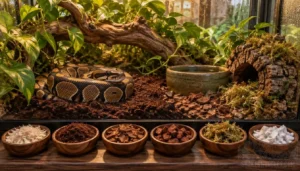
The right substrate shapes humidity, safety, and how much work you’ll face every week. Below are six options that suit large snake enclosures, and each one experiences moisture and cleanup differently. Read through them with your own species and setup in mind, since the best pick depends on what you’re keeping.
If your snake struggles with shedding or dehydration, these snake hydration tips can help you fine-tune humidity no matter which substrate you choose.
Aspen Bedding
Aspen is a dependable pick among reptile substrate types for kingsnakes, milksnakes, and sand boas, since it’s soft, low in dust, and free of the aromatic oils that make cedar risky. It’s lightweight and absorbent, and your burrowing snake can dig stable tunnels in it. Its loose texture also encourages natural burrowing behavior without harming a snake’s delicate scales.
Keep it for 30-50% humidity setups, though. Damp aspen molds quickly, so change soiled bedding promptly.
Coconut Fiber
If your snake wants humidity, coconut fiber is where you turn next. Coconut coir holds water far better than aspen, which makes this reptile substrate a strong match for boa constrictors and green tree pythons.
Soak compressed bricks first, then:
- Break the block apart.
- Squeeze out excess water.
- Mix with cypress mulch.
- Spot clean often.
Don’t use it alone as permanent enclosure flooring.
Cypress Mulch
Since you’re already blending coconut fiber with it, cypress mulch deserves a closer look. It’s a dependable substrate for humidity control and gives a naturalistic enclosure its woody look.
| Factor | Cypress | Tip |
|---|---|---|
| Humidity | Holds well | Mist weekly |
| Mold | Resists | Keep drainage layer |
| Chips | Sharp | Buy milled |
| Burrowers | Poor | Avoid |
Choose milled Zoo Med Forest Floor, skip it for burrowing species.
Whichever substrate you pick, pair it with proper lighting, and this guide to setting up UVB for a snake enclosure explains how to get the placement and distance right.
Bioactive Substrate Mixes
If you’re already blending cypress with coconut coir, a bioactive setup is the natural next step. Mix Zoo Meds Eco Earth with Exo Terras Plantation Soil as your bioactive soil base, then build it in three parts:
- Lay a drainage layer of clay pellets.
- Add a mesh barrier.
- Release springtails and isopods.
Skip pesticides and fertilizers, which harm your crew.
Paper Bedding for Quarantine
Paper is the safest substrate for quarantine, because you can replace it completely and spot mites, urates, or blood immediately. Among reptile substrate types, it simplifies substrate selection, though it won’t hold humidity.
| Reptile bedding | Strength | Drawback |
|---|---|---|
| Newspaper | Cheap | Smudges |
| Butcher paper | Sturdy | Pricier |
| Paper towels | Absorbent | Thin |
| Unprinted newsprint | Ink-free | Scarcer |
Pick any quarantine substrate below and mist.
Sphagnum Moss as a Moisture Additive
A handful of sphagnum moss can transform your humidity management without soaking your enclosure substrate. It holds up to 20 times its dry weight in water, and it’s mildly antimicrobial. Use it like this:
- Layer it over coconut fiber or cypress mulch.
- Fill humid hides halfway.
- Mist spots, not everything.
- Mix it into bioactive substrate bedding.
Shedding gets easier, too.
Match Bedding to Species, Humidity, and Safety
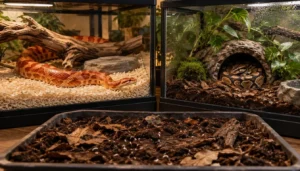
Picture a 6-foot corn snake and a ball python housed side by side, both on aspen. The corn snake thrives; the python struggles through ragged, incomplete sheds. That’s why species-specific choices matter more than any single "best" bedding.
For the python, a natural reptile mulch that holds moisture without getting soggy keeps humidity steady enough to support complete, clean sheds.
The same aspen bedding lets a corn snake thrive while a ball python struggles through ragged sheds, so choose substrate by species
Start with humidity. Dry-climate colubrids do well on aspen, while ball pythons and boas need moisture-holding options like coconut fiber, cypress mulch, or a bioactive substrate mix.
| Species | Humidity | Suitable bedding |
|---|---|---|
| Corn snake | Low | Aspen |
| Ball python | 50-60% | Coconut fiber |
| Boa constrictor | High | Soil mix |
Then weigh substrate safety. Skip sand and gravel, since impaction risk rises if your snake swallows them, and sift out sharp cypress chunks. Feed in a separate enclosure when using loose bedding, and you’ll cut that risk.
Top 3 Bedding Products for Large Enclosures
Once you’ve matched bedding to your species, humidity range, and safety needs, the next step is choosing a product that holds up across a big footprint.
The three options below are the ones owners reportedly rely on most for large enclosures, and each is easy to find in bulk.
Read through them with your own depth and moisture targets in mind so you can pick the one that gives you the most control.
1. Zoo Med Forest Floor Bedding
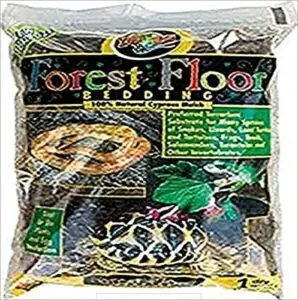
Want a substrate that holds humidity without turning your enclosure into a swamp? Zoo Med Forest Floor is worth a look. It’s natural cypress mulch that retains moisture and gives the tank a forest floor appearance, which suits snakes, tortoises, frogs, and tarantulas.
Cleaning is easy, and it resists mold. Owner accounts do mention occasional infestations, though, so inspect each bag. It can also stay too wet for drier species, and its pale color shows dirt quickly.
| Best For | Owners of humidity-loving reptiles, amphibians, and tarantulas, such as snakes, tortoises, frogs, and salamanders, who want a natural forest floor look in their enclosure. |
|---|---|
| Material | Cypress mulch |
| Natural Composition | Natural cypress |
| Humidity Support | Retains moisture |
| Weight | 10.6 pounds |
| Animal Compatibility | Snakes, lizards, turtles, frogs, tarantulas |
| Package Size | 18 x 12 x 6 inches |
| Additional Features |
|
- Retains moisture to create humidity
- Gives the enclosure a natural forest floor appearance
- Easy to clean and resistant to mold
- Some customers report infestations
- Can hold too much moisture for species that prefer drier conditions
- Pale color shows dirt quickly and needs more frequent upkeep
2. Zilla Reptile Bark Blend Substrate
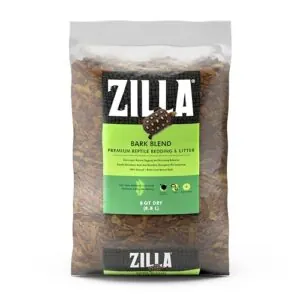
Want a substrate that holds humidity without turning soggy? Zilla’s bark mix is worth a look.
It’s made exclusively from 100% organic fir bark, oven-dried to eliminate pests, and it promotes the heat and moisture transfer tropical enclosures need. Spread one to two inches across the floor, and you’ll get a natural surface for snakes, skinks, and rainforest geckos.
Expect larger pieces than fine mixes, and some owners reportedly find the 3.2 lb bag smaller than expected. Plan quantities accordingly.
| Best For | Keepers of tropical and forest reptiles, such as snakes, skinks, frogs, and rainforest geckos, who want a natural, humidity-friendly substrate for indoor enclosures. |
|---|---|
| Material | Fir bark |
| Natural Composition | 100% organic fir bark |
| Humidity Support | Maintains optimal humidity |
| Weight | 3.2 lb per package |
| Animal Compatibility | Tortoises, turtles, chameleons, frogs, snakes, geckos |
| Package Size | 8-quart or 24-quart |
| Additional Features |
|
- Made from 100% organic fir bark that is oven-dried to eliminate pests.
- Promotes heat and moisture transfer, helping maintain humidity in tropical and forest terrariums.
- Works for many species and can also be mixed into potting soil to improve drainage for plants.
- Bark pieces may be larger than ideal for small enclosures or fine mixes.
- Suited only to indoor reptile habitats and not appropriate for aquatic setups.
- Some users find the 3.2 lb bag smaller than expected.
3. Zoo Med Coconut Fiber Substrate
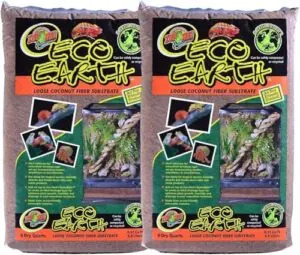
Need humidity control without a swamp? Zoo Med’s coconut fiber comes as a pack of two compressed bricks, each rated at 8 quarts once expanded.
Soak a brick in roughly 4 quarts of water for 30 minutes, then spread it 2 to 4 inches deep so your snake can burrow. Layer it over HydroBalls to prevent waterlogging, or mix it with cypress mulch. Two bricks may fall short for big enclosures, so plan ahead.
Replace it every 4 to 6 weeks.
| Best For | Reptile, amphibian, and invertebrate keepers with small to medium enclosures who want a natural, burrow-friendly substrate that holds humidity without turning swampy. |
|---|---|
| Material | Coconut fiber |
| Natural Composition | All-natural coconut husk |
| Humidity Support | Optimal humidity when damp |
| Weight | 5.8 (units unspecified) |
| Animal Compatibility | Reptiles, amphibians, invertebrates |
| Package Size | 2 bricks, 8 qt each |
| Additional Features |
|
- Made from all-natural, compostable coconut fiber that can be composted or recycled into garden soil
- Layers over HydroBalls for good humidity and drainage, and the soft, pleasant-smelling bedding absorbs odor and waste
- Spreads 2 to 4 inches deep, so snakes and other animals can burrow
- Needs to be soaked and dampened before use, so it isn’t ideal for species that need dry conditions
- A pack of 2 bricks (8 quarts each) may not be enough for larger enclosures
- Should be replaced every 4 to 6 weeks, which adds ongoing upkeep and cost
Plan Substrate Quantity, Depth, and Bioactive Layers
Once you’ve picked a product, quantity is where most owners miscalculate. Multiply length by width by your target depth, then add roughly 20% for settling, since loose material compresses about that much within a month. A 4×8 foot floor at 6 inches needs around 16 cubic feet before that allowance.
For a bioactive enclosure, picture the layers from the bottom up:
- A drainage layer of clay pebbles, 1 to 2 inches deep.
- A mesh barrier that keeps pebbles and soil apart.
- Substrate for bioactive use, 4 to 6 inches of ABG mix, or 8 to 10 for big pythons.
- A surface of leaf litter and moss for your cleanup crew.
Settle your substrate depth before finishing the reptile enclosure setup.
Clean and Replace Large-Enclosure Snake Bedding
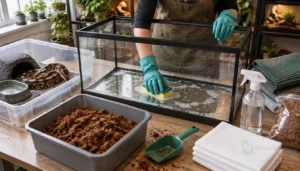
Once your layers are down, upkeep decides whether they stay healthy. Scoop feces and urates the day you spot them, lifting a small margin of clean material with them so nothing lingers.
Check for an ammonia smell, mold, or compacted damp patches; any of these means full substrate change time, whatever the surface looks like. Loose material like coconut fiber needs replacing every one to two months, while paper must go the moment it’s soiled.
For a full change, remove your ball python, water dish, and decor, then discard everything. Scrub the enclosure with F10SC, chlorhexidine, or 1:10 bleach, wait ten minutes, and rinse repeatedly. Dry it completely. Tile or washable mats speed up this hygiene and substrate maintenance routine.
Frequently Asked Questions (FAQs)
What is the best substrate for a terrarium?
The best terrarium bedding depends on your animal, but coconut coir is the safest all-round substrate for most enclosure setups. It holds humidity, stays fluffy, and helps bioactive layers. You’ll still match it to species.
What is the best substrate for a snake enclosure?
A snake’s world is its floor, so choose it like a foundation. For a ball python, substrate safety matters most: pick cypress mulch or coconut fiber blends for humidity, and skip calcium sand because of impaction risk.
Can substrate affect a reptiles overall stress levels?
Your substrate is the floor your snake’s whole world rests on, so yes, it shapes stress.
Species-specific choices guide reptile behavior and reptile health, while steady hygiene and minimal substrate changes keep your snake calmer.
How does enclosure size impact substrate temperature gradients?
Heat fades with distance, so a short tank is a thermal gradient lost at birth. Under four feet, your basking and cool zones merge. At 4 feet, you can reach 105°F basking and 75°F cool.
[/ORIGINAL TEXT]
[WORDS TO REPLACE]
blend
[TASK]
Rewrite [ORIGINAL TEXT] word-for-word, replacing ONLY the [WORDS TO REPLACE] with natural alternatives.
Preserve the original meaning, tone, and all formatting exactly.
[STRICT RULES]
- Replacement words must appear exactly as natural text in a human-written sentence.
- Do NOT wrap replacements in brackets, quotes, parentheses, or any other markers.
- Do NOT replace one AI-sounding word with another — use natural, human language only.
- Retain all special formatting elements (e.g., bold) exactly as they appear in the [ORIGINAL TEXT].
- Markdown elements must not be altered, removed, or missed — any omission will be considered incorrect output.
- If a [WORD TO REPLACE] appears inside link text, replace it normally while keeping the link URL unchanged.
- Do NOT modify link URLs.
- Maintain clarity, readability, and professional tone.
Which substrates work best for egg-laying species?
Why gamble with a clutch? For egg-layers, damp sphagnum moss wins, since you can squeeze it without dripping. Mix in vermiculite if you like. Choose species-specific depth, giving burrowing females substrate for digging in large enclosures.
Are bioactive substrates safe for juvenile reptiles?
A cleanup crew needs 4-8 weeks to establish, so you’ll quarantine first. Bioactive soil suits healthy juveniles when you control impaction risk with feeding platforms, species-specific care, and preventive care, which is solid reptile husbandry.
How do substrate choices differ for arboreal species?
Arboreal species need substrates that hold moisture, not dry aspen. Coconut coir or cypress mulch, kept around 2 inches deep, preserves climbing height. Add sphagnum moss for humidity management, and choose species-specific, bioactive setups when possible.
Can I mix different substrates in one enclosure?
Why choose one? You can mix, and cypress mulch with coconut fiber works well.
Keep it species-specific, since different reptiles need varied humidity. Run a substrate comparison first, then pick a good substrate for burrowing.
What substrates should never be used with snakes?
Skip cedar shavings and pine shavings, since their aromatic oils make them a toxic substrate that irritates your snake’s respiratory tract. Also avoid sand, walnut shell, and calcium sand, which invite impaction, plus scented bedding.
Once quarantine ends, you can move on to safer long-term options, and this guide to the best snake bedding for rescue snakes compares them in detail.
How do I stop substrate from molding?
Mold thrives on stagnant, soggy substrate, so start with humidity control: keep levels in your species’ range, let the surface dry within two hours of misting, and add airflow. Spot-clean daily, and stir coconut coir regularly.
Conclusion
Picture a keeper who swaps a ball python’s dry aspen for damp cypress mulch and watches stuck sheds vanish within two cycles.
The right substrate bedding for large enclosures isn’t the priciest bag on the shelf. It’s the one that fits your animal’s humidity needs, holds its depth, and gets spot-cleaned before problems start.
Measure your humidity and depth first, then buy. Then your enclosure stops being a gamble and becomes something you actually control.