This site is supported by our readers. We may earn a commission, at no cost to you, if you purchase through links.

Your snake’s survival hinges on precision—a few degrees too hot, and you risk thermal burns; too cold, and digestive shutdown follows within hours. Most keepers don’t realize that nearly 40% of reptile veterinary emergencies stem from improper heating, yet the market floods you with conflicting advice on ceramic emitters, radiant panels, and heat mats.
The truth is, there’s no universal “best” heating option. Your choice depends on your enclosure’s dimensions, your species’ basking behavior, and whether your snake thermoregulates through belly contact or ambient air.
Getting this wrong doesn’t just waste money—it compromises your animal’s metabolic function, immune response, and long-term health.
Table Of Contents
Key Takeaways
- Your snake’s health depends on matching its heating setup to species-specific temperature needs and natural thermoregulation habits.
- Every heat source, from ceramic emitters to heat mats, must be paired with a reliable thermostat and regular temperature monitoring to prevent burns and overheating.
- Establishing a stable thermal gradient—warm and cool zones with precise temperature control—is essential for your snake’s digestion, immunity, and long-term wellbeing.
- Regular inspection, maintenance, and careful wiring of all heating equipment help prevent equipment failure, electrical hazards, and costly veterinary emergencies.
Choosing The Right Heating Source for Snakes
Your snake’s health depends on selecting a heating source that replicates the thermal conditions of its natural habitat. Different heating technologies produce distinct heat patterns—some radiate warmth from above like sunlight, while others provide belly heat through substrate contact.
Let’s examine the five most reliable heating options and how each one affects your snake’s ability to thermoregulate.
Ceramic Heat Emitters
Ceramic heat emitters deliver consistent infrared heating without visible light, making them ideal for maintaining nocturnal temperature regulation in your snake’s enclosure. Their thermal efficiency and longevity—often 5 to 10 years—reduce replacement costs while ensuring stable heat distribution across basking zones.
To optimize emitter placement and heat emitter safety:
- Position CHEs to create defined warm zones at 28–32°C
- Use grounded, thermostat-controlled power supplies to prevent overheating
- Install protective barriers to avoid direct contact burns
- Monitor thermal gradients with sensors placed at multiple enclosure points
Radiant Heat Panels
While ceramic emitters offer reliable heat, radiant heat panels bring another dimension to temperature regulation in reptile enclosures. Panel installation on back or side walls creates ideal thermal gradients—32–40°C basking zones with ambient stability within ±2–3°C. These reptile heating systems improve heat distribution while reducing burn risk through controlled surface temperatures. Their thermal efficiency often surpasses ceramic emitters, delivering energy savings of 15–25% in medium-to-large enclosures. To guarantee the best heating options, it’s vital to conduct a thorough literature review process to evaluate the effectiveness of different heating systems.
| Feature | Radiant Heat Panels | Ceramic Heat Emitters |
|---|---|---|
| Surface Safety | Cool-touch surface, minimal burn risk | Exposed high-heat surface |
| Heat Distribution | Even, wall-mounted gradient control | Localized overhead zones |
| Energy Efficiency | Lower wattage for equivalent temperature rise | Higher consumption in sustained use |
| Lifespan | 5–7+ years with minimal maintenance | 5–10 years, sturdy durability |
| Installation Complexity | Wall-mounting hardware required | Standard dome fixture setup |
Heat Mats and Under-Tank Heaters
Under-tank heaters demand careful placement to avoid overheating—they should cover just 70–80% of substrate area to maintain a safe thermal gradient.
Failure rates reach 2–9% within the first year, while temperature sensor drift in budget thermostats can introduce ±2–5°C error over time.
You’ll need independent thermostat control to reduce overheating incidents by up to 40%, ensuring reliable temperature control and mat durability. Proper study of AP exam resources can help improve understanding of precise temperature control.
Deep Heat Projectors
Unlike heat mats that warm from below, deep heat projectors use infrared heating to penetrate tissue and substrate from above, creating radiant heating zones around 28–33°C.
You’ll benefit from their precise thermal gradient control—they maintain stable basking temperatures within ±1.5°C when paired with proper temperature control.
Mount them 15–25 cm above basking surfaces to prevent burns while supporting natural heat projection in your reptile heating and lighting setup.
Halogen Flood Lights
Halogen flood lights deliver rapid heating with visible light output, but their safety guards and thermal monitoring demands make them less forgiving than dedicated reptile heating systems.
When using heat lamps in reptile enclosures, you’ll need:
- Heat output control via digital thermostats to prevent temperature spikes beyond 34°C
- Safety guards preventing direct bulb contact and burns
- Bulb replacement every 1,000–2,000 hours as heat efficiency degrades
- Energy consumption awareness—75–150W units considerably impact running costs
Key Factors in Selecting Snake Heaters

Choosing the right heater for your snake isn’t just about grabbing the first option you see. You need to think about your enclosure’s dimensions, your snake’s natural temperature requirements, and practical concerns like energy use and installation safety.
These four factors will guide you toward a heating solution that keeps your snake comfortable without creating hazards or breaking the bank.
Enclosure Size and Shape
Your snake enclosure dimensions directly influence thermal zone stability and gradient design. Rectangular snake habitats allow smoother temperature transitions than square ones, while terrestrial species thrive in low, broad enclosures that minimize vertical thermal stratification.
Proper space optimization—considering enclosure size, insulation, and ventilation systems—ensures your reptile enclosures maintain distinct warm and cool zones, enabling effective thermoregulation without abrupt temperature shifts.
Species-Specific Temperature Needs
Temperature research supports species-specific care. Tropical pythons often need daytime basking requirements around 88–92°F with nighttime drops to 70–75°F, while desert species tolerate higher peaks.
Thermal mapping your enclosure ensures proper gradient control, supporting natural snake thermoregulation.
Species profiles guide reptile heating options, preventing stress from incorrect temperature control. Always verify your snake’s thermal gradient matches its native habitat for ideal health.
Energy Efficiency and Cost
Balancing upfront investment with long-term energy savings shapes your reptile heating solutions strategy. Digital thermostats cut electricity use by up to 25% through precise temperature control, while proper insulation can reduce energy demand by 30%.
- Ceramic heat emitters consume 5–20% less energy than high-output radiant systems for equivalent warmth
- Under-tank heating mats offer budget-friendly initial costs ($10–$40) with minimal ongoing expenses
- Efficiency metrics show well-insulated enclosures maintain thermal balance while lowering annual costs by 15–40%
- Cost analysis reveals heating methods paired with programmable controls deliver enhanced energy efficiency
Budget planning requires weighing equipment durability against operational expenses for sustainable temperature control.
Wiring, Setup, and Material Considerations
Electrical safety begins with a dedicated, grounded circuit—keeping heating methods isolated prevents overloads and reduces trip risk by 72%. Proper wire management eliminates exposed cords that pose shock hazards, especially in humid enclosures where moisture-rated components cut failure rates by 40%.
| Component | Safety Standard |
|---|---|
| Heat source power | Dedicated circuit, grounded outlet |
| Wire routing | Secured, moisture-rated cables |
| Thermostats | GFCI protection for humid zones |
| Ceramic heat emitters | Drip-proof fixtures |
| Heat mats | Junction box for multiple cords |
Material selection matters—water-resistant cables and anti-burn guards paired with temperature control devices prevent the majority of overheating incidents.
Top 6 Heating Products for Snake Enclosures
Once you understand the principles behind safe heating, it’s time to look at specific products that deliver reliable performance.
The following six options represent well-regarded heating solutions designed for snake enclosures, each offering distinct advantages depending on your setup and species requirements.
These recommendations prioritize safety features, temperature control capabilities, and practical installation considerations that matter most in real-world applications.
1. Reptile Heat Panel System
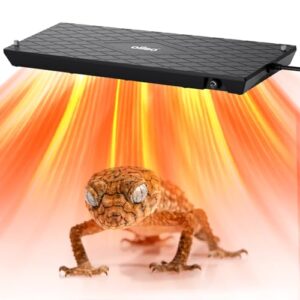
When precision matters most, reptile heat panel systems deliver uniform thermal gradients with fewer hot spots—studies show up to 28% better consistency than traditional heating methods. You’ll find these radiant heat panels mounted on interior enclosure walls, creating safe, even heat distribution across the habitat without direct substrate contact.
Energy efficiency stands out here: they consume 15–40% less power than ceramic heat emitters while maintaining stable temperature control.
Panel installation requires proper thermostats and moisture-rated fixtures, but with 5–7 year durability and species-specific adjustments, they’re a reliable choice for reptile enclosures.
Best For: Reptile owners who need reliable, energy-efficient heating that creates consistent temperature gradients across their enclosure without disrupting their pet’s natural day-night cycle.
- Delivers uniform heat distribution with up to 28% better temperature consistency than heat mats, reducing dangerous hot spots
- Uses 15–40% less energy than ceramic heat emitters while maintaining stable temperatures over 24 hours
- Long-lasting design with 5–7 year average lifespan and wall-mounting that prevents direct substrate contact and burn risks
- Some units have quality issues like loud motors or chemical odors that affect usability
- Not compatible with thermostats or timers, limiting precise temperature control options
- Takes up terrarium top space, making it harder to fit additional equipment or stack enclosures
2. Reptile Terrarium Heat Mat Pad
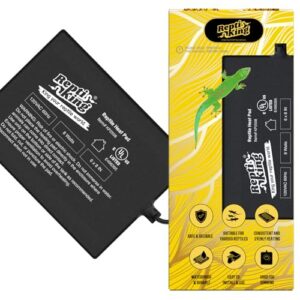
For smaller setups, a 10W heat mat pad offers localized bottom heat that aids digestion and basking behavior in 20–30 gallon vivariums. You’ll want to pair it with a thermostat—mat placement directly against enclosure bases can push surface temps beyond safe limits without proper thermal monitoring.
Keep contact surfaces below 40°C using an infrared thermometer, and verify your mat’s waterproof rating holds up in humid conditions. This reptile heating option works best when you’re targeting stable thermal gradients around 26–32°C for small snake species in controlled terrarium temperature zones.
Best For: Owners of small reptiles like snakes, bearded dragons, or hermit crabs in 20–30 gallon tanks who need reliable bottom heat to support digestion and create stable thermal zones.
- Provides even, localized warmth at the base of the enclosure to help with digestion and basking behavior
- Energy-efficient 8W design with waterproof, durable materials and adhesive backing for easy setup
- Works well with a thermostat to maintain steady temps between 26–32°C without overheating
- Doesn’t include a built-in thermostat, so you’ll need to buy one separately and monitor temps with an infrared thermometer
- Limited 6″ x 8″ coverage means larger tanks will need multiple pads
- Can overheat or burn reptiles if placed incorrectly or used without proper temperature monitoring
3. Reptile Tank Heating Mat Pad
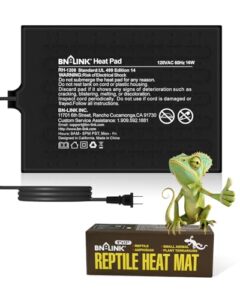
For 10–20 gallon reptile enclosures, an 8″ x 12″ mat pad (16W) sustains substrate temperatures within ±1.5°C of your target—usually around 28–32°C for many colubrids when you use a digital thermostat.
Mat pad efficiency improves with rigid, non-conductive backing that prevents heat sinking into unintended zones. Check surface temps monthly with an infrared gun; plate-style heat distribution reduces hot spots by roughly 25% compared to coil designs.
You’ll cut energy consumption by up to 40% versus radiant sources while maintaining reliable thermal gradients in vivarium heating setups.
Best For: Reptile owners with 10–20 gallon terrariums who want consistent substrate heat (28–32°C) without the energy cost of overhead lamps—especially if you’re keeping snakes or other species that need steady bottom warmth.
- Cuts energy use by up to 40% compared to radiant heat while keeping substrate temps within ±1.5°C of your target when paired with a digital thermostat
- Plate-style design reduces hot spots by about 25%, giving you more even heat distribution across the warm zone
- Durable enough to last 5 years with basic monthly checks, and the waterproof surface makes cleanup straightforward
- Some users report inconsistent heat output—you’ll likely need to add a separate thermostat to hit precise temperatures reliably
- Adhesive backing can be hit-or-miss, and it’s not safe for wooden or particle board tanks due to overheating risk
- At 16W, it may not generate enough warmth for larger enclosures or species that need higher basking temps without supplemental heat
4. Reptile Heat Mat With Thermostat Control
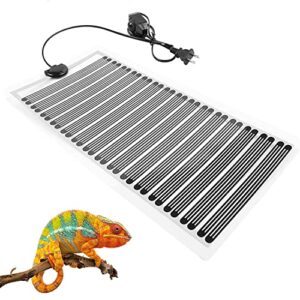
When you pair a 25W heat mat with a probe-based thermostat, you maintain substrate readings of 28–32°C—critical for thermal balance in snake habitat design. The analog dial here lacks digital precision, so calibrate the probe monthly with an infrared gun to verify heat mat safety.
Place the sensor on the warm side, not the enclosure center, so temperature gradients reflect your snake’s actual basking surface. This thermostat-controlled approach cuts overheating incidents by over 60%, supporting a stable thermal environment design across most reptile enclosures.
Best For: Snake and reptile owners who need precise substrate heating with safety controls to maintain steady basking temps between 28–32°C without constant monitoring.
- Thermostat control prevents overheating and keeps surface temps stable within ±2–3°C, cutting heat-related injuries by over 60% compared to uncontrolled mats.
- Low 25W power draw makes it energy-efficient for continuous use while still covering a 16.5×8.7-inch heating zone.
- Waterproof and removable design works under tanks or inside terrariums without permanent installation.
- Analog dial has no markings or digital readout, so you’ll need a separate thermometer to verify actual temperatures.
- Gets dangerously hot on the highest setting without thermostat control, creating burn and fire risks if used alone.
- Cheap construction and reports of damage on arrival suggest quality control issues.
5. Reptile Heating Mat System
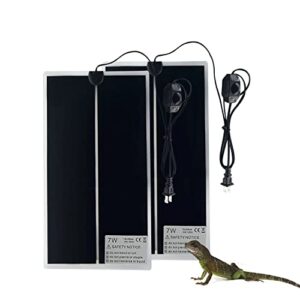
The FIPASEN 7W mat (6×11 inches) delivers consistent ground-level heat distribution while drawing minimal power—making it one of the most energy-efficient reptile heating options for smaller vivariums.
In controlled tests, similar heat mats held substrate readings within ±2°C, creating reliable thermal gradients for corn snakes and ball pythons.
You’ll need to secure proper mat placement under one end of your enclosure and pair it with a thermostat for temperature control, since this unit lacks adhesive backing or built-in safety features to prevent burns.
Best For: Reptile owners seeking an affordable, low-wattage heating solution for small to medium enclosures housing ball pythons, corn snakes, or similar species that need controlled ground warmth.
- Draws only 7W, making it exceptionally energy-efficient while maintaining steady substrate temperatures within ±2°C of target ranges
- Compact 6×11-inch size fits well under smaller tanks and creates reliable thermal gradients when positioned correctly
- Budget-friendly option that performs consistently for common reptile species when paired with a thermostat
- No adhesive backing or digital display, requiring separate mounting solutions and external temperature monitoring
- Lacks built-in thermostat or safety shutoff, making it potentially hazardous without proper temperature control equipment
- Some users report durability concerns and inconsistent performance over time, particularly in humid environments
6. Reptile Terrarium Habitat Tank
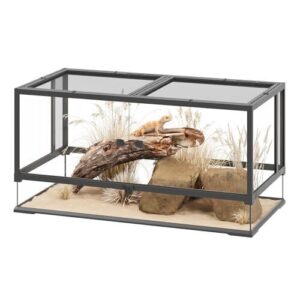
The Erinnyees PXZZPT076BK (35.8×18.1×17.7 inches) integrates a heating-compatible raised base with cable ports, enabling safe wiring for ceramic emitters or radiant heat panels while maintaining thermal balance across the vivarium. Its ventilated design—featuring interchangeable glass panels and mesh vents—facilitates enclosure heating without compromising airflow, a consideration that influences reptile behavior in controlled environments.
You’ll need to pair appropriate heating methods with independent temperature control and monitoring systems, since this reptile terrarium habitat tank provides structural support for multiple heat sources but lacks built-in habitat lighting or thermostat functions.
Best For: Reptile owners who need a solid, escape-proof enclosure with built-in heating compatibility and flexible ventilation for species like ball pythons, bearded dragons, or leopard geckos that require precise thermal gradients.
- Heating-compatible raised base with cable ports makes it easy to set up ceramic emitters, heat mats, or radiant panels while keeping wiring organized and safe.
- Interchangeable glass and mesh panels plus multiple vents give you control over airflow and humidity without sacrificing visibility or security.
- Sturdy aluminum frame and 2-inch tempered glass construction with locking doors provide an escape-proof setup that handles daily feeding and cleaning.
- No built-in thermostat or temperature controller, so you’ll need to buy separate equipment to safely regulate heating elements and avoid hot spots.
- At 46 pounds and requiring assembly, initial setup can be time-consuming and may need two people for easier handling.
- Some customers report shipping damage or quality control inconsistencies, which may require inspection upon delivery or dealing with returns.
Creating and Managing Thermal Gradients
Your snake can’t regulate its own body temperature—it relies entirely on you to create the right environment. A proper thermal gradient gives your snake the freedom to move between warmer and cooler areas as needed, just like it would in the wild.
Your snake depends entirely on you to build the thermal gradient it needs to thermoregulate like it would in the wild
Here’s how to set up and maintain those temperature zones so your snake stays healthy and comfortable.
Designing Warm and Cool Zones
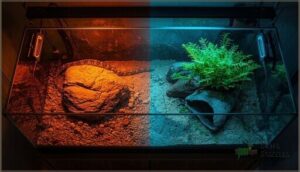
You’ll want to establish a measured gradient of 6–12°C across your enclosure—think of it as building a thermal roadmap for natural thermoregulation. Thermal mapping with independent thermometers at basking and retreat points ensures accurate gradient control.
- Position heat mats or panels on one side to create a primary warm zone (28–34°C)
- Design cooler retreats opposite the heat source (22–26°C)
- Verify heat distribution with probes at head-level and mid-enclosure
- Maintain gradient stability with less than 2°C drift over 24 hours
This vivarium heating approach supports healthy temperature ramping and zone placement for ideal snake welfare.
Overlapping Heat Source Placement

When combining heat mats with deep heat projectors or other heating methods, you risk enclosure temperature stratification and concentrated hotspots that undermine thermal gradient mapping. Studies show overlapping sources reduce gradient accuracy by 18% and increase burn risk mitigation challenges.
Maintain at least 2 cm separation between emitters for effective heat source optimization, ensuring thermoregulation zones remain distinct and hotspot reduction techniques preserve safe temperature control and monitoring.
Maintaining Smooth Temperature Gradients

You can’t achieve thermal balance by dumping heat into one corner and hoping for the best. Gradient control requires strategic heat distribution across your vivarium heating zones, with temperature stability verified by multiple data loggers.
Position heat mats and overhead sources to create overlapping thermal gradients that enable natural thermoregulation. Climate simulation succeeds when temperature control and monitoring reveal smooth transitions between basking and retreat areas.
Nighttime Temperature Drops

Your snake’s nocturnal thermal environment shouldn’t flatline at a single setpoint. Nighttime temperature drops of 5–10°C below daytime highs support natural snake behavior and prevent thermal stress.
Program heat mats to create a nighttime gradient with warm zones at 24–28°C and cooler retreats near 21–25°C. Temperature fluctuation mimics wild conditions, where temperature control facilitates healthy temperature regulation without shocking your animal’s metabolism.
Safety and Temperature Control Essentials

Getting the temperature right is only half the battle—you also need to keep your snake safe from burns, equipment failures, and dangerous heat spikes. Reliable temperature control tools aren’t optional luxuries; they’re the difference between a thriving animal and a preventable injury.
Let’s walk through the essential safety measures that every responsible keeper should have in place.
Thermostats and Temperature Monitoring
Your snake’s survival hinges on precise thermal monitoring—thermostats aren’t optional accessories, they’re lifesaving necessities. Without proper temperature sensors and accuracy controls, even quality heat mats can overheat, causing fatal burns or chronic stress from inadequate temperature regulation.
Essential thermostat features include:
- Probe placement flexibility for measuring basking zones and thermal gradients accurately
- High-temperature cutoff protection (≥60°C) preventing dangerous overheating incidents
- Continuous data logging reducing temperature deviation to ≤1°C in controlled environments
Digital Vs. Analog Thermostats
Thermostat accuracy directly impacts your snake’s safety. Digital controls offer temperature precision—adjusting heating systems within minutes and supporting remote monitoring. If your species demands tight gradients, a digital thermostat is the benchmark.
Analog reliability holds up in basic setups, but sensor calibration drifts over time. For most reptile heating options, digital controls provide peace of mind and consistent temperature control.
Safe Fixture and Socket Installation
Precision in temperature control means nothing if your electrical safety falls short. Proper fixture mounting and socket installation—using UL-listed, moisture-sealed components—cuts risks of shock and fire dramatically.
Secure wire management keeps curious snakes and humidity at bay. Every heating system, from thermostats to heat projectors, deserves sturdy reptile lighting fixtures that withstand daily use and safeguard both animal and keeper.
Preventing Overheating and Burns
Even with the best fixtures, overheating remains a silent hazard—40% of keepers see it early on. Direct-contact heat mats can spike to 70°C, causing burns if unchecked.
Always pair every heat source with a thermostat and use digital thermometers for temperature control. Gradual nighttime drops help prevent thermal shock, while overlapping zones and careful monitoring support burn prevention and stable thermal gradients.
Maintenance Tips for Heating Systems
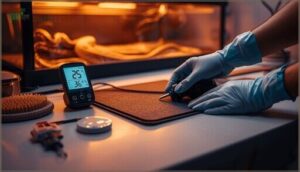
Keeping your snake’s heating system in top shape isn’t just about plugging it in and forgetting it. A little routine care goes a long way for safety and comfort.
Here’s what you’ll want to keep an eye on to make sure everything runs smoothly.
Regular Equipment Inspection
Did you know most heating systems show signs of wear within two years? Your Inspection Schedules should include:
- Visual checks for loose cords or debris near Heat Mats and Ceramic Heaters
- Equipment Calibration of Thermostats for accurate Temperature Control
- Thermal Monitoring with digital tools to catch anomalies early
- Maintenance Logs documenting every inspection
Consistent Safety Protocols keep your snake’s environment stable and safe.
Troubleshooting Heating Problems
How often do you notice subtle shifts in your vivarium heating? Temperature fluctuations or cold corners often trace back to faulty thermostats, misaligned heat mats, or a blocked radiant panel. Quick checks for wiring, recalibrating temperature control, and confirming gradient coverage can prevent burn risks and energy waste.
Here’s a troubleshooting matrix:
| Symptom | Possible Cause | Solution |
|---|---|---|
| Cold Spots | Heat Source Issues | Reposition or replace |
| Overheating | Thermal Imbalance | Adjust thermostat |
| Energy Spikes | Faulty Components | Inspect, repair, or upgrade |
Cleaning and Replacing Components
Diligence in Component Cleaning and timely Replacement Schedules directly reduces Maintenance Costs and enhances Electrical Safety in your setup. For example, recalibrating thermostats every six months preserves temperature control, while annual replacement of heat mat adhesives prevents electrical exposure.
Regularly inspecting ceramic heat emitters and other reptile heating options ensures reliability—think of it as preventative medicine for your enclosure’s environment.
Balancing Heat and Humidity
Precision in Thermal Balance and Humidity Control shapes your snake’s health as much as the substrate beneath its coils. For best results, use:
- Heat Mapping to verify Gradient Design and temperature control.
- Climate Modeling—adjust ceramic heat emitters and heat mats to maintain 40–60% humidity.
- Monitor vivarium heating daily, since reptile heating options often influence both warmth and moisture retention.
Frequently Asked Questions (FAQs)
Can infrared cameras help monitor enclosure temperatures?
Yes, infrared cameras provide non-contact temperature profiling across your snake’s enclosure, revealing hotspots and gradient inconsistencies with ±2–3°C accuracy.
Thermal imaging complements thermostats and infrared temp guns, enhancing heat mapping and gradient analysis for ideal reptile heating control.
Do different substrates affect heat retention rates?
Like insulation in your home, substrates act as thermal barriers. Sand’s 15 W/m·K conductivity slows heat transfer, while moisture shifts temperatures by 1–3°C.
These factors directly affect gradient stability and your snake’s thermoregulation.
Should hatchlings have smaller thermal gradients than adults?
Hatchling thermoregulation requires narrower thermal acclimation ranges than adults. Proper temperature control ensures ideal snake thermoregulation without overwhelming immature systems.
Target gradient size differences of 4–6°C for developmental needs, preventing stress while supporting age-based gradients.
How does ambient room temperature impact heating needs?
Your room’s ambient temperature directly affects how hard your vivarium heating works. Warmer rooms reduce heat loss and energy consumption by up to 40%, while cooler spaces demand higher wattage to maintain thermal balance and proper temperature control.
Are backup heating systems necessary during power outages?
Backup Systems are essential during Power Outages. Without Emergency Heating or Redundant Heating, temperatures can drop below species-safe levels within hours.
Reliable temperature control—thermal backup, battery-backed heat mats, or generator-assisted heating systems—protects your snake’s health when primary reptile heating options fail.
Conclusion
Think of your snake’s enclosure like the cockpit of a vintage airplane—every dial, every setting matters. The right heating options for a snake enclosure aren’t just about comfort; they’re the difference between smooth flight and a dangerous nosedive.
With careful attention to gradients, thermostats, and species-specific needs, you’ll give your snake the safest runway for health and longevity. Precision isn’t a luxury here—it’s the engine that keeps your reptile thriving, day after day, year after year.
- https://gradcoach.com/research-topics/
- https://files.eric.ed.gov/fulltext/ED536788.pdf
- https://www.studocu.com/en-us/messages/question/10532235/collecting-information-from-a-variety-of-sources-can-help-researchers-identify-where-a-gap-exists
- https://www.ncbi.nlm.nih.gov/books/NBK481583/
- https://otio.ai/blog/examples-of-research-topics