
This site is supported by our readers. We may earn a commission, at no cost to you, if you purchase through links.

Ball pythons don’t breed on your schedule—they breed on theirs. Breeders who achieve consistent clutches understand one thing most beginners overlook: success starts months before you ever introduce a male to a female.
Skipping the groundwork means dropped clutches, failed locks, and hatchlings that won’t eat. Get it right, and you’re looking at six to eight eggs per clutch from a healthy female who cycles reliably.
Mastering python snake breeding techniques means controlling every variable—animal health, enclosure conditions, timing, and genetics—so when the season arrives, your snakes are ready to do exactly what they’re built to do.
Table Of Contents
- Key Takeaways
- Selecting Healthy Breeding Ball Pythons
- Setting Up The Optimal Breeding Habitat
- Effective Pairing and Mating Techniques
- Incubation and Hatchling Management
- Health, Nutrition, and Ethical Breeding Practices
- Frequently Asked Questions (FAQs)
- What breeding loans and partnerships work best?
- How do you ship breeding snakes safely?
- When should you retire older breeding animals?
- What record keeping systems track breeding data?
- How do you price offspring competitively?
- How do ball python morphs affect offspring coloration?
- Can ball pythons breed successfully in community enclosures?
- What legal permits are required for selling hatchlings?
- How does stress impact a females egg production?
- When should you retire a ball python from breeding?
- Conclusion
Key Takeaways
- Female ball pythons shouldn’t be bred until they hit at least 1,500 grams—rushing that number leads to failed clutches and cuts her breeding career short.
- Temperature and humidity aren’t set-it-and-forget-it details; precise seasonal cycling—cooler nights, shorter light hours, humidity shifts—is what actually triggers breeding behavior.
- Genetics matter beyond just picking cool morphs: track inbreeding coefficients, outcross every few generations, and screen for morph-linked health issues before you pair anything.
- Hatchling success lives and dies by incubation precision—keep eggs at 88–90°F with 95–99% humidity, and watch for dimpling or wrinkling as your early warning system.
Selecting Healthy Breeding Ball Pythons
Picking the right ball pythons to breed isn’t just a numbers game, but the numbers do matter. Before you even think about pairing, you need to evaluate each animal on a few key factors. Here’s what to look at before making any decisions.
These ball python reproduction tips break down exactly which factors carry the most weight when you’re sizing up potential pairs.
Male and Female Selection Criteria
Start with the right breeding stock, and everything downstream gets easier. Before pairing anything, confirm sex using reliable Sex Verification Methods — probing is the benchmark, though popping works on younger animals. Temperament Evaluation matters too; snakes that feed consistently and stay calm during handling make better breeders long-term.
In addition, regularly applying reptile body scoring helps you confirm that potential breeders are at an ideal weight and muscle condition before pairing.
Here’s what to look for before adding any snake to your program:
- Clear, bright eyes and smooth, intact skin with no retained shed
- Clean vent, no wheezing, no lumps along the body
- Documented Lineage Documentation and Reproductive History Review for genetic considerations in breeding
Run Morph Risk Screening before committing to any pairing.
Age and Weight Requirements
Once your selection criteria are locked in, weight and age become your next gatekeepers. For females, don’t start breeding until she hits at least 1,500 grams — experienced breeders prefer closer to 1,800. Males need 700 grams minimum and 18 months. Age Weight Priority means weight leads, age confirms.
Rushing either one compromises ball python breeding health and shortens Multi-Season Use Limits fast. Many keepers also emphasize long-term breeding readiness to boost clutch size and overall animal well-being.
Assessing Genetic Diversity
Weight gets you in the door — genetics keep you there. Inbreeding Coefficient Analysis tells you how many shared ancestors your pair carries. Push that number past 12%, and hatchling vigor drops fast. Use Heterozygosity Monitoring Methods and Allele Diversity Metrics to spot weak lines early.
- Map your breeding pedigree to catch hidden breeding ancestral connections
- Apply Lineage Outcross Planning every two to three generations
- Consider Wild-Origin Gene Integration to refresh stale captive breeding genetic diversity
Pre-Breeding Health Checks
Good genetics mean nothing if your animals are sick. Book Veterinary Wellness Exams before pairing anyone. Your vet checks body condition, clears stuck eye caps, and confirms females are chunky enough to handle a clutch.
Run Fecal Parasite Screening alongside Pathogen PCR Testing — Nidovirus and Crypto can quietly wreck a breeding program. Visual Health Inspections catch mites, retained shed, and respiratory warning signs early.
For females, Follicle Development Monitoring via ultrasound confirms they’re actually ready.
Setting Up The Optimal Breeding Habitat
Before you even think about pairing your snakes, the habitat has to be right. Ball pythons are particular about their environment, and breeding adds another layer of demands on top of daily care.
Getting the basics dialed in—lighting, temps, humidity—makes a real difference, and a solid ball python habitat and lighting setup guide can save you a lot of trial and error before breeding season starts.
Here’s what you need to set up before the season begins.
Enclosure Types and Sizing

Your enclosure choice shapes everything downstream. Here’s how the main options stack up for a solid breeding environment:
- Plastic Tub Enclosures — 66-quart tubs hold humidity well and stack easily in a rack system design.
- PVC Cage Options — stable humidity, front-opening access, great for gravid females.
- Glass Terrarium Use — works for display breeders; cover three sides to cut stress.
- Lifecycle Sizing Guidelines — upsize by weight, not age.
Temperature and Humidity Control

Temperature and humidity aren’t just background details — they’re the engine behind your whole breeding program. Nail your Breeding Thermal Gradients first: warm side at 82–88°F, cool side at 75–80°F. That spread facilitates reptile temperature regulation and lets females thermoregulate properly. For Nighttime Cooling Strategies, drop temps to 70–78°F to mimic natural African conditions.
Follow smart Humidity Cycling Schedules too:
- Keep ambient enclosure humidity at 50–60% during cycling
- Boost to 70–80% around ovulation and egg-laying
- Use moist hides internally at 70–80% year-round
Consistent Enclosure Climate Monitoring prevents moisture imbalance before it wrecks a clutch.
Substrate and Hide Selection

Substrate sets the tone for your entire reptile breeding environment. For Coconut Substrate Choices, Reptichip absorbs moisture and odor while encouraging natural burrowing at 4–6 inches deep. Cypress Mulch Management works equally well — just bake store-bought mulch at 250°F first.
For Hide Box Materials and Thermal Hide Placement, run one warm hide at 88–92°F, one cool-side hide. Snug fit matters.
Seasonal Environmental Adjustments

Think of it as flipping a switch your snake’s biology actually recognizes. Starting in October, gradually drop daytime basking temps from 88–92°F down to 82–85°F over several weeks — that’s your Dry-Season Simulation in action.
Seasonal Cooling Cycles and Photoperiod Light Shifts, trimmed to 10–11 hours, cue Breeding Season Timing naturally. Keep humidity around 45–55% during this cooler stretch.
Post-Breeding Warmup starts in March — raise everything back slowly.
Effective Pairing and Mating Techniques
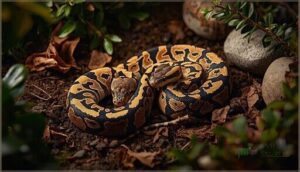
Getting your pairing and mating right is where breeding season either comes together or falls apart. It’s not just about putting two snakes in the same space and hoping for the best.
Here’s what you need to know to make each step count.
Recognizing Breeding Readiness
Your female is telling you she’s ready—you just have to know how to listen. Recognizing breeding readiness comes down to reading several signals at once, not just one.
Watch for these signs your python is approaching follicle development and ovulation:
- Body Weight Patterns: A sexually mature female holding 1,500+ grams with a stable or slightly rising trend is primed
- Pre-ovulation Swelling: A visible bulge in the rear third lasting 12–24 hours signals active ovulation
- Feeding Response Changes: Four to eight weeks of food refusal during breeding season is normal—if she’s alert, don’t panic
- Thermoregulation Cues: Increased warm-side basking aids follicle development
- Seasonal Behavior Shifts: Restlessness and hide-testing reflect natural snake mating behavior kicking in
Track weekly weights. That data tells the real story.
Introducing Males to Females
Always place the male into the female’s enclosure — never the other way around. This one safe introduction procedure cuts stress fast. Start in the evening, when ball pythons naturally get active. Wash your hands first; food scent triggers biting, not courtship.
For introduction scheduling, aim every 7–10 days. Watch for body alignment and tail-searching — those are your green lights. If she strikes repeatedly, pull him out and retry in a few days.
Post-introduction monitoring keeps both snakes healthy and your season on track.
Stimulating Breeding Behavior
Once the introductions are timed right, stimulating breeding behavior comes down to environmental control. Seasonal Cooling Protocols do the heavy lifting — drop nighttime temps to 75–78°F for 60 days while keeping daytime basking spots around 88°F. Pair that with Photoperiod Manipulation, shortening light to 10–11 hours daily.
For stubborn males, Scent Trail Techniques work well — drag the female’s substrate into his enclosure. Watch for Courtship Behavior Cues: chin-rubbing, tail-searching, increased tongue-flicking.
Stress Minimization Strategies matter too; limit handling during this window.
Monitoring Mating Locks
Once courtship kicks in, watch for visual lock cues — the male’s tail twisting tightly under the female’s at the vent. Confirming true locks means seeing that crossed-fingers connection held steady, not just a brush-and-separate. Safe observation methods keep your hands off the pair entirely.
- Most locks run 30–90 minutes
- Log date and duration in your breeding log systems
- Don’t disturb snakes mid-lock
- Count each confirmed coupling period separately
Incubation and Hatchling Management
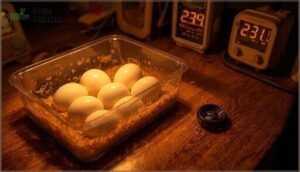
Once your female lays her clutch, the real work begins. How you handle the eggs and raise the hatchlings will determine whether this season is a success or a near-miss.
Here’s what you need to know about each stage.
Egg Collection and Handling
Once your ball python lays eggs, safe clutch removal starts with gently unwrapping her from the clutch — grasp behind the neck and tail base. Check her mid-body for stragglers.
Immediately mark the eggs right side up with a pencil X for correct egg orientation practices. Candle each one to confirm fertility.
Weigh the clutch, remove any yellow slugs, and rinse her off. She’s earned the break.
After laying her clutch, weigh, inspect, and clean her up — she’s earned the break
Incubator Selection and Setup
Now that your eggs are marked and staged, pick your incubator carefully — it’s not the place to cut corners. Forced-air vs still-air comes down to experience: forced-air models distribute heat evenly and simplify thermostat placement, making incubation setup far more forgiving for most breeders.
Factor in incubator capacity planning from the start — overfilling kills airflow. Add monitoring and alarms, solid ventilation and airflow, and a power backup strategy before the first egg goes in.
Temperature and Humidity for Eggs
Get these two numbers right and you’re most of the way home. Ideal Egg Temperatures sit between 88–90°F — 89°F hits the sweet spot for snake egg incubation and care, hatching clutches in 55–60 days. Egg Humidity Targets run 95–99% inside your tub.
Monitoring Incubation Conditions daily matters because Temperature Fluctuation Risks are real:
- Drops below 86°F risk deformities
- Heat above 91°F shortens incubation dangerously
- Humidity Problem Signs include dimpling or wrinkling eggs
- Condensation on tub walls — not dripping on eggs — is your target
Hatchling Care and First Feeding
Once the pips start appearing, the clock starts ticking on hatchling care and feeding. Move each neonate into its own 6-quart tub — that’s your hatchling tub setup sorted. Line it with paper towel, add a hide on the warm end, and keep the hot spot at 88°F. Wait 7–10 days before the first meal timing attempt. For prey size selection, match the pinky to the widest body section.
- Weigh weekly — growth monitoring routines catch problems early
- Feeding refusal strategies: try a dark, quiet room first
- Frozen-thawed prey reduces parasite risk for reptile nutrition
Health, Nutrition, and Ethical Breeding Practices

Getting your snakes to breed is only half the job — keeping them healthy through the process is what separates good breeders from great ones. A few key practices around disease prevention, nutrition, and ethical decision-making will protect your animals and your reputation.
Here’s what you need to stay on top of.
Disease Prevention and Quarantine
Every new snake is a potential Trojan horse — pretty on the outside, problems waiting inside. That’s why Quarantine Setup Protocols aren’t optional; they’re your first line of defense. Isolate new arrivals for 60 to 90 days in a separate room. Use dedicated tongs, tubs, and paper towels.
Run Parasite Screening Schedules through a reptile vet early. For Respiratory Infection Prevention, keep temps stable and stress low.
Biosecurity Handling Practices and consistent Sanitation and Disinfection — 1:10 bleach solution weekly — keep your breeding collection clean and your python hygiene airtight.
Feeding Schedules and Supplementation
Feeding drives everything in a breeding program. Pre-Breeding Conditioning starts with females at 1,350 grams or more — bump meals to weekly small rats to build fat reserves for follicle development.
During Breeding Season Feeding, keep females on a 5-to-7-day schedule; males every 7-to-10 days. Dust prey with calcium and D3 two or three times during spring.
Post-Lay Recovery means weekly meals until she stabilizes.
Promoting Genetic Diversity
Thin gene pools quietly wreck breeding programs over time. Outcrossing New Bloodlines every two to three seasons is your best defense against Inbreeding Risk Management failures — pair animals with no shared ancestors for at least three to four generations. Use Pedigree Tracking Systems to document every pairing, clutch, and hatchling. Rotate males regularly so one sire doesn’t dominate your collection.
Collaborative Breeding Programs and breeder networks expand your access to unrelated stock. When Avoiding Risky Morphs with known neurological issues, your overall python genetics and morph selection stay cleaner across every breeding lineage.
Responsible and Ethical Breeding
Breeding decisions carry real weight. Breeder transparency standards mean labeling morphs honestly, disclosing known health issues, and providing written records at every sale.
Animal welfare priorities require keeping females above 1,500 grams and giving them recovery time between clutches. Genetic health safeguards prevent stacking wobble-linked genes.
Follow snake breeding regulations in your region, practice responsible sales practices, and you’ll build a program worth respecting.
Frequently Asked Questions (FAQs)
What breeding loans and partnerships work best?
A 50/50 clutch split agreement works well for most breeder loan structures — the lender picks first, you cover care costs. Long-term line sharing and solid contract risk management protect both sides.
How do you ship breeding snakes safely?
Ship only Monday through Wednesday using insulated boxes, climate-appropriate heat or cool packs, and secure cloth bags.
Label clearly, use overnight service, and always comply with FedEx carrier requirements to protect reptile health in transit.
When should you retire older breeding animals?
Retire females around 15 to 20 years old, or sooner if they’re laying mostly slugs, losing condition post-clutch, or taking longer than four months to resume normal feeding.
What record keeping systems track breeding data?
Good records are the backbone of any serious breeding program. Digital Breeding Software like The Reptile Keeper logs parentage, clutch dates, and ball python breeding genetics in searchable profiles. Spreadsheet Tracking Systems in Excel or Google Sheets organize pairs, fertility rates, and ball python breeding lineage by season. Enclosure Card Records give you quick in-rack access to lock times and weights without opening a laptop.
Online Collection Platforms such as ReptiDex map ball python breeding pedigree across multiple seasons and auto-populate incubation windows. In parts of Europe, Regulatory Compliance Databases like Terrafile make digital breeding records a legal requirement — so starting now puts you at an advantage.
How do you price offspring competitively?
Pricing hatchlings competitively starts with weekly market price benchmarking. Check MorphMarket regularly. A pastel enchi might list at $150 to $250 depending on sex, lineage, and feeding status.
How do ball python morphs affect offspring coloration?
Ball python morphs work through genetic inheritance patterns — dominant vs recessive alleles shape every hatchling’s color.
Stack multi-gene color combos like Pastel Albino, and melanin loss morphs push breeding colors into stunning super form coloration.
Can ball pythons breed successfully in community enclosures?
Technically, yes — but it’s a bad idea. Community enclosure risks include resource guarding behavior, uncontrolled breeding consequences, and cohabitation stress impacts that tank female health fast. House them separately.
What legal permits are required for selling hatchlings?
Selling hatchlings means paperwork. You’ll need USDA breeder licensing, state wildlife permits, and local business licensing. Interstate transport compliance and CITES export permits apply if you’re shipping across borders.
How does stress impact a females egg production?
Stress kills egg production fast. Cortisol hormone disruption suppresses follicle development, triggering stress-driven follicle atresia where eggs reabsorb entirely.
Control your breeding environment and temperature — your female’s fertility depends on it.
When should you retire a ball python from breeding?
Retirement time isn’t always obvious — but your female will show you. Clutch size decline, weight recovery failures, and post-breeding feeding refusal are clear signals that her reproductive health has hit its limit.
Conclusion
The proof is in the pudding—and with python snake breeding techniques, every variable you control adds up to healthier animals and stronger clutches. Start with animals in peak condition. Build enclosures that mirror natural seasonal shifts. Pair with purpose and patience. Incubate with precision.
The breeders who get consistent results aren’t lucky. They’re prepared. Put in the work before the season starts, and your snakes will handle the rest.
- https://reptilesmagazine.com/breeding-green-tree-pythons-morelia-viridis/
- https://www.americanmadeexotics.com/breeding-ball-pythons-article.html
- https://pythonspawn.com/popping-ball-pythons/
- https://www.worldofballpythons.com/python-regius/breeding/
- https://animals.howstuffworks.com/snakes/how-do-snakes-reproduce.htm