This site is supported by our readers. We may earn a commission, at no cost to you, if you purchase through links.
Ball pythons are crepuscular, meaning they’re most active at dawn and dusk, so slapping a random bulb on their enclosure and calling it done misses the biology entirely. Their wild ancestors bask in dappled sunlight filtering through African grasslands, using UVB to produce vitamin D3 for calcium metabolism, not to soak up rays like a lizard would.
Get the lighting wrong and you risk metabolic bone disease, disrupted sheds, or a snake that refuses to eat.
That’s where a solid ball python habitat lighting guide earns its keep. Below, you’ll find the exact bulb types, mounting distances, and daily schedules that keep your snake’s circadian rhythm on track and its calcium levels where they need to be.
Table Of Contents
- Key Takeaways
- Plan Your Enclosure Lighting Zones
- Choose Safe Ball Python Lighting
- Install Lights at Safe Distances
- Set and Monitor Daily Lighting
- Top 3 Habitat Support Products
- Frequently Asked Questions (FAQs)
- What lighting is best for ball pythons?
- Is 70 degrees too cold for a ball python at night?
- How many hours of light do ball pythons need?
- Do ball pythons need a heat lamp 24 7?
- Can ball pythons see in complete darkness?
- Do albino morphs need different lighting requirements?
- Will lighting affect my ball pythons feeding schedule?
- Should hatchlings have weaker light than adults?
- Can I use smart timers for lighting automation?
- How do I measure UVI with a Solarmeter accurately?
- Conclusion
Key Takeaways
- Ball pythons need low-intensity T5 HO UVB lighting (not coil bulbs) mounted 14-16 inches away to safely produce vitamin D3 for calcium metabolism.
- A consistent 12-hour light, 12-hour dark cycle, ideally automated with a timer, keeps your snake’s circadian rhythm steady and its feeding response reliable.
- Basking spots should hit 95-104°F on the surface, paired with a thermostat-controlled heat source placed on the same side as your UVB for a natural, gradient-based setup.
- Skip colored "night vision" bulbs entirely, since ball pythons can see red light and it disrupts their day-night cycle, causing stress and reduced feeding.
Plan Your Enclosure Lighting Zones
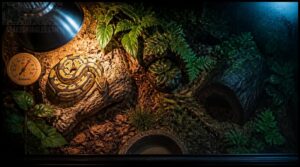
Before you screw in a single bulb, you need a plan for how light and heat will move through your enclosure. Ball pythons rely on distinct zones to regulate their body temperature and stress levels, so where you place each element matters as much as what you buy. Here’s how to map out your setup, zone by zone.
If you’re weighing tank size, heat source, or wattage before you start, this guide to ball python temperature control breaks down those choices zone by zone.
Map Warm and Cool Sides
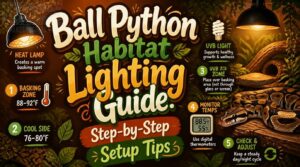
Before placing any bulb, sketch your temperature zoning on paper. Warm side needs 85°F ambient with an 88-92°F basking surface; cool side stays 76-80°F. This gap fuels natural thermoregulation behavior, letting your snake choose comfort.
Track both ambient and surface readings separately, since they’re not interchangeable, and place warm and cool hides on opposite ends for a working thermal gradient.
Use an infrared thermometer gun for accurate surface temperature readings, since it reads hot spots differently than a standard ambient thermometer.
Choose The Basking Location
With your zones mapped, pick the exact basking spot: the warm-side corner, away from doorways and drafts.
Use slate or ceramic tile for strong heat retention, sized to fit your snake’s full coiled body without crowding.
This platform pairs with overhead heating to mimic natural basking, so surface temps stay steady across the whole thermal gradient.
Provide Shaded Hiding Areas
A basking spot means nothing without cover nearby, since ball pythons need to retreat from light entirely. Use opaque ABS hides like a Zen Cave or Zen Corner Cave on both sides, warm (88-92°F) and cool (76-80°F).
Keep entrances single and offset for security, and integrate a humid hide with damp substrate for shedding support.
Measure Basking Surface Height
Get the platform height right before anything else. Position it 1/3 to 1/2 up the enclosure, 6-12 inches below your heat source, targeting 95-104°F surface temps.
Check stability first, snakes coil and shift while basking. Verify with a temperature gun, adjusting bulb wattage in 25% increments if readings run outside range.
Allow Natural Light Choices
A room’s south-facing window can offer more than décor value, it gives your snake ambient natural light without replacing UVB. Keep enclosures 3+ feet from glass to avoid overheating, since glass blocks UVB entirely anyway. Consider these sunlight access options:
- Filtered window light for circadian cues
- Shaded retreats away from glare
- Seasonal light balance shifts
- Fixture-compatible placement
- Natural light gradients
Choose Safe Ball Python Lighting
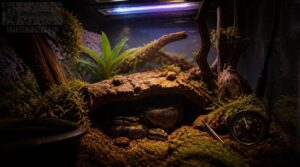
Not every bulb sold as "reptile lighting" belongs in your ball python’s enclosure, and picking the wrong one can do more harm than good.
The right setup balances UVB output, heat, and visibility without overwhelming a species built for dim, secretive spaces.
Here’s what to look for when choosing lights that keep your snake safe and comfortable.
Low-intensity T5 HO UVB
Skip coil bulbs entirely: a T5 HO fluorescent tube like Arcadia ShadeDweller Max delivers efficient 6% UVB without wasted heat. Mount 14-16 inches from the basking surface, replace every 6-12 months, and pair with proper photoperiod cycling for real results.
| Bulb Type | UVB Efficiency |
|---|---|
| T5 HO Tube | High |
| Coil Bulb | Low |
| Mesh-Covered | Reduced |
Reflective UVB Tube Fixtures
Why does fixture choice matter as much as the bulb itself? A reflective T5 HO fixture doubles UVB output by redirecting scattered light toward your snake instead of your wall.
- Arcadia ProT5 and Vivarium Electronics fixtures securely mount tubes
- Reflectors boost output without extra wattage
- Compatible with ShadeDweller Max or ZooMed Reptisun
- Sized roughly half your enclosure’s length for even coverage
Full-spectrum LED Lighting
Why bother with full-spectrum LEDs alongside UVB? They boost CRI to 95-98, revealing true colors in live plants while broadening the visible spectrum your snake actually perceives.
| Feature | Benefit |
|---|---|
| CRI 95+ | True color rendering |
| Full SPD | Mimics natural daylight |
| 5000K-6500K | Balanced efficiency |
| Multi-phosphor mix | Deeper reds, violets |
| Helps plants | Live vivarium growth |
Halogen Basking Lamps
Halogen bulbs deliver deep, sun-like infrared heat that ceramic emitters can’t match watt-for-watt. Aim for 95-104°F basking surfaces, cool side near 72-80°F, using 60-80W cluster bulbs in metal mesh housings 10-12 inches from your snake’s back.
- Use ceramic sockets only
- Always pair with a thermostat
- Cluster bulbs for enclosures over 36"
- Add slate for even heat radiation
Avoid Colored Night Lights
Red or blue light bulbs seem harmless, but they quietly wreck your snake’s day-night cycle and cause real stress.
Red and blue night bulbs look harmless but silently disrupt a ball python’s day-night cycle and stress it out
Ball pythons see red wavelengths, so "night vision" bulbs create a hazy overlay that disrupts navigation and lowers feeding response.
| Light Type | Circadian Impact | Feeding Response |
|---|---|---|
| Red/Blue LED | Disrupted | Reduced 25% |
| Ceramic Heat Emitter | Preserved | Normal |
| Darkness | Preserved | Normal |
| Infrared Heat Lamp | Preserved | Normal |
| White Daytime Bulb | Preserved (timed) | Normal |
Install Lights at Safe Distances
Once you’ve picked the right bulbs, placement becomes the next make-or-break detail, since even a great UVB tube won’t help your ball python if it’s mounted wrong.
Distance, barriers, and heat placement all work together to create a safe, usable light zone rather than a random glow in the tank.
Here’s exactly how to get those distances right.
Mount UVB Without Barriers
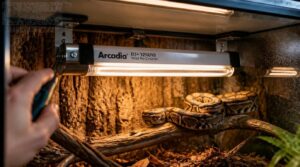
Since glass and plastic block UVB penetration entirely, your fixture needs internal fixture placement, mounted with brackets or Velcro strips directly to enclosure walls, delivering 100% of what an Arcadia ShadeDweller Max or ZooMed Reptisun produces.
Use secure mounting hardware with multiple points, since a falling fixture risks real injury. When barriers can’t budge, UV-transparent panel alternatives beat mesh every time.
Account for Mesh Obstruction
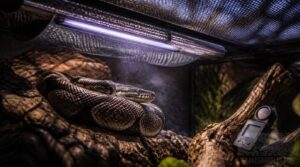
Mesh always steals some UVB, even good mesh. Standard nylon tops block 30-50%, while tighter weaves push losses toward 50%. Chicken wire barely interferes, cutting only 7%.
Compensate with a reflector positioned within 2 inches of your Arcadia ShadeDweller Max tube, recovering roughly 20% UVI. Verify results using a Solarmeter 6.5, since guessing invites vitamin D3 deficiency.
Create a UV Gradient
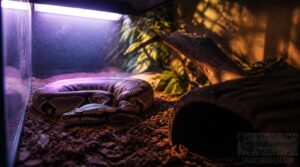
Position the UVB tube toward the back of the enclosure so intensity naturally fades toward the front, giving your ball python a true choice between exposure and retreat.
This mimics dappled sun patches snakes seek in the wild. Aim for roughly half the enclosure length lit, leaving the rest shaded. Check the gradient with a Solarmeter 6.5, confirming UVI drops near zero at the far end.
Align Heat and UVB
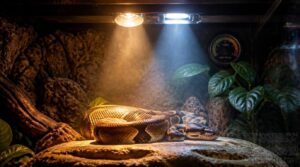
Once your gradient’s mapped, turn to co-locating heat sources with UVB on the same side, since same-side placement mirrors natural sunlight where warmth and light arrive together.
Overlapping beam paths above the basking surface helps integrated thermoregulation, letting your ball python soak up both simultaneously.
- Mount UVB directly above the heat lamp
- Verify basking temps hit 88-92°F
- Confirm thermostat regulation holds steady
Prevent Direct Bulb Contact
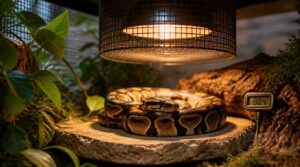
Barriers matter as much as bulbs. Use a mesh guard or lamp barrier so your python can bask without touching the fixture directly, a real risk since curious snakes explore upward.
Pair this with an elevated basking setup, flagstone works well, plus weekly visual inspection of guards and mesh integrity. Combined with thermostat regulation, this keeps enclosure security tight and burns off the table entirely.
Set and Monitor Daily Lighting
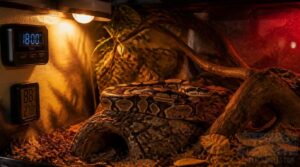
Getting your lights installed is only half the job, because consistency matters just as much as placement. Your ball python’s body relies on a predictable daily rhythm to manage everything from digestion to shedding. Here’s how to lock in that routine and keep it running smoothly, day after day.
Follow a Twelve-hour Cycle
Consistency beats intensity here. Give your ball python 12 hours of light and 12 hours of dark, every single day, so dawn and dusk arrive on schedule and its circadian rhythm can lock in.
That predictable photoperiod triggers natural behavioral shifts, active exploration at twilight, quiet hiding through midday, exactly what wild activity patterns look like.
Automate Lights With Timers
Since humans forget, timers won’t. A Zoo Med ReptiCare Day & Night Timer ($22.99) controls your 12 hour on, 12 hour off schedule automatically, switching daytime bulbs off and nighttime lights on without you lifting a finger.
For multi-enclosure setups, the Lugarti Digital Timer Power Strip ($34.99) or Zilla 24/7 Power Center automates lighting across several tanks, while smart app control adds weekend automation and remote scheduling from your phone.
Control Heat Using Thermostats
A thermostat is your heat source’s brain, without one you’re gambling with your snake’s safety.
Choose proportional thermostats like the Herpstat 1, which hold temps within 0.1°F, over on/off models that cause stressful swings.
Place the probe on the warm floor, not the hide, and program a nighttime drop to 72-75°F for a natural temperature gradient.
If you’re pairing that thermostat with a ceramic heat emitter for overnight warmth, this guide to safe wattage and heat lamp setup will help you dial in the right fixture.
Monitor Daytime Temperature Zones
A thermostat sets the target, but only daily readings confirm it’s working. Map your temperature gradient with an infrared thermometer: warm side surface at 88-92°F, cool side ambient 74-80°F, basking surface up to 104°F.
For a deeper look at how wattage choices affect these readings, boa constrictor heat lamp wattage guidance walks you through dialing in the right bulb for your enclosure size.
Check the neutral zone too. If your snake avoids one area consistently, your overhead heating efficiency needs adjusting, not just the thermostat setting.
Replace UVB Bulbs Regularly
A bulb can glow brightly and still fail your snake, because UVB output degrades long before visible light fades.
Replace T5 HO bulbs every 10-12 months, mark installation dates for calendar reminders, and track operating hours (3,500-hour threshold). A Solarmeter 6.5 confirms actual UVI.
Combine this with your 12 hour on 12 hour off cycle for reliable, safe UVB bulb replacement.
Top 3 Habitat Support Products
Good lighting only works if the enclosure and equipment around it are built to support it, and keeping everything clean matters just as much as getting the UVI right.
A well-designed terrarium gives your fixtures somewhere solid to mount, while the right disinfectants keep bacteria and mites from undoing all your hard work.
Here are three products worth adding to your setup.
1. Repti Zoo Collapsible Reptile Terrarium
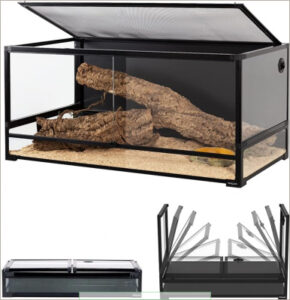
Rigging a lighting rig means nothing if the enclosure underneath can’t support it, and the REPTI ZOO Collapsible Terrarium earns its spot with a removable mesh top that lets UVB and infrared pass through unobstructed.
At 48"L x 24"W x 24"H, it gives your snake ample floor space while the tempered glass base aids substrate heaters safely. The black PVC back panel cuts visual stress, and lockable doors keep your fitted lights and your python exactly where they belong.
| Best For | Reptile owners with active, larger species like bearded dragons or snakes who want a spacious, easy-to-access enclosure with built-in support for UVB lighting and substrate heating. |
|---|---|
| Product Type | Terrarium Enclosure |
| Target Use | Housing Reptiles |
| Pathogen Protection | Visual Stress Reduction |
| Setup Effort | 3-Minute Assembly |
| Safety Profile | Lockable Secure Doors |
| Ideal User | Reptile Owners |
| Additional Features |
|
- Quick 3-minute assembly thanks to the collapsible design with folding panels
- Tempered glass base safely accommodates substrate heaters for desert or rainforest setups
- Lockable doors and a secure lid buckle keep pets safely contained
- Plastic swing tabs used in assembly can become brittle and break over time
- Some users report doors that are difficult to latch or that fall out
- Cable ports struggle with thicker or multiple cords, making wire management tricky
2. F10 SC Veterinary Disinfectant Concentrate
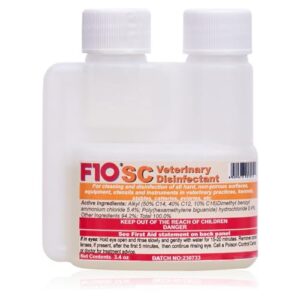
A clean terrarium works with every lighting setup you’ve built, and F10 SC Veterinary Disinfectant Concentrate keeps things that way. Dilute 4 mL per liter of water for high-level disinfection, killing bacteria in 30 seconds and knocking out viruses, fungi, and spores without harming hard surfaces.
It’s biodegradable, unscented, and leaves no residue near your fixtures. For resistant pathogens, bump the ratio to 10 mL per liter. Just rinse porous décor afterward, since F10 works best on non-porous materials.
| Best For | F10 SC Veterinary Disinfectant Concentrate is best for veterinary clinics, kennels, shelters, and reptile or small animal owners who need a powerful, broad-spectrum disinfectant for cages, bowls, and other hard, non-porous surfaces. |
|---|---|
| Product Type | Disinfectant Concentrate |
| Target Use | Cage Sanitizing |
| Pathogen Protection | Kills Viruses/Fungi/Spores |
| Setup Effort | Requires Dilution |
| Safety Profile | Residue-Free Non-Corrosive |
| Ideal User | Vet Clinics/Shelters |
| Additional Features |
|
- Kills a wide range of bacteria, viruses, fungi, and spores while remaining non-corrosive and residue-free
- Highly concentrated formula (1:250 dilution) makes it economical and long-lasting
- Biodegradable and unscented, making it safe to use around animals and sensitive environments
- Must be carefully diluted before use, as the concentrated form can harm animals and surfaces
- Only effective on hard, non-porous surfaces, so porous items may need extra rinsing
- Limited efficacy against certain pathogens, such as Giardia, per some reports
3. Rescue One Step Disinfectant Pet Cleaner
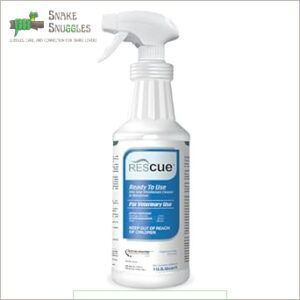
For quicker jobs, Rescue One Step controls daily cleanup without the mixing steps F10 requires. Its ready-to-use formula kills canine parvovirus in as little as 60 seconds, using accelerated hydrogen peroxide at 4.25% concentration.
Unlike disinfectants that disrupt animal routines during lengthy application processes, Rescue One Step’s rapid 60-second action minimizes environmental disturbance—much like how gradual lighting schedules for ball python morphs reduce stress by avoiding abrupt changes to their surroundings.
It dries virtually odorless, leaving no chemical residue on cage walls or basking platforms. Just note it skips a spray nozzle (buy one separately) and can streak clear acrylic panels. Vets recommend it for enclosures, toys, and hard surfaces alike, making it a solid rotation option alongside F10.
| Best For | Rescue One Step is best for pet owners, foster caregivers, and vet professionals who need a fast, ready-to-use disinfectant for daily cleanup of enclosures, toys, and hard surfaces. |
|---|---|
| Product Type | Ready-to-Use Disinfectant |
| Target Use | Enclosure Sanitizing |
| Pathogen Protection | Kills Parvovirus |
| Setup Effort | No Mixing Needed |
| Safety Profile | Odorless When Dry |
| Ideal User | Foster Homes/Owners |
| Additional Features |
|
- Kills canine parvovirus and other pathogens in as little as 60 seconds
- Ready-to-use formula with no mixing or dilution required
- Dries virtually odorless with no harsh chemical residue on most surfaces
- Doesn’t include a spray nozzle, so you’ll need to buy one separately
- Can leave streaks or film on clear surfaces like acrylic panels
- Strong odor during application may call for good ventilation or a mask
Frequently Asked Questions (FAQs)
What lighting is best for ball pythons?
A low-intensity T5 HO UVB tube, like the Arcadia ShadeDweller or ZooMed Reptisun 0, paired with a halogen basking bulb, gives your ball python natural D3 synthesis and a proper heat gradient to thrive safely.
Is 70 degrees too cold for a ball python at night?
Chilly nights aren’t automatically a crisis, but 70°F sits right at the edge. Below that, you’ll risk respiratory infections and digestive shutdown, so treat it as your firm nighttime floor, not a comfortable target.
How many hours of light do ball pythons need?
Aim for a 12-hour on, 12-hour off cycle year-round, mimicking their equatorial habitat. Adjust seasonally if you’d like: 5 hours in summer, 75 in winter. Consistency matters more than precision, so keep that dark period uninterrupted every single night.
Do ball pythons need a heat lamp 24 7?
Think of a basking bulb like a campfire, cozy but not meant to burn all night. Halogen basking lamps shouldn’t run continuously; instead, pair them with a ceramic heat emitter for 24/7 warmth without disrupting your snake’s natural light-dark cycle.
Can ball pythons see in complete darkness?
Not through their eyes alone. In true darkness, your ball python relies entirely on its heat-sensing facial pits, detecting temperature shifts as small as 1°C, letting it hunt effectively without any light at all.
Do albino morphs need different lighting requirements?
Yes, and it’s not a one-size-fits-all situation. Albino morphs lack melanin, so their eyes are naturally photosensitive. They need gentler UVB (0 or lower), shorter 4-6 hour exposure windows, and shaded basking spots to avoid eye strain or discomfort.
Will lighting affect my ball pythons feeding schedule?
It absolutely can. A steady 12-hour light cycle paired with low-level UVB (5-6%) triggers natural dawn/dusk feeding instincts, boosting activity and appetite.
Skip harsh light or reptile night lights, they cause stress, wariness, and food refusal in ball pythons.
Should hatchlings have weaker light than adults?
Bigger snake, brighter light? Not quite. Hatchlings and adults both do best under the same low-intensity UVB, just positioned closer, 8-12 inches, for hatchlings, since size, not age, determines safe basking exposure at UVI 0-
Can I use smart timers for lighting automation?
Smart plugs like Meross or Teckin work well, letting you program precise 12-hour cycles without daily manual switching. They support voice control, remote scheduling, and manual override during wifi outages, keeping your snake’s photoperiod consistent even when you’re away from home.
How do I measure UVI with a Solarmeter accurately?
Hold the meter at reptile eye level, perpendicular to the bulb, and press the button for a steady reading. Check multiple basking points, since output varies, and aim for UVI 0-7 within Ferguson zone
Conclusion
Think a basking bulb alone covers your snake’s needs? It doesn’t, and skipping UVB invites metabolic bone disease down the road.
A proper ball python habitat lighting guide isn’t about brightness, it’s about rhythm: matching dawn-to-dusk cycles, safe gradients, and calcium-supporting UVB to a species built for dim, filtered light.
Get the timing and placement right, and you’ll watch feeding responses steady, sheds come clean, and your snake settle into the quiet confidence of a well-lit burrow.