This site is supported by our readers. We may earn a commission, at no cost to you, if you purchase through links.
Grab the wrong bulb and your boa either shivers through digestion or bakes on a branch that’s meant to feel like the Amazon canopy, not a tanning bed. Boa constrictor heat lamp wattage isn’t a one-size number—a hatchling in a 40-gallon tub and a six-foot adult in a 4×2 enclosure have wildly different heat budgets. Room temperature, enclosure material, even a drafty screen top can throw your gradient off by ten degrees or more.
Get the wattage wrong and you’re not just uncomfortable your snake—you’re stalling its digestion or risking burns.
Here’s how to match your setup to your snake’s actual needs, not a guess.
Table Of Contents
- Key Takeaways
- Boa Constrictor Heat Lamp Wattage Guide
- Match Wattage to Enclosure Design
- Create The Correct Temperature Gradient
- Top 3 Heat Lamp Setup Essentials
- Control and Adjust Wattage Safely
- Frequently Asked Questions (FAQs)
- How many watts is a heat lamp for a snake?
- What heat bulb for boa constrictor?
- How many watts does a heat lamp need?
- Is 150 watts too much for a ball python?
- How often should heat lamp bulbs be replaced?
- Do boas need heat at night too?
- What safety risks come with GFCI-protected outlets?
- How do Radiant Heat Panels differ from standard bulbs?
- Conclusion
Key Takeaways
- Juvenile boas need 60–75 watts and adults need 100–150 watts, but the right number always depends on enclosure size, material, and room temperature, not a fixed rule.
- A basking surface of 28–32°C (roughly 90–100°F) with a cooler zone 5–8°C lower gives your boa the gradient it needs to regulate its own body temperature.
- Glass enclosures lose heat faster than PVC, and screen tops can cut heat lamp efficiency by up to 15%, so your setup’s material and ventilation matter as much as bulb wattage.
- Pairing your heat lamp with a thermostat, checking temperatures daily with a probe or infrared thermometer, and raising wattage gradually (5–10 watts at a time) keeps your boa safe from burns and stalled digestion.
Boa Constrictor Heat Lamp Wattage Guide
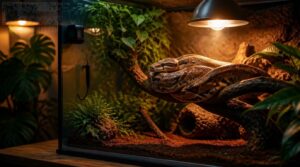
Wattage isn’t a guessing game—it depends on your snake’s age, size, and setup. Get it wrong, and you’re looking at sluggish digestion or a stressed-out boa. Here’s exactly what your enclosure needs, from hatchling to full-grown adult.
Since heat requirements scale with enclosure dimensions, it helps to first check how much space your snake actually needs by reviewing this boa constrictor size and growth guide.
Juveniles Need 60–75 Watts
Sixty to seventy-five watts is your sweet spot for juvenile boas. In a standard 40-gallon setup, that range hits the basking surface temp your snake needs—mid-90s Fahrenheit—without overheating the whole enclosure.
Start at 60 watts. Check the temperature gradient with a thermometer; adjust upward only if the cool side stays put. Always pair your heat lamp with a thermostat for reliable control. Proper heat management involves adjusting distance and monitoring surface temps rather than relying solely on wattage, as covered in basking bulb wattage recommendations.
Adults Need 100–150 Watts
Grown boas eat bigger meals and need more sustained heat to digest them, so their wattage climbs to 100–150 watts in a standard 4×2 enclosure.
- Match wattage to enclosure size
- Watch ambient room temperature
- Calibrate your thermostat monthly
- Track basking zone daily
Digestion temperature needs drive this range—cutting corners here stalls their gut and invites illness.
When 150 Watts Works
150 watts isn’t a default—it’s a response to specific conditions. Tall enclosures, screen top compensation, or a chilly room all push wattage upward. Basking distance adjustment matters too: closer placement raises heat without extra watts. Seasonal wattage needs shift in winter drafts.
Always confirm with a temperature gradient check before assuming higher wattage equals better heat lamp performance.
Why Wattage Requirements Vary
No single wattage number works for every boa. Enclosure material changes everything—glass sheds heat faster than PVC, and screen tops bleed warmth into the room constantly.
Room temperature sets your baseline; a chilly reptile room demands more watts than a heated one.
- Move bulbs closer to boost intensity without upgrading wattage
- Recheck your gradient each season as room temps shift
- Match wattage to material, not just enclosure size
Match Wattage to Enclosure Design
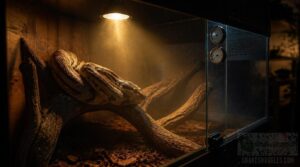
A 75-watt bulb won’t heat every enclosure the same way. Your cage’s material, height, and ventilation all change how much wattage you actually need. Here’s what to think about before picking a bulb.
Glass Versus PVC Enclosures
Glass or PVC? The material changes your wattage math. PVC’s thicker, sealed panels retain heat efficiently, letting lower wattage hit target basking temps. Glass loses heat through drafts, often needing more.
| Factor | Glass | PVC |
|---|---|---|
| Heat Retention | Lower | Higher |
| Visibility | Excellent | Limited |
| Humidity Control | Requires ventilation | Naturally stable |
Weigh display clarity against efficient enclosure temperature management.
A large, easy-to-read display lets you catch subtle temperature drifts before they stress your snake, which is why this boa constrictor heating pad setup guide pairs clear thermostat placement with steady, reliable enclosure warmth.
Enclosure Height and Bulb Distance
Height dictates distance, and distance dictates wattage. Keep 6 inches minimum between bulb and lid; tall tanks need 12 inches of clearance.
For juveniles, mount lamps 8-12 inches above the basking spot. Adults need 12-18 inches for proper heat distribution balance. Too close, and you’ll scorch the surface—too far, and your temperature gradient collapses.
Screen Top Heat Loss
Mesh lids leak warmth like a screen door in winter. Drafts and open weave can cut heat lamp efficiency by up to 15%, disrupting your temperature gradient.
Metal frames conduct heat away faster than PVC. Add a reflective liner or partial solid cover to curb losses, and monitor basking temps with a probe thermometer to catch drops early.
Room Temperature Adjustments
Your home isn’t a rainforest, and that gap matters. Rooms sitting at 20-25°C pull heat from your enclosure faster than a warmer space would, so compensate with wattage, not guesswork.
Calibrate your thermostat seasonally. Cooler ambient air demands higher output; drafts from poor airflow circulation compound losses further. Check humidity too—40-50% keeps warmth from dissipating unevenly across your gradient.
Seasonal Wattage Changes
Winter chills demand a wattage bump; summer often lets you dial back. Central heating raises ambient room influence, easing basking demands, while cold snaps call for seasonal thermostat calibration to offset heat loss.
Watch for temperature fluctuation response in your gradient—adjust incrementally, not drastically. Small seasonal adjustments protect your snake’s thermoregulation without shocking its system.
Create The Correct Temperature Gradient
Wattage only does half the job—placement and gradient do the rest. Your boa needs a clear hot side and cool side to regulate its own body temperature, just like it would in the wild. Here’s exactly what those target numbers should look like.
Juvenile Basking Temperatures
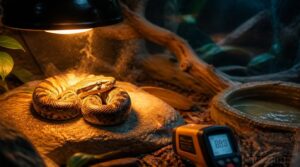
Young boas grow fast, and their basking spot has to keep pace. Aim for a 28–32°C basking surface, with the cool zone sitting 5–8°C lower. Check both spots with an infrared thermometer twice daily.
Limit direct exposure to a few hours—overheating stresses juveniles just as easily as insufficient heat slows their growth and digestion.
Adult Basking Temperatures
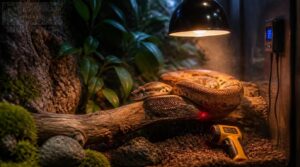
Growth slows once boas mature, but their basking needs stay just as strict.
Target 28–32°C on the surface, checked with a probe or infrared gun—not ambient air. Pair your heat lamp with a thermostat to hold that range steady.
Offer basking access 6–12 hours daily, adjusting heat source placement if room temps drift.
Cool Side Temperature Targets
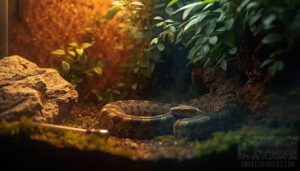
A basking spot means little without its opposite number.
Set your cool zone at 24–27°C (75–80°F) for adults, 26–29°C for juveniles—never above 24°C for sensitive individuals. This resting zone lets digestion and metabolism slow naturally.
Monitor with a dedicated probe. Watch for:
- Drafts near vents
- Substrate trapping heat
- Seasonal ambient shifts
- Sensor drift after bulb changes
Adjust shading for gradient balance.
One-Sided Heat Lamp Placement
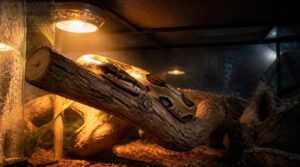
One side hot, one side not—that’s the whole trick. Mount your heat lamp above the basking end, height dialed so the surface hits 90–100°F. Verify with a temp gun at both ends. Keep the cool zone unlit.
One side hot, one side not: heat the basking end, verify with a temp gun, and keep the cool zone unlit
| Zone | Target Range |
|---|---|
| Basking | 90–100°F |
| Cool Side | 75–80°F |
| Gradient | 10–15°F spread |
| Verify | Daily probe check |
Basking Surface Size
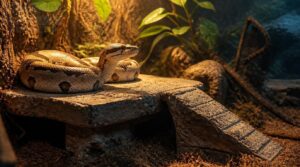
A cramped platform undoes all that careful gradient work. Size it so your boa lifts its head and shoulders clear without crowding—20–30 cm for juveniles, 40–60 cm for adults. Choose a textured, gently ramped surface for grip and easy exit.
Correct basking surface size, paired with smart heat source placement, keeps thermoregulation working the way nature intended.
Top 3 Heat Lamp Setup Essentials
The right gear makes wattage math actually work in practice. You need a solid fixture, a bulb rated for basking, and a way to check your numbers. Here are three products that cover all three jobs.
1. Simple Deluxe Dual Reptile Light Fixture

Why buy one fixture when your setup needs two jobs done at once? The Simple Deluxe dual dome holds independent 100-watt sockets, so you can run a heat lamp and a secondary bulb without cluttering your canopy.
Its polished aluminum reflector boosts heat distribution, and separate switches let you control day and basking cycles on their own schedules. Ceramic sockets resist wear, and the 6-foot cord gives real placement flexibility.
For boas needing 75-150 watts, this fixture controls it cleanly.
| Best For | Reptile owners, like bearded dragon or turtle keepers, who need both basking heat and UVB lighting from one compact fixture. |
|---|---|
| Primary Use | Terrarium basking/UVB lighting |
| Reptile Application | Bearded dragons, turtles |
| Heat Related | 100W max per socket |
| Safety Consideration | Cool-down before bulb change |
| Setup Type | Dual fixture, wall mount |
| Monitoring Role | Provides light/heat source |
| Additional Features |
|
- Independent switches let you control two bulbs separately for custom day and night lighting schedules
- Polished aluminum reflector improves heat reflection and UV output while ventilation holes help prevent overheating
- Long 6 ft cord with a bundling strap makes placement and cord management easy
- Each socket is capped at 100W, so it won’t work for reptiles that need higher-wattage bulbs
- Bulbs need a 30-minute cool-down period before you can safely replace them
- Built for terrarium use only, so it’s not suitable for outdoor or aquatic setups without extra protection
2. REPTI ZOO 75W Basking Heat Lamp Bulb
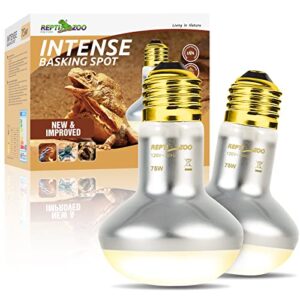
Fill that dual fixture with a bulb built for the job. The REPTI ZOO 75W runs on a standard E26 base, throws a focused beam that’s 35% more concentrated than standard bulbs, and lasts 2,000-3,000 hours before you need a replacement.
It skips the buzz and flicker cheaper bulbs suffer from, and includes UVA output that encourages natural basking behavior. One catch: it’s glass, so keep it dry and away from sudden temperature swings.
| Best For | Reptile and small pet owners looking for a reliable basking heat source for bearded dragons, geckos, turtles, or brooder setups. |
|---|---|
| Primary Use | Terrarium/brooder heat lamp |
| Reptile Application | Bearded dragons, geckos, turtles |
| Heat Related | 75W bulb power |
| Safety Consideration | Fragile glass, shatter risk |
| Setup Type | Standard E26 socket bulb |
| Monitoring Role | Provides heat/light source |
| Additional Features |
|
- Focused beam design delivers 35% more heat and light than standard bulbs
- Runs quietly with no buzzing or flickering, keeping the thermal environment stable
- Long-lasting, with a rated lifespan of 2,000-3,000 hours
- Doesn’t emit UVB, so a separate UVB bulb is still needed for proper D3 synthesis
- Glass construction is fragile and can shatter from moisture or sudden temperature changes
- Not meant for round-the-clock use, so basking cycles need to be monitored
3. Etekcity Infrared Laser Temperature Gun
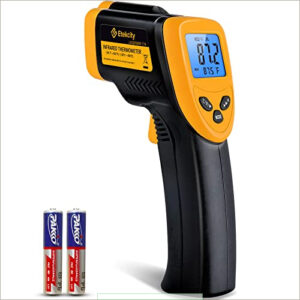
Guesswork has no place near a basking spot. The Etekcity infrared gun reads surface temps from -58°F to 1130°F in under 0.5 seconds, no contact needed.
Point, click, done. Its adjustable emissivity (0.1-1.0) accounts for glass, wood, or substrate differences, while the built-in laser pinpoints exactly where you’re measuring.
Hold it 14 inches from the basking spot for accurate readings within ±2%. Two AAA batteries keep it running—no guesswork, just numbers.
| Best For | Reptile owners, home cooks, and DIY-ers who need fast, accurate, no-contact temperature readings for basking spots, meats, engines, or HVAC systems. |
|---|---|
| Primary Use | Reptile enclosure temp check |
| Reptile Application | Reptiles, hairless cats |
| Heat Related | Reads up to 450°C |
| Safety Consideration | Non-contact for safe measuring |
| Setup Type | Handheld device |
| Monitoring Role | Monitors resulting temperature |
| Additional Features |
|
- Rapid sub-0.5-second response with non-touch laser targeting for quick, safe readings
- Adjustable emissivity (0.1-1.0) allows accurate readings across different surface materials like glass, wood, or substrate
- Wide temperature range (-58°F to 842°F) with ±2% accuracy makes it versatile for both cooking and reptile care
- Accuracy depends on maintaining the recommended 14-inch distance for the 12:1 spot ratio
- Not suitable for measuring human body temperature
- Readings reflect an average surface area rather than a precise single point, which may be less ideal for very small targets
Control and Adjust Wattage Safely
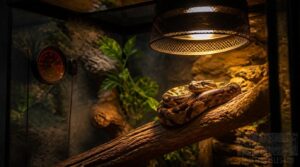
Picking the right wattage is only half the job—running it safely is what protects your boa long term. A few smart habits keep temperatures steady and burns off the table. Here’s how to stay in control of your setup.
Always Use a Thermostat
A bare bulb without a thermostat is a gamble you shouldn’t take. Always use a thermostat to regulate wattage, prevent overheating, and protect your boa.
- Gives precise temperature control and gradient stability
- Provides safety cutoffs against runaway heat
- Improves energy efficiency by cycling output
- Requires correct sensor placement, away from the bulb itself
Check power compatibility before installation—your setup’s safety depends on it.
Check Temperatures Daily
Your thermostat sets the target, but only daily checks confirm reality matches the dial.
Walking through each enclosure with a simple thermometer and hygrometer helps catch drift before it stresses your snake, and this ball python habitat lighting guide shows how proper light placement keeps those daily readings steady.
Run a morning temperature log and afternoon temp check, pairing surface temp readings at the basking spot with an ambient air check on the cool side.
Keep thermostat probe placement consistent.
This daily gradient monitor catches temperature fluctuations before they become digestive or thermal stress problems.
Increase Wattage Gradually
Jumping straight to a higher wattage is asking for trouble. Bump up 5 to 10 watts at a time, then wait 24 hours before checking again. Log basking, cool, and ambient readings for temperature stabilization.
If airflow’s limited, narrow your steps or add a secondary heat source. Patience here beats a scorched enclosure later.
Install Protective Lamp Guards
Once wattage is stable, protect it. A quality heat lamp guard blocks direct contact while allowing airflow—no melted scales, no scorched décor.
Choosing wisely matters:
- Pick corrosion-resistant metal mesh for glass tanks
- Confirm guard clearance sits 1 inch from the bulb
- Verify fit doesn’t block thermostat probes
- Inspect weekly for bends or looseness
Proper guard fit compatibility keeps electrical safety intact and burns rare.
Prevent Burns and Overheating
Guards handle contact risk, but overheating creeps in through neglect. Check basking spots daily with an infrared gun—surface temps above 95°F signal trouble.
Run cord safety checks weekly; frayed wires cause faults, not just fires. Pair every bulb with a working thermostat.
Burn prevention isn’t one fix—it’s guards, gradients, and daily eyes on the tank.
Frequently Asked Questions (FAQs)
How many watts is a heat lamp for a snake?
Picking the right "personal sunshine" for your snake depends on size and setup. Juveniles thrive on 60–75 watts; adults need 100–150 watts. Always pair wattage with a thermostat and daily temperature checks.
What heat bulb for boa constrictor?
A standard incandescent basking bulb works best, fixture-compatible with clamp lamps or dual fixtures. Skip odd color spectrums; white or slightly warm light suits boas fine, while heat distribution and safety certification matter more than bulb tint.
How many watts does a heat lamp need?
Enough to bake a small pizza stone, basically. Juveniles need 60-75 watts; adults need 100-150 watts. Glass, screen tops, and cold seasons demand more — always confirm your basking temperature with a thermometer, not a guess.
Is 150 watts too much for a ball python?
In small enclosures, yes—150 watts often pushes the basking spot past 92°F, risking heat stress. Pair it with a thermostat, monitor surface temps, and adjust wattage based on enclosure size and insulation.
How often should heat lamp bulbs be replaced?
Swap bulbs every 3 to 6 months, sooner if output fades or color shifts toward red. Watch for temperature drops, flickering, or cracked glass. Keep a spare on hand and always monitor with a thermostat for stability.
Do boas need heat at night too?
Not always. A cooler night, around 68-75°F, aids digestion and mimics natural cycles. If room temps dip lower, use a thermostat-controlled ceramic emitter, never a bright lamp, and keep monitoring the gradient closely.
What safety risks come with GFCI-protected outlets?
No protection, no peace of mind: GFCIs guard against shock but not against every failure. Nuisance trips stem from moisture ingress or improper wiring. Test monthly—undetected faults leave heat sources vulnerable, risking burns or sudden outages.
How do Radiant Heat Panels differ from standard bulbs?
Panels deliver radiant heat directly to surfaces, skipping air convection entirely. Standard bulbs heat air first, creating uneven distribution.
This means better surface temperature control, steadier gradients, lower wattage needs, and improved safety—no exposed filament, no shattering glass.
Conclusion
Picture that basking branch glowing like a small patch of equatorial sun, warm enough to coax a heavy meal into motion but never scorching scales. Getting boa constrictor heat lamp wattage right isn’t guesswork—it’s the difference between a thriving snake and a stressed one.
Match the bulb to the enclosure, verify with a thermostat, and adjust as the seasons shift. Do that, and your boa gets what it needs: a gradient it can trust completely.