This site is supported by our readers. We may earn a commission, at no cost to you, if you purchase through links.

A parked car hits 50°C within minutes on a sunny day. For your snake, that’s not discomfort—that’s a death sentence.
Most owners plan the driving part carefully but forget that every stop, every climate shift, and every power interruption quietly threatens their snake’s ability to digest, shed, and stay healthy. Temperature stability isn’t a luxury for traveling snake owners; it’s the difference between a thriving animal and a stressed one burning through its immune reserves.
The right reptile thermostats for traveling snake owners solve this problem before it starts—and the four options ahead make mobile reptile care genuinely manageable.
Table Of Contents
- Key Takeaways
- Why Traveling Snake Owners Need Thermostats
- Key Features in Reptile Thermostats for Travel
- Top 4 Reptile Thermostats for Traveling Snake Owners
- Setting Up a Thermostat in Mobile Snake Enclosures
- Tips for Safe Temperature Management While Traveling
- Frequently Asked Questions (FAQs)
- Do I need a thermostat for my snake?
- Can you leave the heating pad on all night for a snake?
- What is the best heat source for a snake enclosure?
- Can thermostats run on car power adapters?
- How often should thermostat probes be replaced?
- Which snake species need the tightest temperature ranges?
- Are wireless thermostats safe for enclosed travel cases?
- Do thermostats work reliably in extreme outdoor temperatures?
- Conclusion
Key Takeaways
- A parked car can reach 50°C in minutes, making thermostat-controlled heat the line between a healthy snake and a dead one.
- The best travel thermostats offer dual-zone control, remote monitoring, and battery backup — because road trips don’t pause for power outages.
- Probe placement, secure wiring, and a 48‑hour pre‑trip calibration test aren’t optional steps — they’re what keep your setup trustworthy on the move.
- Snakes can die within 20 minutes above 95°F, so picking the right thermostat for your specific setup isn’t a luxury — it’s basic care.
Why Traveling Snake Owners Need Thermostats
Traveling with a snake isn’t as simple as tossing it in a bag and hitting the road. Temperature swings can stress your snake fast, and stress opens the door to illness.
A snake already stretched thin by a long drive has even less tolerance for rough handling, which is why understanding how much handling stress snakes can actually tolerate matters before you even pack the travel bag.
Here’s what you need to know about keeping the heat steady no matter where you’re.
Risks of Temperature Fluctuations on The Road
Traveling with a snake sounds simple until the car turns into an oven or a freezer. Overheating Shock can set in fast — parked vehicles hit 50°C in direct sun.
Cold Shock, Escape Risk, Immune Suppression, and Digestive Failure follow temperature swings you never planned for.
Temperature stability isn’t optional on the road. It’s what keeps your snake alive. A proper temperature gradient requirement helps prevent overheating.
Importance of Consistent Heat for Snake Health
Consistent heat does more than keep your snake warm — it keeps everything working.
Stable temperatures support digestion efficiency, immune support, and shedding success.
Without metabolic balance, digestion stalls, immunity drops, and sheds fragment.
A digital thermostat with remote monitoring gives you temperature control wherever you stop.
Stress reduction follows naturally when your snake stays in its preferred range consistently.
Snakes are most active within their ideal temperature range, as detailed in the ideal temperature range.
Challenges of Mobile Snake Habitat Management
Managing your snake’s habitat on the road is harder than it looks. Vibration impact knocks heat mats loose, disrupting the thermal gradient. Power inverter loss cuts efficiency by 15‑20%, straining your heat mat thermostat. Humidity condensation builds from constant temperature swings.
Road travel tests every part of your snake’s habitat, from loosened heat mats to humidity swings you never planned for
Secure fastening prevents enclosure shifts during braking. Smart thermostat technology for pets with remote control helps with stress hormone management and temperature stability.
Key Features in Reptile Thermostats for Travel
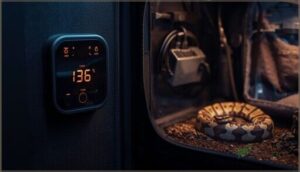
Not every thermostat is built with travel in mind, and that difference matters more than you’d think.
The right one needs to check a few specific boxes before it earns a spot in your travel kit.
Here are the key features worth looking for.
Portability and Compact Design
Size matters when you’re packing for the road. The best budget reptile thermostat won’t help if it won’t fit in your bag.
Look for compact dimensions under 140mm, lightweight housing under 300 grams, and foldable probe cables that coil without tangling. Strong travel mount options — velcro, clips, or magnetic bases — keep your low-wattage reptile thermostat secure during transit.
Digital Accuracy and Remote Monitoring
Sensor precision separates a decent digital thermostat from one you can actually trust on the road. Look for temperature accuracy within ±1°F and remote control through a mobile dashboard integration that offers real-time alerts.
Cloud sync keeps your app updated with live readings from anywhere. Data logging and data trend analysis let you catch subtle shifts before they become problems.
Programmable Settings and Alarms
The right reptile thermostat lets you set Day/Night Cycles once and forget them. Programmable settings handle Lighting Schedules automatically, so your snake keeps a normal rhythm in any hotel room.
Alarm Thresholds alert you through Remote Notifications before temperatures drift into dangerous ranges. Memory Retention means you won’t reprogram after a power flicker.
Automated alerts and precise temperature control work quietly behind the scenes.
Power Compatibility and Battery Backup
Most travel thermostats accept 100–240V input, so your Voltage Range is covered from New York to Tokyo with just a plug adapter.
For power outage backup, pair your setup with:
- USB Power bank running a low‑watt heat mat
- small UPS Capacity unit for short hotel outages
- 12V inverter for Inverter Safety during drives
Keep Battery Wattage low — under 25 watts stretches any backup considerably.
Top 4 Reptile Thermostats for Traveling Snake Owners
Finding the right thermostat for travel doesn’t have to be complicated.
These four options work well for snake owners who need reliable temperature control on the move.
Each one brings different to the table, so let’s break them down.
1. Vivosun Digital Heat Mat Thermostat Controller
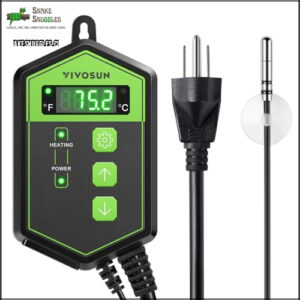
The Vivosun Digital Heat Mat Thermostat Controller keeps things simple without cutting corners. It holds temperatures between 40°F and 108°F, which covers every warm zone your snake needs on the road.
The 6-foot waterproof probe sits directly on substrate and reads accurately without fuss.
Setup takes minutes — three buttons handle everything.
It handles up to 1000 watts, so most heat mats won’t strain it.
Compact at under 10 inches tall, it doesn’t take up much space in your travel kit.
| Best For | Reptile owners, hobbyist growers, and anyone who needs reliable temperature control for heat mats — whether for snakes, seedlings, or fermentation projects. |
|---|---|
| Material | Plastic |
| Weight | 1.06 lbs |
| Max Wattage | 1000W |
| Display Type | LCD |
| Heating Mode | Yes |
| Reptile Compatible | Yes |
| Additional Features |
|
- Wide temperature range (40–108°F) covers most reptiles and plant needs without extra gear
- Dead-simple three-button setup means you’re up and running in minutes
- The included probe sits right in the substrate for accurate, real-time readings
- Maxes out at 1000W, so high-draw setups might hit a wall
- Only works with North American outlets — not great if you travel internationally
- No built-in protection against humidity or extreme conditions, so placement matters
2. DIGITEN Temperature Humidity Controller Timer
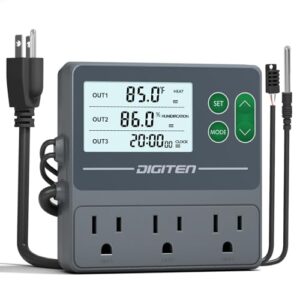
The DIGITEN THT1032 does more than just temperature — it watches humidity too. That matters when your snake’s enclosure needs both heat and moisture dialed in at once.
Two waterproof probes manage each independently, so nothing interferes. The triple-zone control gives you three outlets working on their own schedules.
Temperature accuracy sits at ±0.4°C, which is tight enough to trust. Settings save after power loss, and the programmable timer manages day and night cycles without you touching anything.
| Best For | Reptile keepers, mushroom growers, and hobbyist brewers who need precise control over both temperature and humidity in one device. |
|---|---|
| Material | Plastic |
| Weight | 1.04 lbs |
| Max Wattage | Not specified |
| Display Type | Large digital display |
| Heating Mode | Yes |
| Reptile Compatible | Yes |
| Additional Features |
|
- Dual probes track temperature and humidity separately, so both stay accurate without interfering with each other
- Triple-zone control means three outlets running on their own schedules — great for day/night cycles
- Settings hold after a power loss, so you’re not constantly resetting things
- Some users have had issues with the humidity probe, which is kind of a dealbreaker for moisture-sensitive setups
- The backlight times out, so checking readings in a dark room gets annoying fast
- Durability has been a concern for some buyers, especially for long-term use
3. Pymeter Digital Temperature Controller Thermostat
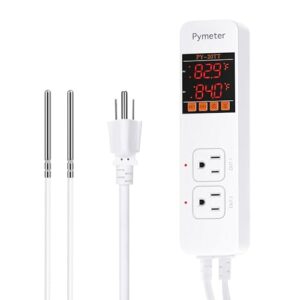
The Pymeter PY-20TT-10A manages two zones at once — a real advantage when your travel enclosure has separate warm and cool sides. Each outlet pairs with its own waterproof sensor, so neither zone interferes with the other.
The sensors reach 6.56 feet, giving you flexible placement without guesswork.
Built‑in temperature difference alarms alert you before conditions drift too far.
It is compact at just 1.04 pounds and works on 85–250V AC, so international trips aren’t a problem.
| Best For | Reptile keepers, aquarium hobbyists, or greenhouse growers who need precise, independent temperature control across two separate zones. |
|---|---|
| Material | Polycarbonate (PC) |
| Weight | 1.04 lbs |
| Max Wattage | 1200W |
| Display Type | Digital display |
| Heating Mode | Yes |
| Reptile Compatible | Yes |
| Additional Features |
|
- Controls two zones at once with separate sensors — no crossover, no guesswork
- Built-in alarms catch temperature drift before it becomes a problem
- Compact and lightweight at just over a pound, easy to take anywhere
- Interface has a learning curve, and you’ll likely need the manual to get started
- No day/night timer — it holds one constant temperature, that’s it
- Thick cables can be awkward to route in tight or custom setups
4. WILLHI Digital Temperature Controller Plug
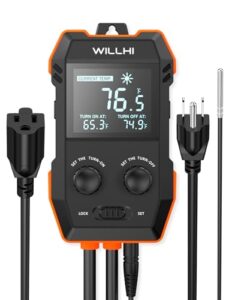
If you only need one zone, the WILLHI WH1436A keeps things simple. It plugs straight into a standard outlet, manages up to 1100 watts, and lets you set separate on and off temperatures in 0.1-degree steps.
The waterproof probe runs nearly 10 feet, so placement isn’t a problem. High and low alarms alert you if temperatures drift while you’re away from the vehicle.
It’s compact, saves your settings through power cuts, and works on 110V North American power.
| Best For | Anyone who needs simple, precise temperature control for a single zone — great for reptile tanks, aquariums, home brewing, or small greenhouses. |
|---|---|
| Material | ABS |
| Weight | 15.5 oz |
| Max Wattage | 1200W |
| Display Type | Digital display |
| Heating Mode | Yes |
| Reptile Compatible | Yes |
| Additional Features |
|
- Plugs straight into a standard outlet with no complicated setup — just plug in and go
- Precise 0.1-degree control across a wide range, handling both heating and cooling applications
- Waterproof probe and fire-retardant shell mean it holds up in humid or demanding environments
- Only controls one zone, so it won’t work if you need to manage multiple areas at once
- Capped at 1200W, which may not be enough for larger or more power-hungry setups
- The black and orange design is pretty utilitarian — not exactly a showpiece if aesthetics matter to you
Setting Up a Thermostat in Mobile Snake Enclosures
Getting your thermostat set up correctly in a travel enclosure makes all the difference for your snake’s comfort on the road.
There are a few key steps you’ll want to follow — from placing the probe right to testing everything before you leave. Here’s how to do it properly.
Proper Thermostat Placement for Accuracy

Where you place the probe decides everything. For warm end placement, set it directly over the heat source at your target basking temperature. Middle placement works well for temperate snakes — position it at substrate surface level to capture accurate temperature gradient readings.
Secure probe fixing prevents shifts during travel. Keep it shaded and away from glass to avoid interference sources, skewing your thermostat setup for snake enclosures.
Connecting Thermostats to Portable Heat Sources

Once your probe is locked in, connecting your heat mat thermostat is straightforward. Plug the mat directly into the thermostat outlet, then plug the thermostat into your power source. Wattage matching matters here — most portable mats draw 4 to 12 watts, well within safe limits.
- USB power integration works for off‑grid setups via a 5 V, 2 A minimum power bank
- Adapter compatibility with 12 V car adapters keeps DC thermostats running during vehicle transport
- Grounding safety means connecting the earth terminal to prevent shock near moisture
- Dual probe models let you monitor both warm and cool ends simultaneously
Ensuring Secure Wiring During Travel
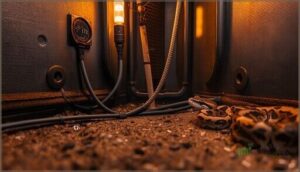
With everything plugged in, keeping wires secure is your next move. Use zip-tie organization to bundle cords away from your snake. Thread probes through grommet sealing ports to prevent escapes and tangles. Braid cables with vibration-dampening probes for a bump-proof setup.
Practice cord-bundling safety and pre-trip wire inspection — check for fraying weekly. A clean enclosure setup keeps everything reliable on the road.
Testing and Calibrating Before Trips

Testing your digital thermostat before any trip isn’t optional — it’s how you stay in control.
Run a Probe Accuracy Check by placing your probe next to a reference thermometer for 30 minutes. Apply an Offset Calibration Procedure if readings drift beyond 1°F.
Complete a Stability Drift Test over 48 hours, validate Battery Backup Validation, and confirm Alarm Response Timing stays under 10 seconds.
Tips for Safe Temperature Management While Traveling
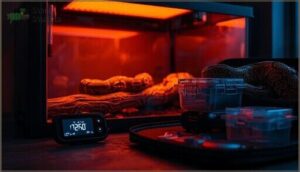
Keeping your snake safe on the road comes down to a key habits.
Temperature swings, equipment hiccups, and humidity shifts can all catch you off guard when you’re away from home.
Here’s what you need to know before your next trip.
Monitoring Temperature Fluctuations on The Go
Keeping tabs on snake’s heat while driving isn’t guesswork anymore. Wireless Probe Integration paired with Mobile App Sync gives you real-time data without pulling over.
- Real-Time Alerts notify you when temps drop below 28°C
- Data Logging Trends track readings every 5 minutes
- Remote monitoring catches fluctuations over 2 degrees fast
- Battery Life Optimization keeps probes running 500+ hours
- Digital temperature monitoring exports CSV logs post-trip
Emergency Protocols for Thermostat Failure
When your thermostat fails mid‑trip, act fast.
Pull your snake into an Insulated Travel Box with a Heat Pack Backup wrapped in a towel — never direct contact.
A Redundant Thermostat setup prevents dangerous overheating before it starts.
Keep a Battery Power Station handy for power outage backup.
If overheating occurred, move your snake somewhere cool immediately and skip feeding for several days.
Maintaining Optimal Humidity Levels
Humidity drops fast in transit — don’t wait until your snake shows stress signs.
- Substrate Moisture Management: Cypress mulch holds moisture longer; mist before departure.
- Portable Hygrometer Calibration: Verify humidity readings match actual enclosure conditions.
- Gel Reservoir Utilization: Hide boxes with gel that hold 55–65% RH for hours.
- Fogger Output Adjustment: Set foggers to 100–200 ml/hour for stable reptile habitat humidity.
Monitor humidity and temperature regulation together using humidity monitoring tools for accurate humidity gauge readings throughout your trip.
Packing Essentials for Mobile Reptile Care
Pack smart — snake’s survival kit is just as important as the thermostat for snakes themselves.
Use cloth snake bags as transport containers, since they reduce light and stress.
Tuck in toilet paper tubes as temporary hides, keep a travel first aid kit with Betadine and vet wrap, add handling tools, and include a heat mat with a temperature probe for reliable portable warmth anywhere.
Frequently Asked Questions (FAQs)
Do I need a thermostat for my snake?
Yes, you do. Snakes can’t regulate their own body heat.
Without temperature control, a heat mat can overheat and burn your snake. A thermostat is essential for safe snake care and environment.
Can you leave the heating pad on all night for a snake?
You can, but only with a thermostat controlling it. Unregulated pads hit 105°F or higher overnight, risking serious burns. Keep substrate at least half an inch thick for insulation.
What is the best heat source for a snake enclosure?
Radiant heat panels work best for most snakes. They warm large spaces evenly without light.
Ceramic heat emitters raise air temps 10–20°F.
Match your heat source to a reliable reptile thermostat.
Can thermostats run on car power adapters?
Most reptile thermostats need 110V AC, so you’ll need a pure sine wave inverter.
Direct 12V options like the STC-1000 skip that step entirely.
Watch your battery drain and electrical load carefully.
How often should thermostat probes be replaced?
Replace your temperature probe every one to two years.
Watch for calibration drift, wear signs, or readings off by five or more degrees.
simple cleaning schedule extends sensor life noticeably.
Which snake species need the tightest temperature ranges?
Green tree pythons and garter snakes have the narrowest thermal windows. Exceed 86°F with a green tree python and dehydration sets in fast. Precise temperature control isn’t optional — it’s survival.
Are wireless thermostats safe for enclosed travel cases?
wireless thermostats like the Inkbird WiFi Reptile Heat Mat Thermostat IPT2CH are safe for enclosed travel cases when probe security, overheat alerts, power backup, and signal interference risks are properly managed.
Do thermostats work reliably in extreme outdoor temperatures?
Not entirely. Cold‑induced lag, sensor drift, and over‑temp shutdown can all compromise accurate temperature control outside the 0–40°C range. Battery drain accelerates in freezing conditions too.
Conclusion
Snakes can die within 20 minutes of exposure to temperatures above 95°F. That single fact makes every stop, detour, and power hiccup a real risk.
The right reptile thermostats for traveling snake owners don’t just regulate heat—they remove the guesswork that costs animals their lives. You’ve got four solid options now. Pick the one that fits your setup, test it before you leave, and your snake won’t know the difference between home and the road.
- https://mramphibian.com/best-reptile-thermostats/
- https://www.evolutionreptiles.co.uk/blog/vivarium-thermostat-probe-position/
- https://www.thebiodude.com/collections/reptile-thermostats-thermometers
- https://www.petzoo.com.au/reptiles/thermostats/
- https://enviroliteracy.org/animals/how-do-you-know-if-your-snake-is-overheating/