This site is supported by our readers. We may earn a commission, at no cost to you, if you purchase through links.
Most snake deaths attributed to “mysterious illness” trace back to the enclosure itself—specifically, materials that off-gas volatile compounds, leach plasticizers, or trap moisture long enough to culture bacterial colonies. A ball python pressed against a PVC panel that never fully cured inhales what amounts to a slow chemical drip, and the symptoms won’t show for weeks. That gap between cause and consequence is where most keepers get blindsided.
Choosing safe snake enclosure materials isn’t a matter of grabbing whatever holds its shape—it’s a material science problem with a living animal at stake. The distinctions between food-grade plastics, tempered glass, marine-grade plywood, and standard composites are narrower than they look but consequential enough to determine whether your enclosure sustains or quietly undermines the animal inside it.
Table Of Contents
- Key Takeaways
- Key Properties of Safe Enclosure Materials
- Top Material Choices for Snake Enclosures
- Moisture Resistance and Humidity Control
- Ensuring Non-Toxicity and Safety
- Preventing Mold and Bacterial Growth
- Durability and Longevity of Materials
- Edge, Joint, and Hardware Safety
- Comparing Material Performance
- Substrate Safety and Compatibility
- Step-by-Step Material Selection Guide
- Frequently Asked Questions (FAQs)
- What plants are safe to put in a snake enclosure?
- Are PVC enclosures safe for reptiles?
- What not to put in a snake enclosure?
- Is acrylic safe for reptiles?
- How to build a safe snake enclosure?
- What is the best material for a reptile enclosure?
- How do I choose a venomous snake enclosure?
- Is PVC safe for snake enclosures?
- Are venomous snake enclosures safe?
- Are snake enclosures waterproof?
- Conclusion
Key Takeaways
- PVC and HDPE are your safest long-term enclosure materials because they won’t off-gas, absorb moisture, or degrade under the humidity and disinfectant cycles your snake’s habitat demands.
- Off-gassing from uncured sealants, composite woods, and substandard plastics can silently harm your snake for weeks before symptoms appear, so always allow full curing time before housing any animal.
- Moisture control isn’t just about comfort—it’s the single biggest factor in preventing scale rot, respiratory infections, and bacterial growth, which means your material choices either solve or create that problem from day one.
- Wood-based builds like marine plywood can work well, but only if you seal every edge and seam with aquarium-grade silicone or polyurethane and allow a full curing period before your snake moves in.
Key Properties of Safe Enclosure Materials
Not every material belongs in a snake enclosure — the wrong choice can put your animal at serious risk. Before you build or buy anything, it helps to understand what actually makes a material safe and functional.
A good starting point is brushing up on ball python habitat decoration tips before you accidentally bring home something harmful.
Here are the core properties to look for.
Non-Toxic and Snake-Safe Options
Your snake’s safety starts with material selection — get this wrong, and you’re fighting off-gassing, chemical residues, and hidden toxicity issues before your animal even settles in. Stick to genuinely reptile-friendly materials: rigid PVC er HDPE panels formulated without heavy metals, tempereded glass, or food-grade polypropylene containers — all proven non-toxic options for snake health.
- HDPE contains no chlorine and won’t off-gas under normal enclosure temperatures normal enclosure temperatures normal enclosure temperatures
- Tempered glass is fully inert er leaches nothing inro the habitat
- Food-grade plastics avoid plasticizers thaC migrate inRO your snake’s skin or water
For a thorough breakdown down of the, research shows thaC acrylic, PVC, glass, er HDPE each offer unique benefits er considerationsations.
Moisture and Rot Resistance
Moisture is where enclosure builds succeed or fail. PVC and HDPE absorb less than 0.1% of their weight in water, making them top choices for moisture resistance and rot prevention.
If you’re working with wood-based options, waterproof coatings and moisture barriers — epoxy, polyurethane, or aquarium-grade sealant options — are non-negotiable.
Proper humidity control depends entirely on smart material selection for enclosures from the start. For additional insights, you can review specific details about mesh top ventilation features and how they impact enclosure suitability.
Structural Strength and Durability
Beyond moisture resistance, structural strength and durability determine whether your enclosure holds up for years or fails under daily stress. Half-inch PVC panels deliver load capacity strong enough for heavy decor and safe stacking, while HDPE’s one-piece construction eliminates joint integrity concerns entirely.
Warping prevention and impact resistance matter too — thin or engineered panels without adequate panel thickness buckle, and warped doors create gaps snakes will find.
Easy Cleaning and Maintenance
Durability only pays off if the enclosure is actually easy to keep clean. Non-porous materials like PVC and tempered glass make enclosure maintenance and cleaning straightforward — waste wipes off the surface instead of soaking in.
- Follow consistent maintenance schedules: daily spot cleaning, monthly deep disinfection
- Use a reptile-safe cleaning solution like chlorhexidine diluted 1:30
- Apply sanitizing methods with proper ventilation systems open for 4–8 hours of drying
- Rotate cleaning protocols to include decor, water bowls, and substrate replacement
Top Material Choices for Snake Enclosures
Not all enclosure materials are created equal, and the one you choose will directly affect your snake’s health, comfort, and safety.
Each option on this list brings a different set of strengths depending on your budget, your snake’s species, and how much maintenance you’re willing to commit to.
Here’s a breakdown of the top materials worth considering.
PVC Panels and Enclosures
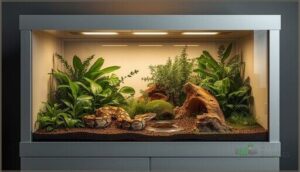
PVC panels have become the backbone of serious snake habitat construction — and for good reason. When you’re building or selecting an enclosure, PVC’s moisture resistance, slight insulation, and non-porous surface work together to simplify maintenance while holding heat and humidity efficiently.
Custom enclosure construction with PVC panels usually lasts over a decade, making this material selection for enclosures a smart long-term investment.
Tempered Glass Terrariums
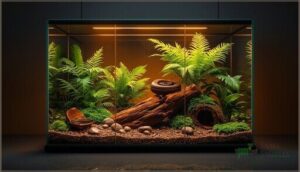
Tempered glass terrariums remain a go-to choice in reptile habitat design for one simple reason: Visual Clarity. That unobstructed view of your snake’s enclosure materials and behavior is genuinely hard to beat. Before committing, weigh these key factors in your material selection for enclosures:
- Glass Strength — tempered glass resists impact better than standard panes
- Thermal Conductivity — glass loses heat faster, demanding stronger heat sources
- Weight Factors — glass terrariums are much heavier than PVC alternatives
- Aesthetic Value — display setups genuinely shine here
- Humidity Control — screen tops complicate tropical species care
Melamine-Coated Particle Board
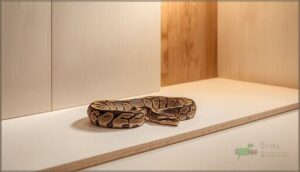
Melamine-coated particle board sits in an interesting middle ground in material selection for snake enclosures — cheaper than PVC at scale, yet capable enough for most terrestrial setups when you seal it properly. The laminate finish creates a smooth, moisture-resistant surface, but unsealed edges are where particle board fails fast.
| Melamine Benefits | Key Consideration |
|---|---|
| Affordable large enclosures | Seal all cut edges |
| Smooth laminate finish | Avoid high-humidity species |
| Easy surface cleaning | Apply waterproof sealant to seams |
| Budget DIY-friendly | Monitor for delamination regularly |
Moisture testing your seams before introducing any snake is non-negotiable — reptile-friendly materials mean nothing if swelling particle board releases contaminants.
If you’re still choosing your enclosure, this guide to snake terrarium options and materials breaks down which builds hold up best against moisture over time.
Marine-Grade Plywood
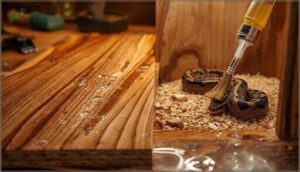
Marine plywood earns its place in enclosure materials as a genuinely tough option. Exterior-grade bonded veneers resist moisture in ways standard plywood simply can’t.
For material selection involving tropical or high-humidity species, marine coatings and proper sealing methods are non-negotiable before panel installation.
Once sealed with reptile-friendly sealants, plywood durability extends well beyond typical wood composites, making it a solid long-term investment.
Food-Grade Plastic Containers
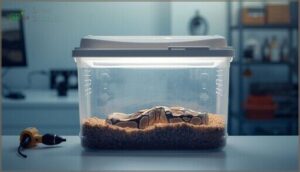
Don’t overlook the humble plastic tub — food-grade plastic containers are the backbone of professional rack system use for good reason. Designed to store consumables without leaching harmful chemicals, they make material selection straightforward when safety and toxicity are your primary concerns.
- Budget Housing: Among the lowest cost-per-snake enclosure materials available
- Easy Disinfection: Non-porous smooth walls clean quickly with dilute disinfectants
- Tub Ventilation: Drill or melt holes to dial humidity precisely
- Safety and Toxicity: Food-grade rating confirms no harmful chemical off-gassing
- Display: Limited visibility compared to front-opening enclosures
High-Density Polyethylene (HDPE)
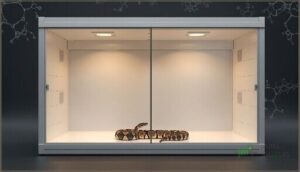
HDPE is undoubtedly the most durable plastic you’ll find in enclosure design — commercial Vision-style cages are built from it precisely because it resists cracking and can stay in service for 20-plus years.
Its smooth, non-porous surface simplifies material selection for snake safety, cleaning up quickly with dilute disinfectants.
Unlike standard food-grade plastic containers, HDPE tolerates higher temperatures without releasing harmful fumes, making it a dependable reptile-friendly material for long-term setups.
Moisture Resistance and Humidity Control

Moisture control isn’t just a comfort issue for your snake — it directly affects shedding quality, respiratory health, and long-term survival. The materials you choose either work with humidity or fight against it, and that difference shows up fast.
Here’s what you need to know about water-resistant options and how to seal wood-based builds properly.
Importance for Snake Health
Humidity isn’t just about comfort — it’s the foundation of snake health and wellbeing. When moisture levels drift outside your species’ target range, respiratory protection fails, skin health deteriorates, and infection control becomes an uphill battle.
Humidity is not a comfort setting — it is the foundation on which your snake’s health either holds or collapses
Poor humidity accelerates scale rot, disrupts shedding, and compromises digestive safety by weakening immune response.
Toxicity prevention starts here too, since damp surfaces accelerate off-gassing from substandard materials.
Water-Resistant Materials
Once you understand how moisture threatens your snake’s health, choosing the right waterproof materials becomes a straightforward defense strategy. Solid PVC panels, food-grade HDPE, and melamine-coated particle board all function as reliable moisture barriers because their non-porous surfaces repel water rather than absorb it.
- PVC panels maintain shape under constant humidity without warping
- HDPE resists water intrusion and stays structurally sound for years
- Marine plywood uses phenolic adhesives that strengthen material durability against repeated moisture exposure
- Exterior-grade plywood with proper sealant options manages damp conditions when edges are fully sealed
These water repellent materials keep your enclosure stable and your snake safe.
Sealing Techniques for Wood-Based Enclosures
Even with marine-grade plywood, raw wood won’t hold up long without proper sealing. Sealant Selection matters — water-based polyurethane, polycrylic, or aquarium-rated epoxy all work well. Surface Prep starts with 120-grit sanding, then dust removal before applying coats. Layered Application means three to five thin passes. Curing Ventilation — fan running, enclosure open — prevents offgassing from harming your snake.
| Step | Method | Timeframe |
|---|---|---|
| Surface Prep | Sand to 120–150 grit, wipe clean | 24–48 hrs drying |
| Layered Application | 3–5 thin coats of sealant | 24 hrs between coats |
| Curing Ventilation | Open enclosure, run fan | 1–4 weeks |
Ensuring Non-Toxicity and Safety
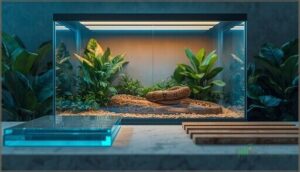
Even the most well-built enclosure can become a hazard if the materials off-gas toxins or leach harmful chemicals into your snake’s environment. Getting this right comes down to three key decisions: what additives you’re avoiding, which plastics are actually safe, and what sealants won’t poison the habitat over time.
Here’s what you need to know about each.
Avoiding Harmful Additives and Off-Gassing
Off-gassing is one of the quieter threats in reptile husbandry—your snake lives inches from every surface, breathing whatever those materials release.
New composite woods can emit formaldehyde well above 0.09 ppm in warm enclosures, while flexible plastics introduce plasticizer risks through phthalate compounds that leach continuously.
Prioritize zero VOC coatings, allow full curing processes of several weeks, and run heat during offgassing prevention periods to accelerate VOC reduction before housing your animal.
Selecting Food-Grade Plastics
Plastic regulation isn’t just bureaucracy—it’s the backbone of safety for enclosure materials you’ll trust next to your snake. Food-grade plastic containers bearing proper plastic certification are best: they undergo material testing for chemical resistance, meet food safety migration limits, and keep toxins at bay. For safe selection:
- Look for explicit food safety labeling.
- Confirm documentation from reputable vendors.
- Inspect for smooth, defect-free surfaces.
- Avoid off-brands lacking clear compliance data.
Safe Sealants and Adhesives
Behind every safe enclosure is a short list of materials that won’t harm your snake once they cure.
For sealing and bonding, aquarium-grade silicone—100% silicone rubber—is the preferred choice in terrarium construction, meeting both silicone safety and reptile-friendly materials standards after 48–72 hours of off-gassing. Fully cured epoxy applications create inert, non-porous surfaces, while wood glue risks emerge under constant moisture.
Always confirm VOCs have cleared before reintroducing your snake.
Preventing Mold and Bacterial Growth
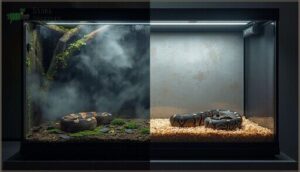
Mold and bacteria don’t need much of an invitation — a little trapped moisture and poor airflow are enough to turn a clean enclosure into a health hazard for your snake.
The good news is that the right materials and habits make prevention straightforward. Here’s what to focus on.
Choosing Non-Porous Surfaces
Surface material is your first line of defense against mold. Non-porous options like PVC panels, tempered glass, and food-grade plastic containers don’t absorb moisture, so bacteria can’t hide where you can’t reach them. Surface sanitizing is predictable and reliable on these materials. Here’s why non-porosity matters:
- PVC panels resist moisture absorption, making Material Durability outstanding in humid setups.
- Tempered glass passes basic Porosity Testing — waste stays on the surface, never inside it.
- Melamine-coated particle board relies on its Non Toxic Coatings for protection, so seal every exposed edge.
- Enclosure Linings using food-grade plastic containers offer Moisture resistance that won’t degrade under routine disinfection.
Proper Ventilation for Enclosures
Think of your enclosure’s ventilation as a circulatory system — without steady airflow, everything stagnates. For effective Airflow Design, position intake vents low on the cool side and exhaust vents high on the warm side, so warm air rises and exits naturally. This approach promotes Respiratory Health while keeping Humidity Control stable without drafts stripping your thermal gradient.
| Vent Position | Function | Benefit |
|---|---|---|
| Low, cool side | Fresh air intake | Reduces stale substrate air |
| High, warm side | Exhaust outlet | Expels humid, bacteria-laden air |
| Opposite side panels | Cross-ventilation | Prevents dead air pockets |
Routine Cleaning Practices
Your cleaning routine is your first line of defense against mold. Daily Spot Cleaning — removing feces, urates, and shed within 24 hours — keeps bacteria from gaining a foothold.
Weekly Sanitizing means scrubbing décor and wiping surfaces with a reptile-safe cleaning solution like chlorhexidine or F10SC.
Monthly Deep Cleaning Tips involve full substrate replacement and disinfecting every interior surface. Consistent enclosure maintenance and cleaning is non-negotiable for Reptile Safety.
Durability and Longevity of Materials
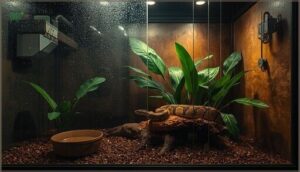
A well-built enclosure isn’t just about what keeps your snake safe today — it’s about what holds up six months from now when humidity, waste, and daily wear start taking their toll. Some materials degrade faster than you’d expect, warping or breaking down in ways that can compromise your snake’s environment.
Here’s what you need to know about choosing materials built to last.
Resistance to Wear and Tear
Not all materials age the same way inside a snake enclosure — and understanding wear patterns before you buy can save you from an expensive rebuild later. Material durability varies markedly across your options:
- PVC panels resist chemical disinfectants without softening and show only cosmetic scratches
- HDPE maintains structural strength under stacked loads and repeated cleaning cycles
- Tempered glass offers excellent surface scratch resistance but fails suddenly at edges under sharp impact
- Melamine chips under heavy décor, exposing moisture-vulnerable particle board beneath
- Food-grade plastics tolerate impact resistance demands of frequent handling without cracking
Matching material properties for reptile habitats to your specific setup isn’t guesswork — it’s what separates a five-year enclosure from one that lasts decades.
Maintenance Routines for Longevity
Durability doesn’t maintain itself — how you clean determines how long your materials last. Daily cleaning of waste and soiled substrate prevents moisture from soaking into seams.
Reptile-safe disinfectant options like F10SC protect PVC and glass without degrading finishes. Pair that with consistent humidity control through programmable misting and proper ventilation systems, and your enclosure maintenance and cleaning routines become the foundation of genuine material longevity.
Inspecting and Replacing Damaged Components
Weekly panel inspections catch cracks, warping, or soft spots before they become escape routes or mold breeding grounds. When silicone seams start peeling, remove and replace them completely — partial repairs fail fast.
Monthly hardware checks on hinges and latches confirm nothing has loosened under your snake’s pressure. Your replacement criteria should be straightforward: if it’s structurally compromised, swap it out.
Edge, Joint, and Hardware Safety
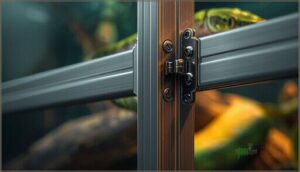
Even the best materials can fall short if the edges, joints, and hardware holding everything together aren’t up to the job. A sharp seam or a rusting hinge isn’t just an eyesore — it’s a real hazard for your snake.
Here’s what to focus on when evaluating these often-overlooked details.
Avoiding Sharp Edges and Rough Surfaces
A single rough edge is all it takes to cause rostral abrasion or scale damage. Your material selection framework must include surface finishing as a non-negotiable step — not an afterthought.
- Edge smoothing: Sand all cut plywood and PVC edges with progressively finer grits
- Corner safety: Bevel or silicone-fill interior panel joints to eliminate scraping lips
- Abrasion prevention: Grind sharp points on slate tiles and decorative rocks until rounded
- Material inspection: Run fingers firmly along all interior surfaces before and after adding decor
Snake-friendly materials mean nothing if finishing is skipped. Enclosure materials must feel smooth to a slow finger-drag test — that’s your practical standard for reptile-friendly enclosure readiness.
Using Stainless Steel Hardware
Surface finishing gets you halfway there — hardware selection closes the gap. In snake enclosures, corrosion resistance isn’t optional; zinc-plated screws rust and flake into the habitat.
Choose 304 stainless steel for most custom enclosures, or 316 stainless when humidity runs above 80 percent. Match load calculations to door weight, and your reptile-friendly materials will hold for years.
Applying Aquarium-Grade Silicone to Seams
Silicone application is where enclosure maintenance and cleaning either gets easy or turns into a recurring headache. Before sealing, seam preparation matters: scrape out old material, wipe with isopropyl alcohol, and let the surface dry completely.
- Cut the nozzle at 45 degrees for a clean bead
- Pull steadily to avoid air pockets
- Bead smoothing with a gloved finger improves moisture resistance
- Remove painter’s tape while still wet for crisp joints
- Allow 48–72 hours curing process before exposing seams to humidity
Regular joint inspection catches lifting edges before reptile safety is compromised.
Comparing Material Performance
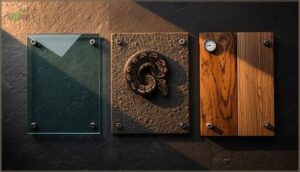
Once you’ve sorted out edges and hardware, the next question is how your material choices actually hold up day to day. Each option has real trade-offs across insulation, weight, and cost that will shape your experience as a keeper.
Here’s how the most common materials stack up across those three areas.
Insulation and Temperature Control
PVC’s lower thermal conductivity makes it the standout choice for climate control, holding temperature gradients far more reliably than glass, which bleeds heat quickly through its walls.
For precise thermoregulation needs, that difference matters—PVC enclosures let you run lower-wattage heat sources while maintaining steady basking spots near 95°F.
Glass demands higher thermal mass compensation, more powerful heating, and constant thermostat vigilance to prevent dangerous fluctuations.
Weight and Ease of Handling
Weight is where material choice gets practical fast. A 4x2x2 PVC enclosure tops out around 45 pounds; tempered glass of equal volume can exceed 80.
That gap directly affects handling safety, ease of transport, and DIY enclosure assembly—especially for large reptile enclosures.
Lower material density means better weight distribution when repositioning, cleaning, or relocating your setup without straining your back or risking a drop.
Cost and Long-Term Value
Upfront price is only half the story. A PVC enclosure running $300–$500 costs more than melamine initially, but its longterm durability means you’re not replacing it every few years when humidity takes its toll.
Factor in energy efficiency—PVC retains heat better than glass, trimming monthly heating costs.
A solid material selection framework for budget planning treats cost analysis as a lifecycle decision, not just a sticker price.
Substrate Safety and Compatibility
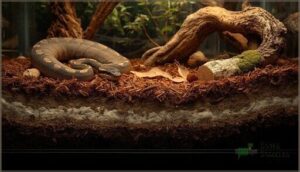
The substrate you choose does more work than most people realize — it’s not just filler on the floor of the enclosure. Get it wrong and you’re looking at respiratory issues, failed sheds, and a stressed snake.
Here’s what you need to know about safe substrate materials, proper depth and maintenance, and what to keep far away from your setup.
Recommended Substrate Materials
Substrate selection is where a lot of keepers get tripped up—and it genuinely affects your snake’s respiratory health, shedding quality, and stress levels. The right reptile-friendly materials create a functional microenvironment, not just a floor covering. Here’s a quick substrate material comparison to guide your choice:
- Aspen Shavings Use suits dry-climate colubrids—low dust, soft, and burrow-friendly
- Coconut Fiber excels in tropical setups, holding humidity above 50% without compacting
- Cypress Mulch resists mold better than most wood-based options in high-humidity enclosures
- Paper Bedding works best for quarantine or medical monitoring due to visibility and easy replacement
- Bioactive Substrates using coir-topsoil blends support naturalistic digging while managing microclimates effectively
Substrate Depth and Maintenance
Depth isn’t one-size-fits-all — species depth requirements vary greatly. Kenyan sand boas need 6 to 8 inches for burrowing, while corn snakes thrive at 3 to 4 inches.
Proper substrate depth aids humidity control and moisture management naturally.
For cleaning and maintenance, spot-clean daily and fully replace every 1 to 3 months. Drainage layers in bioactive builds prevent compaction and protect long-term health.
Materials to Avoid in Substrates
Not every substrate is safe — some materials actively harm snakes. Avoid these three toxic substrate categories entirely:
- Aromatic woods like cedar and pine release phenolic compounds that irritate airways and damage liver tissue over time.
- Sharp particles such as gravel or crushed walnut shells can cause gut impaction and belly scale abrasions.
- Dusty bedding like diatomaceous earth introduces microscopic irritant materials into a snake’s lungs with every breath.
Stick to reptile-friendly materials and always disinfect with a reptile-safe cleaning solution during substrate selection for reptile enclosures.
Step-by-Step Material Selection Guide

Choosing the right enclosure material comes down to three things: what your snake needs, where it lives, and what you can realistically maintain.
The following steps walk you through each decision point so nothing gets overlooked. Work through them in order and you’ll have a clear answer by the end.
Assessing Your Snake’s Needs
Before you buy a single panel or measure a single wall, you need to honestly assess what your snake actually requires. Start with species research: humidity control needs, thermal range, and natural behavior all dictate material choices. A tropical species demanding 80% humidity wrecks untreated wood fast.
Enclosure planning grounded in animal welfare and reptile health and safety protects your snake from day one.
Matching Material to Species and Environment
Once you know your snake’s species-specific needs, matching those requirements to enclosure materials becomes straightforward. Tropical boas demanding 70–80% humidity control will punish wood panels within months, while PVC or HDPE holds dimensionally stable. Desert colubrids need the opposite — glass terrariums with open mesh tops naturally shed excess moisture.
Material durability, thermal insulation, and species compatibility aren’t abstract considerations; they’re daily survival factors.
Decision Flowchart for Material Choice
With your species matched to an environment, the decision flowchart narrows your final pick through four sequential safety protocols:
- Screen for off-gassing — reject any material that softens or emits fumes below 140°F.
- Apply moisture resistance criteria — HDPE and PVC for tropical setups; glass for arid species.
- Assess structural demands — large reptile tanks favor lightweight PVC panels over heavy glass.
- Compare long-term material prioritization — HDPE outlasts most enclosure materials by decades.
Frequently Asked Questions (FAQs)
What plants are safe to put in a snake enclosure?
Pothos, spider plant, and sansevieria are your safest vivarium plants — non-toxic, durable, and genuinely snake friendly.
They tolerate humidity swings and repeated trampling, making reptile safety in habitat design far easier to maintain.
Are PVC enclosures safe for reptiles?
Yes, PVC enclosures are safe for reptiles when properly ventilated and sourced from reputable manufacturers.
Quality PVC panels are lead-free, non-porous, and won’t off-gas at normal enclosure temperatures, making them a reliable reptile-friendly material choice.
What not to put in a snake enclosure?
Avoid cedar and pine shavings, heat rocks, cat litter, crushed walnut shell, and tape inside the tank.
Toxic woods, hazardous decor, unsafe substrates, and problematic rocks all compromise reptile safety and animal welfare directly.
Is acrylic safe for reptiles?
Fully cured acrylic is chemically inert, meaning acrylic toxicity isn’t a real concern under normal conditions.
It excels in heat insulation and humidity retention, making it a solid reptile-friendly enclosure material overall.
How to build a safe snake enclosure?
Measure twice, cut once. When building snake enclosures, planning your enclosure design around your snake’s behavior patterns first ensures every safety feature and ventilation system you add actually supports the habitat creation you’re aiming for.
What is the best material for a reptile enclosure?
PVC panels lead the pack for reptile safety and enclosure design. Inert when cured, moisture-proof, and easy to disinfect, they are the most practical snake-friendly material for long-term humidity control and durable enclosure performance.
How do I choose a venomous snake enclosure?
Choosing a venomous snake enclosure demands escape-proof construction, reliable locking mechanisms, and break-resistant enclosure materials.
Because snake behavior is unpredictable, and enclosure security isn’t something you compromise on with venomous species.
Is PVC safe for snake enclosures?
Yes — when kept below 120°F, purpose-built PVC snake enclosures are non-toxic, moisture-proof, and durable. Air new units out for several days before introducing your snake.
Are venomous snake enclosures safe?
When properly built with keyed locks, rigid PVC or tempered glass, and double containment, venomous snake enclosures are safe — but enclosure security and thorough risk assessment are non-negotiable for housing venomous species responsibly.
Are snake enclosures waterproof?
Most snake enclosures are moisture resistant, not truly waterproof. PVC and HDPE panels handle humidity well, but seams still rely on aquarium-grade silicone for leak prevention and reliable moisture barriers throughout the enclosure.
Conclusion
The quieter an enclosure looks, the louder its material choices speak to your snake’s long-term health. Every panel, sealant, and hardware fastener you select either protects or gradually compromises the animal living inside it.
Choosing safe snake enclosure materials isn’t a one-time decision—it’s a standard you maintain every time you clean, inspect, or rebuild. Get the materials right, and the enclosure disappears into the background, doing exactly what it should: nothing harmful at all.
- https://www.stumpscustomwood.com/keeping-up/pvc-vs-glass-which-is-best-for-reptile-enclosures
- https://reptilekages.com/blogs/blog-kages-ethical-reptile-keeping-starts-here/why-pvc-is-the-best-material-for-reptile-enclosures
- https://www.mychemicalfreehouse.net/2023/08/safe-paint-sealers-for-reptile-enclosures-for-wood-plastic-metal-more.html
- https://www.reptile-cage-plans.com/articles/reptilecages/cagematerials.html
- https://www.visionproducts.us/blog/reptile-enclosure-materials/