This site is supported by our readers. We may earn a commission, at no cost to you, if you purchase through links.

The enclosure you build doesn’t just house your snake. It chemically interacts with your animal every hour, off-gassing compounds, shifting humidity, and concentrating ammonia against fragile respiratory tissue. Unsealed particleboard leaches formaldehyde. Reptile carpet containing lime dust spikes ammonia levels. The wrong material doesn’t cause discomfort; it causes skin irritation, respiratory damage, and death.
Choosing safe snake enclosure materials means understanding how PVC, HDPE, glass, and sealed wood behave under your specific heat and humidity targets. That knowledge is what separates an enclosure that sustains your snake from one that silently harms it.
Table Of Contents
- Key Takeaways
- Safe Snake Enclosure Materials: PVC, HDPE, Glass, and Sealed Wood Compared
- Unsafe Snake Enclosure Materials and Substrates to Avoid
- How Enclosure Materials Affect Heat, Humidity, and Ventilation
- Safe Sealants, Finishes, Edges, and Hardware for DIY Enclosures
- How to Choose a Snake Enclosure Material for Your Species, Budget, and Cleaning Routine
- Frequently Asked Questions (FAQs)
- What is the best material for a snake enclosure?
- What plants are safe to put in a snake enclosure?
- Is 100% silicone safe for reptiles?
- What not to use for snake bedding?
- Are PVC enclosures safe for reptiles?
- What not to put in a snake enclosure?
- Is acrylic safe for reptiles?
- How to build a safe snake enclosure?
- What is the best material for a reptile enclosure?
- How do I choose a venomous snake enclosure?
- Conclusion
Key Takeaways
- PVC panels are the best all-around enclosure material for most keepers—non-porous, easy to sanitize, and insulating—while food-grade HDPE, tempered glass, and fully epoxy-sealed plywood are the only other acceptable options.
- Toxic materials are the hidden killer: avoid unsealed particleboard (formaldehyde), reptile carpet with lime dust (ammonia spikes), low-grade ABS/PVC blends that off-gas at heat setpoints, and cedar, pine, sand, walnut shell, or corncob bedding.
- New enclosures aren’t safe the day they’re built—PVC off-gasses for 24–72 hours and sealants need 7–14 days to fully cure, so wait until odor is minimal before housing your snake.
- Match the material to your species’ humidity and thermal needs, then maintain it: seal wood every 1–3 years, ventilate with 8–12% of floor area in vents (intake low, exhaust high), and inspect edges, joints, and hardware monthly for corrosion or gaps.
Safe Snake Enclosure Materials: PVC, HDPE, Glass, and Sealed Wood Compared
When you choose your snake’s enclosure, the material determines everything from humidity stability to long-term safety. PVC panels top the list: they’re rigid, non-porous, easy to sanitize, and insulate better than glass. Stick to medical-grade or food-contact variants to eliminate toxin concerns.
If you’re weighing PVC against glass or wood for your specific species, our guide to recommended snake enclosure materials breaks down the trade-offs for each setup.
Foodgrade HDPE delivers high impact resistance and chemical inertness, and it transfers heat more slowly than glass, which helps stabilize thermal gradients.
Tempered glass terrariums offer near-zero porosity and excellent visibility, but they’re heavy, breakable, and demand careful thermostat placement because glass holds heat and creates hot spots. Insist on continuous silicone joints.
Marinegrade plywood works if you seal it with non-toxic epoxy or polyurethane, seal every edge, and eliminate gaps. Match the material to your species’ humidity needs, or your snake pays the price.
Unsafe Snake Enclosure Materials and Substrates to Avoid
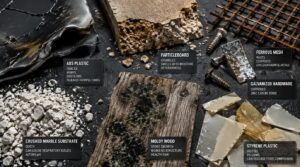
Now flip the script: know what will poison, warp, or rot your build. Material toxicity is the hidden killer in cheap enclosures. Skip toxic substrates like reptile carpeting with concrete dust or lime, which spike ammonia, and calcium-rich bedding such as uncoated limestone or crushed marble that shifts pH and irritates skin. When in doubt, a solid corn snake substrate guide breaks down which bedding options hold humidity without leaching anything harmful.
Avoid ABS and low-grade PVC blends; at heat setpoints they off-gas, creating serious plasticizer risks. Styrene-butadiene plastics degrade in humidity, releasing particulates your snake breathes.
Never use unsealed particleboard or raw timber. Particleboard leaches formaldehyde, and porous wood breeds mold. Untreated ferrous metal rusts, and galvanized hardware reacts with acidic substrates, causing chemical leaching of zinc compounds. Uncured polyurethane, oil stains, and solvent sealants emit VOCs for days. Verify substrate safety before your snake ever touches it.
How Enclosure Materials Affect Heat, Humidity, and Ventilation
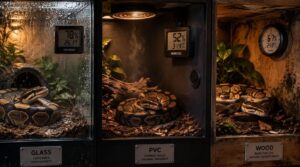
Your enclosure’s material doesn’t just hold your snake; it dictates the climate inside. Glass, PVC, and sealed wood each behave differently under heat lamps, humidity spikes, and airflow demands. Get this wrong, and you’ll fight a losing battle against thermal gradients and mold, so read each factor below before you commit.
Thermal Insulation and Heat Retention
Picture your heat pad fighting a losing battle against a freezing room, warmth bleeding through thin walls all night. That’s what poor thermal insulation does. Ranked by heat retention:
- PVC panels (k ≈ 0.18–0.25 W/m·K)
- Sealed wood with foam backing
- HDPE (k ≈ 0.40 W/m·K)
- Double-glazed glass
- Single-pane glass
Low thermal conductivity plus adequate thermal mass delivers the temperature stability your snake needs.
If you’re setting up your first enclosure, our guide to snake hide boxes for first-time owners covers how the right hide balances these two properties.
Moisture Resistance and Humidity Stability
Thermal stability means little if your humidity crashes or spikes unchecked. PVC and HDPE’s nonporous surfaces deliver strong moisture resistance, keeping humidity control predictable. Glass is equally impervious.
Sealed wood demands real vigilance: without full epoxy coverage, capillary wicking undermines humidity retention fast. Inspect your seals every two to four weeks, because micro-cracks invite moisture intrusion your snake can’t afford.
Vent Placement and Airflow Design
When ventilation requirements aren’t met, stagnant air breeds bacteria and respiratory illness. Place intake vents low, exhaust high on the opposite wall to drive convective flow.
Three airflow design rules:
- Size total vent area to 8-12% of floor area
- Use 0.5-1.0 mm corrosion-resistant mesh
- Baffle vents to block direct drafts
Microclimate management means staggering vent rows to prevent dead zones.
Safe Sealants, Finishes, Edges, and Hardware for DIY Enclosures
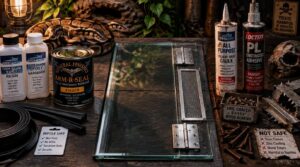
Building your own enclosure means every finish, sealant, and piece of hardware carries real responsibility for your animal’s health. Getting these details wrong can mean slow chemical poisoning from off-gassing, infected wounds from sharp edges, or corroded hardware flaking into the habitat.
In a DIY snake enclosure, every sealant and screw matters—small mistakes can quietly poison or injure your animal
Here’s what you need to know across three critical categories.
Curing and Off-gassing Timelines
A new enclosure isn’t safe the very moment assembly ends. PVC off-gassing peaks within 24–72 hours, but sealants need 3–14 days to fully cure, depending on formulation.
At 20°C, silicone can outgas for a full week. Warmer rooms, around 30–35°C, accelerate VOC reduction noticeably.
Trust your nose, but also wait: minimal odor by day 14 is your actual green light.
Waterproofing Wood-based Enclosures
Untreated plywood in a humid enclosure can degrade structurally in under 18 months. Seal every interior surface with an epoxy-based or two-part polyurethane coating, and let it cure fully for 48 hours before introducing your snake.
Once offgassing clears, these nontoxic finishes provide real, lasting moisture resistance, unlike bare wood, which quickly wicks humidity and warps faster than PVC panels.
Edge, Joint, and Hardware Safety
A rust spot on a hinge can develop sharp edges within days, directly endangering your snake.
Stainless steel hardware, escapeproof seams, and solid joint integrity aren’t optional. Use tongue-and-groove joints with internal sealant and keep edge sealing consistent.
- Maintain edge radii of at least 2 mm
- Inspect joints monthly for gaps over 0.5 mm
- Replace rusted fasteners within 12-24 hours
How to Choose a Snake Enclosure Material for Your Species, Budget, and Cleaning Routine
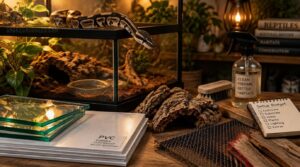
Choosing the right enclosure material comes down to three non-negotiable factors: your snake’s biological requirements, your budget, and how much time you’ll spend cleaning. Get any one of those wrong and you’ll either compromise your animal’s health or burn out maintaining a setup that doesn’t fit your life.
Here’s how to evaluate each consideration before you commit.
Match Species Needs
Your species’ origin dictates every single material choice you make. A ball python from sub-Saharan forests needs moderate insulation and humidity retention, while a sand boa demands low-moisture, solid-walled construction to prevent respiratory infections.
Arboreal species require smooth, snag-free interior surfaces to avoid climbing injuries. Get this wrong and you’re creating a chronic stress environment your snake may not survive.
Prioritize Material Safety
Material toxicity is the silent threat lurking inside every enclosure. Offgassing from improper plastics or uncured sealants can slowly harm your snake long before you’d notice any symptoms. Always prioritize:
- Food-grade plastics or medical-grade PVC with verified inert additives
- A nonporous surface that resists bacteria and moisture absorption
- Reptile-safe sealants cured fully, at least 7 days, before any animal contact
Balance Cost And Durability
Once you’ve confirmed material toxicity isn’t a risk, cost becomes your next calculation.
Lifecycle cost analysis matters more than sticker price. PVC is cheaper upfront but degrades under UV faster, compromising structural integrity sooner. HDPE costs more initially yet outlasts PVC by a wide margin. Sealed wood cuts upfront spending by 30-60%, but re-sealing every one to three years adds ongoing labor costs.
Manage Heat And Humidity
Cost choices directly shape your enclosure’s thermal performance. Glass offers high thermal mass, stabilizing ambient temperatures through heating cycles. PVC’s low thermal conductivity aids heat retention but traps humidity without proper venting. HDPE balances moisture resistance with moderate heat tolerance.
Whatever material you choose, plan ventilation deliberately: increasing airflow by 20-50% after shedding prevents condensate buildup without destabilizing reptile thermoregulation.
Simplify Cleaning Routines
Your material choice determines how fast enclosure maintenance actually happens. Non-porous surfaces like PVC and HDPE support easy cleaning by resisting biofilm adhesion, so reptile-safe cleaning agents work efficiently without repeated scrubbing.
Build your cleaning protocols around a daily wipe, weekly disinfection cycle, and monthly deep clean. Front-opening enclosures with removable trays cut that entire routine to under fifteen minutes.
Inspect Hardware And Edges
Hardware corrodes even in clean enclosures. Inspect monthly:
- Test hinges for looseness; apply thread-locking compound after heat checks.
- Verify edge banding holds; bare edges cause rostral abrasion.
- Keep gaps under 1.5 mm.
- Check fasteners for corrosion.
- Confirm structural strength; look for panel warping.
Reptile safety standards demand this. Material durability means nothing if edges injure.
Frequently Asked Questions (FAQs)
What is the best material for a snake enclosure?
PVC wins for most keepers. It’s lightweight, holds heat and humidity well, and meets reptile safety standards. Glass suits display setups; sealed hardwood works if you waterproof every seam.
What plants are safe to put in a snake enclosure?
Ironically, the safest vivarium plants are ones your snake can’t kill and that can’t kill it. Pothos, spider plant, and sansevieria: reptilefriendly materials for habitat enrichment design; add pietypet hanging vines and sukh sphagnum moss.
Is 100% silicone safe for reptiles?
Respiratory irritation affects reptiles exposed to uncured sealant VOCs. Yes, 100% silicone is reptile safe once fully cured, usually seven days. Use aquarium-safe, solvent-free formulations, ventilate during curing, then perform a sniff test before housing animals.
What not to use for snake bedding?
A ball python keeper switched to walnut shell substrate and lost their animal to gut impaction within weeks. Never use cedar, pine, sand, or corncob; material toxicity and impaction risk make these substrates genuinely lethal.
Are PVC enclosures safe for reptiles?
What makes a material truly reptile-safe? Quality PVC panels are lead-free and non-porous, preventing off-gassing at normal enclosure temperatures.
Source them from reputable manufacturers, apply reptile-safe sealants, and confirm proper ventilation for full toxicity prevention.
What not to put in a snake enclosure?
Cedar and pine shavings release toxic terpenes and phenols that destroy your snake’s respiratory lining. Never use heat rocks, cat litter, crushed walnut shell, or tape inside an enclosure, as material toxicity causes irreversible harm.
Is acrylic safe for reptiles?
Acrylic is like a sealed vault once fully cured: chemically inert, non-porous, and free of real off-gassing concerns. It controls heat retention and moisture resistance well, making it a genuinely reptile-safe enclosure material in practice.
How to build a safe snake enclosure?
Every single construction mistake you make can and will cost your snake its life. Plan around species behavior first, then cut your snake enclosure materials, seal every joint, and verify ventilation before any animal enters.
What is the best material for a reptile enclosure?
Picture a sealed PVC cabinet holding steady 70% humidity through a dry winter, walls wiped clean in seconds. That’s why cured PVC panels win: excellent moisture resistance, inert surfaces, strong structural integrity, and easy disinfection.
How do I choose a venomous snake enclosure?
Choose a venomous snake enclosure with escapeproof construction, zero-gap seams, and dual locking latches. Prioritize break-resistant PVC or HDPE, verify structural integrity, and confirm material toxicity is nil. Never compromise enclosure security.
Conclusion
A vet once told me about a ball python that died from unsealed plywood off-gassing formaldehyde. That’s the real cost of cutting corners.
Every material in this guide either protects respiratory tissue or slowly damages it, and there’s no neutral option. Audit your setup against the standards here: verify sealant cure times, check substrate safety, confirm ventilation.
Choose safe snake enclosure materials deliberately, because your snake can’t choose them for itself.