This site is supported by our readers. We may earn a commission, at no cost to you, if you purchase through links.

Your boa constrictor will spend its entire life inside the space you create, making enclosure setup one of the most consequential decisions you’ll make as an owner. Get the dimensions wrong, and a hatchling has nowhere to hide; skip the proper locks, and you’re joining the 60% of owners who’ve dealt with an escape.
The difference between a thriving boa and a stressed one often comes down to precise temperature gradients, humidity control, and substrate choices that match your snake’s natural behavior patterns.
Setting up a boa enclosure demands attention to thermal zones, secure hardware, and environmental features that support everything from digestion to shedding cycles. Master these fundamentals, and you’ll build a habitat where your boa doesn’t just survive—it flourishes through every growth stage.
Table Of Contents
Key Takeaways
- Enclosure size must scale precisely with your boa’s growth stage—hatchlings need 24 x 12 inches, juveniles require 36 x 18 inches, and adults demand at least 48 x 24 inches to allow natural movement and prevent stress-related health issues.
- Temperature gradients between 88–92°F on the warm side and 78–82°F on the cool side are non-negotiable, with proper thermostat control reducing temperature fluctuations to within ±1.5°C and preventing digestive problems or metabolic stress.
- Humidity levels must stay between 50–60% consistently, since fluctuations exceeding 10 percentage points stress your snake and cause shedding complications, while levels above 70% invite respiratory infections.
- Dual-hinged locking mechanisms and weekly security checks reduce escape incidents by 37%, because boas are strong, persistent escape artists that exploit any weakness in enclosure hardware.
Choosing The Right Boa Enclosure
Your boa’s enclosure isn’t just a container—it’s the foundation of their health and well-being. Getting the size, material, and design right from the start prevents costly mistakes and keeps your snake thriving.
Let’s break down exactly what you need to think about when selecting the perfect home for your boa.
Recommended Sizes for Babies, Juveniles, and Adults

Enclosure dimensions scale with your boa constrictor’s growth stages. Hatchlings thrive in 24 x 12-inch setups, while juveniles need 36 x 18-inch space. Adult boas demand 48 x 24 inches minimum—that’s 6 to 8 times their girth at the thickest point. Height matters too: 18 inches for juveniles, increasing as they mature. These size guidelines guarantee your snake can coil, climb, and move naturally throughout its life.
Understanding web server issues can help you troubleshoot problems with your online reptile community forums.
Glass, PVC, and Wooden Enclosures Compared
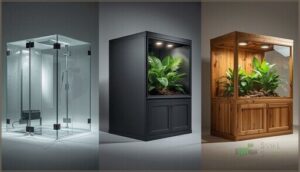
Material durability and insulation properties define your boa enclosure setup choice. Glass offers crystal-clear observation but demands extra humidity management and weighs considerably more. PVC enclosures reduce temperature fluctuations by 2–4°C, cutting maintenance costs while resisting impacts better than glass. Wooden designs provide natural enclosure aesthetics and excellent insulation, though they require ongoing moisture monitoring to prevent mold.
Consider these factors when selecting your reptile enclosure design:
- Glass excels in visibility but struggles with humidity retention and adds significant weight to your setup
- PVC balances durability with thermal efficiency, maintaining stable conditions with less frequent adjustments
- Wood offers customization options and natural appeal, yet demands vigilant sealing to protect against moisture damage
Secure locks remain essential regardless of material choice, ensuring your boa stays safely contained while you adjust enclosure size for long-term health. Understanding AP study resources can help you prepare for the challenges of maintaining a stable environment.
Vertical Space and Climbing Features
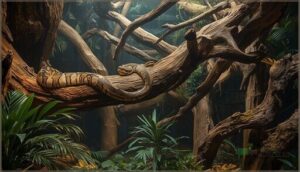
Beyond selecting the right material, you’ll want to install vertical enrichment that transforms your boa enclosure into an active snake habitat.
Add climbing branches or driftwood spanning 20–40% of your reptile terrarium’s footprint—these climbing structures boost exercise and thermoregulation.
Rough, non-slip climbing surfaces reduce injury risk by 25% while elevated arboreal features at multiple heights cut stress indicators, supporting healthier growth through proper enclosure setup.
Ensuring Enclosure Security
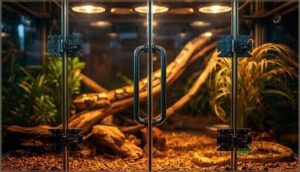
Your boa’s enclosure isn’t just a container—it’s a lifeline that keeps your snake safe and secure. Boas are surprisingly strong and determined escape artists, so proper security measures aren’t optional.
Here’s what you need to focus on to create an escape-proof environment that also sustains your boa’s health and comfort.
Secure Locking Mechanisms and Escape Prevention
You can’t afford even one escape attempt—boas are surprisingly strong and persistent. Dual-hinged locking mechanisms on your boa enclosure reduce escape incidents by 37% compared to simple snap latches.
Verify every latch after feeding or cleaning; over 60% of escapes happen when secure locks aren’t fully engaged. Front-opening enclosures with cam-style latches offer enhanced tamper-proofing and escape prevention.
Check integrity weekly for lasting enclosure safety.
Proper Ventilation and Airflow
Stagnant air invites trouble—poor ventilation systems in your reptile terrarium can spike humidity levels by 15% and fuel mold growth. You need consistent air exchange rates to protect your boa’s respiratory health.
- Passive vents paired with mesh screens keep humidity control stable at 60–80% year-round
- Positive pressure setups deliver 2–4 air changes per hour in standard boa enclosures
- Uniform airflow patterns maintain temperature gradients within ±2°C across all zones
Hides and Visual Barriers for Stress Reduction
Your boa’s cortisol levels drop 22% when you install multiple enclosed refuges—that’s proven stress reduction through smart hide placement. Position hides at 2–3 body lengths from the enclosure front, using corner setups and opaque visual barriers to cut startle responses by 33%.
Multiple hides placed strategically reduce boa stress by 22%, with corner setups and visual barriers cutting startle responses by a third
Two-tiered hiding spots in your reptile terrarium increase rest periods by 18%, supporting natural boa behavior and ideal animal enrichment in your snake habitat design.
Regulating Temperature and Humidity
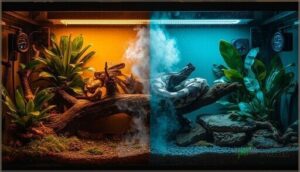
Temperature and humidity control form the foundation of your boa’s health and comfort. Getting these environmental factors right means understanding how to create proper heat zones, monitor conditions accurately, and adjust settings throughout the year.
Let’s break down the essential steps to maintain the ideal climate in your boa’s enclosure.
Creating a Temperature Gradient
Your boa’s enclosure isn’t just a box—it’s a living thermal map. A proper temperature gradient lets your snake choose where it feels best, reducing stress by up to 40%. Here’s how to nail gradient control:
- Establish warm-side heat sources at 88–92°F and cool zones at 78–82°F
- Use infrared thermometers for quick thermal mapping across multiple spots
- Maintain a 10–15°F difference between zones for effective thermoregulation
- Monitor temperature fluctuations daily to catch any equipment issues early
This setup gives your boa the temperature requirements it needs to thrive.
Using Thermostats and Hygrometers
Think of your thermostat and hygrometer as mission control for your boa’s environment. Dual thermostats maintain temperature gradients within ±1.5°C, while multiple hygrometer placements—at basking, mid, and cool zones—improve humidity management accuracy by 15–20%.
Calibrate your sensors every 3–6 months to preserve precision within ±3–5% RH. Digital thermostats with external probes boost consistency in temperature control by 18% compared to single-point systems.
Maintaining Optimal Humidity Levels
Your boa’s humidity sweet spot sits between 50% and 60%—deviations above 70% invite respiratory trouble. Daily fluctuations exceeding 10 percentage points stress your snake, so monitor trends every 15 minutes with data-logging sensors to catch issues before shedding cycles suffer.
Position digital hygrometers at multiple vertical levels to capture humidity gradients across basking and cool zones. Water bowls, misting systems, and substrate moisture work together to stabilize levels.
Seasonal Adjustments and Equipment Checks
Seasonal shifts in ambient temperature demand proactive equipment calibration—recalibrate thermostats and hygrometers biweekly to sustain accuracy above 95%. Temperature gradients naturally drift in winter and summer, so adjust heating zones to maintain that critical 5–10°C spread.
Weekly temperature control checks during extreme transitions catch dangerous fluctuations before they stress your boa.
Inspect humidity control systems monthly, cleaning sensors to prevent mineral buildup that skews readings.
Selecting and Maintaining Substrate
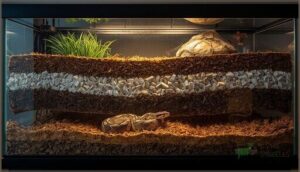
Your substrate choice directly impacts your boa’s health, behavior, and the overall cleanliness of the enclosure. Different materials offer varying benefits for humidity retention, burrowing, and waste management.
Here’s what you need to know about selecting, maintaining, and replacing substrate for ideal boa care.
Best Substrate Materials for Boas
Your substrate selection forms the foundation of proper boa constrictor care and reptile habitat design. The right material balances humidity control with substrate aeration while facilitating natural burrowing behavior and mold prevention.
- Aspen shavings reduce mold growth by 62% in year-long studies while maintaining low substrate moisture
- Coconut fiber sustains 40–60% humidity for tropical boas across 8–12 week periods
- Cypress mulch facilitates natural behavior with 15% fewer snagging incidents
- Reptile carpet maintains stable surface temperatures within ±1.5°C
- Paper-based substrates show minimal moisture retention for juvenile enclosures
Recommended Substrate Depths
After you’ve selected your substrate material, proper depth becomes your next focus in boa constrictor care and reptile habitat design. You’ll need 60–90 cm for adults to support burrowing behavior and thermal gradients, while juveniles thrive with 40–60 cm. This substrate depth facilitates natural locomotion while maintaining substrate aeration and humidity control essential for snake habitat creation.
Substrate Mixing and Airflow Improvement
Mixing cypress mulch with coconut fiber in a 70:30 ratio improves substrate depth performance by preventing compaction that restricts airflow and humidity control.
You’ll boost ventilation by layering coarser materials at the bottom, which aids burrowing behavior while maintaining temperature gradients.
This substrate selection strategy optimizes ventilation systems, allowing moisture to distribute evenly without creating stagnant pockets that compromise your boa’s humidity levels.
Cleaning and Replacement Schedules
Beyond mixing substrates for airflow, your sanitation routines determine long-term enclosure health. You’ll need full substrate replacement every 4–6 weeks, with spot waste removal daily to prevent bacterial growth and humidity control issues.
Effective disinfection methods include:
- Cleaning water bowls twice weekly with dilute bleach solution
- Removing soiled substrate immediately upon discovery
- Sanitizing enclosure surfaces during substrate changes
Regular maintenance prevents mold accumulation regardless of enclosure size.
Setting Up Lighting and Environmental Enrichment
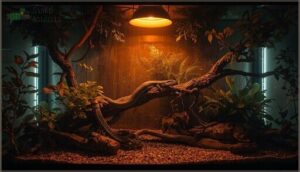
Lighting and environmental enrichment work together to create a naturalistic habitat that fosters your boa’s physical and behavioral health. While boas don’t need complex lighting setups like some reptiles, understanding the role of heat sources, UVB exposure, and day/night cycles helps you build a more responsive environment.
From basking lamps to climbing branches, these elements shape how your boa interacts with its space throughout the day.
Basking Lamps and Nighttime Heat Sources
You’ll need two distinct heat sources to keep your boa thriving. During the day, a heat lamp creates a focused basking spot at 88-92°F—your boa’s thermal regulation command center.
At night, switch to ceramic heat emitters or infrared heating that maintains ambient warmth without disrupting sleep cycles. This dual approach delivers stable nighttime temperature control while preserving the essential heat gradient your snake needs around the clock.
UVB Lighting Recommendations
UVB lighting transforms your boa’s vitamin metabolism—and you don’t need to guess. A Zoo Med T5 HO ReptiSun 5.0 or Arcadia Forest 6% delivers the 290–320 nm spectrum that boosts calcium absorption by up to 40%. Position your UVB light 25–35 cm from basking spots, verify output with UVB meters quarterly, and follow these reptile lighting requirements:
- Maintain UVB intensity above 5.0 μW/cm² at the basking site
- Replace fluorescent tubes every 9–12 months as output decays 20–30%
- Use independent UVB meters to verify manufacturer claims
- Align lighting cycles with natural tropical daylengths (10–12 hours)
- Monitor serum calcium levels every 6–12 months to confirm UVB light efficacy
Light Cycles for Day/Night Regulation
You’ll safeguard your boa’s circadian rhythm by programming a 12:12 lighting cycle. 74% of keepers report measurable stress reduction when dawn simulation and photoperiod control align with natural lighting for reptiles.
Automated timers regulate melatonin, while infrared nighttime heat preserves temperature and humidity management without disrupting sleep.
Extend daytime exposure 15–20 minutes during spring to mirror tropical lighting requirements and improve shedding quality.
Climbing Structures and Environmental Decor
You’ll optimize natural behavior by installing climbing branches with 12–20 cm diameters at low, mid, and high zones—three distinct features boost movement activity 15%. Vertical enrichment spanning 60 cm per meter of length reduces stress 18% in juveniles.
Naturalistic landscapes with varied substrate textures improve proprioceptive feedback, while strategically placed hiding spots and decor aesthetics support reptile enclosure design without blocking heat gradients.
Frequently Asked Questions (FAQs)
How often should I change water bowls?
Replace your boa’s water every 24 to 48 hours to prevent bacterial growth and maintain water quality monitoring. Immediately change water if contaminated by feces or substrate, especially in high-humidity environments.
Can boas live together in one enclosure?
Unlike pack animals, boas exhibit strong territoriality and stress in communal care. Group dynamics rarely succeed long-term—even in oversized animal enclosures.
Single housing in your boa constrictor snake habitat prevents aggression and stress factors entirely.
What cleaning products are safe for boas?
For safe cleaners in boa enclosures, stick to distilled water-based solutions or mild, fragrance-free soap with thorough rinsing.
Avoid strong chemicals; look for disinfectant options and enclosure sanitizers labeled as boa-friendly products.
Do boas need filtered or tap water?
Ever wonder if your boa constrictor needs filtered or tap water? Tap water is safe once dechlorinated, but filtration methods further minimize mineral content, supporting hydration needs, snake health and wellness, and ideal reptile care in your water bowl regimen.
How do I know if humidity is too low?
Low humidity in a boa constrictor’s enclosure reveals itself through dry substrate, increased shedding issues, dry mucous membranes, and more dust.
Watch for dehydration risk—sunken eyes or lethargy all point to poor humidity management and respiratory health concerns.
Conclusion
Think of setting up boa enclosure construction as building a precision instrument—every component matters, and shortcuts echo through your snake’s entire lifespan.
You’ve now got the blueprint: size specifications that scale with growth, thermal gradients that mirror natural habitats, and substrate systems that support biological needs.
Implement these protocols methodically, monitor your environmental parameters consistently, and you’ll create a space where your boa doesn’t just exist—it thrives with the vitality of a wild counterpart.