This site is supported by our readers. We may earn a commission, at no cost to you, if you purchase through links.
Most snake owners never think about UV light—and that’s exactly the problem.
Reptile husbandry has shifted substantially over the past decade, with research now showing that many snake species synthesize vitamin D₃ through UVB exposure, not just dietary supplementation alone.
Skip the right lighting, and the deficiency builds quietly, mimicking other health issues until the damage runs deep. A snake refusing meals, shedding in ragged patches, or trembling during handling isn’t being difficult—it’s showing you a nutritional gap in its environment. Knowing the signs of not getting enough UV light puts you ahead of a problem that most keepers catch far too late.
Table Of Contents
- Key Takeaways
- Lethargy and Lower Activity
- Appetite and Feeding Changes
- Shedding and Skin Problems
- Weak Bones and Muscle Control
- Long-Term Health Decline
- UVB Setup Issues to Check
- Frequently Asked Questions (FAQs)
- Do snakes need UVB lighting?
- How do snakes use UVB?
- What UV level should a snake have?
- Does swell reptiles provide UVB?
- How do I know if my snake plant needs more light?
- How does UV light affect snakes?
- What color light is best for snakes?
- Can diet alone replace UVB for snakes?
- How often should UVB bulbs be replaced?
- Do nocturnal snakes still need UVB light?
- Conclusion
Key Takeaways
- UVB deficiency in snakes rarely shows up dramatically—it creeps in through subtle shifts like reduced exploring, weaker feeding responses, and irregular shedding long before anything obvious appears.
- Behavioral changes such as hiding more, lingering at the basking spot, and refusing meals are early warning signs that your snake’s vitamin D3 synthesis is falling short.
- Physical symptoms—tremors, jaw weakness, patchy sheds, and spinal deformities—signal calcium metabolism breakdown, which can progress to irreversible metabolic bone disease if the lighting issue isn’t corrected.
- Many setup mistakes trace back to setup mistakes: bulbs older than 6–12 months, glass blocking UV transmission, fixtures placed too far away, or no consistent 12-hour light cycle.
Lethargy and Lower Activity
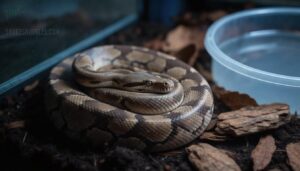
Lethargy is usually the first thing keepers notice when UVB is lacking, and it’s easy to mistake it for a snake just having a quiet day. change is gradual, which is exactly what makes it easy to miss.
Subtle shifts in activity often show up alongside other quiet warning signs, like changes you’d catch in a snake stool health guide before anything more obvious appears.
what to watch for.
Sleeping or Hiding More Than Usual
When your snake starts showing dark corner preference — gravitating to the shadiest part of the enclosure instead of its usual spots — that’s a behavioral withdrawal sign worth tracking. Extended hide duration, where it stays tucked for hours without switching areas, often reflects reduced light exposure and early vitamin D3 deficiency.
altered thermoregulation patterns, like this can quietly accelerate toward metabolic bone disease.
Less Exploring, Climbing, or Roaming
Beyond hiding more, you’ll notice reduced vertical use — fewer trips up branches, ledges, or cork bark. Limited enclosure traversal and decreased exploratory speed are reliable behavioral indicators of adequate UVB exposure gone wrong.
Lower risk-taking follows: your snake avoids open zones it once investigated freely. Fewer daytime windows of movement, combined with these behavioral changes, make evaluating corn snake activity levels a practical health metric worth tracking closely.
Spending Extra Time Under Heat
Less movement often pairs with a different concern: your snake lingering too long at the basking spot. This isn’t warming up — it’s a sign of temperature gradient issues or underexposure to UVB intensity driving behavioral changes.
Watch for:
- Heat burn signs: reddened, roughened skin patches
- Dehydration risk: increased drinking, incomplete sheds
- Heat stress effects from thermostat failure pushing temperatures above safe ranges
Gradual Drop in Normal Alertness
Alertness doesn’t vanish overnight — it fades quietly. Circadian rhythm disruption from inadequate UVB exposure duration shows up as slower environmental scanning, longer reaction latency, and fewer posture shifts during your snake’s normally active window.
| Behavioral Indicator | What to Watch |
|---|---|
| Sensory responsiveness | Delayed reaction to tongs or airflow |
| Monitoring response | Ignores enclosure edges and ventilation zones |
These behavioral changes confirm underexposure before visible symptoms appear.
Appetite and Feeding Changes
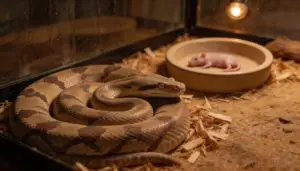
drop in appetite is one of the quieter signs that something’s off with your snake’s lighting setup. It doesn’t happen overnight — the changes tend to creep in slowly, which makes them easy to miss.
what to watch for regarding feeding.
Weaker Feeding Response at Mealtime
weaker feeding response at mealtime is often the first behavioral changes you’ll notice.
Sensory cue reduction means your snake tracks prey less sharply — tongue flicking slows, strike timing delay increases, and prey approach hesitation replaces confident lunges.
Thermal cue dependence rises as feeding confidence drops.
Without adequate vitamin D3 synthesis supporting calcium deficiency correction, monitoring response patterns helps you catch this early.
Refusing Meals More Often
Meal refusal that repeats across several feeding sessions is one of the clearest behavioral stress indicators you’ll notice. Metabolic energy reallocation shifts your snake’s priorities toward basking preference shift — staying warm rather than hunting.
Prey ignoring replaces stalking. Circadian rhythm disruption compounds this, blunting appetite signals entirely.
Outdated UVB output can quietly worsen both issues, so following a solid snake UVB lighting setup guide helps ensure your bulb is actually doing its job.
Without correcting calcium deficiency through proper UVB intensity, this pattern rarely self-corrects.
Trouble Striking or Holding Prey
When calcium metabolism falters from inadequate UVB, feeding behavior breaks down in specific, measurable ways. Strike Latency increases — your snake hesitates longer before committing. Grip Stability and Prey Retention suffer as Muscle Endurance drops, disrupting Capture Coordination throughout the sequence.
Watch for these Behavioral Indicators of Adequate UVB Exposure going wrong:
- Repeated missed or glancing strikes
- Prey slipping free after initial contact
- Multiple failed hold attempts with pauses between
Vitamin D3 in Calcium Absorption directly affects neuromuscular control — without it, bone metabolism weakens jaw strength, and metabolic bone disease follows.
Slow, Gradual Weight Loss
Weight loss rarely announces itself — it creeps in slowly. Your snake may keep eating, but Body Condition Scoring reveals the truth: gradual Muscle Thinning Indicators along the mid-body, a more defined spine, and a thinner tail base.
Metabolic Rate Decline and Digestive Efficiency Issues, from poor calcium metabolism and UVB lighting deficiency, drive this steady drain, quietly worsening reptile health week after week.
Shedding and Skin Problems
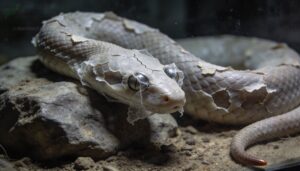
Poor UVB doesn’t just affect your snake’s energy or appetite — it shows up on the outside too. Shedding problems and skin changes are often the first visible clues that something’s off with your lighting setup.
Here’s what to watch for.
Incomplete or Patchy Sheds
A healthy shed comes off in one clean, inside-out piece.
When it breaks into fragments or clings in random patches, that’s your first clue that something’s off.
Low Humidity Levels, a poor Enclosure Layout, missing Rough Substrate, and inadequate UVB lighting all disrupt the process.
Stress Triggers and limited Hydration Access make it worse.
Effects of Inadequate UVB on Shedding and Growth are real — don’t ignore them.
Ensuring low ambient humidity helps avoid retained shed.
Retained Skin After Shedding
Retained skin is more than a cosmetic issue — it signals deeper trouble. When UVB lighting fails to support healthy skin turnover, incomplete sheds leave tight bands that cause Joint Ring Constriction and Toe Nail Trapping, cutting off circulation and restricting movement. Swelling Constriction follows quickly, and Rough Skin Texture creates entry points for bacteria, raising Secondary Infection Risk considerably.
Retained skin is not cosmetic — it cuts off circulation, invites infection, and signals a breakdown in your snake’s basic skin health
Watch for these warning signs:
- Thickened, darker rings around joints or tail segments
- Dull, opaque claw tips that won’t release cleanly
- Raised, rough patches where old skin clings stubbornly
Poor Effects of Inadequate UVB on Shedding and Growth compound over time, eventually contributing to metabolic bone disease if left uncorrected. Review your Guidelines for UVB Light Intensity and Distance to make sure your UVB spectrum reaches the basking zone properly.
Duller Color and Less Healthy Appearance
Scale Sheen Loss is often the quietest signal. Your snake’s scales may develop Matte Skin Texture — less glossy, slightly washed out — even when hydration looks fine.
Faded Coloration and Uneven Pigmentation build across shedding cycles, not overnight.
| What You See | What It Suggests |
|---|---|
| Reduced Color Vibrancy | Insufficient UVB spectrum reaching the basking zone |
| Dull, flat scale surface | Scale Sheen Loss from inadequate UVB lighting |
Shedding Cycles That Become Irregular
Color changes don’t always tell the full story. When Humidity Fluctuations and Temperature Instability disrupt your snake’s environment, Metabolic Rate Shifts follow — and shedding cycles stop being predictable.
Watch for these irregular shedding patterns:
- Molting sooner or later than the normal schedule
- Multiple short shed attempts with long pauses between them
- Photoperiod Inconsistency causing cycles to drift across Seasonal Light Changes
- Incomplete lifts that stall, then restart days later
Weak Bones and Muscle Control
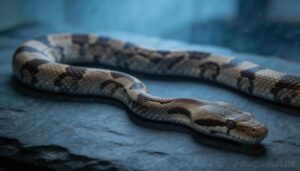
When UVB deficiency lingers long enough, the damage moves past behavior and starts showing up in your snake’s body itself. Calcium metabolism breaks down quietly, and the skeleton and muscles are usually the first to pay the price.
Here’s what to watch for.
Soft Jaw or Jaw Weakness
When UVB lighting falls short, calcium absorption breaks down — and the jaw is often where you’ll notice it first. Insufficient vitamin D3 from poor UVB exposure impairs bone mineralization, leading to jaw shape deformation and reduced bite force.
You’ll see prey handling difficulty: missed strikes, shallow bites, dropped prey. These are classic MBD warning signs.
The role of vitamin D3 in calcium absorption is direct — without UVB, the bones simply can’t hold.
Tremors, Twitching, or Shaky Movement
Beyond jaw weakness, calcium deficiency escalates into full neuromuscular excitability — your snake’s nerves and muscles stop firing reliably.
You may notice posture-dependent tremors during handling, or brief twitches that start and stop unpredictably. Behavioral stress triggers, like repositioning, can intensify shaking.
Distinguishing twitch vs tremor matters here: twitches are sudden and irregular; tremors are rhythmic. Both signal metabolic bone disease progressing.
Trouble Gripping Branches or Climbing
Climbing reveals skeletal health faster than almost any other behavior. Calcium imbalance disrupts neuromuscular signaling, so your snake can’t generate the sustained muscle tension gripping requires. Spine flexibility suffers too — poor mineralization makes controlled bending unreliable.
Dehydration effects compound this, reducing stamina mid-climb. Skin traction also diminishes when overall condition declines.
If your UVB lighting distance or intensity falls outside recommended guidelines, metabolic bone disease quietly erodes these capabilities.
Bent Spine, Deformities, or Falls
When skeletal health breaks down, you’ll often see it in how your snake moves and holds itself. Spine deformity progression can show up as a visible curve or kink along the body — a red flag for MBD.
Balance loss, movement instability, and increased fall frequency follow naturally. Review your Guidelines for UVB Light Intensity and Distance before abnormal posture becomes permanent.
Early Signs of Metabolic Bone Disease
Early MBD rarely announces itself loudly. Instead, it builds quietly — Vitamin D Deficiency and dropping Serum Calcium Levels are eroding your snake’s foundation before you notice anything obvious.
Watch for these Muscle Atrophy Indicators and Immune Suppression Signs:
- Subtle shakiness or grip loss during movement
- Sluggish feeding response and gradual weight drop
- Patchy sheds signaling effects of Inadequate UVB on shedding and growth
- Increasing lethargy despite normal temperatures
Bone Density Loss and Impact of UVB on Metabolic Bone Disease Prevention make the following Guidelines for UVB Light Intensity and Distance essential.
Long-Term Health Decline
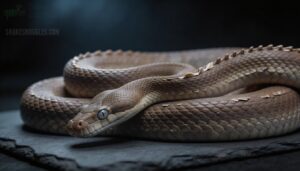
UV deficiency rarely announces itself with a dramatic moment — it creeps in quietly, and by the time you notice something’s wrong, the damage has been building for months. long-term effects reach far beyond weak bones, touching everything from immune strength to growth and reproduction.
watch for as these changes unfold over time.
Slower Recovery From Stress or Illness
A snake with Vitamin D Deficiency and Calcium Imbalance doesn’t bounce back the way a healthy one does. After stress or illness, recovery drags on for weeks instead of days.
Immune Suppression compounds this, leaving your snake vulnerable longer. Stress Hormone Elevation further delays healing, so Monitoring Corn Snake Health Under UVB Lighting isn’t optional — it’s how you catch these slow-building setbacks before they compound.
Reduced Overall Vitality
Reduced vitality is one of the quietest warning signs — easy to miss until it’s been building for weeks. When Vitamin D Synthesis falters, Metabolic Efficiency drops across the board, disrupting Hormonal Balance and Circadian Rhythm together.
Watch for these Behavioral Indicators of Adequate UVB Exposure going in reverse:
- Color looks duller than usual
- Tongue-flick rate drops noticeably
- Recovery after handling takes longer
- Immune Response weakens, increasing illness risk
Poor Growth in Younger Snakes
Juvenile snakes are still building bone, so poor Vitamin D3 synthesis hits them first. Growth Lag Indicators — like falling behind expected size despite regular meals — are among the clearest Juvenile Health Metrics to track.
UVB Spectrum Optimization and proper Thermal Gradient Management, calcium stays metabolically unavailable. Corn Snake Activity Levels as Health Metric matters here too, since slowing movement often accompanies stunted growth.
Egg-laying Problems in Breeding Females
Breeding females carry an extra burden when calcium deficiency and nutrient shortfall go unaddressed. Without adequate Role of Vitamin D3 in Calcium Absorption, egg binding becomes a real risk — the uterus can’t contract properly to pass eggs. Hormonal imbalance from poor UVB exposure compounds this.
Watch for:
- Visible straining with no eggs produced
- Lethargy following mating attempts
- Swollen abdomen that doesn’t resolve
Male absence rules out fertilization issues, but UVB gaps remain the overlooked culprit.
Worsening Symptoms Over Weeks or Months
Unlike egg-laying failure, which usually has visible triggers, Vitamin D Deficiency and Hormonal Imbalance build quietly. Immune Suppression, Behavioral Apathy, and Sensory Dullness don’t announce themselves — they accumulate.
Evaluating Corn Snake Activity Levels as a Health Metric helps you catch UVB output degradation early, before Behavioral Indicators of Adequate UVB Exposure disappear entirely.
| Timeframe | Symptom Progression | UVB Light Maintenance and Replacement Schedules Action |
|---|---|---|
| Weeks 1–4 | Mild Behavioral Apathy, subtle feeding slowdown | Check fixture distance, confirm Reptile UVB safety |
| Months 2–3 | Sensory Dullness, irregular shedding | Test UVB output degradation with a UV meter |
| Months 4–6 | Immune Suppression, visible muscle weakness | Replace bulb; consult a reptile vet immediately |
UVB Setup Issues to Check
Sometimes the problem isn’t your snake at all — it’s the setup. A few common mistakes can quietly undermine even a well-intentioned lighting arrangement. Here’s what to check first.
Bulb is Too Old to Be Effective
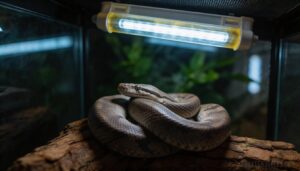
Your UVB bulb’s visible light is genuinely misleading — it can glow perfectly while delivering almost no usable UVB. This is UVB output decay in action.
Spectral shift happens gradually, so intensity measurement is the only reliable check.
Most bulbs have a UVB bulb lifespan of 6–12 months. Follow a strict bulb replacement schedule and replace UVB bulbs before symptoms appear.
UVB Blocked by Glass or Thick Mesh
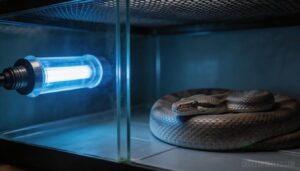
Even a brand-new bulb won’t help if something is blocking the UV radiation before it reaches your snake. Standard glass is one of the biggest offenders — material UV transmission through ordinary panes is nearly zero for UVB light.
Check your reptile enclosure design for these common barriers:
- Glass lids or dividers block UVB almost entirely, even when UVA and visible light pass through
- Glass thickness effects matter — thicker panes absorb more UV radiation
- Mesh density impact reduces delivered UVB dose when weaving is tight or layered
- Plastic covers can show over 90% UVB absorption in barrier UVB testing
Switch to alternative enclosure materials like open-top screen panels for unobstructed UVB lighting.
Fixture Placed Too Far From Basking Spot
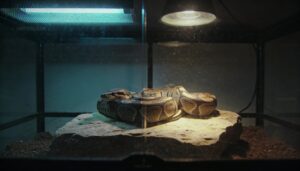
Distance matters more than most keepers expect. A fixture distance error of just a few inches can leave your basking spot cool enough to disrupt digestion and reduce activity.
Heat gradient insufficient setups often cause prolonged heat stays, where your snake lingers endlessly trying to warm up.
Keep your UVB light at the manufacturer-recommended distance — usually 9–18 inches — to maintain a proper temperature gradient loss and ideal lighting.
Wrong UVB Strength for The Species
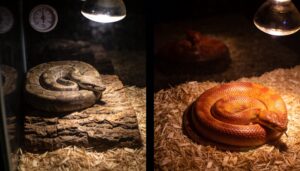
Not every UVB bulb suits every snake. Species UVB Zones matter here — corn snakes and ball pythons fall under forest shade requirements, needing low light intensity, while desert basking need high-output UVB.
Mismatched UVB rating selection means your snake either gets too little for vitamin D₃ synthesis or too much stress. Check your bulb’s UVB spectrum requirements against your species before assuming the setup is correct.
No Proper Day-night Lighting Schedule
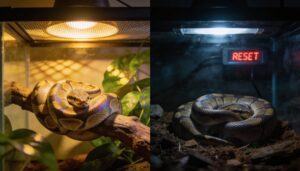
A snake’s biology runs on rhythm. Without a consistent 12-hour day and night cycle, circadian rhythm disruption quietly unravels normal basking, feeding, and rest behavior.
Check your lighting schedule for these common failures:
- Timer failure effects — a reset or broken timer causes irregular light cycles within days
- Nighttime light exposure — lights running after dark flip your snake’s natural activity window
- Inconsistent photoperiod — random on/off timing prevents stable vitamin D₃ synthesis opportunities
- No automation — manual switching drifts, making using timers for consistent UVB photoperiods essential
- Abrupt schedule changes — sudden shifts, not gradual transitions, compound the disruption
Creating a natural photoperiod for reptiles means locking your timer to a fixed 12-hour photoperiod, every day.
When to Contact a Reptile Vet
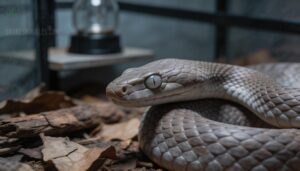
Don’t wait for a crisis.
If your corn snake shows persistent respiratory issues, abnormal eye discharge, swelling or abscesses, or unusual behavior patterns lasting more than a week, call a reptile vet.
Blood test abnormalities can confirm vitamin D₃ deficiency before symptoms worsen.
Consulting veterinarians for UVB lighting decisions is a reptile husbandry essential — because evaluating corn snake activity levels as a health metric, and protecting snake welfare, starts with professional guidance.
Frequently Asked Questions (FAQs)
Do snakes need UVB lighting?
Some snakes thrive without UVB; others can’t properly synthesize Vitamin D3 without it. Species requirements vary widely, making UVB lighting a non-negotiable reptile husbandry essential for many commonly kept species.
How do snakes use UVB?
UVB hits the skin and triggers Vitamin D3 synthesis, which drives Calcium metabolism and promotes Neuromuscular health. Without it, Basking behavior and Immune function both suffer noticeably over time.
What UV level should a snake have?
Not every snake needs the same UV level. Target UVI range varies by species — most pet snakes do well between 0 and 0, with partial baskers staying closer to the lower end.
Does swell reptiles provide UVB?
Yes, Swell Reptiles carries a solid range of UVB lighting, including Desert 10% UVB lamps and T5 kits with reflectors, covering UVA UVB balance and varying UVB percentages for different enclosure setups.
How do I know if my snake plant needs more light?
Your snake plant signals light stress through leaf color changes, growth rate slowdown, and stem orientation shift toward windows.
Measure light intensity and adjust photoperiod timing to around 12–14 hours for steady recovery.
How does UV light affect snakes?
UV light drives Vitamin D3 synthesis in your snake’s skin, supporting calcium absorption, immune function boost, and coloration enhancement.
It also regulates circadian rhythm regulation and maintains reproductive hormone balance for overall health.
What color light is best for snakes?
White daylight or full-spectrum lighting works best during the day. UVB bulbs, especially T5 fluorescent lights or high-output UVB fixtures, handle UVA and UVB needs.
blue moonlight LEDs at night — use red night heat instead.
Can diet alone replace UVB for snakes?
Diet alone can’t fully replace UVB. Prey nutrient variability means vitamin D3 synthesis from food is inconsistent, and without UVB, calcium utilization suffers — quietly, over time.
How often should UVB bulbs be replaced?
Replace UVB bulbs every 6–12 months — fluorescent types around 6–8 months, mercury vapor intervals stretch to 10 months. Visible brightness doesn’t reflect actual UVB output anymore.
Do nocturnal snakes still need UVB light?
Even nocturnal snakes benefit from low-level UVB lighting.
While they don’t bask like diurnal species, UVB exposure guidelines still support Vitamin D3 synthesis and dietary calcium balance, protecting long-term snake welfare when diet alone falls short.
Conclusion
Noticing the signs, taking action, and adjusting your snake’s UVB exposure can be life-changing. Proper lighting prevents deficiencies, promotes healthy habits, and boosts your pet’s quality of life.
As you prioritize your snake’s UVB needs, remember that subtle changes add up over time. Stay vigilant, and your attention to detail will pay off.
Recognizing the signs, your snake isn’t getting enough UV light, enables you to make informed decisions and guarantee a thriving, happy pet.
- https://www.reptiles.swelluk.com/help-guides/uvb-lighting-part-1-snakes-nocturnal-species/
- https://www.toughglaze.com/what-types-of-glass-can-help-safeguard-against-uv
- https://pmc.ncbi.nlm.nih.gov/articles/PMC4660892/
- https://tytarp.com/blog/sun-shade-tarp/
- https://iere.org/does-uvb-light-pass-through-glass/