This site is supported by our readers. We may earn a commission, at no cost to you, if you purchase through links.

Most tropical snake species won’t thrive—or even survive—in a standard pet store terrarium, because the glass boxes designed for temperate reptiles simply can’t maintain the precise humidity gradients and temperature differentials that rainforest-dwelling species require.
When you’re setting up an enclosure for emerald tree boas, green tree pythons, or any other tropical species, you’re not just buying a container; you’re engineering a microclimate that replicates the atmospheric conditions of their native habitat, complete with moisture-retaining substrates, regulated ventilation patterns, and often live plants that function as biological humidity regulators.
The difference between a thriving snake and one plagued by respiratory infections or dehydration often comes down to choosing the right terrarium system with features specifically designed for high-humidity environments—and understanding exactly how to configure those systems for your particular species.
Table Of Contents
- Key Takeaways
- Choosing The Right Terrarium Size
- Essential Features for Tropical Snake Terrariums
- Selecting The Best Substrate Mixes
- Live Plants and Environmental Enrichment
- Water Features and Humidity Management
- Top 8 Terrariums and Accessories for Tropical Snakes
- Maintenance Tips for Tropical Snake Terrariums
- Frequently Asked Questions (FAQs)
- Can you use a terrarium for snakes?
- Are snake plants good for snake enclosure?
- How big of a terrarium do snakes need?
- Do pet snakes live in terrariums?
- How often should substrate be completely replaced?
- Can multiple tropical snakes share one terrarium?
- Whats the ideal terrarium placement in a room?
- Do tropical snakes need nighttime temperature drops?
- How to safely introduce a snake to new terrarium?
- Conclusion
Key Takeaways
- Most tropical snake species require specialized terrariums that maintain precise humidity gradients (60-80%) and temperature differentials through moisture-retaining substrates, regulated ventilation, and often live plants—features that standard glass boxes designed for temperate reptiles simply cannot provide.
- Proper terrarium sizing must account for your snake’s adult dimensions and natural behavior, with arboreal species needing vertical space for climbing while terrestrial species require wider floor plans, typically at least 1.5 times the snake’s body length in enclosure dimensions.
- A successful bioactive setup depends on layering substrate correctly (2-3 inches drainage aggregate, mesh separator, then 3-5 inches of nutrient-rich topsoil blend) and selecting compatible live plants that are non-toxic, humidity-tolerant, and slow-growing to create a self-regulating ecosystem.
- Daily maintenance should include health checks and waste removal, weekly routines require deep-cleaning and equipment sanitation, and complete substrate replacement is only necessary every 12-18 months when following proper bioactive terrarium protocols.
Choosing The Right Terrarium Size
Selecting the right terrarium size begins with understanding that your tropical snake’s adult dimensions, activity level, and natural behavior patterns will determine the minimum floor space and vertical height you’ll need to provide. While a hatchling Ball Python might seem content in a modest enclosure, that same animal will require considerably more room within just a few years—and starting with an appropriately sized habitat from the beginning eliminates the stress and expense of multiple upgrades.
Many keepers find that a well-designed 4×2 foot enclosure for ball pythons strikes the perfect balance between adequate space and practical home placement.
Before you commit to any specific terrarium, you’ll want to contemplate three critical factors that guarantee your setup meets both your snake’s biological needs and your practical constraints.
Matching Enclosure Size to Tropical Snake Species
When selecting snake terrariums, you’ll need to match terrarium size to each species’ adult dimensions. Arboreal tropical snakes demand taller reptile enclosures with adequate terrarium depth for climbing branches, while terrestrial species require wider floor plans that accommodate natural snake movement patterns.
Species length guidelines suggest enclosure volume at least 1.5 times your snake’s stretched length, accounting for species growth rates and ensuring your tropical snakes can fully extend without stress.
Proper material selection is also essential, so it’s important to review when designing your enclosure.
Minimum Space Requirements for Adults
Adult snake housing demands precise space calculations. Your tropical snake needs a terrarium that provides at least its body length plus 1.5 times that measurement for comfortable movement.
For a typical 4 to 6-foot adult, you’ll want terrarium dimensions of 6 to 8 feet in length, with width no less than 24 inches and height reaching 18 to 24 inches to accommodate natural climbing behaviors.
Measuring Your Space Before Purchase
Before you commit to any terrarium size, you’ll need to conduct careful space planning to guarantee your reptile enclosure fits both your room and your tropical snake’s needs. Measure each doorway clearance, floor load capacity, and available vertical space—then add 12 to 18 inches around the terrarium setup and design for maintenance access.
Here’s your room measurement checklist:
- Record wall-to-wall length, width, and ceiling height to determine your maximum terrarium size and configuration
- Measure every doorway, hallway, and stairwell to confirm delivery access without disassembly
- Verify floor support capacity for the combined weight of your snake terrarium, substrate, and water features
Essential Features for Tropical Snake Terrariums
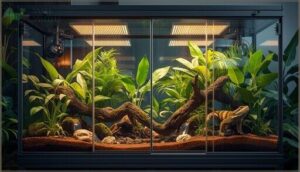
When you’re shopping for a tropical snake terrarium, certain features will make or break your setup’s ability to maintain the precise environmental conditions these species need. The right enclosure does more than just contain your snake—it provides secure access points, regulates airflow without sacrificing humidity, delivers consistent heating and lighting, and prevents even the most determined escape artist from going on an adventure.
Let’s break down the must-have features that separate a basic glass box from a proper tropical snake habitat.
Front-opening Doors for Easy Access
When you’re working with tropical species, front-opening doors transform routine maintenance from a wrestling match into a simple task. You’ll appreciate hinged tempered glass panels with magnetic catches that resist warping in high humidity while providing 12- to 18-inch openings for one-handed feeding and cleaning access in modern reptile enclosures.
| Feature | Benefit for Snake Care |
|---|---|
| Wide door openings (12-18 inches) | Stress-free feeding and handling without disturbing decor |
| Overlapping frames with tight gaskets | Prevents escape attempts while maintaining terrarium humidity |
| Non-porous glass surfaces | Easy cleaning and disinfection between cage setups |
Proper Ventilation and Humidity Control
Beyond front doors, effective air exchange depends on strategic ventilation design. Mesh panels placed high on one side and low on the opposite wall create airflow patterns that stabilize humidity control between 60 and 80 percent without chilling your snake.
Digital humidity sensors positioned at substrate level let you fine-tune moisture management through vent adjustments, ensuring your humidity management system maintains proper thermoregulation year-round.
Heating and Lighting System Options
When you pair heat sources with lighting fixtures, the combined effect drives effective thermoregulation throughout your tropical snake’s environment. Thermostat settings connected to your heating sources maintain stable temperature gradients while preventing dangerous spikes, and proper temperature and humidity control depends on choosing complementary systems:
- Under-tank heating pads deliver gentle warmth from below, creating distinct basking zones when regulated by digital thermostats.
- Ceramic heat emitters provide infrared warmth without visible light, preserving natural day-night cycles.
- Full-spectrum LED fixtures support live plant growth while UVB lighting options boost calcium metabolism.
Security and Escape Prevention Features
Without secure locks and reinforced barrier materials, your tropical snake terrarium becomes a liability rather than a sanctuary.
PVC enclosures and reptile enclosures equipped with triple locking mechanisms, recessed stainless steel hasps, and tamper evident seals prevent escapes that could endanger both your snake and household members—and optional alarm systems provide remote monitoring when unauthorized access occurs.
Selecting The Best Substrate Mixes
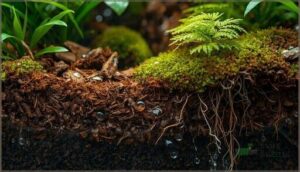
The substrate you choose forms the foundation of your tropical snake’s environment, directly influencing humidity retention, waste breakdown, and overall terrarium health. Whether you’re building a simple setup or establishing a full bioactive system, understanding the properties of different substrate materials will help you create stable conditions that mirror your snake’s natural habitat.
Let’s examine the key substrate options and layering techniques that work best for tropical species.
Moisture-retaining Substrates for Tropical Climates
When your terrarium becomes a bioactive vivarium, moisture-retaining substrates like coconut fiber and sphagnum moss transform into reservoirs that sustain both humidity control and beneficial microorganisms.
Coconut fiber holds four to six times its weight in water, while sphagnum moss maintains moisture for one to two weeks—creating a substrate mix that facilitates substrate layering and sustains live plants without oversaturation.
Safe, Non-toxic Substrate Options
Your snake’s health depends on choosing substrate materials that won’t leach synthetic dyes, pesticides, or chemical fragrances into the bioactive vivarium—substances that disrupt beneficial microorganisms and irritate delicate respiratory tissues.
Prioritize these toxic-free natural materials for substrate safety:
- Coconut fiber (coco coir): pH-neutral and additive-free for humidity control
- Kiln-dried orchid bark: Provides structure for bioactive layers
- Untreated sphagnum moss: Antimicrobial and moisture-retentive
- Paper-based substrates: Low-dust options supporting live plants and cleanup crew activity
For even greater environmental safety and long-term durability, some keepers consider engineered substrate options for terrariums that align with green building and sustainability practices.
Creating Layered Substrate for Bioactivity
To establish a thriving bioactive vivarium, you’ll layer your substrate beginning with 2–3 inches of drainage aggregate—expanded clay pellets work exceptionally well—followed by mesh separator fabric, then 3–5 inches of nutrient-rich topsoil blended with coconut fiber and orchid bark.
This substrate depth sustains live plants, beneficial microorganisms, and your cleanup crew while maintaining soil stability and humidity management through interconnected bioactive layers that promote microfauna balance and ongoing nutrient cycling.
Live Plants and Environmental Enrichment
Live plants transform your tropical snake’s terrarium from a simple enclosure into a thriving microhabitat that fosters natural behaviors and physiological health. When you select the right species and arrange them thoughtfully, these plants provide climbing opportunities, visual barriers for security, and improved air quality through gas exchange and humidity regulation.
The following sections will guide you through choosing compatible plant species, understanding their health benefits for your snake, and strategically positioning them to optimize both function and environmental enrichment.
Choosing Compatible Live Plant Species
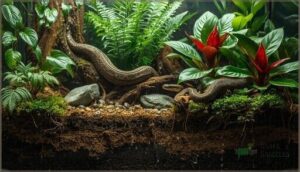
When selecting live plants for your bioactive vivarium, you’re fundamentally designing an ecosystem that must support both tropical snakes and botanical life—so compatibility becomes your foundation for successful reptile husbandry.
- Plant Toxicity: Choose only non-toxic species such as pothos, snake plants, or bromeliads, since your snake may brush against or occasionally nibble foliage during exploration.
- Humidity Tolerance: Select moisture-loving varieties like ferns and philodendrons that thrive in the 60-80% humidity range typical of tropical environments, preventing leaf rot or desiccation.
- Growth Rates: Favor slow-growing or compact species to avoid aggressive root systems that disrupt substrate layers or crowd your enclosure within months.
- Root Depth: Match root structures to your substrate depth—shallow-rooted mosses for ground cover, moderate systems for mid-level plants, ensuring they don’t destabilize your drainage layer.
Leaf structure matters too; broad, sturdy leaves support climbing better than delicate foliage that tears under a snake’s weight.
Benefits of Live Plants for Snake Health
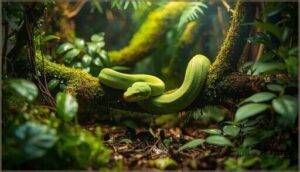
Beyond aesthetic appeal, live plants deliver measurable improvements to snake health through enhanced humidity control, microfauna support, and natural enrichment that encourages instinctive behaviors. Plants actively increase moisture levels via evapotranspiration—keeping your snake’s skin properly hydrated for clean sheds—while dense foliage creates hiding spots that reduce stress and promote calmer feeding responses.
Bioactive vivarium ecosystems with living vegetation support beneficial microfauna, establishing a self-regulating environment that mirrors your tropical snake’s native habitat.
Living plants in bioactive enclosures support beneficial microorganisms that create a self-regulating ecosystem mirroring your snake’s natural habitat
Arranging Plants for Climbing and Hiding
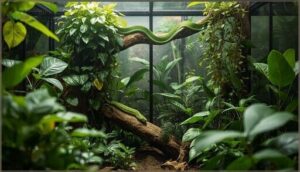
Once you’ve added the right plants, strategic terrarium design transforms foliage into a functional network for climbing structures and concealed retreats. Position taller specimens—reaching 60 to 90 cm—near the warm end to encourage vertical gardens that tropical snakes instinctively explore, while arranging dense clusters around cork bark creates natural hide creation zones that reduce stress and support healthy behaviors in reptile enclosures.
- Install sturdy trellises at 12- to 18-inch intervals to support plant training and climbing routes
- Group plants in staggered heights for layered microhabitats and plant placement variety
- Drape trailing vines over branches to form alcoves that blend hide creation with ecosystem design
- Maintain 20 cm of clearance at front openings for easy access and visibility
Water Features and Humidity Management

Water management in tropical snake enclosures goes far beyond simply placing a bowl in the corner—it requires careful consideration of your snake’s hydration needs, your terrarium’s humidity requirements, and the biological health of the entire system.
Whether you opt for a simple ceramic dish or invest in a recirculating water feature, each choice carries specific maintenance responsibilities and potential pitfalls that can make or break your bioactive setup.
Let’s examine the key factors you’ll need to balance when designing your water strategy.
Water Bowls Versus Running Water Features
When designing reptile enclosures for tropical snakes, you’ll face a fundamental choice between traditional water bowls and running water features—each offering distinct advantages for snake hydration and terrarium design and setup.
Bowls provide reliable hydration without electrical components, require straightforward bowl maintenance, and minimize mechanical failures.
In contrast, running water features improve water quality through built-in filtration, allow adjustable flow rates to match species preferences, and contribute notably to humidity control through splash zones and continuous movement.
Maintaining Optimal Humidity Levels
Throughout the day, you’ll need to maintain indoor relative humidity between 60 and 80 percent for tropical snakes using these evidence-based techniques:
- Humidity sensors positioned at multiple terrarium heights to track gradient zones accurately
- Fogger systems programmed for peak activity periods to mimic natural rainforest cycles
- Water cycling schedules that prevent rapid fluctuations stressing your snake
- Humid microclimates created through strategic plant placement and substrate layering
- Evaporation control achieved by elevating water bowls away from direct heat sources
Preventing Mold and Stagnant Water Issues
When condensation appears, you’ll want to boost airflow management within five minutes—cross ventilation at 0.5 meters per second across the substrate prevents stagnant zones where mold thrives.
Raise water bowls at least 2 cm above substrate, empty them daily, and remove any standing water within an hour; proper drainage systems paired with strategic ventilation transform humidity control from reactive firefighting into proactive terrarium maintenance.
Top 8 Terrariums and Accessories for Tropical Snakes
Once you’ve nailed down the environmental requirements for your tropical snake, the next step is choosing an enclosure and accessories that make maintaining those conditions easy.
The right terrarium won’t just house your snake—it’ll simplify your husbandry routine while providing the security, ventilation, and thermal gradients your species needs to thrive.
Below, you’ll find eight carefully selected terrariums and accessories that consistently deliver results for keepers working with humidity-dependent species.
1. Exo Terra Glass Reptile Terrarium Kit
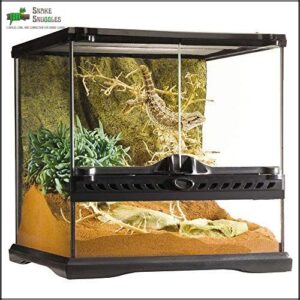
The Exo Terra Glass Reptile Terrarium Kit establishes a foundation for tropical snake husbandry through its dual-door front access design, which minimizes escape risk while you service the enclosure. With dimensions of 12 x 12 x 12 inches, this compact glass terrarium provides a waterproof bottom and raised frame that accommodates substrate heaters beneath the floor—critical for maintaining the thermal gradients that tropical species require.
You’ll appreciate the patented front window ventilation system, which balances airflow with humidity retention, though be aware you may need supplemental humidification equipment for moisture-demanding species.
| Best For | Hobbyists setting up a compact habitat for small tropical snakes, geckos, or amphibians who need secure front access and easy substrate heater integration. |
|---|---|
| Material | Glass |
| Dimensions | 12x12x12 in |
| Weight | 13.2 lbs |
| Ventilation Type | Screen top |
| Door Style | Front dual doors |
| Color | Transparent |
| Additional Features |
|
- Dual front-opening doors with a lock prevent escapes while making feeding and cleaning way easier than top-entry tanks
- Raised bottom frame fits substrate heaters perfectly, so you can create proper heat gradients without custom modifications
- Full screen top lets UVB and heat lamps penetrate while the front vents balance airflow and humidity retention
- Doesn’t hold humidity well on its own—you’ll likely need a humidifier or frequent misting for moisture-loving species
- Styrofoam background might not hold up long-term and isn’t ideal if you want a more naturalistic or permanent setup
- At 13.2 pounds empty, it gets heavy fast once you add substrate and décor, making it tough to relocate
2. Exo Terra Glass Terrarium Tank
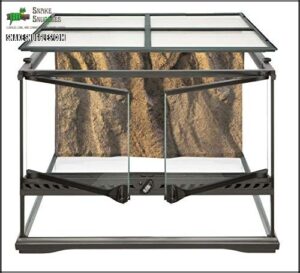
When you need more vertical space without sacrificing your floor plan, this 18 x 18 x 12-inch Glass Terrarium Tank delivers the climbing dimension that arboreal tropical species demand—alongside the substrate depth required for bioactive setups.
The extra-high fixed front window accommodates thick substrate layers up to 5 inches, while the full screen top allows UVB and infrared penetration for proper thermoregulation.
You’ll find the five closable wire inlets on the back particularly useful for routing heating cables and misting system tubing without compromising security.
| Best For | Reptile keepers housing arboreal species like crested geckos or day geckos who need vertical climbing space and enough substrate depth for bioactive drainage layers. |
|---|---|
| Material | Glass |
| Dimensions | 18x18x12 in |
| Weight | 27.5 lbs |
| Ventilation Type | Screen top |
| Door Style | Front opening doors |
| Color | Black/Clear |
| Additional Features |
|
- Full screen top allows proper UVB and heat lamp penetration while maintaining ventilation
- Extra-high front window fits thick substrate layers (up to 5 inches) for naturalistic planted setups
- Five wire inlets on the back make it easy to route cables and tubing without leaving gaps for escapes
- Screen lid doesn’t hold humidity well for species that need 80% levels
- Background insert looks cheap and doesn’t add much functional climbing space
- Front doors can be tricky to clean thoroughly around the hinges and seals
3. Exo Terra Glass Terrarium Kit
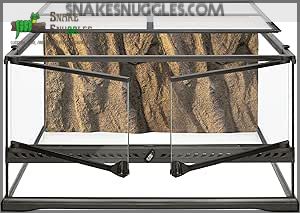
A complete kit approach simplifies your initial setup when you’re building a tropical snake enclosure from scratch—this 24 x 18 x 12-inch Glass Terrarium Kit arrives ready to house ground-dwelling species like Ball Pythons with its short-wide footprint maximizing usable floor area.
The front-opening dual doors allow daily feeding and spot-cleaning without disturbing your carefully arranged substrate layers, while the mesh top balances airflow against humidity retention.
You’ll appreciate the raised bottom frame, which accommodates substrate heaters beneath your bioactive layer while preventing direct thermal contact that could harm burrowing cleanup crews.
| Best For | Keepers setting up their first tropical snake enclosure who want a complete, ready-to-use kit with front-access convenience and enough floor space for ground-dwelling species like Ball Pythons. |
|---|---|
| Material | Glass |
| Dimensions | 24x18x12 in |
| Weight | 13.66 kg |
| Ventilation Type | Mesh top |
| Door Style | Front opening doors |
| Color | Black/Clear |
| Additional Features |
|
- Front-opening doors make daily feeding and maintenance easy without disturbing your snake or substrate setup
- Short-wide design (24″x18″x12″) maximizes floor space, which is ideal for species that need room to move horizontally
- Raised bottom frame lets you safely install under-tank heating while protecting live plants and cleanup crews in bioactive setups
- Glass construction is fragile and units sometimes arrive cracked or broken during shipping
- Higher price point compared to simpler plastic or acrylic enclosures
- Requires careful handling during setup since the all-glass build can break if dropped or knocked over
4. Repti Zoo Glass Terrarium Tank
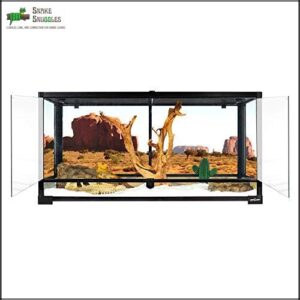
When scaling up for larger tropical species, the Repti Zoo’s 36 x 18 x 18-inch dimensions provide ample floor space for adult Ball Pythons or active hunters like King Snakes.
At roughly 52 pounds empty, you’ll want to position this enclosure on a sturdy stand before filling it with substrate and hardscape.
The dual front doors operate independently, letting you access feeding zones without disturbing established microclimates. The raised waterproof bottom accommodates heating elements beneath your bioactive layer without compromising structural integrity or biological activity.
| Best For | Keepers of adult Ball Pythons, Boas, or larger lizards who need a spacious, easy-access enclosure with solid glass construction and flexible heating options. |
|---|---|
| Material | Glass |
| Dimensions | 36x18x18 in |
| Weight | 51.9 lbs |
| Ventilation Type | Screen top |
| Door Style | Double hinge door |
| Color | Black |
| Additional Features |
|
- Dual front doors open independently for targeted feeding and maintenance without disrupting temperature zones
- Raised waterproof base lets you install under-tank heaters beneath bioactive substrate setups
- Generous 36″ x 18″ x 18″ floor space gives adult snakes and active lizards room to move and explore
- Screen side panels may struggle to maintain high humidity levels for tropical species
- Top frame can feel flimsy under heavy lighting fixtures or frequent opening
- Corner pieces are fragile and prone to cracking during shipping
5. Carolina Custom Glass Terrarium Cage
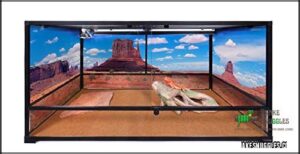
If you’re planning a bioactive terrarium for mid-sized tropical snakes like Corn Snakes or young Ball Pythons, the Carolina Custom’s 48 x 24 x 24-inch all-glass design offers the depth you need.
That 7.5-inch waterproof base tray traps substrate spills and drainage runoff, protecting your flooring during weekly misting sessions.
The sliding doors with key-lock security prevent escapes while you work inside, and the full steel mesh top maintains airflow without sacrificing the 60–80 percent humidity tropical species require.
| Best For | Hobbyists creating bioactive enclosures for mid-sized tropical snakes like Corn Snakes or young Ball Pythons who need deep substrate space and reliable humidity control. |
|---|---|
| Material | Tempered Glass |
| Dimensions | 48x24x24 in |
| Weight | 73 lbs |
| Ventilation Type | Steel mesh top |
| Door Style | Sliding doors |
| Color | Clear |
| Additional Features |
|
- Deep 7.5-inch waterproof base tray handles substrate depth and drainage without leaking onto floors
- Sliding key-lock doors and steel mesh top balance easy access with escape prevention
- Large 48 x 24 x 24-inch size gives snakes room to move while supporting various lighting setups
- 73-pound weight makes it difficult to move or reposition without help
- Included suction cups often don’t stick well and may need upgrading
- Door lock can malfunction if not installed carefully during assembly
6. ReptiChip Coconut Reptile Substrate Bedding
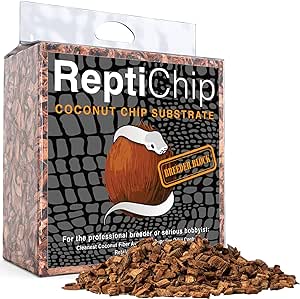
Substrate choice directly impacts humidity retention and odor control in tropical setups—which is where ReptiChip’s compressed coconut husk chips shine.
This 72-quart brick expands to 10 pounds of dust-free bedding when hydrated, absorbing moisture without turning soggy and creating the cushiony, porous layer your snake needs for comfortable movement.
The biodegradable chips encapsulate waste to keep your enclosure smelling fresh between spot cleanings, and you can vacuum debris without stripping entire substrate layers, making routine maintenance faster.
| Best For | Ball python owners looking for a low-maintenance substrate that holds humidity well and keeps odors under control in tropical setups. |
|---|---|
| Material | Coconut Husk |
| Dimensions | 72 qt block |
| Weight | 10 lbs expanded |
| Ventilation Type | N/A |
| Door Style | N/A |
| Color | Natural brown |
| Additional Features |
|
- Expands to 10 pounds of bedding from a compact brick, making it easy to store and cost-effective over time
- Absorbs moisture without getting mushy, helping maintain stable humidity levels for shedding and respiratory health
- Naturally controls odors by trapping waste, so you can spot-clean instead of doing full substrate swaps every week
- Costs more upfront compared to basic options like aspen or paper bedding
- Can take a while to fully hydrate if you’re not using a hose or large water source
- Some users notice dust when breaking apart the dry brick, though it settles once moistened
7. Aqua Reptile Corner Branch Decoration
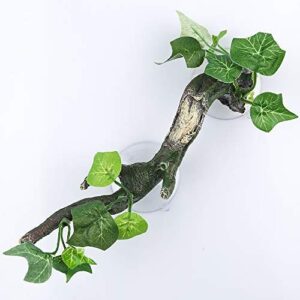
While substrate anchors your bioactive setup, vertical space lets your snake thermoregulate and explore—and that’s where the Aqua Reptile Corner Branch Decoration earns its place.
This resin piece fits snugly into rectangular enclosure corners using dual suction cups, freeing up floor space while offering textured grip points for climbing and coiling.
The 8- to 12-inch structure resists warping in high humidity, doubles as an elevated basking platform beneath heat sources, and requires only periodic cleaning with mild soap to prevent mold buildup on glass contact zones.
| Best For | Snake keepers with tall glass terrariums who need a space-saving climbing structure that doubles as a basking spot. |
|---|---|
| Material | Glass |
| Dimensions | 18x18x24 in |
| Weight | 50 lbs |
| Ventilation Type | Screen top |
| Door Style | Front dual doors |
| Color | Green/Brown |
| Additional Features |
|
- Corner design maximizes vertical space without cluttering the enclosure floor
- Resin construction holds up well in humid environments and under heat lamps
- Textured surface gives snakes solid grip for climbing and perching
- Suction cups can lose grip over time, especially on curved or dirty glass
- Fixed corner shape limits placement options in non-rectangular tanks
- Thin leaf details may develop mold if not cleaned regularly in high-humidity setups
8. Hylyun Reptile Terrarium Plants
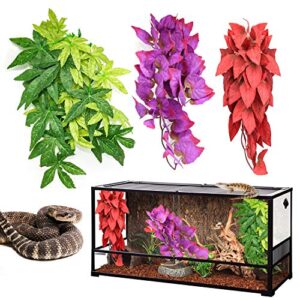
Once you’ve locked in substrate and hardscape, you’ll need foliage that can handle daily misting without molding or leaching toxins—and Hylyun Reptile Terrarium Plants deliver exactly that.
This three-pack of silk plants ships with suction cups that anchor vines to glass walls, creating vertical pathways and shaded microhabitats in minutes. The non-toxic leaves resist tearing when your snake rubs during shed cycles, and a quick wipe-down between cleanings prevents debris buildup.
One caveat: you may need two packs to fill larger enclosures.
| Best For | Reptile owners who need durable, low-maintenance climbing structures and visual interest in tanks for bearded dragons, geckos, lizards, and snakes. |
|---|---|
| Material | Tempered Glass |
| Dimensions | 48x18x18 in |
| Weight | 64.9 lbs |
| Ventilation Type | Steel mesh top |
| Door Style | Sliding doors |
| Color | Clear |
| Additional Features |
|
- Includes suction cups for quick vertical installation on glass walls
- Soft, tear-resistant silk stands up to daily misting and reptile contact during shedding
- Easy to wipe clean without developing mold or releasing toxins
- Suction cups won’t grip dirty or textured surfaces reliably
- One plant in the pack may struggle to stick depending on placement
- Larger enclosures need multiple packs for adequate coverage
Maintenance Tips for Tropical Snake Terrariums
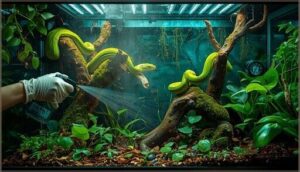
Maintaining a tropical snake terrarium requires consistent attention to environmental parameters and biological balance, though the specific routines you’ll follow depend largely on whether you’ve built a bioactive system or a traditional setup. While bioactive enclosures reduce substrate changes and waste removal through their cleanup crews, both approaches demand regular monitoring of temperature gradients, humidity levels, and overall ecosystem health.
The following sections break down daily tasks, weekly checks, and troubleshooting strategies—giving you a practical framework to keep your snake’s environment stable and thriving.
Daily and Weekly Care Routines
Your tropical snake terrariums thrive when you establish consistent routines that address feeding schedules, hygiene practices, and waste management—all cornerstones of effective reptile care and terrarium maintenance. Daily health checks guarantee you catch potential issues early, while weekly deep-cleaning protocols keep the bioactive system balanced.
Consider these essential practices for peak snake care and maintenance:
- Daily Hygiene and Observation: Check your snake’s activity level, inspect for signs of stress or illness, and remove visible waste to prevent bacterial growth in humid environments.
- Feeding and Equipment Sanitation: Feed at consistent times based on species requirements, remove uneaten prey within 15 minutes, and sanitize all snake handling tools after each use.
- Weekly Enclosure Cleaning: Wipe interior surfaces with reptile-safe cleaner, disinfect water dishes thoroughly, and inspect door seals for potential escape routes during terrarium setup maintenance.
Monitoring Humidity, Temperature, and Plant Health
To keep tropical ecosystems thriving, you’ll need to track humidity between 60 and 80 percent using a digital hygrometer positioned at snake height—calibrating monthly for precision in microclimate management.
Place temperature sensors away from heat sources to capture accurate gradients from 75 to 85°F during the day, while monitoring plant health indicators like leaf color and soil moisture ensures your environmental enrichment and terrarium maintenance stay on point with proper sensor calibration.
Troubleshooting Common Terrarium Issues
When condensation clouds your view, briefly crack the lid 1–2 hours daily to reduce foggy glass and prevent mold growth in snake terrariums—persistent fogging signals overwatering or poor air exchange that threatens plant dieback and soil compaction.
Balance your water levels by monitoring substrate moisture with a finger test, maintaining proper terrarium maintenance and environmental enrichment that fosters both reptile care and snake health without compromising humidity requirements.
Frequently Asked Questions (FAQs)
Can you use a terrarium for snakes?
Yes, terrariums work perfectly for snakes when properly equipped with bioactive systems, humidity controls, and secure lids—transforming glass boxes into thriving tropical environments.
These setups support reptile wellness through careful terrarium maintenance and species-appropriate snake care.
Are snake plants good for snake enclosure?
Sansevieria species excel in reptile enclosure design, offering exceptional air quality improvement, minimal terrarium maintenance, and snake safety through non-toxic foliage.
Their drought tolerance aids humidity control and enhances terrarium aesthetics without compromising your snake habitat’s delicate environmental balance.
How big of a terrarium do snakes need?
Adult tropical snakes need terrariums that are at least as long as their body, usually measuring 48 by 24 by 24 inches for medium species. These enclosures must provide climbing space, proper ventilation, and sufficient depth to support natural movement and thermoregulation.
Do pet snakes live in terrariums?
Most pet snakes live in terrariums or specialized reptile enclosures designed to replicate their native habitats. These enclosures ensure proper heating, humidity control, and substrate layers, which are essential for ideal pet snake care and health.
How often should substrate be completely replaced?
Think of substrate like the foundation of a house—when the base crumbles, everything suffers. For tropical snakes, complete substrate replacement should be performed every twelve to eighteen months to maintain ideal humidity control and snake health.
Can multiple tropical snakes share one terrarium?
Most tropical snakes are territorial and should live alone—cohabitation risks disease transmission and aggression.
Species like garter snakes may tolerate companions in spacious enclosures, but solo housing remains the safest default.
Whats the ideal terrarium placement in a room?
Position your enclosure on a stable stand near an indirect light source, at least two feet from vents or heaters, ensuring accessible power outlets and comfortable viewing height for easy terrarium maintenance.
Do tropical snakes need nighttime temperature drops?
Yes, you’ll want to provide a nighttime drop of 5 to 10 degrees Fahrenheit—mimicking natural nocturnal cooling—which aids thermoregulation needs and maintains consistent humidity levels essential for shedding and digestion.
How to safely introduce a snake to new terrarium?
Before you unpack that new enclosure, let your snake settle into a quiet transport container first—then place it inside with minimal handling for seven to ten days, reducing introduction stress markedly.
Conclusion
Like a symphony where every instrument must harmonize perfectly, your tropical snake’s health depends on each terrarium component working in concert—from moisture-gradient substrates to strategically placed live plants that regulate atmospheric conditions.
The snake terrariums for tropical snakes you’ve explored here represent more than mere enclosures; they’re precision life-support systems that, when properly configured and maintained, transform captive husbandry into an authentic replication of equatorial rainforest microclimates where your serpents will genuinely thrive.