This site is supported by our readers. We may earn a commission, at no cost to you, if you purchase through links.

A ball python in the wrong enclosure doesn’t just feel uncomfortable—it slowly breaks down. These snakes can live 30 years in captivity, but poor cage conditions cut that number short in ways most new owners never see coming.
A space that’s too large triggers anxiety. One that’s too small restricts movement and traps humidity in all the wrong places.
Getting the cage right from the start isn’t about ideal; it’s about working with how ball pythons actually behave.
The setup you choose affects their feeding response, shedding cycles, and stress levels every single day.
Table Of Contents
- Key Takeaways
- Ball Python Enclosure Size and Dimensions
- Choosing The Best Cage Type
- Substrate Options for Ball Python Cages
- Essential Temperature and Humidity Control
- Cage Furnishings and Hide Placement
- Lighting and Daily Cage Maintenance
- Top 10 Products for Ball Python Cages
- 1. PietyPet Artificial Terrarium Plant Set
- 2. Sukh Sphagnum Moss for Reptiles
- 3. Repti Zoo 50 Gallon Glass Terrarium
- 4. 25 Gallon PVC Reptile Terrarium
- 5. Zoo Med Reptile Rock Corner Water Dish
- 6. New Age Pet Ecoflex Small Reptile Terrarium
- 7. Vodolo 15 Inch Snake Feeding Tongs
- 8. Reptile Temperature and Humidity Gauge
- 9. SunGrow Leaf Litter for Reptiles
- 10. Leoterra Snake Hide Reptile Habitat
- Frequently Asked Questions (FAQs)
- How big should a ball python enclosure be?
- What do you need for a ball python?
- How to set up a ball python’s habitat?
- What size tank do ball pythons need?
- Can ball pythons live with other snakes together?
- How often should I handle my ball python?
- What size prey should I feed my python?
- Do ball pythons need live or frozen food?
- How long can ball pythons go without eating?
- How often should I clean my ball pythons cage?
- Conclusion
Key Takeaways
- Adult ball pythons need at least a 48×24×24-inch enclosure with a warm hide set to 88–90°F and a cool side at 76–80°F to stay healthy and stress‑free.
- Coconut husk or cypress mulch at 3–4 inches deep holds humidity in the 60–80% range your snake needs, especially during shedding cycles.
- Every setup needs three hides—warm, cool, and humid— placed at opposite ends of the enclosure so your snake always has a safe retreat.
- Spot‑clean daily, do a full substrate swap every 3–4 months, and remove uneaten prey within 15–30 minutes to keep your snake’s environment safe and hygienic.
Ball Python Enclosure Size and Dimensions
Getting the enclosure size right is one of the most important decisions you’ll make for your ball python.
Before anything else, measure your snake — then use this guide to find the right ball python enclosure dimensions based on their actual size.
Too small, and your snake will feel cramped and stressed; too large without the right setup, and it can feel exposed and anxious.
Here’s what you need to know about sizing, dimensions, and keeping your snake safely inside.
Minimum Cage Size Guidelines
Most modern care guides agree on a clear floor space standard for adult ball pythons: at least 48 × 24 inches of enclosure floor space. That snake length ratio matters — your snake should be able to fully stretch out.
Key minimums for reptile habitat design:
- 48 × 24 inches preferred floor space
- 24" internal height for natural posturing
- One snake per enclosure only
- Rack tub footprint must match these dimensions
Following the recommended minimum enclosure size ensures the snake can fully stretch.
Size Requirements by Snake Age and Length
Once you’ve nailed the minimum floor space, the next step is matching enclosure size to your snake’s actual age and weight.
Fresh hatchlings under 300g do fine in a 20×11×13 inch setup.
Juveniles hitting 600g need a 36×18×18 inch space.
Adults over three feet call for a full 48×24×24 inch Ball Python cage — no exceptions.
Maintaining maintain high humidity levels is essential to prevent respiratory problems.
Importance of Width, Depth, and Height
Size matters, but so does shape. A 48×24×24 inch ball python cage gives your snake real movement freedom across three directions.
The 24‑inch width creates space utilization for a proper thermal gradient, while that same depth lets your python turn around comfortably. Height provides climbing opportunities that keep muscles active. Together, these dimensions improve humidity retention and stress reduction — a well‑proportioned reptile enclosure design makes everything else easier.
A well-proportioned enclosure turns dimensions into comfort, giving your ball python room to move, climb, and thrive
Secure Lids and Escape Prevention
Getting the dimensions right is only half the job — keeping your snake inside is the other half. Ball pythons are stronger than most people expect, and a loose lid means a lost snake.
- Use metal screen clip designs with four clips per lid, placed front and back
- Front door security on PVC enclosures beats top-opening lids entirely
- Skip weighted lid risks; heavy objects warp screens without guaranteeing containment
Choosing The Best Cage Type
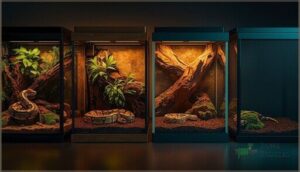
The type of enclosure you pick shapes everything — how easy it is to maintain temperature, how well your snake settles in, and how much work you’ll put in long-term.
Not every cage type works the same way, and each one comes with its own trade-offs.
Here are the four main options worth knowing about.
Glass Aquariums
Glass enclosures are one of the most common starting points for ball python care, and they work well when set up correctly. The key is managing what glass can’t do on its own — hold humidity.
| Snake Size | Tank Size | Notes |
|---|---|---|
| Hatchling (under 17") | 10-gallon (20×10×12") | Ideal for new arrivals |
| Juvenile (20–25") | 20-gallon (30×12×12") | Allows room to explore |
| Sub-adult | 40-gallon breeder (36×18×18") | Holds up to 1,600g |
| Adult | 48×24×24" minimum | Full thermal gradient possible |
| Breeding female | 48×24×24"+ | Extra floor space matters |
Standard screen lids drop humidity to around 40 percent fast. Covering 75 percent of the lid with aluminum foil tape is one of the most reliable lid sealing techniques available. For heat mat placement, position the mat under one-third of the tank floor to maintain an 88°F hotspot. With smart ventilation design and humidity retention strategies, glass terrarium setup becomes very manageable.
Commercial Reptile Terrariums
Built specifically for reptile keeping, commercial terrariums solve most of the problems glass aquariums create. Front Opening Doors let you reach in without looming overhead — a small detail that reduces your snake’s stress noticeably.
Ventilation Systems and Humidity Retention work together through thoughtful reptile design, and Locking Mechanisms keep escapes impossible.
Stackable Designs also make expanding your setup practical as your collection grows.
PVC and Plastic Enclosures
PVC and plastic enclosures stand out for serious keepers who want reliable performance. Thermal Insulation keeps heat stable without constant adjustments, and Humidity Retention naturally holds 50–60% — exactly what ball pythons need. Ventilation Design prevents stale air while protecting your snake.
Top reasons keepers choose PVC reptile enclosures:
- Cleaning Durability — wipes down in minutes
- Portability Assembly — ships flat, builds tool‑free
- Consistent cage size gradients for stable snake housing
Custom-built Cages
Custom-built cages give you total control over every detail of your ball python’s habitat design.
You choose the frame materials — plywood works well and holds up over time.
Sealing techniques like pond epoxy and silicone keep moisture where it belongs.
Add proper ventilation design, front door mechanisms for easy access, and even background carving for a natural look.
Cage setup becomes exactly what your snake needs.
Substrate Options for Ball Python Cages
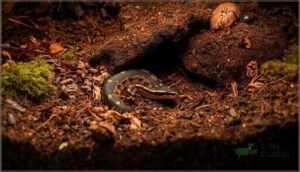
What you put on the floor of your ball python’s enclosure matters more than most people expect. The right substrate holds humidity, facilitates natural burrowing behavior, and makes cleanup a whole lot easier.
Here are the main options worth considering.
Coconut Husk Bedding
Coconut husk bedding is hard to beat for moisture retention — it holds up to 10 times its dry weight in water, keeping humidity steady around 50–60% without constant misting.
It also facilitates natural digging behavior, so your ball python can burrow and feel secure. It is non-toxic, manages odor control well, and spot‑cleans easily.
Just watch for mold if it stays too wet.
Aspen Bedding and Cypress Mulch
Aspen bedding offers impressive absorbency — around 191% — making spot cleaning straightforward since waste shows clearly against its light color. The downside? It dries out fast, raising mold risk if dampened, and fine dust can cause respiratory irritation.
Cypress mulch manages humidity regulation better through sustainable sourcing and gradual moisture release, but it can over‑humidify your snake habitat.
Aspen suits drier setups; cypress fits tropical builds.
Reptile Carpet, Paper Towels, and Newspaper
Where aspen and cypress fall short on flexibility, reptile carpet, paper towels, and newspaper step in. Each works best in specific situations:
- Reptile carpet suits permanent cage setups but risks bacterial growth in frayed fibers
- Paper towels offer cost efficiency with easy cleaning, though ingestion risk exists near feeding time
- Newspaper fits breeder racks despite poor moisture retention
- All three reduce environmental impact from loose substrate waste
Substrate Depth and Maintenance
Depth guidelines matter more than most new keepers realize. Aim for at least 2 inches in smaller setups, and 3 to 4 inches for adults — deeper layers improve humidity retention considerably.
Check under your hide box daily for waste, and spot clean immediately. Mold prevention depends on cleaning frequency, so rotate substrate patches monthly and do a full replacement every 3 to 4 months.
Essential Temperature and Humidity Control
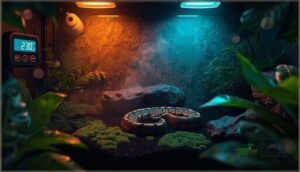
Getting the temperature and humidity right is probably the most important part of keeping a ball python healthy.
Too hot, too cold, or too dry — and your snake will feel it fast.
Here’s what you need to know to get those conditions dialed in.
Creating a Thermal Gradient
Getting the thermal gradient right means placing your heat source on one end only — this is one-sided heating done correctly.
Your thermostat probe placement matters too; set it inside the warm hide at floor level.
A 36-inch minimum length provides solid gradient width planning, while proper ventilation-assisted gradient flow and surface-air temperature balance keep your ball python comfortably moving between zones.
Recommended Temperature Ranges
Once your gradient is in place, set your warm hide range to 88–90°F — that’s where digestion actually happens.
Your cool hide range should sit around 76–80°F.
A nighttime drop to 72–75°F is fine; just keep it above 70°F.
Juvenile needs match adults exactly.
For maximum safe limits, never let any surface hit 95°F.
A heat mat with temperature control manages this reliably.
Humidity Requirements and Monitoring
most critical factors in ball python care and maintenance. Your enclosure should be at 60 percent daily, with a nighttime humidity spike reaching up to 80 percent naturally.
Use moisture-retentive substrate and a consistent misting schedule to hold those levels steady. A humid hide placement on the cool side — packed with sphagnum moss — adds localized moisture that your snake will use regularly.
Thermostats and Hygrometers
Without the right tools watching over your enclosure, temperature and humidity can drift before you notice. A dimming or proportional thermostat keeps heating steady — no spikes, no crashes.
Smart probe placement matters too: position probes in the warm hide zone around 88°F for reliable readings. Choose a digital hygrometer for humidity management, and look for alarm safety features that alert you when conditions shift.
Cage Furnishings and Hide Placement
Once you’ve got temperature and humidity sorted, the inside of the cage is where your ball python really starts to feel at home.
What you put in there — and where you put it — makes a real difference in how comfortable and secure your snake feels day to day.
Here’s what to focus on when furnishing the enclosure.
Number and Placement of Hides
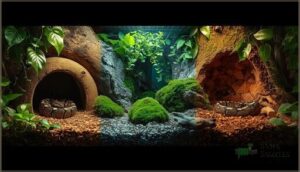
Your snake habitat needs at least three hiding spots — not two. In any solid cage setup, hides follow a simple rule of placement:
- Warm hide — sits on the hot end, 86–90°F
- Cool hide — positioned on the opposite side, 72–80°F
- Humid hide — middle or cool area, packed with moist sphagnum moss
For hide size guidelines, each hide box should fit your snake snugly. Cork bark and commercial caves both work well for material hide selection.
Water Dish Selection and Placement

clean water dish is one of the easiest wins in your cage setup. Get the size right, and placement matters too — keep it on the cool side, away from heat lamps, or you’ll fight evaporation all week.
| Snake Age | Bowl Size | Depth |
|---|---|---|
| Hatchling | 2.5–4 in wide | 1 in |
| Juvenile | 4–6 in wide | 1–2 in |
| Adult | 8–10 in wide | 2–3 in |
Ceramic or stainless steel wins on material durability — both resist bacteria and handle weekly scrubbing well. Change water daily, scrub bowls every week.
Branches, Rocks, and Artificial Plants
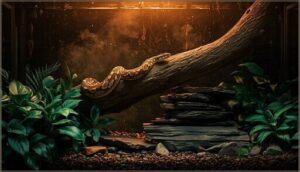
Decorations do more than fill empty space — they shape how comfortable your snake feels every day. A thoughtful cage setup uses each piece with purpose:
- Branch Sterilization: Bake collected branches at 250°F for two hours before adding them to your terrarium setup.
- Climbing Branch Safety: Secure branches with zip ties or silicone so nothing shifts under your snake’s weight.
- Rock Heat Retention: Slate rocks hold warmth up to 92°F, doubling as a shedding surface — rock texture shedding support is a real bonus.
- Artificial Foliage Placement: Position silk plants to block sightlines and break up open space across your reptile habitat design.
Visual Barriers and Snake Security
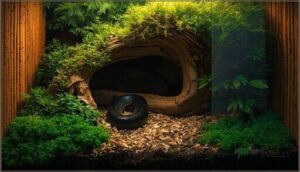
ball python that can see clear across its enclosure is a stressed one. Cork textured walls and moss screening panels block open sightlines, supporting visual stress reduction and calming snake behavior and biological instincts.
Acrylic enclosure dividers create separate microclimates, while magnetic door locks seal gaps tightly.
Good reptile husbandry means your cage setup makes the hide box feel like the safest place in the room.
Lighting and Daily Cage Maintenance
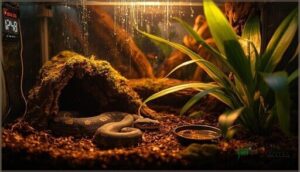
Once you’ve got snake’s hides and furnishings sorted, there are two more things that’ll keep the whole setup running smoothly.
Lighting and daily maintenance mightn’t be the most exciting part of ball python care, but they matter more than most people expect.
Here’s what you need to know about each one.
Lighting Options and Photoperiod
Lighting your terrarium setup doesn’t need to be complicated. A simple 12-hours-on, 12-hours-off photoperiod timing cycle keeps your python’s rhythm steady year-round. Here’s what matters most:
- UVB bulb types like the Zoo Med ReptiSun 5.0 T5 HO support overall health at 11–13 inches above the mesh.
- Full-spectrum LEDs around 6000–7000K benefit live plants and mental wellbeing.
- Night-light rules are firm — red or blue bulbs disrupt sleep; use light‑free heating like ceramic heat emitters instead.
Cleaning Routines and Disinfecting
Good lighting sets the mood — but a solid cleaning schedule keeps your snake healthy.
For daily cage maintenance, spot clean visible waste and refresh the water bowl every day.
Weekly disinfection with chlorhexidine solution (1:32 dilution) manages surface buildup.
Every 4–6 weeks, do a bleach deep clean using a 1:10 ratio.
Safe disinfectants like F10SC or hydrogen peroxide work great between full cleans.
Removing Waste and Uneaten Food
Spot cleaning is your first line of defense for snake health and wellness. Check the enclosure morning and evening—remove waste immediately and replace only the soiled substrate section.
For prey removal timing, take out uneaten food within 15–30 minutes. A simple waste monitoring log helps you catch health changes early, making cage maintenance far easier over time.
Top 10 Products for Ball Python Cages
Now that you know what ball python needs, the next step is finding the right products to bring it all together. The items below cover everything from enclosures and hides to humidity tools and feeding tongs. Here are ten products worth considering for your setup.
1. PietyPet Artificial Terrarium Plant Set
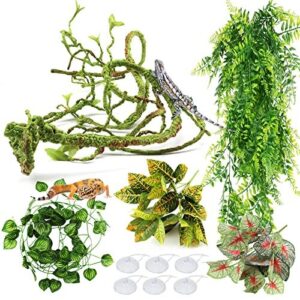
Adding cover to your ball python’s enclosure doesn’t have to mean managing live plants. The PietyPet Artificial Terrarium Plant Set gives you flexible vines, hanging ivy, and a jungle vine with leaves — all made from non-toxic plastic reinforced with iron wire so they hold their shape after your snake coils through them.
Six suction cups attach everything directly to the glass. It’s easy to arrange, simple to wipe clean, and built to handle the humidity your python needs.
| Best For | Reptile owners who want a low-maintenance, natural-looking setup for ball pythons, bearded dragons, geckos, or other lizards without the hassle of live plants. |
|---|---|
| Material | Plastic |
| Ease of Cleaning | Easy to clean |
| Reptile Compatible | Yes |
| Snake Suitable | Yes |
| Humidity Support | Low |
| Durability | Durable |
| Additional Features |
|
- Flexible vines and leaves hold their shape even after your snake coils through them
- Six suction cups make setup quick and easy to rearrange anytime
- Non-toxic plastic is safe for your reptile and a breeze to wipe clean
- May come with a noticeable plastic smell right out of the box
- The foam vine can feel a bit flimsy and may tear with too much bending
- Not a great fit for bio-active enclosures where a more natural look matters
2. Sukh Sphagnum Moss for Reptiles

Sphagnum moss pulls double duty in a ball python setup — it holds humidity where you need it most and stays naturally resistant to bacteria.
Pack it into your hides or use it to line a dedicated wet box, and it keeps conditions damp without turning soggy. The Sukh Sphagnum Moss is safe for ball pythons, soft enough for burrowing, and easy to prep: just soak, squeeze, and place. During shedding, it’s genuinely hard to beat.
| Best For | Ball python owners and tropical reptile keepers who need reliable humidity control in their enclosures. |
|---|---|
| Material | Natural Moss |
| Ease of Cleaning | Requires regular maintenance |
| Reptile Compatible | Yes |
| Snake Suitable | Yes |
| Humidity Support | High |
| Durability | Degrades over time |
| Additional Features |
|
- Holds moisture really well — great for hides, wet boxes, and keeping shed cycles smooth
- Soft and natural texture that’s comfortable for burrowing reptiles
- Works beyond reptiles too, so you can use leftovers on orchids or ferns
- Needs regular cleaning and re-moistening to stay fresh
- Works best mixed with other substrates, not great as a standalone option
- Can break down into dust over time, so it won’t last forever
3. Repti Zoo 50 Gallon Glass Terrarium
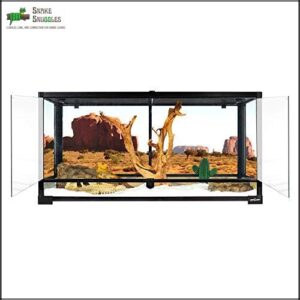
The REPTI ZOO 50 Gallon Glass Terrarium checks most of the right boxes for a young adult or adult ball python. At 36 x 18 x 18 inches, it gives your snake enough room to move, thermoregulate, and feel at home.
The front doors open separately, so feeding is simple and escape risk stays low. A raised bottom frame fits a heat mat underneath, and the closable side vents help you dial in humidity without fighting the enclosure the whole time.
| Best For | Young adult and adult reptiles like ball pythons, corn snakes, and bearded dragons who need a spacious, easy-to-manage home. |
|---|---|
| Material | Glass |
| Ease of Cleaning | Easy to clean |
| Reptile Compatible | Yes |
| Snake Suitable | Yes |
| Humidity Support | Moderate |
| Durability | Sturdy glass |
| Additional Features |
|
- Front doors open independently, making feeding simple and keeping escape risk low
- Raised bottom frame fits a heat mat right underneath — no workarounds needed
- Closable side vents give you real control over airflow and humidity
- Screen panels on the side walls can make holding humidity a challenge for tropical setups
- The top frame isn’t built for heavy lighting rigs or constant handling
- A few buyers have dealt with damaged glass doors on arrival due to packaging issues
4. 25 Gallon PVC Reptile Terrarium
25 Gallon PVC Reptile Terrarium is a solid pick for juvenile ball pythons or smaller adults.
At 24x16x16 inches, it won’t fit a full-grown five-footer, but it’s a great starter home.
The PVC walls hold humidity well, and the front-opening doors make feeding low‑stress for both of you.
It’s priced at $95.99, weighs just 18 pounds, and comes with a 10‑year warranty.
One heads‑up — double‑check the snap locks if your snake often pushes boundaries.
| Best For | Ground-dwelling reptiles like leopard geckos, ball pythons, and bearded dragons, plus nocturnal spiders and other small reptiles that prefer darker, humidity-friendly environments. |
|---|---|
| Material | PVC & Acrylic |
| Ease of Cleaning | Easy to clean |
| Reptile Compatible | Yes |
| Snake Suitable | Yes |
| Humidity Support | Moderate |
| Durability | Shatter-resistant |
| Additional Features |
|
- PVC construction holds humidity well and the front-opening panel makes feeding and cleaning way less stressful
- Light-blocking design is a nice touch for nocturnal species that just want to feel safe and hidden
- At $95.99, it’s a reasonably priced starter home that’s lightweight and easy to move around
- Assembly can be a bit fiddly, and those acrylic screws have a habit of coming loose over time
- The snap locks on the sides aren’t the most escape-proof, so keep an eye on them if your pet is a known escape artist
- The ventilation slits are roomy enough for tiny critters like isopods to slip right through
5. Zoo Med Reptile Rock Corner Water Dish
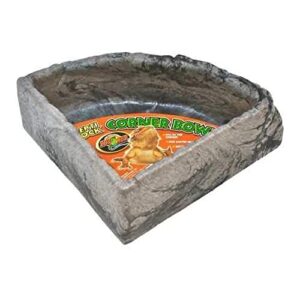
The Zoo Med Reptile Rock Corner Water Dish is a smart, space-saving choice for ball python setups. Its triangular shape tucks neatly into enclosure corners, freeing up floor space that your snake actually uses. The large size measures 9x9x3 inches — roomy enough for soaking, especially during shed cycles.
Made from 100% recycled plastic in the USA, it’s durable, easy to wipe clean, and the faux rock exterior blends naturally into the habitat. Just replace the water daily to keep things fresh.
| Best For | Reptile owners with ball pythons, bearded dragons, or turtles who want a water dish that fits neatly in a corner without eating up valuable enclosure space. |
|---|---|
| Material | Plastic |
| Ease of Cleaning | Easy clean surface |
| Reptile Compatible | Yes |
| Snake Suitable | Yes |
| Humidity Support | Low |
| Durability | Durable |
| Additional Features |
|
- Corner design saves floor space, so your pet has more room to roam
- Made from recycled plastic — durable, easy to clean, and eco-friendly
- Spacious enough for soaking, which is great during shed cycles
- Sides may be too high for smaller or younger reptiles to climb in and out easily
- Takes up a noticeable footprint in smaller enclosures despite the corner fit
- Color can vary from what’s shown online, so you might not get exactly what you expected
6. New Age Pet Ecoflex Small Reptile Terrarium
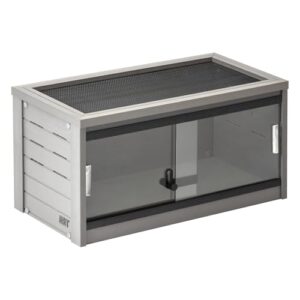
The New Age Pet Ecoflex Small Reptile Terrarium is a tidy option if you’re housing a juvenile ball python or a smaller snake species.
It measures 24 inches long by 12 inches wide and holds around 10 to 15 gallons — workable for young snakes, not adults.
The ECOFLEX material resists moisture and cleans up easily, while sliding glass doors with locks keep things secure.
Vented side panels and a mesh top support heating equipment.
Just note it’s best for low-to-moderate humidity setups.
| Best For | Reptile owners housing juvenile ball pythons, small lizards, or tortoises who want a clean, stylish enclosure that fits nicely in a living space. |
|---|---|
| Material | ECOFLEX & Glass |
| Ease of Cleaning | Easy to clean |
| Reptile Compatible | Yes |
| Snake Suitable | Yes |
| Humidity Support | Low to Moderate |
| Durability | 10-year warranty |
| Additional Features |
|
- ECOFLEX material resists moisture and wipes down easily, so cleanup isn’t a chore
- Glass front panel and sliding doors give you a clear view and safe access to your pet
- Vented side panels and mesh top keep airflow solid and work well with standard heating setups
- Not great for high-humidity species — you may need extra sealing for tropical setups
- No cord ports or grommets, which makes running wires for sensors a little awkward
- The sliding glass doors can run loud and might need some adjusting over time
7. Vodolo 15 Inch Snake Feeding Tongs
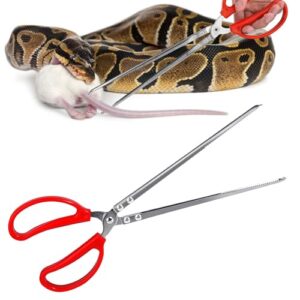
Feeding tongs are one of those tools you don’t think about until your snake mistakes your hand for dinner.
The Vodolo 15 Inch Feeding Tongs keep your fingers well out of striking range — about 12 inches away — while the serrated jaws hold frozen-thawed rodents securely without dropping them mid-feed.
The stainless steel build resists rust in humid enclosures, and the silicone handle feels solid even during longer sessions.
A practical, low-cost addition to any ball python setup.
| Best For | Reptile owners who want a safe, reliable way to hand-feed snakes, bearded dragons, and other reptiles without risking a bite. |
|---|---|
| Material | Silicone & Stainless Steel |
| Ease of Cleaning | Easy to clean |
| Reptile Compatible | Yes |
| Snake Suitable | Yes |
| Humidity Support | Low |
| Durability | Rustproof |
| Additional Features |
|
- At 15 inches, it keeps your hand a safe distance from even the most aggressive feeders
- Serrated jaws grip frozen-thawed rodents firmly so nothing slips mid-feed
- Stainless steel and silicone construction holds up well in humid enclosures
- The ridges on the tongs may feel too deep or sharp for some users’ preferences
- The handle runs on the larger side, which can be awkward for people with smaller hands
- The serrated teeth make it a poor choice for directly handling or moving snakes
8. Reptile Temperature and Humidity Gauge
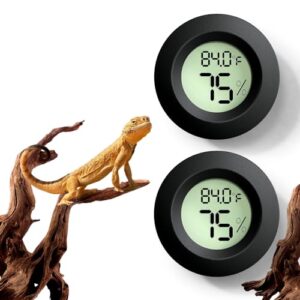
Once the feeding session’s done, your attention shifts to the numbers — temperature and humidity.
This combo gauge gives you both in one compact unit. It reads temperature from -58°F to 158°F and humidity from 10% to 99%, more than enough to cover a ball python’s needs.
The 5-second response time is quick, and the digital display is easy to read at a glance. Keep one on the warm side, another near the cool side, and you’ll always know what’s happening in the enclosure.
| Best For | Reptile owners who want a simple, affordable way to keep tabs on temperature and humidity in their enclosure without overthinking it. |
|---|---|
| Material | Plastic & Electronics |
| Ease of Cleaning | Easy to clean |
| Reptile Compatible | Yes |
| Snake Suitable | Yes |
| Humidity Support | Monitoring only |
| Durability | 3-month battery |
| Additional Features |
|
- You get two units in the box, so you can cover both the warm and cool sides of the enclosure at once.
- The 5-second response time and digital display make it easy to check conditions at a glance.
- Works across a wide range — -58°F to 158°F and 10–99% RH — so it covers most common reptiles with room to spare.
- Accuracy can be inconsistent between the two units, which is frustrating when you’re trying to compare readings.
- Battery life is only about three months, so you’ll be swapping those out a few times a year.
- Some users have had trouble with the unit randomly switching between Celsius and Fahrenheit.
9. SunGrow Leaf Litter for Reptiles
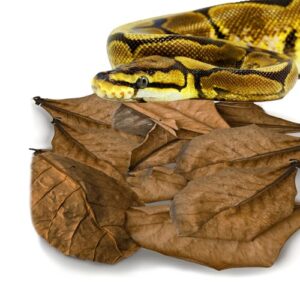
Leaf litter might seem like a small detail, but it pulls a lot of weight inside a ball python enclosure. SunGrow’s Indian Almond Catappa leaves come in packs of 10, sized 4 to 7 inches — big enough to create natural cover without cluttering the space.
They hold moisture, support microfauna like springtails and isopods, and give your snake low spots to hide and forage.
Just boil them for 15 minutes before adding. Swap them out monthly, and they stay clean and effective.
| Best For | Reptile owners who want a natural, bioactive setup that keeps humidity up and gives their snake real places to hide and explore. |
|---|---|
| Material | Natural Leaves |
| Ease of Cleaning | Requires boiling |
| Reptile Compatible | Yes |
| Snake Suitable | Yes |
| Humidity Support | High |
| Durability | Fragile in shipping |
| Additional Features |
|
- Holds moisture well, which helps maintain the humidity ball pythons need
- Supports microfauna like springtails and isopods — live food that forages right in the enclosure
- Gives snakes natural cover and a more stress-free environment
- Leaves can arrive crushed or broken from shipping
- Need to be boiled for 15 minutes before use, which adds a prep step
- Have to be swapped out monthly, so it’s an ongoing cost and task
10. Leoterra Snake Hide Reptile Habitat
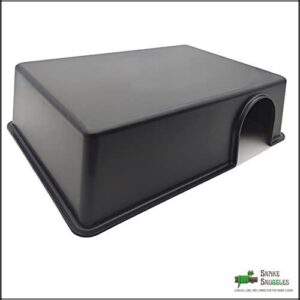
Your snake needs more than leaf cover — it needs a real retreat. The Leoterra Snake Hide gives adult ball pythons exactly that. At 16.5 × 10.6 inches, the XL fits comfortably inside a 40‑gallon setup without eating up floor space.
The top seal design holds humidity inside the hide, which helps during shedding. It’s plastic, so cleaning takes minutes. Snake owners report their pythons settle in fast, which tells you something about how secure it feels.
| Best For | Small reptile owners — especially those keeping geckos, small lizards, or juvenile snakes — who want an affordable, easy-to-clean hide that fits neatly in most enclosures. |
|---|---|
| Material | Plastic |
| Ease of Cleaning | Easy to clean |
| Reptile Compatible | Yes |
| Snake Suitable | Yes |
| Humidity Support | Moderate |
| Durability | Sturdy plastic |
| Additional Features |
|
- Rounded edges make it safe to handle and safe for your animal
- Top seal design helps lock in humidity, which is a big deal during shedding
- Super easy to clean — plastic wipes down in no time
- Runs smaller than expected, so larger snakes will outgrow it fast
- Lighter animals might need something weighing it down if they push against it
- Price has crept up over time, so the value isn’t quite what it used to be
Frequently Asked Questions (FAQs)
How big should a ball python enclosure be?
Your ball python needs at least a 4×2×2-foot enclosure as an adult. Hatchlings start in 20×11×13-inch tubs, then upgrade as they grow past 3 feet.
What do you need for a ball python?
To keep a ball python healthy, you need a properly sized enclosure, two snug hides, a water dish, the right substrate, and tools to monitor temperature and humidity daily.
How to set up a ball python’s habitat?
Setting up a ball python’s habitat starts with size, heat, and shelter. Get those three right, and your snake will thrive. Everything else builds on that foundation.
What size tank do ball pythons need?
Tank size depends on age. Hatchlings do fine in a 10-gallon. Adults need at least a 4×2×2-foot enclosure — roughly 48 by 24 by 24 inches — to move, thermoregulate, and stay stress-free.
Can ball pythons live with other snakes together?
No, ball pythons should live alone. Cohabiting causes stress, disease transmission, and even cannibalism. Each snake needs its own enclosure to stay healthy and thrive.
How often should I handle my ball python?
Aim for 1–3 sessions per week, each lasting 10–20 minutes. Avoid handling 48 hours after feeding, and watch for stress signs like balling up or striking — those mean it’s time to stop.
What size prey should I feed my python?
Match prey width to your python’s widest body section. A good rule is feeding one item weighing about 10 to 15 percent of your snake’s body weight every 10 to 14 days.
Do ball pythons need live or frozen food?
Frozen food is the safer, smarter choice. Thawed rodents carry the same nutrition as live prey but eliminate bite risks, bacterial spread, and stress for your snake.
How long can ball pythons go without eating?
Healthy adult ball pythons can go 4 to 6 weeks without eating and often fast 2 to 3 months seasonally. Juveniles shouldn’t skip more than 1 to 2 weeks.
How often should I clean my ball pythons cage?
Check your ball python’s cage daily for waste and remove it right away.
Do a full deep clean every one to three months, swapping out all substrate and scrubbing hides and decor.
Conclusion
Like Goldilocks searching for what’s just right, your ball python needs an environment that hits every mark—not too big, not too small, not too dry, not too warm.
Meeting proper ball python cage requirements isn’t a one-time setup; it’s an ongoing commitment to an animal that will share your home for decades.
Get the temperatures, hides, humidity, and space dialed in, and your snake won’t just survive—it’ll genuinely thrive.