This site is supported by our readers. We may earn a commission, at no cost to you, if you purchase through links.

A ball python refusing food for weeks. A corn snake with persistent respiratory issues. A king snake with repeated incomplete sheds. These common problems often share a single root cause: less than ideal environmental conditions.
Your snake’s enclosure isn’t just a container—it’s a life-support system that directly influences digestion, immune function, and stress levels. Getting the temperature gradient wrong by even five degrees can slow metabolism to a crawl. Letting humidity drift outside species-specific ranges invites a cascade of health complications.
The difference between a thriving snake and one that merely survives comes down to precise environmental control. Understanding how to engineer superior snake room conditions transforms basic husbandry into effective reptile care, where every parameter works together to support your animal’s physiological needs.
Table Of Contents
- Key Takeaways
- Choosing The Best Snake Enclosure
- Determining Ideal Enclosure Size
- Creating Optimal Temperature Gradients
- Maintaining Proper Humidity Levels
- Selecting Safe and Effective Substrates
- Designing Enclosure Enrichment and Decor
- Monitoring and Maintaining Room Conditions
- Supporting Snake Health and Wellness
- Frequently Asked Questions (FAQs)
- What temperature should a snake enclosure be?
- How do you care for a snake’s enclosure?
- How do I choose a snake enclosure?
- How do I choose a snake habitat?
- Do snakes need enclosures?
- How do you keep a snake healthy?
- How often should I clean snake room air filters?
- What lighting schedule is best for snake rooms?
- Do snakes need UVB lighting in their enclosures?
- How do seasonal changes affect snake room conditions?
- Conclusion
Key Takeaways
- Precise control of temperature gradients and humidity levels in your snake’s enclosure is essential for preventing health problems like respiratory infections and poor shedding.
- Choosing the right enclosure material, such as PVC for better heat and humidity retention, directly impacts your snake’s comfort and long-term well-being.
- Secure locks, proper ventilation, and accurate monitoring tools like digital hygrometers and thermostats help prevent escapes and maintain a stable environment.
- Providing adequate space, safe substrates, and enrichment elements like hides and climbing structures supports natural behaviors and reduces stress in captive snakes.
Choosing The Best Snake Enclosure
Your snake’s enclosure isn’t just a container—it’s the foundation of their entire environment. The material you choose affects everything from humidity retention to visibility and maintenance.
Let’s compare the most popular options so you can pick what works best for your setup.
Glass Terrariums Vs. PVC Enclosures
When you’re comparing glass terrariums and PVC enclosures for your snake enclosure, each reptile habitat offers distinct trade-offs. Glass provides excellent visibility but loses heat faster and struggles with humidity control. PVC excels in thermal performance and durability, retaining warmth 15–25% longer with tighter humidity regulation.
PVC enclosures, for instance, are known for their superior insulation properties, making them ideal for maintaining stable temperatures.
Cost implications vary—glass starts cheaper, while PVC’s energy efficiency and safety reduce long-term expenses in your enclosure design.
Secure Locks and Escape Prevention
Even premium enclosure design means nothing when a snake slips past weak lid security. The University of Florida found that 70% of escapes trace back to improper locks—not gaps, not defects, just forgotten latches or flimsy clips.
Even the best enclosure is useless if 70% of escapes happen because owners forget to lock the lid
A primary cause of these escapes is inadequate habitats. Your secure enclosure needs sliding locks for PVC security or heavy-duty clips meeting escape standards. Wire locks and ratcheting aluminum thwart the persistent nudging that lightweight clip failures on screen tops.
Proper Ventilation Features
While locks keep your snake inside, ventilation determines whether it thrives there. Poor airflow raises respiratory infection risk by trapping stagnant, humidity-saturated air against delicate lung tissue.
Your snake enclosure needs 6-12 square inches of total ventilation area for adequate environmental control. Position lower vents on the cool end and upper vents on the warm side—this cross-ventilation pattern maintains temperature gradients while preventing bacterial pneumonia in reptile care.
- Wire mesh vents suit glass terrariums without compromising security
- Adjustable plastic vents help you fine-tune humidity levels seasonally
- Target 2-4 air changes per hour for most species
- Four-foot cages require two to three 5″×3″ screened openings minimum
- Opposite-end vent placement mimics natural airflow patterns
Determining Ideal Enclosure Size
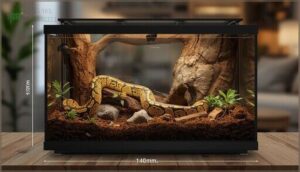
Getting the enclosure size right isn’t just about fitting your snake into a box—it’s about giving them room to live comfortably throughout their entire life. You’ll need to think about how long your snake will eventually grow, not just how small they’re now.
The space you provide directly impacts their physical health, stress levels, and overall quality of life.
Measuring Snake Length Accurately
You can’t rely on guessing—Visual Estimation Errors lead handlers to misjudge snake length by over a meter. Use the String vs. Ruler technique: lay a flexible string along your snake’s body to capture natural curves, then measure the string. Photographic Measurement with calibration objects works well for nervous animals.
Record Snout-Vent Length separately for precision. Accurate measurement ensures proper enclosure size, directly supporting snake health and effective reptile care.
Allowing for Adult Growth
When planning your snake enclosure, you’re making an investment in your pet’s entire lifespan. Snakes grow to their genetic potential regardless of enclosure size, so choose dimensions that accommodate adult size from the start.
A hatchling corn snake under 300g will eventually need 48″L x 24″W x 24″H, while juvenile ball pythons quickly outgrow 20-gallon tanks, requiring 4′ x 2′ x 2′ enclosures by adulthood.
Effects of Enclosure Size on Health
When your snake can’t stretch fully, the consequences extend beyond simple discomfort. Research shows that cramped enclosures increase obesity risks and reduce muscle tone through chronically low activity levels.
Inadequate snake enclosure size also correlates with spinal health problems and elevated stress hormones that suppress immune function.
For ideal snake care and animal welfare, providing space equal to your snake’s body length preserves physical fitness and fosters cognitive impacts through natural exploration behaviors.
Creating Optimal Temperature Gradients
Your snake can’t regulate its own body temperature, so you’ll need to create the right heat zones in its enclosure. This means setting up a warm basking area on one end and a cooler retreat on the other, giving your snake the freedom to move between them as needed.
Here’s how to establish and maintain these essential temperature gradients safely.
Basking and Cool Side Temperatures
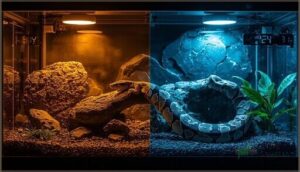
Think of your snake’s enclosure as a temperature gradient highway—snakes cruise between zones to regulate their body temperature. Set basking spots at 88–92°F to boost digestion rate and immune function, while cool zones should sit around 78–82°F. Night temperatures can drop slightly, mimicking natural cycles.
This thermal gradient gives your snake control over thermoregulation, supporting everything from metabolism to shedding.
Placement of Heaters and Thermostats
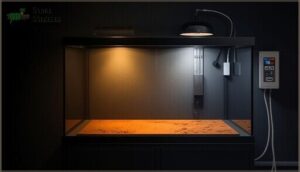
Your heating systems won’t work if probes and heaters land in the wrong spots. Position thermostat probes directly at the basking site—ideally on the glass above undertank heaters or near overhead fixtures—to capture accurate temperature control.
Cover roughly one-third of the floor with heat mats to build effective temperature gradients. Use proportional thermostats for overhead lamps and on/off models for mats, keeping each heat source on its own channel for precise gradient monitoring.
Preventing Overheating and Burns

Unregulated equipment causes most reptile burns—malfunctioning heat mats and hot rocks reach dangerous surface temperatures that injure snakes resting directly on them.
Connect every undertank heater and overhead lamp to a reliable thermostat for consistent temperature control. Shield all basking spots so your snake can’t touch bulbs, and check devices weekly for hot spots or water damage that compromise thermal gradient safety.
Maintaining Proper Humidity Levels
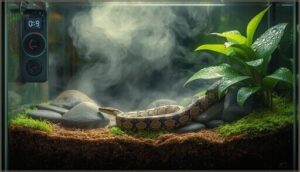
Getting humidity right isn’t guesswork—it’s one of the most critical factors in preventing respiratory infections and ensuring clean sheds.
Different snake species have evolved in vastly different environments, which means their moisture needs vary greatly.
Let’s break down how to identify your snake’s specific requirements, track humidity accurately, and adjust levels when they drift out of range.
Species-Specific Humidity Requirements
Different pythons and colubrids need different humidity levels—there’s no one-size-fits-all approach to species-specific care. Ball pythons need 60-80% humidity during the day, while corn snakes range from 65-75%. GTP fluctuations cycle between 40-70%, reticulated pythons maintain 65-90%, and kingsnakes vary between 40-60%.
Getting these numbers right prevents respiratory infections and shedding problems. That’s where precise hygrometry with a quality hygrometer becomes essential.
Using Hygrometers for Monitoring
You’ll need reliable equipment to track those humidity levels accurately. Digital hygrometers offer ±3% precision—far better than analog models that drift over time. Position your hygrometer midway up the enclosure’s side for the most accurate readings, and add a second unit inside humid hides if you’re running them.
Here’s your monitoring protocol:
- Check readings twice daily to catch fluctuations early
- Recalibrate every 3-6 months to maintain brand reliability
- Place probes at snake height—on substrate for terrestrial species, elevated for arboreal
- Invest in rapid-sampling models that update every 10-30 seconds
- Cross-reference with visual cues like shedding quality and respiratory sounds
Digital accuracy matters because even small deviations affect respiratory health. Pair your hygrometers with thermostats for complete environmental control, and you’ll prevent most humidity-related problems before they start.
Methods to Increase or Decrease Humidity
Once your digital hygrometer shows you need adjustments, you’ve got several proven methods. Misting systems raise humidity levels quickly—program 30-second bursts every 4 hours for consistent results. Water evaporation from bowls placed near heat sources works passively.
Substrate choice matters too; coconut fiber holds moisture while aspen stays dry.
Ventilation control and room adjustment with dehumidifiers bring levels down when they climb too high.
Selecting Safe and Effective Substrates
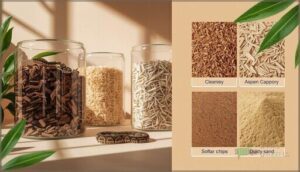
The substrate you choose forms the foundation of your snake’s environment, directly affecting both hygiene and your pet’s comfort. Some materials support natural behaviors like burrowing, while others can actually harm your snake’s respiratory system or skin.
Let’s examine the safest options and the ones you need to avoid entirely.
Recommended Substrate Materials
Your substrate selection shapes daily care routines and your snake’s comfort. Aspen shavings work well for species preferring moderate humidity, offering excellent absorbency and minimal dust. Coconut husk retains moisture effectively, supporting tropical snakes that need higher humidity. Cypress mulch provides a balanced option for intermediate conditions.
Paper-based bedding simplifies substrate hygiene through easy replacement, making daily maintenance straightforward when you spot-clean regularly.
Toxic Substrates to Avoid
While safe substrate selection protects snake health, certain materials actively harm your pet. Avoid these nontoxic-sounding but dangerous options:
- Aromatic shavings (cedar, pine) release volatile compounds causing respiratory problems and liver stress
- Calcium sand clumps and hardens inside the digestive tract
- Walnut shells create sharp particles that damage intestinal tissue
- Corncob bedding generates harmful ammonia and airborne particulates
- Printed paper releases chemical vapors when heated
Choose proven snake care substrates instead.
Bioactive Vs. Traditional Substrates
When choosing between bioactive and traditional substrates, you’ll face distinct trade-offs in maintenance and cost analysis. Bioactive systems establish self-sustaining ecological balance through waste breakdown by microfauna, reducing replacement frequency while supporting natural behavioral impacts.
Traditional options like aspen offer higher sanitation levels through regular changes but lack ecosystem establishment benefits.
Your substrate selection affects humidity levels, temperature gradients, and environmental control—consider your commitment level before deciding.
Substrate Depth for Burrowing
When your snake digs, burrowing depth needs vary by species—corn snakes thrive in 2–3 inches of substrate, while fossorial hognoses require 4–5 inches minimum for species-specific tunnels.
Deeper layers improve microclimate stability and reduce substrate compaction risks, letting your snake create secure hiding spots.
Always match substrate selection to natural behavior, giving larger individuals extra depth vs. security concerns in shallow hiding places within the snake enclosure.
Designing Enclosure Enrichment and Decor

Your snake needs more than just four walls and a water bowl to thrive. A well-designed enclosure with thoughtful enrichment elements reduces stress, encourages natural behaviors, and keeps your snake mentally and physically healthy.
Let’s look at the key features that transform a basic setup into a secure, stimulating environment.
Essential Hides for Security
Your snake won’t thrive without proper hiding spots—they’re non-negotiable for stress reduction and natural snake behavior. Place at least two hides per snake enclosure, one on each thermal gradient end, ensuring suitable sizing where your snake fits snugly but completely.
PVC or resin materials meet material standards for durability and cleaning. Proper hide placement facilitates thermoregulation while giving your snake the security it instinctively craves in its habitat.
Climbing and Exploration Elements
Ever noticed how a cramped snake habitat feels like living in a hallway with no doors? Vertical Space transforms enclosure requirements—snakes climb, bask, and explore when given proper Branch Material and Perch Diameter. For Climbing Safety and environmental enrichment, rotate structures regularly. Try these:
- Secure climbing branches
- Mixed perch angles
- Hammocks or shelves
- Routine Enrichment Rotation
Incorporating Live or Artificial Plants
Imagine boosting humidity levels and ecological balance simply by adding live plants—Boston ferns and pothos excel at humidity regulation in snake habitats. Yet, plant toxicity risks from pesticides or sap mean safe plant choices are essential.
Artificial plant advantages include zero maintenance and durability. For environmental enrichment, mixing live and artificial plants aids temperature gradients and keeps your enclosure visually engaging.
Monitoring and Maintaining Room Conditions
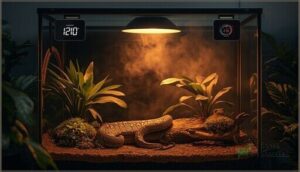
Keeping your snake healthy starts with controlling the room’s temperature and humidity. You’ll need the right tools and placement to track these conditions accurately.
Here’s what you should focus on when setting up your monitoring system.
Ambient Room Temperature Guidelines
Did you know a room running just a few degrees too hot can send pythons into a health spiral? Tropical Temperatures thrive at 80–82°F, while Temperate Ranges suit 70–80°F. Nighttime Drops mimic natural cycles, supporting thermoregulation.
Reliable temperature control—using thermostats, heating systems, and consistent monitoring practices—keeps gradients stable, preventing stress and serious Health Impacts for your snakes.
Room-Level Humidity Monitoring
Just as temperature gradients matter, tracking humidity levels across your room reveals invisible risks. Digital hygrometers offer ±1–3% Hygrometer Accuracy, much better than analog gauges. Spatial Variability means humidity near vents can differ by 10+ percentage points from enclosure height, directly affecting Enclosure Impact.
Consider these monitoring essentials:
- Calibrate sensors every 2–3 months using salt-test methods
- Place hygrometers at enclosure height, away from drafts
- Use Humidifier Use or Dehumidifier Use to maintain 40–60% baseline
- Track daily trends to prevent rapid moisture loss
Proper hygrometry protects against dysecdysis and respiratory stress.
Positioning Thermometers and Hygrometers
Humidity levels change fast, so probe placement matters as much as device security. For accurate readings, secure digital hygrometers and thermometers at snake level—one at each end for gradient coverage.
Daily checks help spot shifts in temperature or humidity. Tie probes to branches or hides, and use hot glue to prevent snake movement from skewing your temperature control.
Supporting Snake Health and Wellness
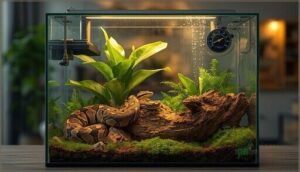
Keeping your snake healthy starts with careful attention to its environment and daily routines. There are a few key steps you can take to spot problems early and keep common issues at bay.
Let’s look at the essentials for maintaining wellness in your enclosure.
Early Detection of Health Issues
Frequently, subtle behavioral changes—like reduced exploration or altered posture—signal early shifts in snake health. Watch for appetite trends, such as skipped meals or regurgitation, and note any abnormal respiratory signs, including wheezing or open-mouth breathing.
Regular veterinary exams and periodic fecal screening are essential for animal health and wellness, catching issues before they threaten your reptile’s wellbeing.
Preventing Respiratory and Shedding Problems
Spotting health shifts early gives you an edge, but preventing respiratory and shedding problems means mastering the basics. Humidity Importance can’t be overstated—low humidity triggers incomplete sheds and breathing issues. Temperature Gradients, proper Ventilation Needs, and strict Hygiene Practices all help. Quarantine Protocols stop disease spread, especially in multi-snake rooms.
- Maintain correct humidity levels
- Establish stable temperature gradients
- Guarantee adequate ventilation
- Clean enclosures routinely
- Quarantine new arrivals
Importance of Regular Veterinary Care
Your snake’s long-term health hinges on wellness exams at least once a year. Reptiles mask illness until it’s too late, so early detection through preventive screening—fecal tests, weight checks, and husbandry reviews—saves lives and money.
Economic aspects matter: a routine visit costs less than treating late-stage disease. Owner adherence to veterinary guidance directly improves snake care and maintenance outcomes.
Frequently Asked Questions (FAQs)
What temperature should a snake enclosure be?
Think of your enclosure like a weather map—snakes need thermal gradients with basking temperatures around 85-95°F, cool zones at 72-84°F, and night drops to 70-78°F for proper thermoregulation using heating systems with thermostats.
How do you care for a snake’s enclosure?
You’ll need to clean your snake enclosure regularly, monitor temperature gradients and humidity levels, and make sure water quality stays fresh.
Check hiding spots for waste, verify enclosure security, and conduct routine checks for pests in your reptile habitat.
How do I choose a snake enclosure?
Many believe glass and PVC reptile enclosures perform identically, but material heat loss tests reveal otherwise.
You’ll want PVC for tropical species needing humidity stability, glass for display setups tolerating breakage risk and faster evaporation.
How do I choose a snake habitat?
Your snake habitat selection hinges on four priorities: enclosure material that retains humidity, adequate tank size allowing full extension, secure locks preventing escape, and proper ventilation maintaining air quality while supporting habitat complexity.
Do snakes need enclosures?
Yes, captive snakes require secure reptile habitat containment. Enclosure necessity stems from behavioral needs, stress reduction, and environmental control over temperature and humidity.
Proper snake enclosures with escapeproof lids prevent safety concerns while supporting natural behaviors and health.
How do you keep a snake healthy?
Keeping your snake healthy requires proper snake handling, recognizing illness signs early, meeting nutritional requirements, quarantining new arrivals, and establishing preventative care protocols.
Regular veterinary checkups and environmental control maintain reptile health and animal welfare.
How often should I clean snake room air filters?
You should inspect air filters monthly and replace them every 30–60 days in snake rooms. Bio-load considerations from animal-related particulates require more frequent HVAC filter replacement than standard residential intervals.
What lighting schedule is best for snake rooms?
You’ll want a consistent 12-hour light cycle for most captive snakes. This photoperiod maintains natural circadian rhythms, aids vitamin D3 synthesis with UVB lighting, and synchronizes feeding and activity patterns effectively.
Do snakes need UVB lighting in their enclosures?
While not strictly required for survival, UVB lighting offers documented benefits for many snake species. Corn snakes synthesize vitamin D3 under appropriate UVB exposure, supporting calcium metabolism and potentially preventing metabolic bone disease in captivity.
How do seasonal changes affect snake room conditions?
Winter temperature drops of 3–5°C demand heating systems adjustments, while summer overheating risks require active cooling.
Seasonal light cycles, humidity fluctuations, and equipment recalibration maintain proper environmental control and monitoring year-round.
Conclusion
Think of your snake room as a precision instrument rather than a storage space. When you dial in ideal snake room conditions—accurate temperature gradients, species-appropriate humidity, and thoughtful enrichment—you’re not just preventing problems. You’re creating an environment where your snake’s natural behaviors flourish.
Monitor parameters consistently, adjust as needed, and watch defensive animals become confident, feeding refusals disappear, and sheds complete flawlessly. Environmental mastery separates adequate care from superior husbandry.