This site is supported by our readers. We may earn a commission, at no cost to you, if you purchase through links.
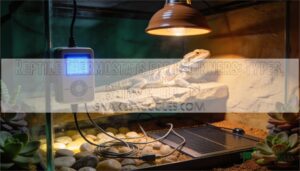
A reptile that stops eating, refuses to bask, or sits lethargic in the corner isn’t necessarily sick—it’s often just cold. Reptiles can’t generate their own body heat, so the temperature of their enclosure directly controls whether they digest food, fight off infection, or even move around normally. Get it wrong, and their biology stalls. A few degrees too low, and digestion slows to a crawl; too high, and you’re looking at thermal burns or worse.
That’s where reptile thermostats for beginners become less of an accessory and more of a lifeline. Without one, your heat mat or ceramic emitter runs at full power, unchecked, with nothing to catch a spike before it turns dangerous. The right thermostat holds temperatures within a tight, consistent range—giving your animal the stable environment its body actually needs to thrive.
Understanding which type fits your setup, and how to use it correctly, makes every other part of reptile care easier.
Table Of Contents
- Key Takeaways
- Why Reptile Thermostats Are Essential
- Types of Reptile Thermostats Explained
- Key Features to Look for in Thermostats
- Setting Up Your Reptile Thermostat
- Top 10 Reptile Thermostats for Beginners
- 1. BN Link Reptile Thermostat Controller
- 2. Inkbird Digital Temperature Controller Thermostat
- 3. Hydrofarm Digital Thermostat Controller
- 4. Vivosun Digital Heat Mat Thermostat Controller
- 5. Willhi Digital Temperature Controller Thermostat
- 6. iPower Digital Heat Mat Thermostat Controller
- 7. Bayite Digital Temperature Controller Thermostat
- 8. VivoHome Digital Heat Mat Thermostat Controller
- 9. Zoo Med Reptile Thermostat Controller
- 10. Zacro Digital Heat Mat Thermostat Controller
- Choosing The Right Thermostat for Your Reptile
- Maintaining and Troubleshooting Thermostats
- Optimizing Temperature Zones in Enclosures
- Common Beginner Mistakes to Avoid
- Frequently Asked Questions (FAQs)
- What is the easiest thermostat to set up?
- What are the different types of thermostats for reptiles?
- What should my Bearded Dragons thermostat be set at?
- Do I need a thermostat for a reptile enclosure?
- What are the different types of reptile thermostats?
- How to set up a thermostat for a reptile?
- Can I use one thermostat for multiple enclosures?
- Do thermostats work with ceramic heat emitters?
- How often should I calibrate my thermostat?
- What wattage heating element do I need?
- Conclusion
Key Takeaways
- Reptiles can’t make their own body heat, so without a thermostat keeping your enclosure in a tight temperature range, an unchecked heat mat can spike quickly enough to cause burns, stress your animal’s digestion, or start a fire.
- The four main thermostat types—on/off, pulse proportional, dimming, and digital—each suit different heat sources, so matching the right type to your setup matters as much as the temperature you set.
- Probe placement is the most common beginner mistake: if your sensor sits on the heat mat surface or too far from where your reptile actually rests, every reading you get is wrong before you even start troubleshooting.
- A thermostat alone isn’t enough—pairing it with a secondary thermometer, calibrating at least once a year, and checking probe placement monthly are what actually keep your reptile safe long-term.
Why Reptile Thermostats Are Essential
Keeping your reptile’s enclosure at the right temperature isn’t just important—it’s essential for their health and safety. A reliable thermostat gives you the control you need to prevent dangerous swings and stress.
Browsing reptile thermostats safe for kids’ rooms can help you find options that balance precision with child-friendly safety features.
Here’s what you should know before choosing the best setup for your pet.
The Importance of Temperature Control for Reptiles
Unlike mammals, reptiles are ectotherms — they can’t generate their own body heat, so they depend entirely on their environment to stay warm. That makes temperature regulation one of the most important parts of their care.
A proper thermal gradient inside the enclosure helps metabolic efficiency, healthy digestion, immune function, and behavioral thermoregulation.
Without it, growth rate slows and stress builds fast. Consistent temperature monitoring through a reliable thermostat gives your reptile what it needs to thrive every single day.
Risks of Not Using a Thermostat
When you skip a thermostat in your reptile setup, you’re inviting a whole set of risks that can spiral fast. Ectotherms like reptiles can’t escape Burns and Overheating if a heat mat or ceramic emitter runs unchecked—thermal burns and even fire hazard potential become real threats.
You might see sudden Humidity Fluctuations too, as uncontrolled heat dries out the enclosure, making proper shedding and hydration nearly impossible.
Temperature fluctuations stress your reptile’s metabolism, leading to poor appetite and sluggish digestion.
Without safety features, equipment failure risk climbs—worn cords or overheated elements can break down or spark.
Ask yourself: is it worth gambling with these dangers?
- Thermal burns from overheated surfaces
- Dangerous fire hazard potential
- Unstable humidity, harming skin and shed cycles
- Metabolic stress from erratic temperatures
- Higher risk of equipment failure without safeguards
Benefits for Reptile Health and Safety
All those risks make it clear—stable temperature control is the backbone of reptile health.
With a thermostat, you get safety features like temperature alarms and automatic shutoffs, which lower fire risk and prevent burns.
Consistent heat helps stable metabolism and digestion, while reliable temperature accuracy keeps stress low. Even hygiene improves, since a well-regulated habitat is easier to clean and safer for your animal’s routine.
| Benefit | How It Helps | Key Feature |
|---|---|---|
| Reduced Fire Risk | Prevents overheating | Safety features |
| Stable Metabolism | Helps digestion | Temperature accuracy |
| Stress Minimization | Predictable warmth | Consistent control |
| Hygiene Improvement | Cleaner habitat | Stable conditions |
| Consistent Digestion | Regular basking zones | Secondary thermometer |
Types of Reptile Thermostats Explained
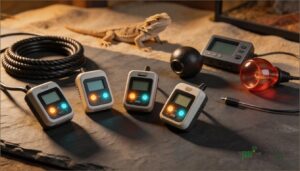
Not all reptile thermostats work the same way, and picking the wrong type can mean unstable temps or a fried heat bulb. Each type is built for specific heat sources and setups, so understanding the differences actually matters.
Here’s a breakdown of the four main types you’ll come across.
On/off Thermostats
An on/off thermostat works exactly how it sounds — power cycling on when the probe drops below your set temperature, then cutting off once it hits the target. It’s simply wired, low-cost, and genuinely beginner-friendly.
The catch? That power cycling creates a temperature swing, so it’s not ideal for basking bulbs. Stick to heat mats or ceramic emitters for best results.
Perform regular temperature checks to guarantee safe operation.
- Cost efficiency — usually under $25
- Probe dependence — secure placement is everything
- Best match — non-light-emitting heat sources only
Pulse Proportional Thermostats
Pulse proportional thermostats work differently from basic on/off units — instead of cutting power completely, they use Pulse Width Modulation to deliver rapid bursts of electricity, giving you Fine Power Control over your heat source. Think of it like tapping a brake pedal rather than slamming it. That Rapid Temperature Response keeps fluctuations within about 0.5–2°C, which matters a lot for species needing stable basking zones.
Here’s what sets them apart:
- Continuously adjusts pulse duration for precise temperature accuracy
- Delivers Energy Efficiency Gains by avoiding full-power spikes
- Offers a wide temperature range, often 20–50°C
- Safety features include probe-failure overrides and overcurrent protection
- Some models offer Multi‑Zone Pulse Management and dual relay outputs for complex setups. The HTPWHR model offers a high‑range 600 W load capacity for powerful ceramic heaters.
Dimming Thermostats
Fine-tuning your reptile’s heat with dimming thermostats means steady, gradual power modulation—no harsh spikes, just smooth phase-angle control. These units pair best with incandescent or ceramic heat sources, keeping basking zones stable.
Safety alarms kick in if temperatures creep above safe levels, and calibration procedures guarantee accuracy.
Compared to on/off models, PID dimming offers tighter control. Here’s a quick comparison:
| Feature | Dimming Thermostat | On/Off Thermostat |
|---|---|---|
| Power Modulation | Smooth, gradual | Full cut-off |
| Heat Source Pairing | Incandescent, ceramic | Any |
| Safety Alarms | Yes | Sometimes |
| Calibration | Required | Basic |
| Temperature Swings | Minimal | Larger |
Analog Vs. Digital Thermostats
When choosing between an analog and digital thermostat, the difference really comes down to precision versus simplicity.
- Analog models use a mechanical dial—low power consumption, rugged reliability, and no software to glitch
- Digital thermostats display readings to one decimal, making the calibration process straightforward
- The user interface on digital units is beginner-friendly, with clear buttons and LCD screens
- Reliability concerns favor analog in surge-prone setups
- Digital offers a natural upgrade path as your collection grows
Key Features to Look for in Thermostats
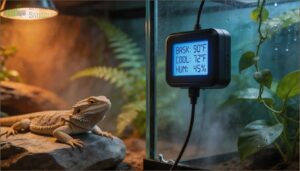
When you’re picking out a thermostat, there are a few features that make all the difference for your reptile’s safety and comfort. The right model keeps temperatures steady and gives you peace of mind.
Here’s what you’ll want to look for as you compare your options.
Prioritize a device that logs readings continuously and supports periodic recalibration, since this guide to monitoring humidity and temperature together explains why consistent tracking beats one-off checks.
Temperature Accuracy and Control
Did you know even a small temperature swing can stress your reptile? Accurate control is the backbone of safe husbandry.
To keep your pet thriving, you need more than just a good probe—you need smart features that tackle Calibration Drift Management and Thermal Lag Compensation. Look for:
- Dual Probe setups for multi-zone accuracy
- PID vs OnOff thermostat technology for stable temperature range
- Resolution Bit Depth and Noise Filtering Techniques for precise readings
- Hysteresis Settings and temperature alarms for early warning
These tools help you catch errors before they become problems.
Programmable Settings
Imagine setting your reptile’s day‑night temperature cycling with just a few taps—no more guesswork or constant tweaks.
Flexible Scheduling lets you automate temperature setpoints for morning, day, and night, while Schedule Import makes switching routines easy.
Program Lock prevents accidental changes, and Battery Backup keeps your settings safe during power loss.
Temperature History shows real-time trends, helping you fine‑tune the temperature band.
Software programming thermostats with PID vs OnOff technology deliver consistent, species‑appropriate control.
Safety and Fail-safes
A good thermostat doesn’t just control heat — it protects your reptile when something goes wrong. Emergency Shutdown triggers within 100 milliseconds of an overheat event, while Redundant Sensors cross‑check readings so one faulty probe won’t cause a false alarm. Power Failover switches to a backup supply in under 5 milliseconds, and a Self‑Test Routine runs every 24 hours automatically.
Look for these four safety features:
- Hardware Interlock — cuts power if the enclosure lid opens
- Temperature alarms — alert you within 60 seconds of unsafe conditions
- Probe failure auto shutoff — disables heating when sensor drift exceeds 2°F
- Overheat protection — locks the heater off until you manually reset it
Always verify readings with a secondary thermometer.
Compatibility With Heating Devices
Once your safety systems are in place, focus on heat source compatibility with thermostats. Always match wattage load capacity—your thermostat should handle the combined wattage of all connected heaters.
For heat mats, pair with on/off units rated for their output.
Heat lamps demand careful Relay Type Selection. Multi-Channel Control or dual relay models let you manage both a basking lamp and mat separately.
Use proper Probe Wiring Gauge and guarantee Dry Contact Isolation for reliability.
Setting Up Your Reptile Thermostat
Getting your reptile thermostat set up right is key for safe and steady temperatures. There are a few steps you’ll need to follow to make sure everything works as it should.
Here’s what you need to know before you start.
Placing The Temperature Probe Correctly
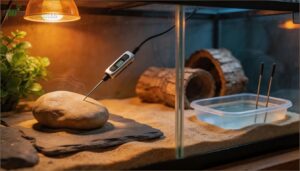
Although it’s tempting to drop your temperature probe anywhere, careful placement is the backbone of accurate reptile care. Your probe’s location shapes every reading—so follow these temperature probe placement guidelines:
- Warm Zone Positioning: Place the probe at head height, 2 inches from the basking site, avoiding glass interference and direct heater contact.
- Middle Zone Alignment: Secure probe mounting halfway between heat and cool areas, using the right probe length.
- Cool End Placement: Keep a waterproof probe away from moisture, verify with a secondary thermometer for peace of mind.
Connecting to Heating Elements
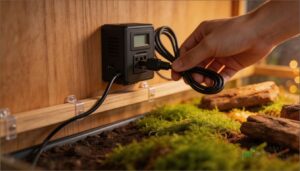
With your probe in place, it’s time to connect your heat source — and the power sequence here matters.
Start with everything unplugged.
Plug your thermostat into the wall first, then plug your heat mat or basking lamp into the thermostat’s output socket.
Never reverse that order.
Check the socket rating before you start — most units handle up to 1,000 W, so your heater needs to stay under that limit.
For dual relay thermostats for heating and cooling, you’ll have separate outlets for each function.
Mind your cable management to keep cords clear of water, and verify grounding safety and heat source compatibility with thermostats before powering up.
Initial Temperature Calibration
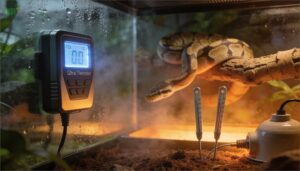
Once everything’s connected, set your thermostat within 1–2 degrees of your species’ recommended temperature range — that’s your baseline temperature recording. Let the enclosure run for 24–48 hours and watch for temperature drift before touching anything.
Then use a secondary thermometer at the same calibration point to check thermostat accuracy. If readings differ by more than 1°F, adjust your setpoint in small half-degree steps.
Avoiding Common Setup Mistakes
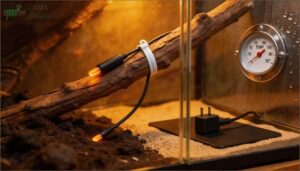
Three mistakes catch beginners off guard every time.
First, burying the temperature probe in substrate throws off your readings — follow temperature probe placement guidelines and secure it at basking height using zip ties.
Second, skipping secondary thermometer checks means missing calibration frequency checks that catch drift early.
Third, ignoring power supply matching risks heat overload prevention failures.
Always enable high/low temperature alarms before your reptile moves in.
Top 10 Reptile Thermostats for Beginners
Choosing the right thermostat makes all the difference in keeping your reptile safe and comfortable. There are plenty of beginner-friendly models out there, each with their own strengths.
Here’s a rundown of the top options to help you find what fits your setup best.
1. BN Link Reptile Thermostat Controller
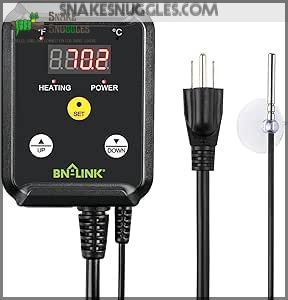
The BN Link Reptile Thermostat Controller is one of those rare budget picks that actually punches above its weight. What makes it stand out is the dual outlet design — one outlet controls heating, the other controls cooling, and both run independently from a single compact unit. That’s genuinely useful when your enclosure needs more than just a heat mat.
The waterproof probe reads temperatures accurately across a wide range, and the digital display lets you switch between Fahrenheit and Celsius without digging through a manual. Setup is straightforward: plug in, attach the probe, set your target temperature, and you’re done.
Built-in overload protection controls up to 1,000W safely, so common heat mats and lamps won’t overwhelm it. The ETL certification adds an extra layer of confidence. For beginners who want reliable dual-stage control without a steep learning curve, this one delivers.
| Best For | Beginners and hobbyists who need simple, reliable temperature control for reptile enclosures, plants, or home brewing. |
|---|---|
| Temperature Range | 32°F–113°F |
| Max Wattage | 1000W |
| Display Type | Digital LCD |
| Probe Type | Waterproof |
| Control Type | Dual outlet (heat+cool) |
| Power Outage Memory | Not specified |
| Additional Features |
|
- Easy 3-button setup and clear digital display
- Handles up to 1,000W with built-in overload protection and ETL certification
- Versatile for different heating devices and applications
- Not suitable for cooling devices or applications
- Sensor probe shouldn’t be immersed in water or exposed to overheating
- Some users report issues with temperature accuracy and reliability
2. Inkbird Digital Temperature Controller Thermostat
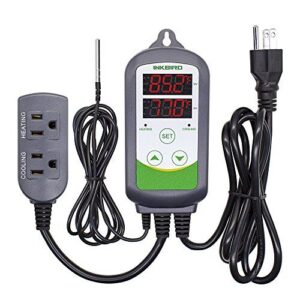
When you’re aiming for steady, reliable climate control in your reptile enclosure, the Inkbird Digital Temperature Controller stands out for both precision and convenience. Its dual-relay system means you can manage heating and cooling at the same time—no need for separate devices. The backlit LCD shows both the current temperature and your setpoint, so you won’t be guessing. If temperatures slip outside your safe range, a buzzer alarm lets you know right away.
Wi-Fi connectivity is a real bonus here. You can check and adjust settings from your phone, whether you’re in the next room or miles away. The probe is waterproof and built to handle humidity, making it suitable for snakes, lizards, or amphibians. With a 1100W capacity and wide temperature range, this controller fits most beginner setups, from terrariums to homebrew projects.
| Best For | Hobbyists and DIYers who need reliable dual-relay temperature control for reptile enclosures, brewing setups, aquariums, or any project where both heating and cooling need to be managed from one device. |
|---|---|
| Temperature Range | 32°F–212°F |
| Max Wattage | 1100W |
| Display Type | Backlit LCD |
| Probe Type | Waterproof |
| Control Type | Dual relay (heat+cool) |
| Power Outage Memory | Not specified |
| Additional Features |
|
- Dual-relay design handles heating and cooling simultaneously, so you don’t need two separate controllers
- Wi-Fi connectivity lets you monitor and adjust temps from your phone no matter where you are
- Built-in alarm buzzer alerts you the moment temps drift out of your safe range
- Google Home integration is basically cosmetic—you can’t actually control or query the device through it
- The sensor is non-replaceable, so any damage means replacing the whole unit
- Temperature logging only updates every 15 minutes, which isn’t great if you need tighter data tracking
3. Hydrofarm Digital Thermostat Controller
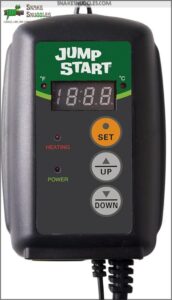
Ever wondered how you can keep your reptile’s heat mat running safely, without hovering over the enclosure all day? The Hydrofarm MTPRTC is a practical solution, especially if you’re starting out. Its ETL-certified safety means you won’t have to second-guess electrical reliability—a rare feature among thermostats. With a digital display, you can set and monitor temperatures from 68°F to 108°F, switching easily between Celsius and Fahrenheit.
Just remember to place the mat beneath solid glass rather than mesh or thick substrate—this guide to choosing and safely positioning reptile heating pads walks you through getting the setup right from the start.
The water-resistant probe and flat six-foot cord let you position it right where your reptile feels the warmth. For instance, you can lay the probe directly on the mat for accurate feedback. The LED indicator shows when heating is active, so you’ll know at a glance if your setup is working. Just remember: the lightweight controller needs securing, since the cable can tip it off surfaces. It’s simple, effective, and designed for your peace of mind.
| Best For | Reptile owners, hobbyist growers, and home brewers who want a simple, reliable way to control heat mat temperatures without constant manual monitoring. |
|---|---|
| Temperature Range | 68°F–108°F |
| Max Wattage | 1000W |
| Display Type | Digital LED |
| Probe Type | Water-resistant |
| Control Type | On/off heating only |
| Power Outage Memory | Not specified |
| Additional Features |
|
- ETL-certified safety approval — it’s the only thermostat on the market with this certification, so you’re not gambling on electrical reliability
- Digital display lets you dial in temps from 68°F to 108°F in either Celsius or Fahrenheit, with an LED that tells you at a glance if the heat is on
- The 6-foot flat probe cord is easy to tuck right onto the mat for accurate, real-time temperature feedback
- The cable is heavy enough to tip the unit off surfaces, so you’ll need to find a way to keep it secured
- No built-in timer means you’ll have to handle scheduled on/off cycles yourself or grab an external timer
- Changing the temperature requires a 3-second button hold, which gets a little tedious if you’re making frequent adjustments
4. Vivosun Digital Heat Mat Thermostat Controller
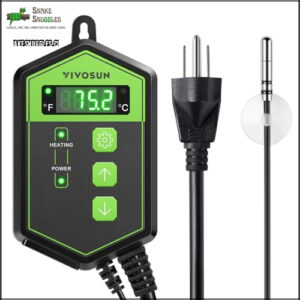
At just $17.09, the VIVOSUN Digital Heat Mat Thermostat punches well above its price tag. It controls heat mat temperatures across a 40°F to 108°F range — wide enough to cover most common reptile setups, whether you’re keeping ball pythons or leopard geckos. The LCD display shows your current and target temperatures at the same time, so you’re never guessing where things stand.
The three-button interface keeps things simple: hold set, then nudge the temperature up or down. Done. The included sensor probe monitors substrate warmth accurately when placed near your mat. Worth noting — as an on/off controller, you may see temperature swings of 4 to 5°F around your setpoint, which is normal for this type.
Its fortified plastic housing resists wear, and the angled socket keeps cords tidy. For beginners on a budget, this is a solid, no-fuss starting point.
| Best For | Beginners and budget-conscious reptile keepers who need a simple, reliable way to regulate heat mat temperatures without spending a lot. |
|---|---|
| Temperature Range | 40°F–108°F |
| Max Wattage | 1000W |
| Display Type | LCD |
| Probe Type | Standard sensor |
| Control Type | On/off heating only |
| Power Outage Memory | Not specified |
| Additional Features |
|
- Affordable at $17.09 — hard to beat for what you get
- Easy three-button setup means no learning curve
- Included probe gives you accurate substrate readings right out of the box
- On/off cycling can cause 4–5°F temperature swings around your setpoint
- Probe suction cup tends to slip, which can throw off your readings
- Some units arrive dead or fail after a few months of continuous use
5. Willhi Digital Temperature Controller Thermostat
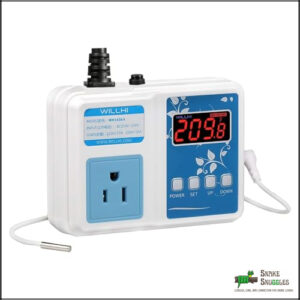
The Willhi WH1436A is one of those controllers that quietly does a lot more than its price suggests. It manages up to 1,100 watts of heating load, which covers most heat mats and ceramic emitters you’d use in a beginner setup. The 9.8-foot waterproof probe is a genuine advantage — long enough to position precisely where your reptile actually sits, not just near the heater.
What sets it apart from simpler on/off units is its dual-mode operation. You can switch between heating and cooling control, making it useful for species with stricter temperature requirements. Accuracy sits at ±0.5°F, and settings survive power outages without resetting. The built-in compressor delay also protects any connected equipment from rapid cycling damage.
temperature range runs from -58°F to 230°F — far beyond what most reptile enclosures need, but that headroom means it won’t strain under normal conditions.
| Best For | Hobbyists and beginners who need a simple, reliable way to control temperature for reptile enclosures, fermentation, seedling germination, or other DIY setups without any wiring or tech headaches. |
|---|---|
| Temperature Range | -58°F–230°F |
| Max Wattage | 1100W |
| Display Type | Digital LED |
| Probe Type | Waterproof 9.8ft |
| Control Type | Dual mode (heat+cool) |
| Power Outage Memory | Yes |
| Additional Features |
|
- Switches between heating and cooling modes, so it works with heat mats, lamps, or even a mini fridge
- The 9.8-foot waterproof probe gives you plenty of reach to place the sensor exactly where it matters
- Settings stay saved after a power outage, so you’re not constantly reprogramming it
- Capped at 1,100W, which may not cut it for larger or higher-powered refrigeration units
- Temperature overshoot can happen with slow-releasing heat sources like ceramic inserts
- Only works with 110V U.S. outlets — no 220V support
6. iPower Digital Heat Mat Thermostat Controller
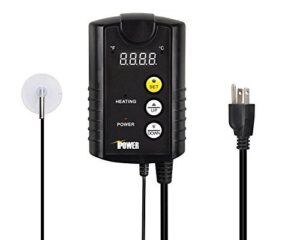
If the Willhi felt like a professional-grade tool, the iPower Digital Heat Mat Thermostat Controller brings things back to basics — and that’s not a knock against it.
For beginners running a single heat mat under a ball python or corn snake enclosure, this controller covers exactly what you need. It manages loads up to 1,000 watts, controls temperatures between 40°F and 108°F, and features LED indicators that tell you at a glance whether the heater is running. No guesswork.
It’s an on/off unit, so expect minor temperature swings of 1–2°F as it cycles your mat on and off. That’s normal for this type, and well within safe range for most beginner setups. The metal-tipped probe and grounded three-prong plug add a solid layer of reliability. Settings also hold through power interruptions, so a brief outage won’t reset your target temperature.
| Best For | Beginners who need a simple, reliable thermostat for a single heat mat setup with snakes, small reptiles, or starter grow trays. |
|---|---|
| Temperature Range | 40°F–108°F |
| Max Wattage | 1000W |
| Display Type | LED indicator |
| Probe Type | Metal-tipped |
| Control Type | On/off heating only |
| Power Outage Memory | Yes |
| Additional Features |
|
- Easy plug-and-play setup with no complicated configuration
- LED indicator lets you see at a glance whether the heater is on or off
- Handles up to 1,000 watts and works with most standard heat mats
- On/off cycling can cause small temperature swings of a few degrees
- Probe can’t be submerged, so it’s not ideal for wet or aquatic setups
- Some users report reliability issues once the warranty period is up
7. Bayite Digital Temperature Controller Thermostat
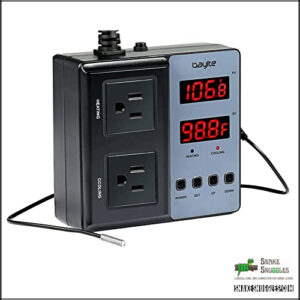
The iPower keeps things simple — the Bayite BTC201 goes a step further by giving you real control over both heating and cooling from a single unit.
That dual-relay design is the standout feature here. Most budget thermostats handle one job. The Bayite manages two, letting you a heater and a cooling fan independently without buying separate controllers. For aquariums, small greenhouses, or even a fermentation project alongside your reptile setup, that flexibility is genuinely useful.
The dual display window shows your current temperature and setpoint at the same time, so you’re never guessing where things stand. High and low alarms alert you before temperatures drift into dangerous territory, and compressor delay protection keeps equipment from short-cycling. The waterproof probe stretches 9.8 feet, the unit manages up to 1,100 watts, and settings survive power outages without resetting.
It’s a capable step up when one relay isn’t enough.
| Best For | Anyone running a small aquarium, greenhouse, or fermentation setup who needs one device to handle both heating and cooling without buying two separate controllers. |
|---|---|
| Temperature Range | 32°F–212°F |
| Max Wattage | 1100W |
| Display Type | Dual digital display |
| Probe Type | Waterproof 9.8ft |
| Control Type | Dual relay (heat+cool) |
| Power Outage Memory | Yes |
| Additional Features |
|
- Dual-relay design controls a heater and cooling fan at the same time — genuinely rare at this price point
- Dual display shows current temp and setpoint simultaneously, so there’s no toggling or guessing
- The 9.8-foot waterproof probe gives you plenty of reach for aquariums, fermentation chambers, or outdoor enclosures
- Only one setpoint, so you can’t program separate heating and cooling thresholds independently
- The manual is rough — expect some trial and error before everything behaves the way you’d expect
- Maxes out at 1,100 watts, which rules out anything bigger than small fans, heaters, or pumps
8. VivoHome Digital Heat Mat Thermostat Controller
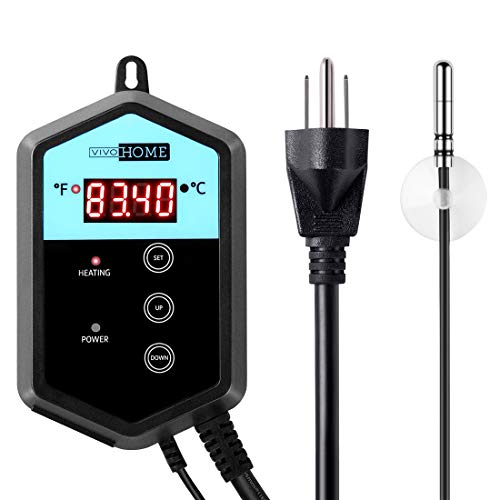
Where the Bayite manages dual relays, the VivoHome keeps it focused — heat mat, one job, done simply.
For keepers using heat mat over lamps or ceramic emitters, this controller covers the basics without overcomplicating things.
Its 40–108°F (5–42°C) range works well for most beginner setups.
The LED display is easy to read at a glance.
The three-button interface lets you adjust temperatures without hunting through menus.
The probe cord gives you decent placement flexibility, and the setup is genuinely plug-and-play.
That said, some users report readings drifting noticeably from actual enclosure temperatures.
That’s not unusual for budget units, but it does mean you shouldn’t rely on it alone — keep an independent thermometer nearby.
Check probe placement monthly.
| Temperature Range | 40–108°F (5–42°C) |
| Display | LED screen |
| Probe Cord | 6.4 ft |
| Interface | 3-button |
| Best For | budget heat mat setups with independent monitoring |
Best For: Beginner reptile keepers or hobbyists who need a simple, affordable heat mat controller and are happy to pair it with an independent thermometer for peace of mind.
| Temperature Range | 40°F–108°F |
|---|---|
| Max Wattage | 1000W |
| Display Type | LED screen |
| Probe Type | Standard 6.4ft |
| Control Type | On/off heating only |
| Power Outage Memory | Not specified |
| Additional Features |
|
- Dead simple plug-and-play setup — no menus to dig through, just three buttons
- Wide temperature range (40–108°F) covers most beginner reptile and plant setups
- Long probe cord gives you good flexibility on where to place the sensor
- Temperature readings can drift from actual enclosure temps, so you’ll need a backup thermometer
- Only handles one heat mat at a time — you’ll need a power strip for more
- Some users report reliability issues after a few months, especially on colder nights
9. Zoo Med Reptile Thermostat Controller
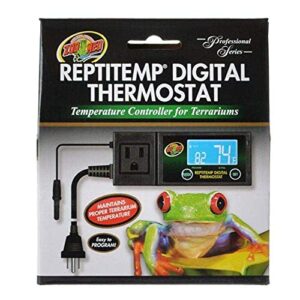
If the VivoHome keeps things minimal, the Zoo Med RT-600 steps it up — especially if your setup involves both a heat source and a cooling device.
That dual-mode capability is what makes it stand out. It supports heating devices up to 600 watts and cooling equipment up to 150 watts, which isn’t something you’ll find at this price point very often. The 50–122°F range covers most reptile species comfortably, from ambient zones to warm basking spots.
The six-foot remote sensor gives you real flexibility in probe placement, and the built-in memory means your settings survive power outages without resetting. The audible alarm and flashing display alert you when temperatures hit dangerous extremes — that kind of early warning matters.
One honest heads-up: the backlit display has no dimming option, so it stays bright even at night.
| Temperature Range | 50–122°F |
| Max Wattage | 600W (heating) / 150W (cooling) |
| Display | Backlit LCD |
| Probe Cable | 6 ft |
| Best For | Dual heating/cooling control in small to medium enclosures |
Best For: Reptile and amphibian keepers who need both heating and cooling control in a single device, especially those managing sensitive species that require stable temperatures around the clock.
| Temperature Range | 50°F–122°F |
|---|---|
| Max Wattage | 600W heating / 150W cooling |
| Display Type | Backlit LCD |
| Probe Type | Remote sensor 6ft |
| Control Type | Dual mode (heat+cool) |
| Power Outage Memory | Yes |
| Additional Features |
|
- Dual heat/cool mode in one unit — rare at this price point
- Six-foot sensor cable gives you flexible probe placement for more accurate readings
- Built-in memory keeps your settings intact after a power outage
- Only one outlet, so running multiple devices means adding a power strip
- The backlit display stays bright 24/7 with no dimming option
- The audible click each time it switches on or off can be noticeable in a quiet room
10. Zacro Digital Heat Mat Thermostat Controller
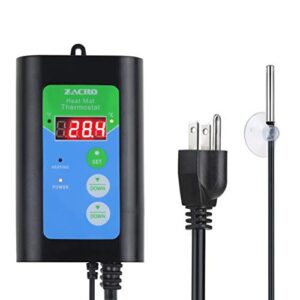
At under $20, the Zacro Digital Heat Mat Thermostat is hard to overlook if you’re just getting started and don’t want to spend big upfront.
It controls temperatures between 41°F and 108°F — plenty of range for most beginner setups — and the LED display is clear enough to read from across the room. The three-prong grounded plug and waterproof probe are solid safety touches for humid enclosures. Switching between Celsius and Fahrenheit takes just a hold of the UP or DOWN button for three seconds, which is a small but genuinely useful feature.
That said, accuracy can drift 1–2°F from your set point, so keep an infrared thermometer nearby as a backup check. It supports up to 1,000 watts, making it well-matched for heat mats specifically — not ceramic emitters or basking bulbs.
| Temperature Range | 41–108°F |
| Max Wattage | 1,000W |
| Display Type | LED digital |
| Probe Included | Yes |
| Unit Options | °C / °F |
| Best For | Budget-friendly heat mat control for beginner reptile keepers |
Best For: Beginner reptile keepers who want a simple, affordable way to regulate heat mats without spending a lot upfront.
| Temperature Range | 50°F–110°F |
|---|---|
| Max Wattage | Not specified |
| Display Type | 7-segment digital |
| Probe Type | External wired |
| Control Type | On/off heating only |
| Power Outage Memory | Not specified |
| Additional Features |
|
- Easy to set up and use — no technical experience needed
- Clear digital display that’s readable from across the room
- Keeps heat mats from overheating, protecting your animals and equipment
- Temperature can drift 1–2°F off the set point, so a backup thermometer is a good idea
- Faulty probes on some units mean you should test it right out of the box
- Customer support runs through Amazon only, with no clear warranty backing
Choosing The Right Thermostat for Your Reptile
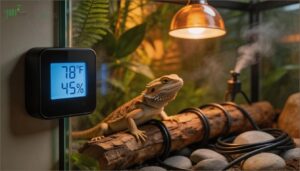
Picking the right thermostat comes down to three things: your reptile’s needs, your enclosure setup, and your budget. Not every thermostat fits every situation, so knowing what to look for saves you time and keeps your animal safe.
Here’s what to think about before making your choice.
Matching Thermostat Type to Species Needs
Not all reptiles need the same level of temperature precision — and that’s exactly where thermostat type makes a real difference. Desert species handle natural heat swings well, so a simple on/off thermostat usually does the job. Tropical gradient setups with narrow temperature ranges, though, need pulse proportional or dimming controls to stay stable. Nocturnal profiles benefit from programmable thermostats that drop temps automatically after dark.
Match your thermostat to your reptile: desert species need simple on/off control, while tropical and nocturnal species demand precision
- Amphibian humidity environments and stable temps (72–79°F) pair best with digital controllers
- Seasonal adjustments are easier with programmable or Wi‑Fi‑connected models
- Always match temperature range requirements to your specific species before buying
Considering Enclosure Size and Heat Source
Enclosure size directly shapes how hard your thermostat works. Larger habitats hold more air volume, which lowers heat density but demands smarter large enclosure heating solutions — think better airflow distribution, higher thermal mass materials, and careful vent placement to prevent cold pockets.
Heat source selection matters too: match your heat source compatibility, with thermostats to your setup size, and design your temperature gradient with the probe where your reptile actually sits.
Budget and Ease of Use for Beginners
Good temperature control doesn’t have to cost much. Budget-friendly reptile thermostat options like the BN-Link and Zacro start between $20–$35, offering a Plug‑and‑Play Design that gets you running fast.
Here’s what makes them beginner-worthy:
- Simple Wiring with minimal steps
- User‑Friendly Interface with large digital displays
- Basic Safety Features like auto-shutoff
- Affordable Power rated up to 1,000W
Easy operation, solid results.
Maintaining and Troubleshooting Thermostats
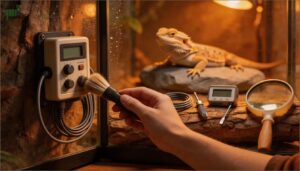
Even the best thermostat needs a little attention to keep doing its job right. dust, probe drift, and worn connections can throw off your readings without any obvious warning signs.
Here’s what to check, watch for, and do when things aren’t working the way they should.
Cleaning and Inspecting Equipment
Thermostat maintenance and calibration tips start with one simple habit: clean your probe after each use. Probe hygiene matters because residue and moisture cause false readings.
Wipe probes with 70% isopropyl alcohol, check cable integrity monthly for fraying or kinks, and inspect the housing for cracks.
Replace any worn seals for proper seal replacement. basic cleaning schedule keeps everything running safely and accurately.
Monitoring Temperature Consistency
Daily temperature checks catch problems before your reptile ever feels them.
Log readings every 15 minutes, and follow a solid probe calibration protocol — compare your temperature probe against a known reference thermometer at setup and annually after that.
Use alarm threshold settings to flag deviations beyond ±2°C.
Data logging frequency matters for trend analysis methods, and keeping a redundant sensor backup ensures temperature stability even when one sensor fails.
Addressing Common Thermostat Issues
Even careful monitoring doesn’t make your thermostat bulletproof. Issues still pop up, and catching them fast is what keeps your reptile safe.
Temperature drift between two and four degrees often points to poor temperature probe placement guidelines or electrical noise from nearby devices throwing off your sensor. Here’s what to check first:
- Test sensor calibration monthly against a reliable infrared thermometer
- Inspect all wiring for loose connections — wiring integrity matters more than most beginners expect
- Check power supply reliability by bypassing surge protectors that cause voltage fluctuations
- Look into firmware updates if your smart thermostat behaves erratically or skips schedules
- Set temperature alarms to alert you the moment readings drift beyond safe limits
If readings keep fluctuating despite stable room conditions, you’re likely dealing with one of several thermostat failure modes — probe faults, wiring corrosion, or compatibility mismatches, being the most common culprits.
When to Replace or Upgrade
Troubleshooting buys you time, but not forever. Most digital thermostats last five to seven years before thermostat failure modes—like sensor drift, worn relays, or software compatibility issues—make replacement the smarter call.
Watch for temperature accuracy slipping past ±2°F, missing security patches on smart models, or incompatible wattage ratings with newer heaters.
The cost benefit of upgrading early is real: modern units offer dual high/low temperature alarms, better energy efficiency, and stronger safety certification.
Don’t wait for a full breakdown—your reptile can’t afford that gamble.
Optimizing Temperature Zones in Enclosures

Getting your reptile’s temperature zones right makes a real difference in how healthy and active they stay. It’s not just about hitting one number — it’s about creating a gradient your animal can actually use.
Here’s what to focus on when building and fine-tuning those zones.
Creating Basking and Cool Areas
Your reptile doesn’t want one temperature — it needs options. Set up your basking area at one end using a basking lamp above a non-skid basking platform made from rock or wood, ideally with reflective heat backing to spread warmth evenly.
Aim for 32–38°C at the basking surface. Then let the opposite side cool to 20–25°C, adding cool zone hides where your reptile can escape the heat.
That contrast is the whole point of a temperature gradient.
Using Multiple Thermometers for Verification
Once you’ve set up your temperature gradient, don’t just trust a single display. Multi-Device Validation is how you confirm what’s actually happening inside the enclosure.
Use a dual probe setup — one at the basking surface, one at animal level — as part of your Spatial Temperature Mapping routine.
Here’s what solid temperature monitoring tools for reptiles look like in practice:
- Compare readings across zones using Calibration Protocols quarterly
- Apply Reference Bath Testing against ice water to evaluate sensors
- Flag anything beyond ±1°C through Error Margin Assessment
- Follow temperature probe placement guidelines to avoid false readings
- Log simultaneous data for secondary temperature verification
Adjusting Thermostat Settings Seasonally
As seasons shift, your thermostat settings need to shift with them. In winter, raise daytime basking temps by 2–4°C using Seasonal Setpoint Scheduling, then drop nighttime setpoints 3–5°C for smarter day/night temperature cycling.
Spring calls for gradual 1–2 degree changes every few days.
Run Probe Recalibration Timing after each adjustment, activate Energy Saving Modes to cut costs, and keep temperature alarms enabled so nothing slips past you.
Common Beginner Mistakes to Avoid
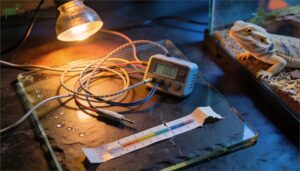
Even experienced keepers slip up sometimes, so it’s no surprise that beginners make a few predictable mistakes when setting up their first thermostat. Most of these errors are easy to fix once you know what to look for.
Here are the four most common ones worth avoiding right from the start.
Incorrect Probe Placement
Even a small probe placement mistake can throw off your entire setup. Vertical Position Errors happen when the probe sits too high or too low, missing the actual thermal gradient your reptile uses. Surface Proximity Issues arise when the probe rests on a heat mat, reading the mat surface heat instead of ambient air. Thermal Lag Effects delay the thermostat’s response when the probe sits too far from the heat zone. Watch for:
- Probe Slippage Risks from vibrations or maintenance shifting the placement by centimeters
- Incorrect probe length reaches into the enclosure’s warmest zone
- Waterproof probe exposure near water dishes causing skewed readings
Use Calibration Validation Steps with a secondary thermometer to confirm accuracy within ±1.5°C.
Overlooking Thermostat Compatibility
Compatibility isn’t a bonus feature—it’s the foundation of a safe setup.
Before buying, check these three things:
- Voltage Mismatch Risks: Confirm your heat source rating matches the thermostat’s supported range; pairing a 1,000W mat with a 300W unit causes overheating.
- Probe Signal Incompatibility: Temperature probe placement guidelines mean nothing if the probe doesn’t communicate correctly with your controller.
- Zone Controller Conflict: Missing C-Wire connections or Zone Controller Conflicts can cause erratic readings—especially with dual relay thermostats for heating and cooling.
Heat source compatibility with thermostats is non-negotiable.
Neglecting Regular Maintenance
Skipping maintenance is where most beginners quietly lose control of their setup. Probe Dust Buildup alone can throw off temperature accuracy by up to 10°F, and Calibration Drift compounds that over time.
Check for Power Cord Wear monthly, wipe probes to prevent Humidity Corrosion, and test Safety Cutout Failure indicators regularly.
Run probe calibration against a backup thermometer, and don’t ignore temperature alarms—they’re your first warning sign.
Ignoring Manufacturer Guidelines
Your thermostat’s manual isn’t just legal fine print — ignoring it can trigger warranty voidance, serious safety hazards, and real legal liability if your reptile is harmed. Incorrect probe placement causes performance degradation, producing inaccurate readings that stress or injure your animal.
Non-certified setups lose regulatory certifications for reptile heating devices and cut off support limitations when troubleshooting matters most.
Follow the guidelines — your reptile’s health depends on it.
Frequently Asked Questions (FAQs)
What is the easiest thermostat to set up?
For pure plug‑and‑play design, BN‑Link and Inkbird models win hands down.
Pre‑wired terminals, an straightforward UI, and a quick start guide mean easy operation — no programming needed, and a battery backup option keeps things running.
What are the different types of thermostats for reptiles?
Four main types exist: ON/OFF thermostats, pulse proportional thermostats, dimming thermostats, and analog or digital thermostat models — each designed to match different heat sources and control needs.
What should my Bearded Dragons thermostat be set at?
For a bearded dragon, set your basking spot to 104–107°F (40–42°C) for adults. Keep the cool zone around 77°F and let nights drop naturally to 70–75°F.
Do I need a thermostat for a reptile enclosure?
Yes, you absolutely need one. Without a thermostat, your heat source runs unchecked — temperatures can spike to dangerous levels within hours, putting your reptile’s health and life at serious risk.
What are the different types of reptile thermostats?
There are three main types of reptile thermostats: on/off units, pulse proportional models, and dimming thermostats — each controlling heat differently to suit specific heating devices and species needs.
How to set up a thermostat for a reptile?
Setting up a reptile thermostat comes down to four steps: place the probe correctly, connect your heat source, calibrate the temperature, and verify the readings before your reptile moves in.
Can I use one thermostat for multiple enclosures?
Technically, yes — but it’s risky. One thermostat controlling multiple enclosures can’t accurately sense each habitat. Use a dedicated probe and thermostat per enclosure to keep every animal safe.
Do thermostats work with ceramic heat emitters?
Thermostats work very well with ceramic heat emitters. Pulse Proportional Stability makes them the top pairing, keeping fluctuations under 1°C.
Dimming Incompatibility risks — most dimming models can damage ceramics through incompatible switching.
How often should I calibrate my thermostat?
Calibrate your thermostat at least once a year. Stick to a seasonal adjustment timing routine — spring and fall work well.
If readings drift more than 1–2°F from a separate thermometer, calibrate immediately.
What wattage heating element do I need?
Your wattage needs depend on enclosure size, wattage, heater type matching, and room temperature factor.
A 20-gallon tank generally needs around 40 watts, while 40-gallon setups need roughly
Always build in a safety headroom margin.
Conclusion
Precision pays off when perfecting your pet’s paradise. The right reptile thermostats for beginners transform guesswork into confidence, ensuring stable temperatures that shield against silent dangers.
Master setup, maintenance, and seasonal tweaks, and you’ll safeguard your scaly companion’s health while simplifying your routine. Consistent care isn’t optional—it’s the bedrock of their vitality.
With these tools and insights, you’re not just maintaining an enclosure; you’re crafting a thriving habitat where your reptile can truly flourish, one calibrated degree at a time.