This site is supported by our readers. We may earn a commission, at no cost to you, if you purchase through links.

The wrong substrate can kill a reptile slowly—through respiratory infections, impaction, or chronic stress from inadequate humidity. Most keepers learn this the hard way, usually after their first expensive vet visit.
Substrate bedding for large enclosures adds another layer of complexity because what works in a 40-gallon tank fails completely when you’re managing 8 cubic feet of living space. Moisture gradients shift, burrowing depths matter more, and maintenance mistakes compound fast. The right substrate does more than line the bottom of an enclosure—it regulates the entire microclimate your animal depends on.
Table Of Contents
- Key Takeaways
- Best Substrate Types for Large Enclosures
- Key Factors in Substrate Selection
- Top Substrate Bedding Products Reviewed
- Setting Up Substrate in Large Enclosures
- Substrate Maintenance and Replacement Tips
- Frequently Asked Questions (FAQs)
- What is the best substrate for a terrarium?
- What is the best substrate for a snake enclosure?
- Can substrate affect a reptiles overall stress levels?
- How does enclosure size impact substrate temperature gradients?
- Which substrates work best for egg-laying species?
- Are bioactive substrates safe for juvenile reptiles?
- How do substrate choices differ for arboreal species?
- Conclusion
Key Takeaways
- The substrate choice doesn’t just line the bottom of the enclosure — it controls humidity levels, supports natural behavior, and can either protect or slowly harm your reptile over time.
- Matching substrate to species matters more than personal preference: coconut fiber and sphagnum moss suit humid tropical setups, while aspen and cypress mulch are the safer call for drier environments.
- In large enclosures, depth and layering aren’t optional — burrowing species need 4 to 12 inches of bedding, and bioactive builds require a proper drainage layer underneath to prevent stagnant moisture from building up.
- Long-term success comes down to consistent maintenance: daily spot cleaning, monthly partial refreshes, and keeping an eye out for mold or odor will extend substrate life and keep your animal’s environment stable.
Best Substrate Types for Large Enclosures
Choosing the right substrate for a large enclosure can feel overwhelming — there are a lot of options, and they don’t all work the same way.
If you want a solid breakdown of what sets each option apart, this guide on reptile substrate types and their key differences is a great place to start.
Each type brings its own strengths and trade-offs depending on your reptile’s needs. Here’s a closer look at the most practical choices worth knowing.
Aspen Bedding
Aspen is one of the most trusted reptile bedding options for dry setups. Its standout aspen absorbency pulls moisture away quickly, making spot cleaning straightforward in large reptile enclosures.
Pack it several inches deep to support burrow formation and give burrowing species room to work. It’s safe, dust-reduced, and biodegradable — a practical terrarium substrate that keeps reptile health front and center.
You can learn more about the benefits of aspen for reptiles from this natural and sustainable material overview.
Coconut Fiber
Where aspen shines in dry setups, coconut fiber steps in for moisture-loving species. Made from coconut husks, this terrarium substrate absorbs several times its weight in water — giving you reliable humidity control without constant misting.
It’s safe if ingested in small amounts, facilitates burrowing naturally, and breaks down as compost after use. For reptile health and eco-friendliness, it’s hard to beat.
For further details on compostable and eco-friendly options, explore their coconut fiber substrate benefits.
Cypress Mulch
If coconut fiber takes care of the moisture work in tropical setups, cypress mulch brings its own strengths to the table. The natural cypress aroma doubles as mild pest resistance, while the wood properties slow decomposition — giving you real substrate longevity.
It’s a go-to for tortoise bedding and broader reptile enclosure design, supporting burrowing and steady humidity without turning your enclosure into a swamp.
LECA Balls and Drainage Layers
Where cypress mulch works the surface, LECA balls handle what’s underneath. These lightweight, porous pellets form a drainage layer at the bottom of your terrarium, keeping the water table well below your main substrate.
That separation is the backbone of solid reptile enclosure design — especially in bioactive systems. Proper substrate aeration, no stagnant pooling, and cleaner conditions for your animal overall.
Sphagnum Moss
Moss brings a toolkit of benefits to your reptile care routine. Its acidic properties discourage bacteria, making it a clean choice for tortoise bedding and humid hides.
Sphagnum’s water-holding ability delivers steady humidity regulation, supporting microfauna and live plants in bioactive substrates. You can rinse and reuse moss, extending substrate lifespan and keeping maintenance practical for large enclosures.
Key Factors in Substrate Selection
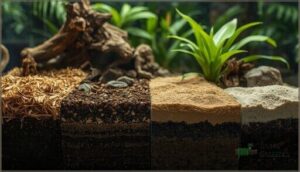
Picking the right substrate isn’t just about what looks good in the tank — it’s about what actually works for your animal. A few key factors will make or break your choice, and knowing them upfront saves you a lot of trial and error.
Depth matters more than most people think — substrate layering guides for humid enclosures can help you dial in the right balance between moisture retention and drainage.
Here’s what to weigh before you commit to any bedding.
Humidity Retention and Control
Humidity management starts with choosing the right substrate. Coconut fiber excels at water cycling — it holds moisture far longer than loose shavings, releasing it slowly to stabilize humidity levels throughout your enclosure.
Pair that with evaporation control by partially covering screen lids, and you’ll keep readings steady. Use humidity sensors at substrate level, not the ceiling, for accurate data.
Airflow management matters too — strong drafts dry bedding fast.
Burrowing and Enrichment Needs
Digging behavior is more than instinct — it’s how your reptile stays mentally sharp and physically healthy.
Fossorial needs vary by species, but most benefit from substrate texture that’s loose on top and slightly firmer below, allowing stable burrow design without constant collapse. Aim for 8 to 12 inches of bedding in large enclosures, and vary depth across zones for richer environmental enrichment.
Ease of Cleaning and Maintenance
Some substrates practically clean themselves — others turn daily spot cleaning into a chore you’ll dread. For reptile care and maintenance, your choice of tortoise bedding or loose substrate directly affects how quickly odors build and how often you’re doing full replacements.
Bioactive maintenance setups offer the longest intervals between deep cleans, while standard enclosures usually follow this routine:
- Daily spot cleaning removes waste before bacteria multiply.
- Weekly substrate sanitizing targets soiled patches and damp zones.
- Monthly odor control methods, like partial refreshes, keep the habitat stable.
Safety and Risk of Ingestion
Every substrate choice carries some ingestion hazards — fine coconut fiber and loose soil pass through the gut more safely than sharp bark or mid-sized chunks that are easy to gulp but hard to pass.
Substrate toxicity is a real concern too, since untreated, pesticide-free bedding matters as much as particle size. For solid reptile care, match your tortoise bedding to the animal’s feeding behavior to minimize digestive issues and gut blockages.
Cost and Availability
Cost can quietly become the biggest factor in your substrate decisions — especially for large enclosures. Here’s what shapes what you’ll actually spend:
- Farm Sourcing cuts bulk pricing dramatically — aspen bales run $15–$20 for 5 cubic feet at Tractor Supply, versus far more at chain pet stores.
- Seasonal fluctuations affect regional costs, with coconut coir easier to find cheaply during garden season.
- Wholesale options and online shopping open access to specialty reptile substrate blends unavailable locally.
Top Substrate Bedding Products Reviewed
With so many substrate options out there, it helps to know which ones actually hold up in large enclosures.
The three products below are worth your attention — each one brings something different to the table depending on your reptile’s needs.
Here’s a closer look at how they compare.
1. Zoo Med Forest Floor Bedding
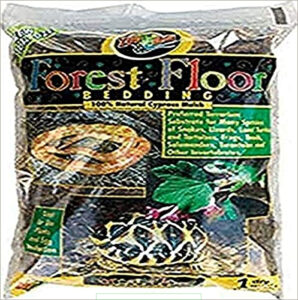
Zoo Med Forest Floor Bedding is one of those substrates that just works. Made from 100% natural cypress mulch — no dyes, no fillers — it absorbs moisture quickly and releases it slowly, keeping humidity stable for hours.
That makes it a solid pick for snakes, tropical tortoises, and amphibians. It’s ready to use straight from the bag, no soaking required. For large enclosures, the 24-quart bag covers a good amount of ground, and it layers well with soil-based setups too.
| Best For | Snakes, amphibians, tropical tortoises, and other humidity-loving reptiles or invertebrates that need a natural, moisture-retaining substrate. |
|---|---|
| Material | Natural cypress mulch |
| Primary Use | Reptile substrate |
| Species Compatibility | Snakes, lizards, frogs, tortoises |
| Weight | 10.6 pounds |
| Color | Natural brown |
| Setup Required | Spot-clean regularly |
| Additional Features |
|
- Made from 100% natural cypress mulch — no dyes or fillers, just a clean, natural look
- Holds humidity well, so you’re not constantly misting or monitoring levels
- Works great on its own or mixed with other substrates for easier spot cleaning
- Can get pricey if you have a large enclosure that needs a thick layer
- Some bags may have oversized pieces that could pose an injury risk and need to be picked out
- Hard to spot waste when used alone, so cleanup takes a little more effort
2. Zilla Reptile Bark Blend Substrate
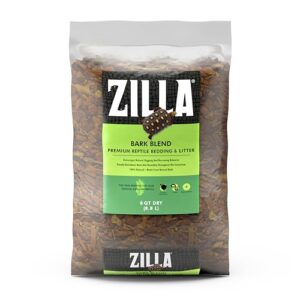
If cypress mulch is your go-to for humidity control, Zilla’s Bark Blend takes that idea a step further with 100% organic Douglas fir bark — no dyes, no additives. It’s heat-treated before packaging, so you’re not introducing mites or hidden pests into your enclosure.
The loose texture manages moisture well, absorbing it quickly and releasing it gradually after misting. It’s available in 8 and 24-quart bags, making it practical for larger builds without frequent restocking.
| Best For | Reptile owners setting up tropical or rainforest terrariums for chameleons, frogs, snakes, skinks, or rainforest geckos who want a natural, pest-free substrate. |
|---|---|
| Material | Fir bark |
| Primary Use | Reptile substrate |
| Species Compatibility | Chameleons, frogs, snakes, geckos |
| Weight | 3.2 pounds |
| Color | Brown |
| Setup Required | Occasional misting needed |
| Additional Features |
|
- Made from 100% organic fir bark and oven-dried, so no pests or additives sneak into your enclosure
- Absorbs moisture quickly and releases it slowly, which helps keep humidity levels steady without much effort
- Comes in 8 and 24-quart sizes, so it works whether you have a small setup or a bigger build
- Some bark chips run large, which might not be ideal for smaller reptiles
- Occasional long, narrow sticks mixed in that you’ll need to pick out by hand
- Can grow fuzzy fungus if the enclosure isn’t kept clean and well-maintained
3. Zoo Med Coconut Fiber Substrate
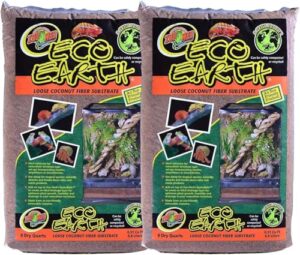
If fir bark doesn’t suit your setup, coconut fiber might be exactly what you’re looking for. Zoo Med’s Eco Earth comes in compressed bricks or loose 8-quart bags — both expand into a soft, soil-like substrate that holds moisture well without staying soggy.
It’s gentle on burrowing animals, biodegradable, and works beautifully in tropical builds when layered over HydroBalls for drainage. One honest drawback: it can get pricey for large enclosures needing frequent full replacements.
| Best For | Reptile, amphibian, and invertebrate keepers who want a natural, moisture-retaining substrate for tropical or burrowing setups. |
|---|---|
| Material | Coconut fiber |
| Primary Use | Reptile substrate |
| Species Compatibility | Reptiles, amphibians, invertebrates |
| Weight | 6.4 pounds |
| Color | Natural brown |
| Setup Required | Can be used damp |
| Additional Features |
|
- Holds humidity really well, making it great for tropical species that need a moist environment
- Soft and loose enough for animals that love to dig and burrow
- Works as part of a drainage system when layered with HydroBalls
- Can get expensive fast, especially for larger enclosures that need frequent substrate changes
- May arrive dry if you get an older batch, so you’ll need to rehydrate it before use
- Not a one-size-fits-all solution — some species just don’t do well with coconut fiber, so check before you buy
Setting Up Substrate in Large Enclosures
Getting the substrate setup right in a large enclosure makes everything else easier — humidity, burrowing, cleanliness, all of it.
There are a few key things to get right before you even add your first layer. Here’s what you need to know.
Recommended Substrate Depth
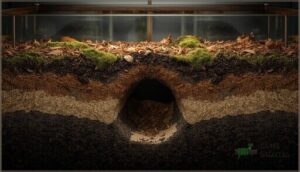
Depth matters more than most keepers realize. For burrowing species, aim for 4 to 6 inches of bedding — that’s the sweet spot for burrow formation and moisture control in any large terrarium.
A 4-by-2 foot enclosure needs roughly 80 quarts at 4 inches deep. Factor that into your enclosure design early, because substrate layering and reptile habitat supplies add real weight fast.
Layering for Bioactive Setups
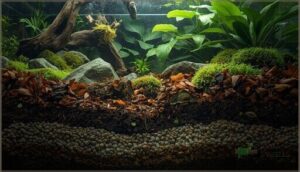
Think of a bioactive enclosure as a living system, not just a box with bedding. Start with a drainage layer, then add your soil mix, and finish with leaf litter on top.
If you’re setting this up for a ball python, our guide to creating an enriching ball python environment walks through the ideal enclosure zones and layout in detail.
That leaf litter feeds microfauna balance — springtails and isopods that quietly handle waste. Anchor visual hardscaping between layers for stability.
Bioactive layering done right means less cleaning, healthier animals, and a setup that genuinely works for itself.
Done right, bioactive layering creates a self-sustaining habitat that works harder than you do
Drainage and Mesh Separation
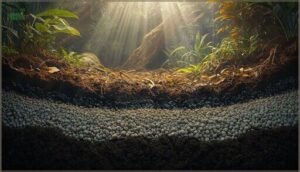
Beneath your substrate layers, drainage materials like LECA or lava rock do the heavy lifting in large bioactive systems — pulling excess water away before it turns stagnant.
Lay mesh screens directly on top of that drainage zone to keep your reptile substrate from sinking in and clogging water channels. This simple separation keeps your enclosure’s water management clean and your bioactive system actually functional.
Maintaining Proper Moisture Levels
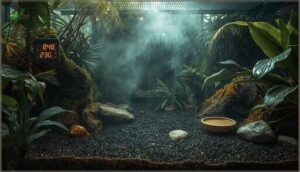
You’ll quickly notice how moisture management shapes your enclosure’s health. For steady humidity control, you’ll want to:
- Use digital hygrometers for accurate moisture monitoring.
- Mist or fog bedding as needed, adjusting evaporation rates.
- Position water dishes and substrate zones to balance humidity.
This approach keeps your substrate from swinging between dry and soggy, supporting your reptile’s well-being.
Substrate Maintenance and Replacement Tips
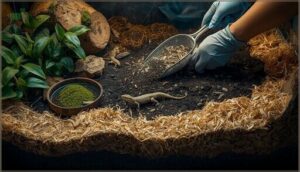
Keeping your substrate clean and healthy isn’t just about looks—it’s key for your reptile’s well-being.
Choosing beginner-friendly reptile substrates also makes routine cleaning easier while supporting your pet’s natural behaviors.
There are a few practical steps you’ll want to follow to make maintenance easier and more effective. Here’s what you should know before choosing how to care for your enclosure.
Cleaning Frequency and Methods
In a large reptile habitat, Daily Cleaning isn’t optional—it’s your safety net against odors and bacteria.
Waste Removal should happen every day, with deep cleans scheduled every four to six weeks for most bedding types.
For bioactive maintenance, you’ll rely on topping off substrate and replenishing microfauna, while sanitizing methods like F10SC keep your enclosure safe and healthy.
Spot Cleaning Vs. Full Replacement
Spot cleaning is your daily Waste Management routine—removing messes keeps Reptile Health steady and your Cleaning Schedules simple.
Full replacement, though, resets the entire Bedding layer, tackling hidden waste and compacted spots. For Bioactive Maintenance, spot cleaning preserves microfauna, while Substrate Rotation in non-bioactive Enclosure Setups prevents buildup.
Balance both methods to keep your Terrarium Substrate clean and efficient.
Monitoring for Mold and Odors
Ever notice a musty whiff or fuzzy patch in your reptile habitat? That’s your early warning system for Mold Detection and Odor Control.
Regular surface checks, especially under décor or in moist coconut fiber, paired with consistent Humidity Management and good Ventilation Systems, keep mold and odors at bay—key for Bioactive Maintenance and a healthy, stable substrate in large enclosures.
Extending Substrate Lifespan
Once you’ve got mold and odors under control, keeping your reptile substrate going longer is mostly about consistency.
Bioactive Systems with good Moisture Control can stay functional for years — think strategic Substrate Rotation, Cleaning Schedules, and topping off settled Tortoise Bedding or Coconut Fiber Substrate instead of full replacements.
Substrate Reuse works well when the base layer stays balanced. Skip Reptile Carpet — it traps waste fast.
Frequently Asked Questions (FAQs)
What is the best substrate for a terrarium?
The best terrarium substrate depends on your reptile’s needs.
Coconut fiber substrate works well for tropical species, while bioactive systems benefit from layered reptile substrate that promotes moisture control and natural reptile environments.
What is the best substrate for a snake enclosure?
For snake substrate, cypress mulch and coconut fiber are your strongest options.
Both support reptile wellness, manage humidity well, and keep your snake habitat clean — solid choices for any reptile habitat or enclosure design.
Can substrate affect a reptiles overall stress levels?
Yes — the substrate you choose directly shapes your reptile’s stress levels.
Proper humidity control, burrow security, and substrate comfort reduce anxiety, while poor substrate selection raises ingestion risks and triggers chronic stress.
How does enclosure size impact substrate temperature gradients?
Enclosure size directly shapes temperature gradients. Larger floors let heat dissipate naturally, creating a 10–20°F spread from warm to cool end — giving your reptile real gradient control and substrate depth choices.
Which substrates work best for egg-laying species?
Coconut fiber and sphagnum moss are the go-to reptile nesting materials for egg-laying species, offering reliable humidity control methods, safe burrow formation, and minimal ingestion risk — core priorities in any solid reptile care and maintenance plan.
Are bioactive substrates safe for juvenile reptiles?
Bioactive substrates can be safe substrates for juvenile reptiles, but only when substrate cycling, microbe management, and reptile development needs align.
Rushing the setup raises juvenile health risks, so always quarantine first.
How do substrate choices differ for arboreal species?
Arboreal species flip the script on substrate selection. Vertical space takes priority, so you only need a shallow base layer — just enough for humidity control and cushioning the occasional fall.
Conclusion
Getting substrate right isn’t about flawlessness—it’s about creating an environment where your animal doesn’t have to fight its own home to survive. Choosing the right substrate bedding for large enclosures means thinking in layers, gradients, and long-term maintenance rather than just what fills the bottom.
When your setup holds humidity without breeding mold, facilitates natural behavior, and stays manageable week after week, you’ll know the ground beneath your animal is finally working for it.