This site is supported by our readers. We may earn a commission, at no cost to you, if you purchase through links.

A ball python hatchling sheds its skin before it ever takes its first meal—sometimes within hours of birth.
That’s not a quirk.
It’s a biological reset, a signal that growth has already begun.
Snake growth and shedding rate are tightly linked processes driven by hormonal cycles, environmental conditions, and nutritional intake, not random timing.
Juveniles may shed every three to four weeks; adults slow to just two or three times a year.
Whatever the schedule, watch for those pre-shed cues—dull color and cloudy eyes appear right on time, and knowing how to handle a snake shedding in pieces can save you a lot of worry.
Understanding what controls that cycle gives you precise control over your snake’s health, growth trajectory, and long‑term condition.
Table Of Contents
Key Takeaways
- Shedding frequency is a direct readout of your snake’s growth rate — juveniles shed every 3–6 weeks, adults slow to just 2–4 times a year, and any deviation signals a husbandry or health problem worth investigating.
- Temperature and humidity aren’t background conditions; they’re the engine of the shedding cycle, and letting humidity drop below 60% is how you end up with retained eye caps and tissue death.
- Every shed does triple duty — it accommodates growth, strips parasites like Ophionyssus natricis, and replaces damaged tissue — so a clean, single-piece shed is your most reliable indicator that nutrition, hydration, and hormones are all dialed in.
- Chronic stress elevates corticosterone, suppresses growth, and triggers dysecdysis, meaning your snake’s incomplete sheds aren’t bad luck — they’re a direct consequence of the environment you’re maintaining.
What Drives Snake Growth and Shedding?
Snake shedding isn’t random — it’s a tightly regulated biological process tied directly to growth, skin health, and survival.
Getting the environment right plays a huge role in how smoothly this happens, and proper conditions for snake shedding can make the difference between a clean shed and a stressful one.
Three core drivers explain why and when it happens. Here’s what’s actually going on beneath the scales.
Biological Reasons for Shedding
Ecdysis isn’t just skin‑deep — it’s a full metabolic renewal driven by a precise hormonal cascade. Thyroid hormone regulation kicks off each cycle, triggering the formation of a new epidermal complex beneath the old layer. That process manages skin repair, growth accommodation, and parasite removal in one event.
Your snake sheds because it has to:
- Rigid keratin scales can’t stretch — new skin forms underneath first
- Bacteria and mites get wiped out with every discarded layer
- Damaged tissue gets replaced through systematic skin renewal
The new skin formation process is essential for parasite removal.
Growth Stages and Skin Renewal
Growth doesn’t pause — and neither does skin renewal.
From neonatal shedding within 24–72 hours of birth, your snake’s cycle is locked to its growth rate.
Juvenile snakes shed every 3–6 weeks under hormonal regulation driving rapid mass gain.
Adolescent molting stretches to 6–10 weeks.
Adult skin turnover slows to just a few times yearly.
| Life Stage | Shedding Frequency |
|---|---|
| Neonatal | Within 24–72 hours of birth |
| Juvenile | Every 3–6 weeks |
| Adolescent | Every 6–10 weeks |
| Adult | 2–4 times per year |
| Geriatric | Once or twice yearly |
Shedding also helps remove parasites and dirt, keeping the snake healthy.
Role of Shedding in Snake Health
Shedding does more than make room for a bigger body — it’s active maintenance.
Each shed cycle also signals how well your boa is eating, hydrating, and handling stress — track any irregularities with this guide to boa constrictor shedding problems.
- Parasite removal — mites like Ophionyssus natricis get stripped with the old skin, cutting infection risk quickly
- Skin repair — abrasions, scale rot precursors, and trapped bacteria shed away, exposing fresh, pathogen‑resistant tissue
- Eye vision reset — new spectacles replace clouded caps, restoring sharp visual acuity.
A perfect one‑piece shed signals your snake’s hydration, nutritional needs, and hormonal cascade are all dialed in.
How Often Do Snakes Shed?

Shedding frequency isn’t random — it’s a direct reflection of your snake’s growth rate, age, and overall health.
Young snakes shed far more often than adults, and certain patterns you can almost set your watch by.
Here’s what you need to know about how often shedding actually happens.
Shedding Frequency by Age and Species
Age matters more than you think. Juvenile snakes shed every 3–6 weeks — their shedding cycle runs hot because snake growth demands it. Adults slow considerably.
Older snakes shed far less often, though their scales remain just as vital — explore how snake scale health and shedding cycles shift across different life stages.
Here’s how species-specific cycles actually compare:
| Species | Juvenile Frequency | Adult Frequency |
|---|---|---|
| Ball Python | Every 4–6 weeks | Every 6–8 weeks |
| Corn Snake | Every 4–6 weeks | Every 3 months |
| Boa Constrictor | Every 6–8 weeks | Every 2–3 months |
Adult interval variability is normal. Don’t panic when your mature snake skips a cycle.
Growth Rate and Shedding Correlation
The faster your snake grows, the shorter its shedding cycle. It’s that direct. Ball python hatchlings hit 1,000 grams in their first year, shedding every 3–4 weeks. Once the adult growth plateau hits, that pace drops substantially. Juvenile shed frequency reflects raw metabolic demand — nutrition and humidity levels drive every interval.
The faster a snake grows, the shorter its shedding cycle — juvenile metabolism sets the pace
- Rapid juvenile growth compresses shedding cycles to 3–4 weeks
- Adult snakes extend intermolt periods as snake growth decelerates
- Rattle segment buildup in rattlesnakes directly tracks each shed episode
- Nutritional impact from protein‑rich meals shortens the shedding cycle measurably
Signs Your Snake is About to Shed
Your snake telegraphs shed days in advance. Cloudy eyes appear 4–7 days out, dull skin dulls the pattern noticeably, and hiding behavior intensifies as vulnerability rises. Decreased appetite and increased rubbing against rough surfaces confirm the preshedding symptoms are active.
| Sign | Timing | Action |
|---|---|---|
| Dull skin | 7–10 days before | Raise humidity levels to 60–80% |
| Cloudy eyes | 4–7 days before | Suspend handling immediately |
| Decreased appetite | 3–7 days before | Skip feeding entirely |
| Increased rubbing | 1–3 days before | Add rough surfaces to enclosure |
| Eyes clearing | 24–48 hours before | Monitor for complete shedding cycle |
Ignoring these signals risks retained eye caps — a direct threat to snake health.
Key Factors Affecting Shedding Rate

Shedding doesn’t happen on a fixed schedule — your snake’s environment, diet, and health all pull the timing in different directions.
Some factors you can control directly; others require you to understand what’s happening beneath the surface.
Here are the three main variables that determine how often your snake sheds.
Environmental Temperature and Humidity
Temperature gradients and humidity levels aren’t optional — they’re the engine driving your snake’s shedding cycle.
Ball pythons need 88–92°F on the warm side and humidity peaks of 70–80% during blue phase.
Dropping below 60% humidity invites retained eye caps.
Gradient optimization through consistent climate monitoring and designated moisture zones keeps skin renewal on track and protects long‑term snake health.
Nutrition and Feeding Schedules
Feeding drives shedding — full stop. Your snake’s metabolism, meal timing, and prey size directly regulate how fast it grows and how often it sheds. Nail the feeding schedule and nutrient balance, and you’ll see predictable, clean sheds.
- Feeding Frequency: Juveniles need meals every 5–7 days; adults every 10–21 days.
- Prey Size: Match prey width to the snake’s widest girth — 10–15% body weight for juveniles.
- Nutrient Balance: Whole prey supplies calcium, vitamins A and D, and hydration.
- Overfeeding Risks: Excess weight triggers shedding difficulties and metabolic stress.
- Nutritional Needs for Snakes: Consistent snake growth depends on species-appropriate, correctly sized meals.
Health, Stress, and Genetic Influences
Your snake’s biology doesn’t lie.
Chronic stress floods the system with corticosterone, suppressing growth and triggering dysecdysis — patchy, incomplete sheds that signal deeper trouble.
Disease impact compounds this: fungal infections and organ failure disrupt the shedding cycle entirely.
Genetic variability also matters — hereditary shedding traits differ between lineages.
Prioritize immune function, stable environmental factors, and low‑stress reptile care to protect animal growth and overall snake health.
The Shedding Process Explained
Shedding isn’t just tightly sequenced biological process — it’s a tightly sequenced biological process with distinct phases, each with its own timeline and warning signs. Knowing what’s happening inside that dull, cloudy exterior helps you tell a healthy shed from a problem one.
Here’s what actually unfolds from start to finish.
Phases of The Shedding Cycle

The shedding cycle runs through five distinct phases. It starts with the Dull Skin Phase, where skin loses its sheen and belly turns faintly pink. Next, the Opaque Eyes Phase clouds vision entirely — don’t handle your snake then.
The Skin Clearing Phase follows, then Skin Loosening Phase triggers the actual slough.
Duration and Signs of Normal Shedding
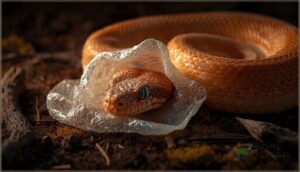
Once the Dull Skin Phase begins, the full shedding cycle usually runs 7 to 14 days. Eye Opacity Timing matters here — that milky blue-grey phase lasts 4 to 7 days.
Pre-shed Activity drops sharply: hiding, refusing food, increased irritability. These Behavioral Indicators signal normal shedding, not illness. A complete shed in one piece confirms solid Snake Health and proper Reptile Care.
Common Shedding Problems
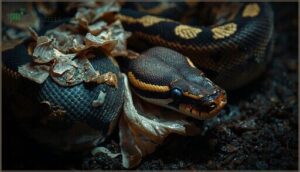
Not every shed goes cleanly.
Dysecdysis — incomplete shedding — happens when humidity levels drop below 50 percent, leaving stuck shed on tails, toes, or midsections.
Retained eye caps are particularly serious; multiple layers accumulate quickly.
parasite-induced shedding and stress-related shedding also disrupt the normal shedding cycle.
Spot these low humidity issues early, or you’re risking tissue death and infection.
Optimizing Growth and Shedding in Captivity

Captivity puts you in the driver’s seat — every variable that shapes your snake’s growth and shedding is yours to control.
Get the basics right, and you’ll rarely deal with stuck sheds or stunted development.
Here’s what actually moves the needle.
Ideal Enclosure Conditions
Your enclosure’s environmental conditions directly drive shedding success.
Set basking temperature zones to 90–95°F for ball pythons, 85°F for corn snakes, and cool-side thermoregulation areas staying 70–80°F.
Substrate selection matters — coconut coir maintains humidity levels between 60–80%, while aspen suits drier species.
Strategic hide placement on both warm and cool sides reduces stress.
Proper ventilation design prevents mold without collapsing your humidity gradient.
Hydration and Skin Health
Hydration does more for skin elasticity than most owners realize. Dehydration signs — wrinkled, accordion-like scales, sunken eyes, retained shed — signal deeper moisture management failures.
Prioritize these three practices:
- Maintain a shallow water bowl large enough for soaking.
- Warm soaks at 85–90°F for 20–30 minutes loosen stuck skin.
- Offer wet prey to boost internal hydration benefits.
Consistent hydration management keeps shedding frequency normal and reptile health stable.
When to Seek Veterinary Help
Some shedding problems can’t wait.
Retained eye caps, tail constriction signs, and frequent incomplete sheds all demand professional assessment — not a second soak.
| Warning Sign | Risk Window | Action Required |
|---|---|---|
| Retained eye caps | Within days | Vet removal only |
| Tail constriction | 24–48 hours | Immediate circulation check |
| Frequent incomplete sheds | 2+ in 3 months | Parasite/metabolic workup |
| Infection indicators | Within one week | Antibiotic cultures needed |
| Appetite loss duration | 1+ week post-shed | Diagnostic imaging |
Frequently Asked Questions (FAQs)
What repels snakes immediately?
Cinnamon Oil Spray and Clove Oil Repellent work instantly — both disrupt snake sensory signals on contact.
Ammonia Scent Barrier, Garlic‑Onion Mix, and Vinegar Perimeter Treatment also drive snakes away quickly.
Just like these repellents, patience matters—snakes won’t vanish overnight, so it helps to understand what temperature draws snakes out of hiding before judging whether a method is working.
Where do snakes go in October?
In October, snakes follow temperature triggers below 60°F, migrating to hibernacula — rocky outcrops, abandoned burrows, or caves — where stable warmth prevents freezing.
Garter snakes commune underground; rattlesnakes travel at dusk seeking shelter.
Can snakes shed more during breeding season?
Yes. Hormonal shedding surges during breeding season are well-documented.
Seasonal ecdysis timing shifts dramatically — male breeding frequency spikes monthly in spring, while female pre-lay shed signals imminent egg-laying through pre-mating pheromone release.
Do wild snakes shed differently than captive ones?
Wild snakes shed far less often — roughly 5 to 3 times yearly — while captive snakes average 4 to 6 sheds. Seasonal prey availability, predator stress effects, and habitat humidity impact drive that gap.
Does shedding frequency decrease as snakes age?
Absolutely — shedding frequency drops dramatically as snakes age. Metabolic slowdown and hormonal changes reduce skin elasticity demands.
Adult snakes shed just two to six times yearly, a stark contrast to juvenile intervals.
Can medications affect a snakes shedding cycle?
Medications can disrupt the shedding cycle. Antibiotics like enrofloxacin alter ecdysis timing, while painkillers slow metabolism.
Hormone disruptions from steroids delay skin renewal.
Always discuss veterinary care for snakes before starting any treatment.
Do snakes eat their shed skin after molting?
Keratophagy incidence in snakes is rare, not routine. Some colubrids occasionally consume shed skin — likely hunger-driven, not nutritional.
reptile care, remove the shed promptly and monitor post-shedding care to protect animal health.
Conclusion
What separates a thriving snake from one that’s merely surviving? Mastery of the details. Snake growth and shedding rate aren’t passive biology—they’re a direct reflection of the environment and care you provide.
Control the temperature, nail the humidity, feed on schedule, and the cycle regulates itself. Miss those fundamentals consistently, and retained sheds and stunted growth follow.
Husbandry decisions are written on your snake’s skin, literally, with every completed shed.