This site is supported by our readers. We may earn a commission, at no cost to you, if you purchase through links.

A soaked substrate, a waterlogged hide, a snake that won’t stop sitting in its bowl—humid enclosures punish every small mistake. water dish sits at the center of that problem.
In high-humidity setups, the wrong bowl doesn’t just stay wet; it breeds bacteria, warps under heat cycles, and turns your careful humidity management into guesswork.
Material, size, and placement all interact in ways most keepers don’t consider until something goes wrong.
The right snake water dishes for humid climates do more than hold water—they become a controllable variable in an otherwise unpredictable environment.
Table Of Contents
Key Takeaways
- Non-porous materials like ceramic, glass, and food-grade resin are your best defense against bacterial biofilm and mold in humid enclosures.
- Bowl placement isn’t passive — shifting it warm-side versus cool-side can swing your humidity several percentage points without touching any other controls.
- Size your dish to your snake’s mid-body width and keep depth just below rib level to balance safe soaking with drowning prevention.
- Daily water changes combined with dedicated cleaning tools and a quality tap water conditioner are what actually keep water quality stable in warm, moist setups.
Choosing Water Dish Materials

The material your snake’s water dish is made from matters more than most keepers realize, especially in a humid setup. Not every bowl manages moisture, bacteria, and repeated cleaning the same way.
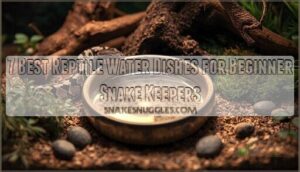
Choosing wisely upfront saves you headaches later — this guide to reptile water dishes for beginner snake keepers breaks down which materials actually hold up over time.
what to look for before you buy.
Why Non-porous Materials Matter in Humid Climates
In a humid enclosure, your material choice is the first line of defense. Non‑porous materials create a natural moisture vapor barrier — their low permeability and surface smoothness mean bacterial biofilm never gets a foothold.
Unlike porous alternatives that trap moisture inside micro‑crevices, these surfaces support consistent microbial growth control and durability under humidity, keeping water quality stable and your snake safer.
The high surface tension of non‑porous surfaces causes water to bead up, further limiting moisture retention.
Resin Vs. Ceramic Vs. Glass Water Bowls
Each material brings trade-offs worth knowing before you buy.
- Resin — lightweight and forgiving if dropped, with solid heat tolerance and plenty of aesthetic options
- Ceramic — heavier, stays put, and its glazed nonporous and smooth surface makes sanitation straightforward
- Glass — the cleanest long-term but fragile under impact
Cost comparison and weight differences often decide it.
Which Materials Resist Mold, Warping, and Cracking
Beyond looks and weight, durability is what you’ll actually live with.
Mold-Resistant Polymers and Warp-Stable Glass hold up where cheaper options fail — glass won’t warp through repeated humidity cycles, and Crack-Proof Ceramics shrug off accidental drops better than thin plastic.
Nonporous materials block biofilm at the surface level.
Antimicrobial Coatings add another layer of defense, while Thermal-Expansion Composites stay dimensionally stable as enclosure temps shift.
Safe Finishes and Food-grade Construction
Durability keeps the dish standing — but the finish keeps your snake safe.
Look for food-grade epoxy or food-grade resin coatings, non-toxic sealants, and low-VOC coatings that actually cure completely.
Curing time guidelines matter here: cut it short and you risk leaching.
Antimicrobial surface additives and non-porous materials coated to prevent the development of harmful bacteria are safety features of reptile water dishes worth prioritizing.
Picking The Right Bowl Size
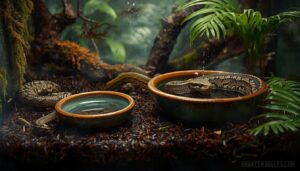
Bowl size isn’t one-size-fits-all — what works for a corn snake can leave a ball python struggling to soak properly. Getting the dimensions right affects everything from safety to how well your enclosure holds humidity.
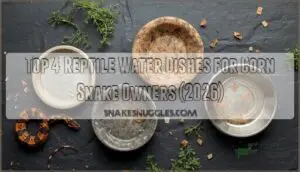
For a deeper look at what actually matters when choosing a dish, this guide to water dishes for corn snake owners breaks down size, material, and stability in practical terms.
Here’s what to think about when sizing up your options.
Matching Dish Size to Your Snake’s Body
Size your dish to the snake, not the shelf. Match the bowl’s diameter to your snake’s widest mid-body point — that’s the core of smart reptile water dish design and reptile hydration strategy.
- Body Width Ratio: Aim for a proportional diameter equal to mid-body width plus a small margin.
- Neck Extension: Depth should allow comfortable drinking without awkward bending.
- Growth Stage Adjustments: Reassess sizing annually — juveniles need shallower bowls than adults.
- Tail Length Consideration: Longer snakes may need wider dishes to avoid coiling awkwardly.
- Size and depth considerations: Too wide encourages soaking; too narrow causes spillage.
Shallow Vs. Deep Water Dish Designs
Depth changes everything. A shallow dish wins on Evaporation Efficiency — wider evaporation surface area pushes humidity up fast. A deeper bowl offers Temperature Retention, Splash Containment, and real Submersion Comfort during shed cycles.
| Feature | Shallow Dish |
|---|---|
| Humidity Stabilization | Faster evaporation |
| Bacterial Biofilm Prevention | Easier daily scrubbing |
| Stability Risk | Lower center of gravity |
| Submersion Comfort | Limited for larger snakes |
For big constrictors, an Extra-deep Water Dish manages size and depth considerations for reptile water bowls far better.
When a Wider Bowl Improves Evaporation
Think of your water dish as a humidity engine — a wider bowl is simply a bigger engine.
A wider water dish is a bigger humidity engine — more surface, more evaporation, more control
Surface area boost is real: more exposed water means a faster evaporation rate, spreading a broader vapor plume throughout the enclosure.
Airflow enhancement around the open rim keeps moisture moving, while heat transfer acceleration from warm substrate drives steady evaporation, strengthening your humidity gradient without repositioning water bowl placement constantly.
How Depth Affects Soaking and Safety
Water that hits just below your snake’s ribs gives the best soak — enough to soften shed skin without restricting movement. Too deep risks drowning, especially for juveniles.
Shallow water loses heat fast, so deeper bowls win on heat retention and evaporation control.
As your snake grows, scale the depth up gradually.
Always prioritize a wide, stable base to prevent tipping and spills.
Best Placement for Humidity
Where you set the water dish matters more than most keepers realize. A small shift in position can raise or drop your enclosure’s humidity by several percentage points without touching a single dial.
Here’s what you need to know about placement.
Warm-side Vs. Cool-side Placement
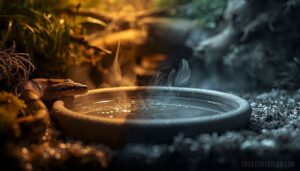
Where you put the bowl matters more than most keepers realize. Heat source proximity drives evaporation control directly — a dish near the warm side raises enclosure humidity noticeably, while cool side placement slows moisture release for tighter thermal gradient management.
- Warm side raises RH several percentage points daily
- Cool side limits evaporation, protecting substrate from saturation
- Bowl relocation timing matters — move gradually to avoid stressing your snake
- Species comfort varies; some snakes prefer drinking near heated areas
- Never place bowls directly on heating elements
Using Water Dishes to Support Humidity Gradients
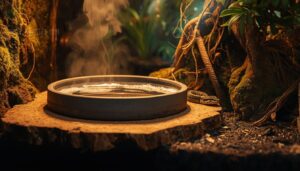
Your water dish does double duty when you treat it as a humidity tool, not just a drinking station. Gradient zone placement is everything here.
Raising the dish on a low platform increases the evaporation rate in the upper enclosure zone while keeping substrate below drier. Pair that with smart heat source proximity and airflow management, and you’re actively shaping your microclimate — no guesswork needed.
Positioning Near Humid Hides Without Oversaturating Substrate
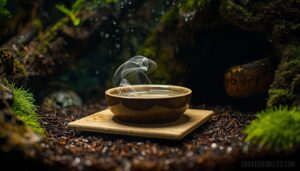
Placing the dish a few inches from your humid hide entrance creates a shared microclimate without flooding the substrate.
Use Elevated Platform Placement — raise the dish 1–2 cm — and add a Ceramic Tile Barrier underneath.
This provides Microclimate Gradient Control and Substrate Moisture Management by slowing capillary wicking.
Keep Heat Source Alignment steady nearby, and an Escape Rim Design prevents overflow spreading outward.
Avoiding Vents and Direct Airflow
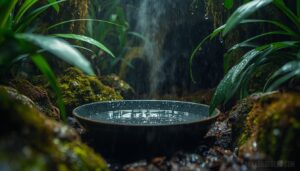
Now that your dish is positioned near the hide, airflow becomes the next thing to manage. Drafts from screen tops or vents pull moisture out fast — and that wreaks your humidity regulation before you even notice.
Use these Airflow Mapping Techniques to lock in a stable microclimate:
- Apply Shielded Bowl Design with a recessed placement or low shelf barrier for Draft Free Placement
- Follow Vent Positioning Strategies by keeping bowls below intake vents
- Run Low Speed Fans only to avoid turbulence near the water surface
Keeping Water Clean Longer
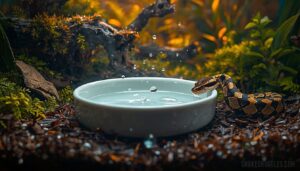
Humid enclosures are tough on water quality — warmth and moisture speed up everything, including bacterial growth. A dirty dish can undo all the careful work you’ve put into your snake’s setup.
Here’s what actually keeps the water cleaner, longer.
Daily Water Changes in Humid Enclosures
In humid enclosures, daily water changes aren’t optional — they’re your first line of defense.
Heat drives evaporation rate monitoring into high gear, meaning water volume drops fast and bacteria multiply faster.
Swap it out every day, rinse the bowl with hot water, and track your record keeping practices. That simple habit keeps your humidity gradient stable and your snake safe.
Preventing Bacterial Biofilm and Algae Buildup
Even with daily changes, biofilm can sneak up on you. That invisible slick coating the bowl’s interior? Bacterial biofilm — and it builds fast in warm, moist enclosures.
Choosing nonporous water dishes for reptiles cuts off its foothold. Smooth surfaces, antimicrobial coatings, and pH monitoring all work together to protect water quality.
Some keepers also use UV light treatment or safe biocide additives to stay ahead of algae before it starts.
Safe Scrubbing and Disinfection Methods
Scrubbing the bowl isn’t enough on its own. Use dedicated cleaning tools — a brush kept solely for water dishes — to avoid dragging substrate bacteria into the mix.
Apply your disinfectant at the label’s recommended concentration, then let it sit for the full contact time while the surface stays visibly wet.
Rinse thoroughly, air dry, and wear gloves throughout.
Non-porous water dishes and food-grade resin make every step more effective.
Water Conditioners and Tap Water Safety
Tap water isn’t automatically safe for your snake. Before you refill the bowl, treat it with a quality conditioner like Aquatize for chlorine neutralization, chloramine removal, and heavy metal binding from pipes or treatment byproducts.
Correct dosage timing matters — add the conditioner to the full water volume right before use. If you run a filtered setup, account for filtration media interaction, since activated carbon can affect how long the conditioner stays active.
Then add any electrolyte and calcium supplements after treating.
Matching Bowls to Snake Needs
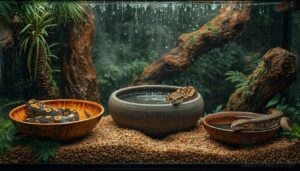
Not every snake needs the same setup, and the water dish is no exception. What works perfectly for a ball python can fall short for a boa or a corn snake.
Here’s how to match your bowl choice to your specific snake.
Water Dish Choices for Ball Pythons
Ball pythons thrive at 60–70% RH, so your water dish does real work here. Choose a heavy ceramic or resin bowl — dish weight keeps it stable when your snake investigates. A wide bowl shape boosts evaporation efficiency naturally.
Place it warm-side to support a solid humidity gradient. Nonporous water dishes for reptiles block biofilm, and stable water dish design means consistent water temperature and easy accessibility design for soaking.
Water Dish Choices for Corn Snakes
Corn snakes are more forgiving than ball pythons — they prefer 40–60% RH, so you’re not chasing aggressive humidity numbers. A 4–6 inch food-grade resin bowl with bowl stability features prevents tipping when your snake moves through.
Nonporous water dishes for reptiles simplify bacterial prevention in terrariums. Keep water depth around 1.5 inches, change it daily, and humidity control practically regulates itself.
Water Dish Choices for Boa Constrictors
Boas are big snakes with big soaking needs. Bowl shape matters here — go wide and deep enough for your boa to curl in comfortably, with an anti-slip base so it won’t tip mid-soak.
Choosing nonporous water dishes for reptiles keeps water quality stable and simplifies cleaning. Monitor evaporation rate seasonally — seasonal humidity adjustments and smart material selection for reptile accessories make enclosure humidity control noticeably easier.
How Substrate Affects Moisture and Bowl Performance
Your substrate does more than just sit there — it actively shapes how your water dish performs. Substrate porosity controls how fast moisture moves into the enclosure air, which directly shifts your evaporation rate and ambient humidity.
- Coconut fiber buffers moisture steadily without spiking RH
- Coarse sand drains fast, reducing bowl stability on shifting surfaces
- Dense substrates trap humidity near the dish, causing temperature fluctuations
- Porous mixes speed moisture transfer between bowl and air
- Damp moss in hides creates targeted humidity buffer substrates without saturating the whole enclosure
Match your reptile water dish design to your substrate for stable, predictable humid setups.
Frequently Asked Questions (FAQs)
What is the best substrate for snakes in humidity?
Coconut fiber holds humidity at 60–80% without staying wet. Cypress mulch adds airflow. Blend substrates combine both benefits.
Sphagnum moss buffers moisture near hides.
Coco blocks expand into a stable, humidity-friendly base.
What can I use as a water bowl for a snake?
You can use a heat-resistant ceramic dish, glass jar, silicone tray, or food-grade resin bowl. Each resists biofilm prevention issues well. Avoid porous materials—they trap bacteria fast.
Can a water dish replace a humid hide entirely?
No, a water dish can’t replace a humid hide. It raises ambient moisture but won’t create the concentrated microclimate your snake needs for shedding success without respiratory risk.
How often should I replace my snakes dish?
Think of it like a kitchen cutting board — small cracks mean it’s time to go.
Replace your snake’s dish when you spot crack detection issues, glaze wear, algae buildup, or odor persistence after cleaning.
Do weighted dishes prevent tipping during soaking?
Yes — a weighted dish with a wide footprint and low center of gravity won’t easily be tipped over, even when snakes love to bathe and shift their full weight mid-soak.
Should hatchlings use smaller dishes than adult snakes?
Absolutely — hatchlings need smaller dishes. A 3–4 cm bowl aids drowning prevention, helps evaporation management, and reduces stress. Match size to head width, then upgrade as they grow.
Conclusion
snake water dishes for humid climates comes down to three things: material, measurement, and mindful placement. Get those right, and enclosure stops fighting you.
non-porous bowl in the right spot becomes less of an accessory and more of a tool—one that quietly stabilizes humidity, discourages bacterial growth, and keeps your snake healthier with less guesswork.
Small decisions inside the enclosure add up. This one’s worth getting right the first time.