This site is supported by our readers. We may earn a commission, at no cost to you, if you purchase through links.

A corn snake in a well-maintained enclosure can outlive most family dogs—some reach 25 to 32 years with consistent, deliberate care. That’s not luck. It comes down to measurable decisions: enclosure size, temperature gradients held within a few degrees, feeding intervals matched to body condition, and annual exams with a reptile vet.
Most keepers don’t lose their snakes to mystery illnesses. They lose them to slow, preventable drift—humidity that tends too low, prey that is slightly too large, or hides placed in locations that prevent proper thermoregulation.
The details covered here are the ones that actually move the needle.
Table Of Contents
- Key Takeaways
- Corn Snake Lifespan Expectations
- Build a Lifespan-Friendly Enclosure
- Perfect Temperature Gradients
- Maintain Healthy Humidity Levels
- Feed for Long-Term Health
- Choose Safe Prey Practices
- Reduce Stress and Overhandling
- Monitor Weight and Growth
- Prevent Disease With Clean Husbandry
- Schedule Regular Reptile Vet Care
- Frequently Asked Questions (FAQs)
- Are corn snakes good for beginners?
- How do you know if a corn snake is aging?
- How big should a corn snake enclosure be?
- How big should a 7 year old corn snake be?
- How often should a 10 year old corn snake eat?
- How old is a 15 inch corn snake?
- How old is a 5 ft corn snake?
- Do corn snake morphs affect overall lifespan?
- Can corn snakes safely cohabitate with other snakes?
- How does brumation impact a captive corn snakes longevity?
- Conclusion
Key Takeaways
- Keeping the warm side at 80–85°F, the cool side at 70–75°F, and humidity between 40–60% directly determines how well your corn snake digests, sheds, and fights off disease.
- Match every meal to 1–1.5 times the snake’s mid-body width and feed adults every 10–14 days — overfeeding is one of the fastest routes to obesity and regurgitation.
- Annual vet exams with blood work and twice-yearly fecal parasite testing catch problems before they become emergencies, and no amount of good husbandry replaces that.
- The corn snakes that reach 25+ years get there through consistent daily habits — stable temperatures, prompt spot-cleaning, correct prey sizing, and stress reduction — not luck.
Corn Snake Lifespan Expectations
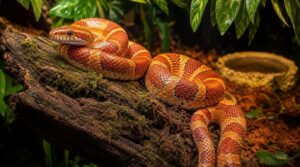
Corn snakes in captivity routinely outlive what most people expect. With the right care, 15–20 years is a realistic baseline — and some have pushed well past 25.
Good husbandry really is the difference-maker — proper corn snake care and longevity practices can help your snake hit those upper age ranges rather than falling short of them.
Here’s what actually shapes how long your snake lives.
Average Captive Corn Snake Lifespan: 15–20 Years
Most captive corn snakes live 15–20 years when their basic needs stay consistently met. Corn snake lifespan in captivity depends heavily on ideal environmental conditions, early nutrition, and daily husbandry decisions under your control.
Factors influencing corn snake longevity include genetic longevity tied to morph lifespan differences and telomere maintenance at the cellular level.
Getting these fundamentals right, and 15 years becomes a realistic floor. Remarkable longevity cases have been documented beyond 30 years.
Maximum Reported Lifespans of 25–32 Years
Some corn snakes have reached 25–32 years — these aren’t myths, but documented longevity case studies from keepers who maintained long-term environmental stability across decades.
Morph-specific lifespan differences play a role, with genetic longevity markers and telomere research suggesting certain morphs age more slowly at the cellular level.
Think of it as a biological head start — one that your husbandry either bolsters or undermines.
Why Wild Corn Snakes Live Shorter Lives
Wild corn snakes average just 6–8 years — a stark contrast to the 25–32 year ceiling you just read about.
Predation pressure, seasonal weather extremes, parasite burden, and food scarcity all chip away at survival.
Reproductive trade-offs drain energy reserves further.
These differences between wild and captive lifespans aren’t trivial — they’re the exact gaps your husbandry closes.
Captive Care Factors That Add Healthy Years
Stable temperature and humidity regulation, consistent feeding strategies, and low-stress handling practices form the foundation of effective husbandry, directly closing critical gaps in care. These practices compound over time, creating an environment that supports biological longevity.
Adding microhabitat complexity, a reliable lighting cycle, and proper air exchange further enhances genetic resilience. These environmental factors work synergistically with core husbandry methods to optimize health and growth.
Veterinary health monitoring ensures early problem detection—a decisive factor in extending lifespan. This proactive approach keeps years "on the clock" by addressing issues before they escalate.
Build a Lifespan-Friendly Enclosure
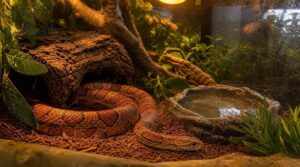
The enclosure you set up today shapes how long your corn snake lives tomorrow. Getting the size, layout, and security right isn’t complicated, but every detail matters.
Here’s what your snake actually needs at each stage of life.
Minimum Enclosure Sizes by Life Stage
The right enclosure size changes as your snake does. A hatchling footprint of 10–20 gallons provides enough floor space for reliable microclimate zoning without overwhelming a small feeder. Juvenile floor space steps up to 20–30 gallons to support exploration and thermoregulation.
At every corn snake growth stage, enclosure height clearance and minimum enclosure size directly shape how well your snake can regulate its own temperature.
Adult Enclosure Target: at Least 40 Gallons
Once your corn snake reaches adulthood, a minimum enclosure size of 40 gallons — ideally 36″ × 18″ × 18″ — is essential. This floor space enables a real thermoregulation zone with distinct warm and cool sides.
Proper enclosure design ensures stable temperature gradients through heat source spacing, while adequate equipment clearance prevents hot spots.
Visual enrichment via layout variety encourages natural movement throughout the full enclosure footprint.
Secure Lids and Escape-proof Ventilation
Corn snakes are accomplished escape artists, and a single gap is all they need. Locking fasteners along the lid perimeter and a tight edge seal design remove that opportunity entirely.
Choose mesh vent material sized small enough to block passage, and use dual vent placement — low on one side, high on the other — for airflow uniformity.
Every vent hole sizing decision matters in a truly escapeproof enclosure.
Warm-side and Cool-side Hide Placement
Two hides are not optional — they’re the backbone of your snake’s thermal environment. Place one hide directly over your heat source and one at the cool end. Single-entry concealment keeps your snake secure while it thermoregulates naturally.
- Match hide interior temperature to each zone
- Check heat source proximity before finalizing placement
- Confirm thermal gradient alignment end-to-end
- Balance hide size so the snake feels snug
- Verify the cool hide stays cool after nighttime temperature drops
Water Dish Size for Drinking and Soaking
Your water dish does double duty — drinking station and soaking basin — so size matters more than most keepers realize. Choose a non-porous material with a stable rim design to prevent tipping during entry and exit. Dish diameter should allow full-body contact, and basin depth must keep water below the rim. Capacity requirements remain manageable with weekly changes.
Fresh water maintains healthy humidity levels without disrupting substrate moisture management.
Perfect Temperature Gradients
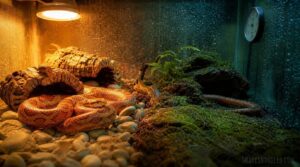
Temperature is the single biggest variable you control inside your corn snake’s enclosure. Get it right, and everything else—digestion, activity, shedding—falls into place. Here’s exactly what each zone needs to hit.
Warm Side: 80–85°F
Your warm side air temperature should stay between 80 and 85°F — this is the foundation of effective temperature gradient management.
Probe positioning matters: place your thermostat probe at snake height on the warm side. Heat source placement, whether under-tank or overhead, affects how evenly that range holds.
Run spot temperature checks daily, mitigate drafts near vents, and ensure thermostat calibration to maintain energy efficiency and stability.
Basking Surface: 88–90°F
Above that 80–85°F air range, your basking surface needs to hit 88–90°F — and air temperature alone won’t tell you that. Use an infrared thermometer to read the actual contact point where your snake rests.
Surface material selection matters here: tile or slate holds heat more consistently than thin plastic.
Thermostat sensor positioning and overhead heat emitters determine whether you maintain that target without creating a hot spot.
Cool Side: 70–75°F
The opposite end of your enclosure should hold steady at 70–75°F — that’s where thermoregulation actually happens. Your snake moves to this cool zone when it needs to slow digestion or rest.
Sensor accuracy matters here: place your thermometer at hide surface level, not mid-air.
Airflow management and seasonal adjustments keep this temperature range stable without letting heat bleed across the thermal gradient.
Safe Nighttime Temperature Drops

At night, a 2–5°F drop across the temperature gradient is safe — your snake expects it. Use a proportional thermostat with careful probe placement near the warm-side hide to prevent overshooting.
Deep-heat emitters maintain warmth without disrupting sleep cycles.
Add insulation barriers around the enclosure and practice draft mitigation, especially during winter.
Seasonal temperature adjustments keep temperature regulation consistent year-round.
Why Temperatures Above 90°F Are Risky
Pushing past 90°F flips your temperature gradient from helpful to harmful. Thermal stress kicks in fast — cardiovascular strain builds as your snake’s body fights to offload excess heat.
Dehydration acceleration follows, along with digestive complications that make regurgitation more likely after meals. Immune suppression isn’t far behind.
Burn hazards from direct contact with overheated surfaces add another layer of risk.
Using Thermostats With Every Heat Source
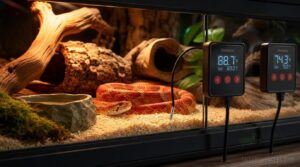
Every heat source needs its own thermostat — no exceptions. Separate thermostats prevent cross-interference and give you precise output control over each zone.
Match each unit’s load rating to your specific heater type. Probe placement matters too: position it at surface level where your snake actually rests.
Built-in safety cutoffs protect against probe failure. Without this, your temperature gradient becomes guesswork.
Maintain Healthy Humidity Levels

Humidity doesn’t get nearly as much attention as temperature, but it matters just as much for your corn snake’s health. Get it wrong, and you’ll start seeing stuck sheds, dehydration, or worse — respiratory problems that are tough to reverse.
Here’s what you need to know to keep moisture levels where they should be.
Ideal Daily Humidity: 40–60%
Humidity between 40–60% is the non-negotiable baseline for daily environmental humidity control. Three practical pillars keep you in that range:
- Placement strategy matters: Position your hygrometer mid-enclosure, away from the water dish, to avoid skewed evaporation readings—then prioritize sensor calibration every few months.
- Substrate selection drives baseline humidity: Coconut husk holds moisture longer; paper-based options dry faster.
- Dish sizing affects evaporation: Larger dishes near the warm side push humidity up—size accordingly.
Raising Humidity During Shedding
When your corn snake’s eyes turn blue and skin looks dull, it’s time to push humidity toward 70%. Here is how to manage each method:
| Method | Action | Effect |
|---|---|---|
| Water Dish Evaporation | Use a larger dish | Raises baseline steadily |
| Spot Misting | Mist once daily | Provides temporary boost |
| Hygrometer Placement | Keep at substrate level | Gives accurate humidity range readings |
Consistent humidity control prevents shedding problems without soaking the enclosure.
Using a Humid Hide Safely
A humid hide works best when the moss inside feels damp, not dripping. Squeeze-test it: if water runs out, it’s too wet.
Preventing water pools is crucial, as standing moisture softens scales and invites bacterial growth. Ensure ventilation access remains unblocked to maintain airflow.
Routine cleaning and mold checks are essential to keep conditions safe. Address these tasks consistently to prevent hazards.
Adjust the moss’s dampness according to seasonal humidity changes to avoid shedding problems year-round.
Preventing Dehydration and Stuck Shed
Dehydration sneaks up fast, particularly in dry enclosures during heating cycles, which can strip moisture from a snake’s skin even before shedding begins. Daily humidity gauge checks are critical to detect early drops in moisture levels.
Implement targeted misting and partial soak hides to maintain hydration without oversaturating the enclosure. These methods directly address moisture loss while preserving the habitat’s balance.
Incorporate rough shedding surfaces to aid natural exfoliation, and maintain seasonal humidity adjustments to prevent retained shed throughout the year. Consistent vigilance ensures long-term skin health and successful shedding cycles.
Avoiding Overly Damp, Bacteria-prone Substrate
Wet substrate is a slow-burning problem—bacteria thrive before you notice the smell. Keep these three rules in mind:
- Substrate Thickness: Shallow layers dry faster; thick beds trap moisture at the bottom even when the top looks fine.
- Misting Frequency and Drying Intervals: Mist only where needed, then let it fully dry before adding more moisture.
- Ventilation Optimization: Unobstructed screen tops move air consistently, pulling dampness out between cycles.
Spot-clean waste daily. Swap affected patches immediately. Your cleaning protocol and ventilation factors together do more for humidity control than any single substrate material choice.
Feed for Long-Term Health
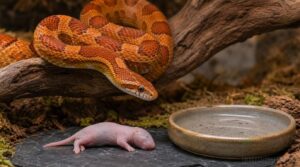
Feeding your corn snake correctly is one of the most direct ways to protect its long-term health. Get the schedule and prey size wrong, and you’re looking at obesity, regurgitation, or a snake that simply stops thriving.
Here’s what you need to know across every life stage.
Prey Size: 1–1.5 Times Body Width
Match prey to your snake’s mid-body width — no wider than 1.5 times that measurement. This simple gape measurement prevents esophageal stress during swallowing and keeps metabolic load manageable.
Prey width calibration also assists bulk management, ensuring nutritional consistency without overloading digestion.
Think of it as body condition scoring in action: right-sized meals protect long-term health better than any supplement.
Hatchling Feeding Schedules
First meal timing matters: wait 2–3 days after hatching before the first offer. Then, feed every 5–7 days, adjusting only around the shed fasting window — not randomly.
Keep a feeding log essentials checklist in mind:
- Date and prey type offered
- Acceptance or refusal noted
- Shed status at time of offer
- Consistent offer timing maintained weekly
Juvenile Feeding Schedules
Once your hatchling hits about six months, its needs shift. Feed juveniles every 5–7 days, adjusting based on Appetite Cue Tracking—if it hunts eagerly after five days, maintain that pace.
Prey size should remain at 1–1.5 times body width. Schedule meals during the warm light-cycle period, maintain Feeding Schedule Logs, and ensure a full Digestive Recovery Window before the next feeding.
Adult Feeding Schedules
Adults eat every 10–14 days — that’s your baseline adult feeding schedule. Match each meal to 1–1.5 times your snake’s widest point; prey size matching prevents regurgitation.
Use Weight-Based Portioning and body condition scoring monthly to fine-tune portions.
Maintain Record Keeping Practices and consider Prey Diversity Rotation between mouse sizes.
Feeding Frequency and Seasonal Meal Adjustments follow body condition, not the calendar.
Adjusting Meals for Senior Corn Snakes
Once your corn snake reaches senior status, feeding rules must adapt to their slowing metabolism. Implement monthly Body Condition Scoring and Weight Monitoring to tailor portion sizes. Adjust feeding frequency seasonally, particularly reducing intake during cooler months. Always respect natural pre-shed fasting periods and prioritize vigilant digestive monitoring between meals.
- Shift to every 14–21 days
- Match prey to midbody width only
- Reduce prey size if midbody thickens
- Pause feeding pre-shed
- Log every meal for trend tracking
Avoiding Obesity and Regurgitation
Overfeeding is one of the fastest routes to obesity and regurgitation. Keep prey size matched to your snake’s midbody width—nothing larger.
Calorie tracking matters: portions should be scaled down when body condition and weight monitoring show upward trends.
Pre-meal warmth ensures digestion stays on track, while post-meal rest prevents stress-induced regurgitation.
A consistent feeding schedule and nutrition keeps everything predictable.
Choose Safe Prey Practices
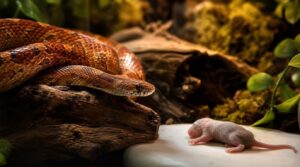
What you feed your corn snake matters, but how you feed it matters just as much.
Safe prey practices protect your snake from injury, digestive trouble, and unnecessary stress. Here’s what every responsible keeper should know.
Benefits of Frozen-thawed Rodents
Frozen-thawed rodents are the ideal choice for a reason. They eliminate injury prevention concerns entirely — dead prey can’t bite or scratch your snake.
They also support parasite reduction, mess reduction, and portion consistency, since standardized sizing makes prey size selection straightforward.
Almost all corn snakes can be trained to accept them, making the ease of training a genuine advantage for long-term feeding strategies.
Safe Thawing and Warming Methods
Thawing matters more than most keepers realize. Cold water thaw requires leak-proof packaging, submerging prey in water at 70°F or below, with water changed every 30 minutes. Refrigerator thawing is ideal for overnight preparation, ensuring safe and gradual defrosting for planned feedings.
Microwave safety demands careful monitoring: always check for hot spots before offering prey to avoid burns or uneven heating.
Finish with a water bath warming process to achieve consistent surface warmth, creating a thermal gradient that mimics natural conditions for the prey model itself.
Why Live Prey Can Cause Injuries
Live prey fights back — and your snake pays the price. Tooth punctures and claw scratches can tear skin and reach deeper tissue. Eye trauma from a rodent bite near the snake’s head can cause lasting damage or blindness.
Open wounds become infection entry points, and prolonged struggling triggers immune suppression through sustained stress. These complications pose significant health risks to the snake.
Frozen-thawed prey eliminates this risk entirely, ensuring safer feeding practices.
Fresh Water Access Between Meals
Your corn snake needs fresh water available at all times — not just after meals. Keep a clean bowl in the enclosure continuously, and check it daily for evaporation monitoring and biofilm control. Rinse and refill before cloudiness develops.
Water temperature should stay at room level.
Consistent continuous hydration directly sustains humidity levels, habitat quality, enclosure cleaning standards, and reliable health monitoring between feeding days.
When Supplements May Be Appropriate
Most corn snakes don’t need supplements beyond calcium dusting. But targeted dosing matters in specific situations:
- Nutrient deficiencies confirmed by bloodwork, not guesswork
- Malabsorption disorders reducing effective nutrient uptake
- Senior snake nutrition and metabolism slowing after age eight
- Dietary calcium supplementation preventing metabolic bone disease
Always weigh product safety and nutrient balance before adding anything new. When in doubt, ask your reptile vet first.
Reduce Stress and Overhandling

Stress is one of the quietest threats to a corn snake’s long-term health, and it’s easier to cause than most keepers realize. Everything from how often you handle your snake to how loud the room gets can chip away at its wellbeing over time.
Here’s what actually matters regarding keeping stress low.
How Stress Affects Corn Snake Health
Chronic stress quietly dismantles your corn snake’s health from the inside out. Immune suppression leaves it vulnerable to infections, while appetite loss and digestive disturbance can accelerate visible weight decline. Stress-related behaviors — nose rubbing, tail rattling, frantic movement — are your early warning system. Without stress mitigation, chronic stress compounds into reproductive decline and shortened lifespan. Don’t ignore what your snake is telling you.
Chronic stress quietly dismantles a corn snake’s health — and its silence is exactly what makes it deadly
Safe Handling Frequency and Duration
Handling Session Length to 5–15 minutes. Cool‑Room Checks before sessions — if your room runs cold, cut that time shorter.
Watch for Stress Cue Recognition: striking or frantic bolting ends the session immediately.
Respect the Pre‑shed Rest Period by reducing handling frequency entirely until the shed completes.
Avoiding Handling After Feeding
After a meal, your snake needs one thing: stillness. Digestive stress prevention starts with a simple rule — wait 48 hours before handling.
Here’s what good post-meal observation looks like in practice:
- Keep the enclosure in a low-traffic area for jostle-free environment recovery
- Avoid bright light and loud noise near the tank
- Don’t open the lid to "check on" swallowing progress
- Watch from a distance — visual checks cause zero handling stress
- Postpone any scheduled handling if feeding just occurred
Providing Secure Hides and Cover
A snake that can’t hide is a snake under constant stress. Your enclosure design and escape prevention setup starts with hide door dimensions wide enough for easy entry but snug enough to provide security. Anchor each humid hide firmly — burrowing substrate can shift hides out of position.
Use visual barrier placement and cover material choice to block overhead sightlines from both hiding places, supporting genuine environmental enrichment.
Limiting Loud Noise and Enclosure Disruption
Sound matters more than most keepers realize. Place the enclosure away from televisions, speakers, and heavy foot traffic — room placement alone reduces a surprising amount of chronic stress. Use vibration isolation pads under the stand, and choose quiet heating equipment to minimize mechanical noise.
Practice access discipline: open the enclosure only at scheduled times, gently. Consistent, calm handling techniques complete the process.
Monitor Weight and Growth
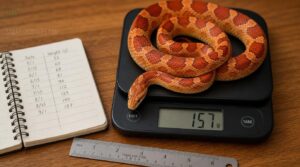
Tracking your corn snake’s weight and size is one of the clearest windows into its health. A few key metrics tell you more than any visual guess ever could. Here’s what to watch at every stage of life.
Monthly Weight Tracking
Weigh your corn snake on the same day each month — same scale, same time, same conditions. Tare the container first, record in grams, and note any recent feeding or shedding.
Consistent weighing removes guesswork from body condition scoring. Log each entry with the date so trend interpretation is clear over time.
A sustained drop across three months means something needs attention.
Healthy Growth Patterns in Hatchlings
Hatchlings emerge at 10–15 inches and grow fast — that first shed usually happens within two weeks.
Track early development markers like shed frequency (every 4–6 weeks) and steady weight gain to confirm your growth curve benchmarks are on track.
Skin elasticity during molting assistance tells you a lot: clean, complete sheds signal that your temperature and humidity requirements for corn snakes are dialed in.
Juvenile Size and Feeding Expectations
Once juveniles hit their stride, girth-based prey sizing becomes your most reliable tool—not length, not age. Match prey width to 1–1.5 times the snake’s widest point, ensuring proportional meals for healthy growth.
Adjust feeding schedules and nutrition for pet snakes every 7–10 days, as digestion speeds up with proper temperature-dependent conditions. Monitor metabolic shifts closely to maintain optimal health.
Track shedding appetite shifts; a cloudy-eyed juvenile won’t eat, and this is completely normal. Respect their natural cycles during these periods to avoid unnecessary stress.
Adult Body Condition Scoring
Monthly weigh-ins tell part of the story, but body condition scoring fills in the rest. Run your fingers along palpation landmarks — ribs, spine, tail base — to assess fat distribution patterns and muscle coverage. Visual scoring criteria help you grade contour and symmetry on a consistent scale.
Use the same consistent protocols each session so trends, not single readings, guide your care decisions and flag when regular veterinary checkups are needed.
Aging Signs After Eight Years
After eight years, your corn snake enters a phase of senescence in reptiles that shows up in predictable ways. Dull skin, slow shedding, reduced appetite, and muscle weakness are common markers.
Watch for changes in respiratory rhythm — any noticeable straining signals a vet visit.
Tracking these shifts alongside your body condition score promotes smarter, proactive senior snake care.
Why Length Alone Cannot Determine Age
Length is one of the weakest age estimation methods for unknown corn snakes. Two snakes can measure identical on a growth chart yet differ by years in age — feeding history, morph size diversity, and environmental stress impact all shape how fast a snake grows. Record keeping gaps make this worse. Rely on body condition score and behavior instead.
Prevent Disease With Clean Husbandry
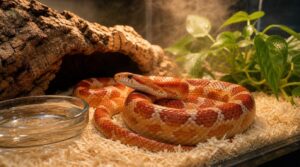
A dirty enclosure is one of the fastest ways to shorten your corn snake’s life. Bacteria, parasites, and respiratory infections thrive in neglected setups — and most are entirely preventable.
Here’s what clean husbandry actually looks like in practice.
Spot-cleaning Waste Promptly
Rapid waste removal is one of the simplest things you can do for your snake’s health. The moment you spot feces or urates, remove them. Waiting lets bacteria multiply and odors build fast.
Your spot-cleaning protocols should include:
- Dedicated Spot‑Cleaning Tools like a scoop or paper towels used only for that enclosure
- Moisture Minimization by keeping the cleaned area dry immediately after removal
- Routine Observation during daily checks to catch waste before it dries into substrate
Clean enclosures mean fewer pathogens, better preventive parasite management, and a genuinely snake‑safe environment.
Full Substrate Replacement Schedule
Spot-cleaning manages the surface, but change frequency matters just as much. Loose substrates like coconut fiber and cypress mulch trap waste below where you can see it.
For non-bioactive setups, full substrate replacement every four to eight weeks is standard. Substrate type selection drives that timeline — paper-based options need weekly swaps.
After removal, post-change disinfection of walls and hides prevents residual contamination from restarting the cycle.
Preventing Bacterial Buildup
Beyond bacterial buildup sneaks in through biofilm on water dishes, feeding tools, and hide surfaces. Rotate reptile-safe disinfectants to prevent resistance, and practice consistent tool sterilization between uses.
Airflow management keeps moisture from pooling in corners. Strong cleaning protocols and disease prevention depend on antimicrobial surfaces staying genuinely dry before your snake returns — a small habit that makes your enclosure a reliably snake-safe environment.
Quarantining New Snakes for 30 Days
Thirty days of strict isolation protect every snake you have worked hard to keep healthy.
Set up a dedicated Isolation Room with Dedicated Equipment that never crosses into your main collection.
Your quarantine protocols checklist:
- Use separate feeding tongs, hooks, and water bowls
- Apply consistent Hygiene Protocols after each handling session
- Perform Daily Health Monitoring — appetite, behavior, waste output
- Document everything for record keeping continuity
- Confirm full health before Safe Integration begins
Parasite Screening and Prevention
Parasite screening catches problems before they spiral. Submit fecal samples at least twice yearly — Sample Collection Frequency matters because parasites shed intermittently, and a single test can miss them. Collect from two separate bowel movements to improve accuracy.
| Parasite Prevention Step | Why It Matters |
|---|---|
| Fecal testing twice yearly | Detects intermittent shedders |
| Treatment Cycle Timing with repeat doses | Eliminates all life stages |
| Equipment Isolation Practices per enclosure | Stops cross-contamination |
| Prey Source Verification before feeding | Reduces transmission risk |
| Enclosure Disinfection Schedule every 6–12 months | Removes persistent infectious material |
Veterinary Health Monitoring for captive snakes ties everything together — your vet selects antiparasitic medications by parasite type and your snake’s weight, not a one-size-fits-all dose. Consistent preventive parasite management keeps your collection clean long-term.
Recognizing Early Illness Signs
Your snake may indicate something’s wrong before visible signs emerge. Watch for Appetite Changes first—repeated refusals across multiple feedings matter more than one missed meal. Monthly weigh-ins catch early weight loss before it becomes noticeable.
Breathing Issues, Shedding Problems, and lethargy indicators signal deeper trouble. These symptoms often reflect underlying health concerns requiring prompt attention.
Combine daily observation of behavior with annual wellness exams, diagnostic bloodwork, and parasite screening to detect illness early. This proactive approach ensures comprehensive care and timely intervention.
Schedule Regular Reptile Vet Care

Even with perfect husbandry, some problems only a vet can catch — and catching them early is the difference between a minor fix and a serious crisis. A reptile-specialist vet isn’t just for emergencies; they’re your best tool for keeping your corn snake healthy for the long haul.
Here’s what regular veterinary care should actually look like.
Annual Wellness Exams
Annual wellness exams are your single best investment in your corn snake’s long-term health. Once a year, a reptile-specialist vet should perform a full physical inspection — checking muscle tone, skin condition, eye clarity, and oral health.
This preventive veterinary care also includes behavioral observation and diagnostic screening for hidden issues. Exam frequency matters: one visit annually catches problems before they become emergencies.
Blood Work for Early Disease Detection
Blood work catches what hands and eyes miss. A standard panel includes four key screens your vet should run annually.
- CBC screening to flag anemia or immune response shifts
- Serum chemistry to assess liver and kidney function baselines
- Glucose testing to detect metabolic imbalances early
- Inflammatory markers and a lipid panel to identify internal stress before symptoms appear
This is preventive veterinary care working at its best.
Fecal Parasite Testing
Beyond fecal testing rounds out your snake’s health screening, complementing blood work. Sample collection is straightforward—vets use flotation methods or sedimentation to concentrate parasite material, employing the Baermann examination for larval detection and PCR testing when microscopy proves insufficient.
Interpreting results is critical: a negative result doesn’t guarantee the snake is parasite-free. Consistent veterinary health monitoring for captive snakes remains essential to prevent infections from taking hold. Preventive parasite management through regular screening ensures proactive care, safeguarding your snake’s well-being.
When Radiographs May Be Needed
Radiographs fill gaps that blood work and fecal tests can’t. Your vet may recommend imaging for four specific concerns:
- Swallowed objects — to locate blockages along the digestive tract
- Internal trauma — to identify fractures or organ displacement after a fall
- Lung disease — to detect fluid or inflammation causing breathing changes
- Body swelling or reproductive problems — to assess masses, egg retention, or urinary stones
This imaging aids complete veterinary health monitoring for captive snakes.
Emergency Signs Requiring Immediate Care
Some same-day emergencies in corn snakes include mouth breathing, loss of coordination, rapid swelling, and bleeding vents. These signs require immediate veterinary attention. Regurgitation events happening back-to-back may indicate impaction or metabolic bone disease, both critical conditions needing urgent care.
Respiratory infections escalate fast in reptiles—wheezing or bubbling sounds are red flags demanding immediate action. Delaying treatment risks severe complications.
Knowing these common health issues and acting on veterinary care guidelines immediately can save a corn snake’s life.
Keeping Lifelong Health Records for Longevity
Once an emergency passes, your next step is documentation. Maintaining lifelong health records through Digital Record Systems ensures comprehensive care for your snake across every life stage.
Use Health Log Templates to track critical details, including:
- Medication Tracking entries with dose, start, and stop dates
- Growth chart tracking tied to hatch year records
- Annual vet exams with blood work outcomes
Implementing Data Privacy Practices and Audit Trail Implementation ensures your record-keeping remains reliable and secure. This structured approach supports accurate age estimation methods, particularly for corn snakes with unknown origins.
Frequently Asked Questions (FAQs)
Are corn snakes good for beginners?
Corn snakes have a docile temperament, compact size, and low maintenance needs that suit beginners well.
With an affordable setup, stable temperatures, humidity between 40–60%, a clear feeding schedule, and basic handling techniques, they thrive.
How do you know if a corn snake is aging?
Aging shows up gradually.
Watch for muzzle graying, scale sheen reduction, shedding delays, and a hiding tendency. Slower feeding responses and scale cloudiness round out the picture of a senior corn snake.
How big should a corn snake enclosure be?
Think of your corn snake’s home like a studio apartment — tight quarters works short-term, but long-term health needs real room.
Aim for at least a 40-gallon enclosure with a 36×18×18-inch footprint.
How big should a 7 year old corn snake be?
By 7 years old, your corn snake is fully grown — expect 4–6 feet, depending on sex, genetics, and morph. Body condition matters more than length at this stage.
How often should a 10 year old corn snake eat?
Feed your 10-year-old corn snake every 10–14 days. At this age, its metabolic rate slows, so less is more. Watch body condition closely and adjust portion size before changing frequency.
How old is a 15 inch corn snake?
At 15 inches, your corn snake is most likely 3–6 months old. That length sits just past the hatchling stage, well into the early juvenile stage.
This phase is defined by rapid growth and frequent feeding, which characterize this life stage.
How old is a 5 ft corn snake?
Size tells you the stage, not the story. A 5 ft corn snake is fully adult, usually 3–6 years old, though hatch date and care history remain the only reliable age biomarkers.
Do corn snake morphs affect overall lifespan?
Most morphs don’t inherently shorten lifespan. Morph-specific mutations mainly affect pigment gene impacts, not core physiology. Breeder line health and inbreeding depression matter far more than the morph label itself.
Can corn snakes safely cohabitate with other snakes?
No. Corn snakes are solitary by nature. Cohabitation risks parasite transmission, territorial competition, and captivity stress. Keep each snake in its own enclosure.
How does brumation impact a captive corn snakes longevity?
Brumation effects on corn snake longevity depend heavily on preparation. Metabolic slowdown conserves energy reserves, but immune function dips.
Proper brumation timing, temperature range, and post‑brumation recovery care determine whether captivity lifespan improves or suffers.
Conclusion
Longevity isn’t a scale you tip once—it’s a balance you maintain daily. Every temperature check, every correctly sized meal, every annual vet visit compounds over time into years your snake wouldn’t otherwise have.
To truly extend corn snake years, treat husbandry as a living system, not a setup-and-forget checklist. The snakes that reach 25 years don’t get there by accident. They get there because their keeper paid consistent, deliberate attention to the details that matter.