This site is supported by our readers. We may earn a commission, at no cost to you, if you purchase through links.
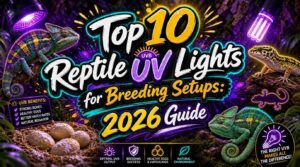
A failed clutch often traces back to one overlooked variable: inadequate UVB during the breeding cycle. Breeding females synthesizing eggs need sustained D3 production—and without the right light, calcium metabolism stalls before the first follicle develops.
Most hobbyists dial in temperatures and humidity while the UV setup runs on guesswork. The fixture that works for a display enclosure won’t cut it for a gravid female or a male being conditioned to cycle. Intensity, spectrum, and mounting distance all shift when reproduction is the goal. Getting these variables right separates a productive breeding season from an expensive disappointment.
Choosing the right reptile UV lights for breeding setups means matching output to species, enclosure size, and reproductive stage—and the options below make that decision measurably easier.
Table Of Contents
- Key Takeaways
- Top 10 Reptile UV Lights
- 1. Repti Zoo Adjustable UVB Reptile Light
- 2. Coospider T8 UVB Reptile Light
- 3. Eckpo Dual Reptile Light Fixture
- 4. Zoo Med ReptiSun T8 UVB Light
- 5. Repti Zoo T8 UVB Lighting Fixture
- 6. T5 UVB Terrarium Light Fixture
- 7. Hygger Zoo T5 UVB Reptile Light
- 8. REPTIDLDB T5 UVB Light Fixture
- 9. MouMouPurr 12 Inch T5 UVB Terrarium Light
- 10. MECESOR Dual Reptile Lamp Fixture
- UVB Needs for Breeding Reptiles
- Species-Specific UVB Recommendations
- T5 Versus T8 Fixtures
- Placement and Photoperiod Setup
- Monitoring and Maintenance Essentials
- Frequently Asked Questions (FAQs)
- Conclusion
Key Takeaways
- Without consistent UVB, a breeding female can’t synthesize enough D3 to absorb calcium, and your clutch fails before it starts.
- T5 fixtures outperform T8s for breeding setups because they deliver stronger UVB at greater distances, giving your animals more usable exposure.
- Match your UVB intensity to your species’ Ferguson Zone — a desert basker and a crepuscular gecko need completely different outputs, and getting it wrong costs you a season.
- Bulbs degrade silently, so test with a UV meter monthly and replace every 6–12 months, whether the light looks dim or not.
Top 10 Reptile UV Lights
Not all UV lights are built the same, and the wrong one can quietly derail your breeding success.
Matching bulb type and output to your setup makes a real difference, especially when you’re working with UVB lighting systems for large terrariums.
These ten options cover a solid range of setups, budgets, and species needs. Here’s what made the cut for 2026.
1. Repti Zoo Adjustable UVB Reptile Light
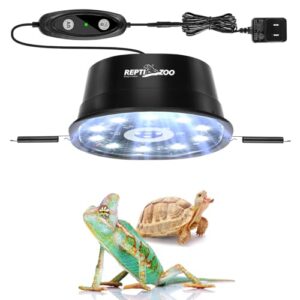
The Repti Zoo Adjustable UVB Reptile Light punches above its weight for a 6 W fixture. It delivers up to 303 µW/cm² at four inches and lets you switch between Tropical (5.0) and Desert (10.0) UVB modes without rewiring anything.
This flexibility is crucial for managing mixed reptile collections. The dimmable LED also enables realistic sunrise and sunset transitions, enhancing habitat simulation.
However, the light is best suited for smaller enclosures. Adult bearded dragons in tall tanks will likely require a stronger alternative.
| Best For | Small reptile enclosures and mixed collections where you need flexible UVB modes for both tropical and desert species. |
|---|---|
| UVB Rating | 5.0/10.0 selectable |
| Power Draw | 6W |
| Housing Material | ABS plastic |
| Bulb Included | Yes (LED integrated) |
| Mounting Options | Dual hanging hooks |
| Replacement Needed | LED longevity varies |
| Additional Features |
|
- Two UVB modes (5.0 and 10.0) let you match the light to your specific reptile without buying separate fixtures.
- The dimmable LED makes it easy to simulate natural day/night cycles, which is great for your animal’s wellbeing.
- At just 6 W, it’s energy-efficient and won’t drive up your electricity bill the way traditional bulbs do.
- Not powerful enough for large enclosures or high-demand species like adult bearded dragons in tall tanks.
- Some users have reported flickering or early failure due to internal wiring issues.
- It costs more than basic LED options, and there are scattered reports of units arriving repackaged or used.
2. Coospider T8 UVB Reptile Light
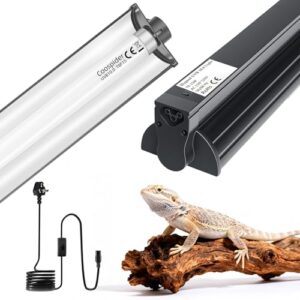
The Coospider T8 UVB Reptile Light is worth considering for those needing a larger, straightforward solution. It delivers 15W through an 18-inch T8 tube with a 10.0 UVB rating, making it ideal for desert species and breeding environments.
The fixture features a polished reflector that boosts UV utilization by over 90%, compensating for the T8 format’s shorter effective range of 6–8 inches. This design ensures efficient UV distribution despite the tube’s limitations.
Users must supplement this light with a separate heat source, as it does not provide warmth. Additionally, the bulb requires replacement every six months to maintain optimal performance.
| Best For | Reptile owners with desert species like bearded dragons who need solid UVB coverage without breaking the bank. |
|---|---|
| UVB Rating | 10.0 |
| Power Draw | 15W |
| Housing Material | Aluminum alloy |
| Bulb Included | Yes (T8 15W) |
| Mounting Options | Brackets on tank lid |
| Replacement Needed | Every 6–12 months |
| Additional Features |
|
- 10.0 UVB rating with a polished reflector that pushes UV utilization up by over 90%
- Wide 12-inch coverage zone gives your animal room to move while still soaking up rays
- Easy to install with everything included — brackets, wiring, and a detachable power cable
- No heat output, so you’ll need to buy a separate basking lamp
- The bulb degrades over time and needs replacing every 6–12 months
- 12 inches of coverage won’t cut it for larger enclosures — you may need a second fixture
3. Eckpo Dual Reptile Light Fixture
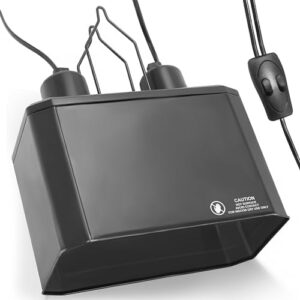
The Eckpo Dual Reptile Light Fixture takes a different approach by combining heat and UVB in one unit. It features two ceramic E26 sockets housed in separate reflective domes, each with its own independent on/off switch. This design allows the basking lamp and UVB bulb to operate separately, eliminating extra cords.
The fixture accommodates bulbs up to 150W per socket and is designed to fit small to mid-sized terrariums. Its dual-functionality and compact setup make it a practical choice for reptile enthusiasts.
Priced at $25.89, it offers a budget-conscious solution for breeding environments without compromising essential lighting needs.
| Best For | Reptile owners with small to mid-sized tanks who want heat and UVB in one tidy setup without spending a lot. |
|---|---|
| UVB Rating | N/A (fixture only) |
| Power Draw | Up to 150W per socket |
| Housing Material | Metal dome |
| Bulb Included | No |
| Mounting Options | Hooks/direct placement |
| Replacement Needed | Bulbs sold separately |
| Additional Features |
|
- Two independent switches let you run the heat lamp and UV lamp on separate schedules—no extra timer hardware needed.
- Fits compact terrariums where bulkier dual fixtures just won’t work.
- At $25.89, it’s one of the more affordable ways to cover both lighting needs at once.
- The metal housing feels thin, and the power cord is delicate—handle it carefully or it may not last.
- One AC plug means you can’t easily plug it into a timer without an adapter.
- Some users have reported early switch and wiring failures, so long-term reliability is a question mark.
4. Zoo Med ReptiSun T8 UVB Light

If budget-friendly heat control matters to you, the Zoo Med ReptiSun T8 UVB Light emphasizes raw UVB output. Each 17W, 24-inch tube delivers 10.0% UVB, suitable for bearded dragons, box turtles, and desert species.
The pack includes two bulbs, ensuring a spare is always ready. Mount the bulb within 12 inches of the basking spot for optimal effectiveness.
Replace both bulbs every six to twelve months, even if they still glow, to maintain consistent UVB levels.
| Best For | Reptile owners with bearded dragons, box turtles, or other desert species who want a vet-endorsed, budget-friendly UVB solution. |
|---|---|
| UVB Rating | 10.0 |
| Power Draw | 17W |
| Housing Material | N/A (bulb only) |
| Bulb Included | Yes (2x T8 17W) |
| Mounting Options | Standard T8 fixture |
| Replacement Needed | Every 6–12 months |
| Additional Features |
|
- Comes in a two-pack, so you always have a spare on hand
- 10.0% UVB output is strong enough to prevent metabolic bone disease and support shell health
- Fits standard T8 fixtures and runs cool, making setup and daily use simple
- UVB output fades after 6–12 months, so bulbs need regular replacement even if they still light up
- The 10.0% UVB level is too intense for species that need lower exposure—not a one-size-fits-all pick
- Shipping can take weeks and packaging sometimes isn’t sturdy enough to survive rough handling
5. Repti Zoo T8 UVB Lighting Fixture
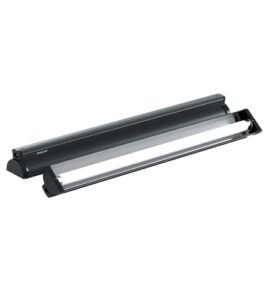
The Repti Zoo T8 UVB Lighting Fixture keeps things simple without cutting corners. This 24-inch, 18W kit ships complete with the fixture, ballast, and 10.0 UVB bulb included.
The curved reflector efficiently directs UVB downward, ensuring solid coverage in the basking spot without needing extra hardware. It operates on standard 110–120V and carries ETL certification for safety.
For optimal use, mount it above your screen top and keep the basking spot within 12 inches. Swap the bulb every six to twelve months to ensure consistent performance.
| Best For | Reptile owners keeping bearded dragons, turtles, geckos, or other UVB-dependent species in small to mid-sized enclosures who want a complete, ready-to-use lighting setup. |
|---|---|
| UVB Rating | 10.0 |
| Power Draw | 18W |
| Housing Material | High-impact plastic |
| Bulb Included | Yes (T8 18W) |
| Mounting Options | Multiple hardware configs |
| Replacement Needed | Periodic replacement |
| Additional Features |
|
- Comes as a full kit — fixture, ballast, and 10.0 UVB bulb all included, so there’s nothing extra to buy out of the box
- Curved reflector pushes UVB coverage further into the enclosure, which is a nice touch for bigger basking zones
- Low heat output makes it a safe pick for temperature-sensitive setups like ball python tanks
- At $55.99, it’s significantly pricier than basic T8 fixtures, and you still don’t get a built-in timer or dimmer
- Plastic housing feels light and a little cheap compared to metal alternatives
- Fixed 24-inch length won’t cut it for larger vivariums, so you may end up needing a second light anyway
6. T5 UVB Terrarium Light Fixture
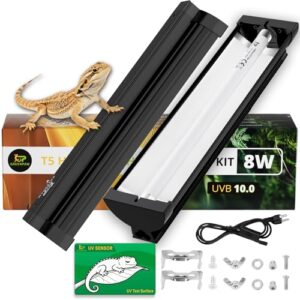
Step up to T5 HO territory, and the difference is immediate. This 8W fixture packs a 10.0 UVB tube inside a reflective aluminum hood that nearly doubles UV intensity compared to bare setups.
Before committing to any setup, check whether your snake is showing signs of UV deficiency — even a high-output fixture won’t help if the spectrum doesn’t match your species’ needs.
At 12 inches, desert reptiles like bearded dragons and tortoises get the UVB they need for strong D3 synthesis. The included UV sensor card eliminates guesswork in bulb monitoring, ensuring optimal performance.
Its heavy-duty aluminum housing maintains steady, flicker-free output—a critical factor during breeding cycles, where consistency is paramount.
| Best For | Desert reptile owners—bearded dragons, tortoises, iguanas, and geckos—who need reliable UVB lighting to support D3 synthesis and long-term health. |
|---|---|
| UVB Rating | 10.0 |
| Power Draw | 8W |
| Housing Material | Aluminum |
| Bulb Included | Yes (T5 8W) |
| Mounting Options | Clips/screws/brackets |
| Replacement Needed | Every 6–12 months |
| Additional Features |
|
- The reflective aluminum hood nearly doubles UV intensity compared to bare fixtures, so your animals actually get the exposure they need.
- Comes with a UV sensor card that lets you quickly confirm the bulb is still working—no guesswork about invisible output decay.
- Even, shadow-free coverage across the enclosure makes it a solid fit for both tall and wide setups.
- The bulb needs replacing every 6–12 months since UVB output fades over time, even if the light still looks bright.
- The sensor card only tells you UVB is present—not how strong it is—so you’d need a separate meter for precise readings.
- At 13 inches with a reflective hood, it may be too bulky for small terrariums or enclosures with limited clearance.
7. Hygger Zoo T5 UVB Reptile Light
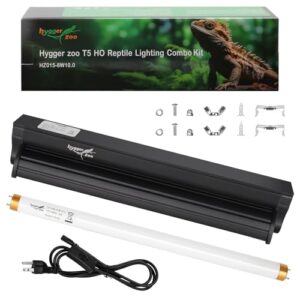
The Hygger Zoo T5 delivers 10.0% UVB from a compact 8W tube, ensuring sufficient output to drive D3 synthesis for desert species like bearded dragons. Its design prioritizes efficiency, with a polished curved reflector that directs UVB radiation precisely into the basking zone, minimizing wasted output.
The fixture’s aluminum housing manages heat effectively, while its multiple mounting options allow flexible installation—inside a canopy, on mesh, or within the vivarium itself. This versatility ensures compatibility with various enclosure setups.
For 12-inch setups, the Hygger Zoo T5 simplifies UVB provision without compromising strength, making it a reliable choice for maintaining optimal reptile health.
| Best For | Reptile owners keeping desert species like bearded dragons or leopard geckos who need solid UVB output without spending a lot. |
|---|---|
| UVB Rating | 10.0 |
| Power Draw | 8W |
| Housing Material | Aluminum |
| Bulb Included | Yes (T5 8W) |
| Mounting Options | Mesh/inside/vivarium |
| Replacement Needed | Every 6–12 months |
| Additional Features |
|
- Puts out a true 10.0% UVB rating, which is strong enough to support D3 synthesis in desert reptiles
- The polished curved reflector does a good job concentrating light right where your animal basks
- Mounts a few different ways—on mesh, inside the tank, or in a wooden vivarium—so it fits most setups
- Some buyers report the bulb dying within weeks, so reliability can be hit or miss
- Not built for humid environments; the aluminum hood can degrade if exposed to moisture over time
- A few users noticed electrical interference when pairing it with timers or fuse-based circuits
8. REPTIDLDB T5 UVB Light Fixture
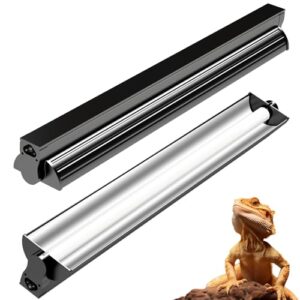
The REPTIDLDB T5 UVB Light Fixture prioritizes simplicity without compromising quality. It operates on 8W with a built-in T5 HO ballast, delivering 10.0% UVB and 30% UVA, ideal for desert species like bearded dragons.
Its slim 12-inch design fits most enclosures without consuming excessive headspace, while the alloy reflector directs UVB downward into the basking zone. However, the reflective coating may peel over time, requiring monthly inspections.
A separate heat source remains necessary, as this fixture focuses solely on UVB/UVA output.
| Best For | Desert reptile owners — especially those with bearded dragons or tortoises — who need reliable UVB coverage in a small to medium-sized enclosure. |
|---|---|
| UVB Rating | 10.0 |
| Power Draw | 8W |
| Housing Material | Alloy reflective |
| Bulb Included | Yes (T5 8W) |
| Mounting Options | External mesh/tank lid |
| Replacement Needed | Regular replacement |
| Additional Features |
|
- Delivers solid 10.0% UVB and 30% UVA output, giving desert reptiles the light they need for healthy bones and vitamin D₃ production.
- The slim 12-inch design tucks in nicely without eating up headspace, and the detachable cable makes mounting flexible.
- Built-in T5 HO ballast runs flicker-free and stays cool, so it won’t accidentally overheat your setup.
- The reflective coating can peel or crack over time, which chips away at UV output and raises some safety concerns.
- At only 8W, it’s not going to cut it for larger tanks — you’d need a bigger model for more spacious enclosures.
- Provides no heat on its own, so you’ll need a separate heat source to keep temps where they need to be.
9. MouMouPurr 12 Inch T5 UVB Terrarium Light
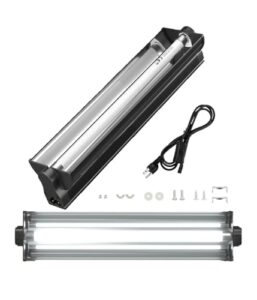
The MouMouPurr 12 Inch punches above its compact size, delivering 8W power with 10.0% UVB and 30% UVA output—impressive specifications for desert species like bearded dragons and tortoises.
Its curved alloy reflector achieves over 95% reflectivity, doubling the effective UVB reach into your basking zone.
Mounting is versatile: it attaches to mesh tops, hangs from ceilings, or secures to side walls, adapting to diverse enclosure setups.
For optimal performance, position the fixture 12–18 inches above the basking spot to maintain a consistent, ideal UVI range.
| Best For | Desert reptile owners—bearded dragons, tortoises, chameleons, and geckos—who want reliable UVB and UVA coverage in a compact, easy-to-mount fixture. |
|---|---|
| UVB Rating | 10.0 |
| Power Draw | 8W |
| Housing Material | Aluminum |
| Bulb Included | Yes (3x T5 8W) |
| Mounting Options | Mesh/ceiling/side-wall |
| Replacement Needed | 5,000+ hour lifespan |
| Additional Features |
|
- The curved alloy reflector pushes over 95% reflectivity, so you’re getting serious UVB output from just an 8W bulb.
- Flexible mounting options (mesh top, ceiling, or side wall) make it easy to fit almost any enclosure setup.
- Wide light spread means more even coverage across the habitat—no harsh hot spots concentrated in one corner.
- Some users have reported early bulb failures, with burnouts happening within days or a few months of use.
- The fixture only covers 12 inches, which may not cut it for very large or tall enclosures.
- International buyers beware—the plug is US-standard, so EU users will need an adapter.
10. MECESOR Dual Reptile Lamp Fixture
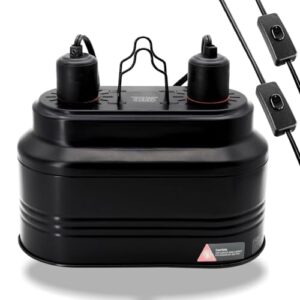
The MECESOR Dual Reptile Lamp Fixture excels at one core function: enabling you to run a heat bulb and UVB bulb side by side, independently. Its polished aluminum interior efficiently reflects light into the basking area, maximizing illumination.
Each dome features its own dedicated switch, allowing you to cut the heat at night without disrupting the UVB cycle. This design ensures precise control over your reptile’s thermal and UV exposure.
The fixture supports bulbs up to 160W total, accommodates standard E26 sockets, and mounts securely above most enclosures. Its straightforward installation requires only that you source your bulbs separately and ensure the power cable remains clear of hot surfaces.
| Best For | Reptile owners who want independent heat and UVB control in one clean, easy-to-mount setup. |
|---|---|
| UVB Rating | N/A (fixture only) |
| Power Draw | Up to 160W combined |
| Housing Material | Aluminum |
| Bulb Included | No |
| Mounting Options | Two S-hooks |
| Replacement Needed | Bulbs sold separately |
| Additional Features |
|
- Dual independent switches make day/night lighting cycles effortless — no unplugging required
- Polished aluminum interior reflects heat and light efficiently into the basking zone
- UL-certified with a ceramic E26 socket, so it handles high-wattage bulbs safely
- The metal hood bends easily and may need reshaping to fit properly
- The power cable can rest against hot surfaces, which could be a safety issue over time
- Bulbs aren’t included, so you’ll need to budget for those separately
UVB Needs for Breeding Reptiles
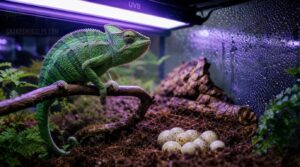
Breeding reptiles puts extra demands on your UVB setup — their bodies work harder, and the lighting must keep up.
Getting this right means understanding what UVB actually does for a breeding animal. Here’s what you need to know.
Vitamin D3 and Calcium
UVB strength directly drives vitamin D3 synthesis in a reptile’s skin. Without sufficient UV exposure, the entire calcium chain breaks down, disrupting critical physiological processes.
Without sufficient UVB, a reptile’s calcium chain collapses, triggering a cascade of critical physiological failures
The pathway unfolds as follows:
- UVB triggers vitamin D activation in skin tissue
- Active D3 raises serum calcium levels via intestinal absorption
- Low absorption triggers a parathyroid hormone response to compensate
- Chronic deficiency causes metabolic bone disease
Watch your calcium‑vitamin ratio carefully—toxicity risk management matters too. adequate calcium‑vitamin D intake helps maintain healthy bone tissue in reptiles.
Egg Production Support
Calcium absorption doesn’t stop at bones. For breeding females, it fuels shell strength directly.
UVB lighting keeps vitamin D3 synthesis running, which pulls calcium into the bloodstream and toward the shell gland.
Pair that with proper protein intake, omega-3 enrichment, and trace mineral balance, and egg yolk quality improves noticeably.
Weak UVB bulbs quietly undermine all of it.
Reproductive Hormone Balance
Hormones rely on precise timing. Consistent UVB exposure facilitates vitamin D3 synthesis, which supports calcium metabolism and maintains stable reproductive signaling.
Disruptions in day length or a weak photoperiod can quickly disrupt gonadotropin pulsatility, leading to systemic hormonal imbalances. Key contributing factors include:
- Chronic stress triggers glucocorticoid stress responses, suppressing LH and FSH.
- Poor energy balance signaling stalls GnRH pulses.
- Endocrine disruptor effects quietly shift estrogen and testosterone ratios.
- Irregular seasonal hormone rhythms delay breeding readiness.
- Inconsistent UVB exposure breaks the entire cycle.
Preventing Metabolic Bone Disease
Weak bones don’t happen overnight. Poor Calcium Ratio Management and low vitamin D3 slowly rob your reptile of bone density. Without proper UVB lighting triggering vitamin D3 synthesis, calcium metabolism breaks down completely.
Watch for UVB deficiency signs like soft jaws or limb tremors. These symptoms indicate a critical breakdown in nutrient absorption and bone health.
Use Sunlight Simulation Techniques—matching UVB bulb output to your species’ Ferguson Zone—to prevent Metabolic Bone Disease before it starts. This proactive approach ensures optimal calcium metabolism and long-term skeletal health.
Breeding Female Health Signs
A healthy breeding female tells you a lot — if you know what to watch for. Good UVB directly enhances vitamin D3 production, calcium metabolism, and overall reptile health.
Spot these signs that she’s on track:
- Receptive behavior timed to her breeding season
- Normal cloacal discharge with no foul odor
- Active nesting activity and site-seeking behavior
- Stable body condition and healthy bone density
- Strong egg viability with no soft-shelled defects
Species-Specific UVB Recommendations
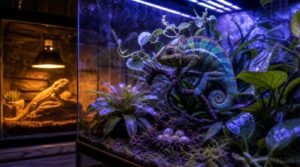
Not every reptile needs the same UVB setup — and getting this wrong during breeding season can cost you a clutch. Your species’ native habitat is the starting point for every lighting decision you’ll make.
Here’s how to match UVB intensity to what your animals actually need.
Ferguson Zone Matching
Ferguson Zone matching functions as your reptile’s UV prescription. Zone Assignment begins with identifying your species: Zone 1 crepuscular geckos require only 0.4–0.7 UVI, while Zone 4 desert baskers need 2.6+ UVI at the hotspot.
Implement Microgradient Design in every enclosure using Species Zone Profiles, UVB measurement tools, and smart UV gradient spacing. This ensures precise UVB delivery across habitats.
Maintain consistency through Seasonal Zone Shift adjustments and UVI Calibration, safeguarding breeding success year-round.
Low-light Snake Setups
Most snakes don’t need intense UVB — but "low light" doesn’t mean no light. Crepuscular species thrive with 2.0–5.0% UVB bulbs mounted 12–18 inches up, running 6 hours daily.
Keep your setup dialed in with these three priorities:
- Substrate Selection using aspen or cypress for humidity management and minimal glare
- Camouflage Hides for stress-free refuge under dim light cycles
- Nighttime Warmth via ceramic emitters — no light disruption
Replace bulbs every 6–12 months.
Forest Species Requirements
Forest species live in dappled light — leaf litter, dead wood, vertical complexity all shape how much UV actually reaches them. Pair this with a 5.0–6.0% tube like the Arcadia Forest D3 6% UVB T5 Bulb, mounted 12–18 inches up. Target UVI 1.0–2.6.
Soil moisture and light gaps matter for stress levels, too. Swap bulbs every six months.
Desert Reptile Breeding Setups
Desert breeders demand serious UV. Bearded dragons and similar species need UVI 2.6–3.5+ at the basking spot — achieve this with an Arcadia Desert D3 12% UVB T5 Bulb or Zoo Med ReptiSun T5 HO 100, mounted 8–12 inches above. High-output T5 lighting paired with UVB intensity measurement tools ensures accurate setup.
- Sand Substrate and crushed granite support natural digging and nest box placement near the warm end
- Humidity Management stays between 20–40%; keep the water station placement away from heat zones
- Sex Separation reduces stress during breeding cycles and protects female health
Avoiding UVB Overexposure
Too much UVB is just as harmful as too little. Use a UV index measurement tool to verify your UVB output intensity after every bulb swap. Log readings in an Exposure Logbook and apply Intensity Tapering by raising fixture height slightly each week. Follow UV Dose Limits and practice Seasonal UV Scaling to match natural cycles.
| Control Method | Action | Purpose |
|---|---|---|
| Intensity Tapering | Raise fixture 1–2 in | Reduce peak UVI safely |
| Symptom Checklist | Check eyes, skin weekly | Catch overexposure early |
| Seasonal UV Scaling | Shorten timer in winter | Mirror natural UVB exposure duration |
UVB intensity decay over distance is your best built-in safety tool — use it deliberately for UVB exposure safety.
T5 Versus T8 Fixtures
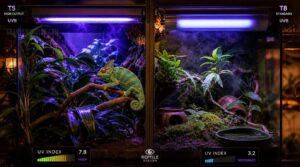
Choosing between T5 and T8 fixtures can make or break your breeding setup. Each type hits differently regarding output strength, effective distance, and how well it fits your enclosure.
Here’s what you need to know before picking one.
UVB Strength Differences
T5 fixtures simply outperform T8s — and the gap matters for breeding setups. Thanks to higher phosphor density and enhanced Reflector Efficiency, T5 tubes deliver stronger UVB output intensity across the critical 305–315 nm Spectral Peak Variation range.
Ballast Influence, bulb age, and UVB output degradation compound over time through Phosphor Aging, further widening performance differences.
Meanwhile, Inverse Square Decay causes UVB intensity to drop more rapidly with distance, affecting T8s harder and faster than T5s.
Effective Basking Distance
Distance is where T5 and T8 setups really split apart. Follow these lamp distance guidelines to get it right:
- Mount T5 HO tubes 8–12 inches above the basking spot for target UVB intensity.
- Apply Mesh Lid Compensation — add 2–4 inches when screening blocks UVB output.
- Use Incremental Distance Tuning and Heat Load Balancing if basking spot temperature exceeds 110°F.
- Apply Juvenile Proximity Adjustment and Seasonal Distance Shifts as your animals grow or seasons change.
Tube Length Selection
Once you’ve mastered lamp distance guidelines, tube length selection becomes your next critical decision. Match your UVB tube length precisely to the enclosure width: T8 tubes accommodate 18–48 inches, while T5 UVB bulbs offer 12–39 inch options.
| Enclosure Width | Recommended Tube Length |
|---|---|
| Up to 24 in | 18–24 in |
| 24–36 in | 24–36 in |
| 36–48 in | 36–48 in |
| 48 in+ | 48 in |
Enclosure Width Matching ensures Uniform Light Distribution across the basking zone. Prioritize Mounting Bracket Adjustability for easy repositioning, maintain Heat Dissipation Clearance above end caps, and confirm fixture compatibility before purchasing—Easy Bulb Replacement is essential during UVB tube replacement cycles.
Compact Enclosure Options
Small setups need smart Mounting Solutions. For nano terraria under 12×12×18 inches, a nano UVB lamp like the Zoo Med ReptiSun Compact Fluorescents 5w delivers combined UVB and UVA without crowding the space.
Material Choices and IP Ratings matter too—lightweight housings handle Size Constraints well.
Skip LED UVB alternatives; they can’t match proper UVB light distance guidelines for vitamin D₃ synthesis.
Dual Fixture Considerations
Dual fixtures do more than double your output — they reshape your whole basking zone. Adjustable Angles let you dial in UVB light distance guidelines precisely for each species.
Watch your Electrical Load; running two tubes requires proper wiring. Sealed Housing resists humidity well, while built-in reflectors improve UVB spectrum coverage and spectral balance.
Align Heat Distribution carefully to avoid hot spots, and stick to your UVB bulb replacement schedule before UVB output degradation quietly undermines your setup.
Placement and Photoperiod Setup
Getting the light in the right spot matters just as much as choosing the right bulb. Where you mount it, how long it runs, and whether your reptile can escape it — all of that shapes how well your breeding setup actually works.
Here’s what you need to know to get placement and photoperiod right.
Basking Zone Alignment
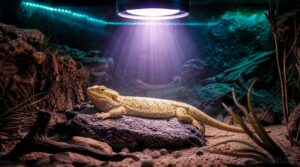
Think of your basking area as a stage — everything needs to hit its mark. Hotspot positioning matters most: center the basking spot directly above your platform so full-body coverage reaches from nose to tail.
Keep platform leveling consistent so your reptile maintains natural posture guidance without awkward twisting.
Clear accessory clearance ensures your UVB fixture design delivers unobstructed terrarium UVB placement across the entire basking area.
Safe Mounting Distance
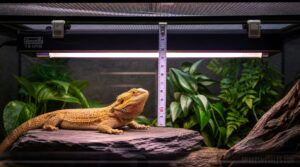
Get your UVB lamp placement right, and everything downstream improves. For T5 fixtures, mount them 12–18 inches above the basking spot — T8 tubes need just 6–8 inches for comparable output.
Bracket stability and secure mounting clips prevent accidental drift. Follow clearance guidelines carefully: glass attenuation can quietly steal UVB, so account for it.
Check reflector alignment monthly. Heat interference and mesh lids reduce effective irradiance faster than most keepers expect.
Heat and UVB Overlap
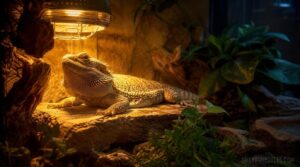
Your heat source and UVB lamp must be positioned on the same side of the enclosure to create the thermal UV gradient essential for hormonal cue integration in breeding females. This overlap ensures proper physiological responses.
Elevated skin temperature dynamics accelerate vitamin D3 synthesis, but heat UV stress poses risks. Proper enclosure airflow is crucial to prevent dangerous hot pockets. Always consider UVB bulb wattage selection to ensure safe heat source integration and maintain optimal conditions.
Seasonal Timer Schedules
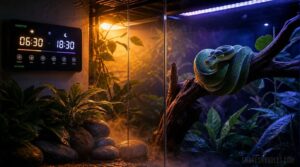
Breeding reptiles live by the sun — and your timers should too. Use Dawn Dusk Automation with GPS Solar Sync, like the BNLINK Digital Timer, to photoregulate light cycles automatically.
Temperature Linked Timing delays morning UVB when it’s cold, ensuring optimal conditions. Weekend Programming keeps photoperiods consistent without manual resets, maintaining routine reliability.
Add Battery Backup Alerts to safeguard schedules during power outages. Seasonal shifts happen — your setup shouldn’t miss them.
Shade and UV Gradients
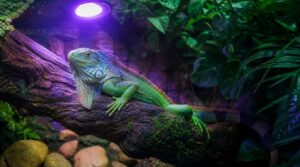
Your UV gradient isn’t just about light — it’s about giving your reptile the freedom to choose. Canopy Shade Effects and UV Ratio Shifts mean UVB drops faster than UVA under cover, altering exposure quality across the enclosure. Leverage the UVB gradient principle to optimize conditions:
- Map hotspots with Gradient Mapping tools every 2–4 weeks
- Account for UVB glass transmission and mesh filtering
- Use ShadeDweller bulbs for low-intensity shaded zones
- Place light-colored surfaces to boost Surface Reflectivity in dim corners
Behavioral Thermoregulation hinges on precise UVB attenuation throughout the habitat.
Monitoring and Maintenance Essentials
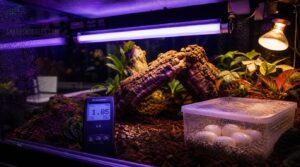
Getting your UVB setup right is only half the job — keeping it working is the other half.
A few simple habits make the difference between a thriving breeding setup and one quietly failing your animals.
Here’s what you need to stay on top of.
UV Meter Testing
A handheld UV meter reveals what your eyes cannot: whether your UVB output is actually hitting target levels. Calibration procedures matter here: verify against a traceable standard annually, and always after a drop or heat exposure. Check spectral accuracy in the 320–420 nm UVB spectrum range to ensure readings reflect real lamp output.
| Check | Target | Frequency |
|---|---|---|
| UV index at basking | Species Ferguson Zone | Weekly |
| Spectral accuracy | 320–420 nm range | At calibration |
| Field durability test | No drift after handling | Monthly |
Log results for data logging and compare readings over time to detect UVB output degradation early. Interpreting readings is simple: if UVI drops below your species’ zone minimum, act before health issues arise.
Bulb Replacement Timing
Your UVB bulbs degrade silently, so don’t wait for visible dimming. Act promptly when your UV meter flags a drop in output.
Replace T5 and T8 tubes every 6–12 months, as hotter fixtures accelerate heat-induced degradation, shortening this window. Staggered fixture swaps in multi-lamp setups prevent coverage gaps during replacements.
Track installation dates and monitor for output decline indicators. This proactive maintenance ensures consistent UV delivery.
Align your replacement schedule with seasonal scheduling around breeding cycles to avoid disrupting critical periods.
Cleaning Lamps and Reflectors
Dust and mineral buildup quietly steal UV output — sometimes as much as 10%. Stay ahead of it with this simple routine:
- Dust removal first: wipe lenses with a dry microfiber cloth.
- Apply a 1:100 vinegar-water mix for mineral deposits.
- Reflector disassembly follows manufacturer instructions only.
- Handle by edges to avoid oil transfer.
- Dry fully before powering on.
Clean monthly. Skip ammonia — it damages UV-transmitting coatings fast.
Glass and Mesh Barriers
Clean lamps help, but your glass barrier matters just as much. Standard glass blocks nearly all UVB. Use screen cages or metal mesh screen tops instead — they preserve visual transparency while allowing full UV penetration. Avoid thick plastic too.
Wire mesh offers structural reinforcement without sacrificing output. Even decorative mesh or screen mesh panels work, as long as they’re fine, open-weave designs.
Troubleshooting Weak UVB Outputs
Weak UVB readings don’t always mean a bad bulb. Run through these checks first:
- Ballast Failure — A failing ballast cuts power, causing UVB output degradation even in new tubes.
- Socket Corrosion — Dirty contacts reduce lamp drive; clean them before replacing anything.
- Lamp Burn-in — New bulbs need stabilization time before hitting peak output.
- Enclosure Optics — Distance, reflector angle, and power fluctuations all affect what your meter reads.
Frequently Asked Questions (FAQs)
Can mercury-vapor bulbs work in breeding enclosures?
Yes, mercury vapor bulbs can work. Like a two-for-one deal, they deliver heat-UV synergy in one unit. Follow safety protocols, track bulb lifespan, and handle mercury disposal responsibly.
How does photoperiod length affect egg-laying frequency?
Longer days cut melatonin and trigger a gonadotropin surge, accelerating egg cycles. Around 14–16 hours is your light threshold for a real seasonal laying boost. That’s photoregulation doing the heavy lifting.
What UVB percentage suits crepuscular breeding species?
Aim for 3–0% UVB with a gradient. Gradient Calibration and UVB Dose Titration let crepuscular species self-regulate. Microhabitat Preference drives exposure. Stress Mitigation matters — never push past 0%.
How soon can UVB deficiency affect breeding success?
It takes only weeks to decline.
UVB output degradation triggers calcium regulation failure fast.
Egg quality drops, and hormone disruption follows, quietly reducing incubation success before any issues are noticed.
Conclusion
Light is the invisible foundation every breeding season is built on. Without it, even perfect temperatures and humidity cannot release a female’s reproductive potential. The right reptile UV lights for breeding setups do more than illuminate an enclosure—they trigger the biological chain that enables successful clutches.
Match the output to your species, mount it correctly, and replace bulbs on schedule. When the light is right, everything else falls into place.
- https://reptilesmagazine.com/rethinking-reptile-lighting/?srsltid=AfmBOoqx_lL92fXutMKHeUhmRSTnQXofjJEKiuny54NNUU36FFLHKWts
- https://www.thebiodude.com/blogs/reptile-and-amphibian-lighting-faqs-and-help/photoperiod-is-important-to-your-pet-reptile-here-s-why?srsltid=AfmBOopPJfgeXMS9sjaeoBDnQJqh5Vtkx5aWRofMI7gNksdXiFbw3Nk8
- https://lafeber.com/vet/sunburned/?srsltid=AfmBOopbXeXoOpDo02zxNskX6NcwWzNueruMI99HYhscuwAQHk06pByq