This site is supported by our readers. We may earn a commission, at no cost to you, if you purchase through links.

A boa constrictor born small enough to coil around your wrist can grow into an 8-foot animal that outweighs a border collie. That gap between hatchling and adult surprises most first-time owners—and it’s where care decisions either succeed or fall apart.
How long boa constrictors grow depends on subspecies, sex, and what happens in those first four years of rapid development. A red-tailed boa female can push past 10 feet; a dwarf island boa maxes out under 30 inches.
Knowing your snake’s full growth trajectory shapes every choice, from enclosure size to feeding schedule.
Table Of Contents
- Key Takeaways
- How Long Boa Constrictors Grow
- Boa Growth by Age
- Size Differences by Subspecies
- Factors That Influence Final Length
- Measuring Your Boa Safely
- Enclosure Size for Growing Boas
- Top 5 Boa Length Comparison Toys
- Frequently Asked Questions (FAQs)
- Do boa constrictors recognize their owners?
- How cold is too cold for a boa?
- How often do boa constrictors shed their skin?
- How long do boa constrictors typically live?
- Can two boa constrictors be housed together?
- Do boas stop eating during the winter?
- At what age do boa constrictors reach sexual maturity?
- Conclusion
Key Takeaways
- Female boas (Boa constrictor constrictor) can reach 10–13 feet, outgrowing males by roughly 30% — so knowing your snake’s sex up front shapes every housing decision you’ll make.
- Genetics set your boa’s size ceiling, but your husbandry — feeding quality, temperature gradients of 75–90°F, and parasite control — determines how close it gets.
- Growth is fastest in the first four years, hitting 8 feet by year four, then slows to centimeters annually after sexual maturity; your enclosure needs to scale ahead of that curve, not behind it.
- Subspecies vary wildly — dwarf island boas max out under 30 inches while red-tailed boas push past 13 feet — so confirm your snake’s lineage before you plan space or feeding schedules.
How Long Boa Constrictors Grow
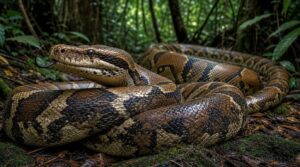
Boa constrictors aren’t small snakes — and knowing what ‘full grown’ actually looks like matters before you bring one home. Size varies more than most people expect, depending on sex, subspecies, and how the animal is kept.
A full boa constrictor care guide can help you understand exactly what size, space, and commitment you’re signing up for before day one.
Here’s what the numbers really look like.
Adult Size Range
Adult boa constrictors aren’t one-size-fits-all. Typical lengths range from 6 to 10 feet in the wild, with the average adult size around 8 feet for most specimens.
Length distribution varies considerably by subspecies and origin. Weight-to-length ratio averages 20–60 lbs for healthy adults.
Maximum documented outliers reach 13–14 feet — extreme outliers worth knowing but not expecting.
Male Versus Female Length
Sex matters more than you’d think. Female boa constrictors consistently outgrow males — often by 30% or more. That’s sexual dimorphism at work.
- Females usually reach 8–10 ft; males stay at 6–8 ft.
- Hormonal influence drives size dimorphism throughout development.
- Reproductive size trade-offs favor larger female body mass long-term.
Captive Versus Wild Boas
Captive boas grow faster and larger than wild ones — and the reasons come down to consistency. Temperature stability, nutrition quality, and health monitoring all favor captive animals. Wild boas face diet variability, seasonal stress indicators, and unpredictable environmental impact on growth patterns.
Genetics set the ceiling, but your husbandry determines how close your boa gets to it. In the exotic pet trade, wild‑caught animal proportion can be as high as 95% of sales, highlighting why captive‑bred boas often have lower disease risk.
Average Adult Weight
Weight tells you just as much as length. Most adult boas weigh between 20–60 lb (9–27 kg), though large females often exceed 100 lb. Sex-based weight differences are significant: females consistently outweigh males.
Here’s what shapes your boa’s average weight:
- Captive weight ranges often exceed wild norms
- Feeding influence on weight compounds over the years
- Regional weight variation tracks prey availability
- Genetic potential for growth sets the ceiling
- Weight-related health implications are evident in muscle tone
Biggest Realistic Expectations
Realistically, adult boa constrictors in captivity top out at 9–13 feet, with females occasionally hitting 14 feet under ideal prey size and nutrition quality. Genetic influence sets the hard ceiling — no amount of feeding breaches that barrier.
Long-term growth limits begin around age five or six. After that, enclosure space scaling and seasonal growth shifts matter more for health than adding length.
Boa Growth by Age
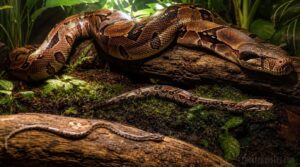
Boas don’t just wake up one day fully grown — their size follows a pretty predictable timeline from birth to adulthood. Knowing what to expect at each stage helps you plan housing, feeding, and handling before your snake outgrows its setup.
Here’s how a boa’s length changes from day one through full maturity.
Newborn Boa Length
Most newborn boa constrictors measure 14 to 22 inches—small enough to fit on your forearm, yet fully formed. Hatchling length varies with subspecies, parental size, and pre-hatch nutrition. Island dwarf hatchlings are shorter, typically 12 to 16 inches.
The key factors shaping their starting size include:
- Subspecies origin — red-tails hatch at 14–22 inches
- Parent size — larger mothers produce longer neonates
- Clutch size correlation — bigger litters often mean slightly smaller individuals
- Pre-birth nutrition — well-fed females deliver stronger, longer hatchlings
First-year Growth
The first year is your boa’s fastest growth window — don’t waste it. Under ideal conditions, juveniles add 12 to 24 inches, reaching 3 to 4 feet by month twelve. Prey size optimization and stable temperatures drive this surge.
Track monthly length gains against growth standard charts to monitor growth percentiles and catch early red flags before they stall juvenile development.
Juvenile Size Milestones
Juvenile development follows a predictable Growth Curve — and knowing it keeps you ahead. By six months, most hatchlings reach 24 to 36 inches.
Hatchling health, feeding frequency, and temperature influence significantly shape your boa’s growth rate as they age.
- Age three usually brings 5–7 feet
- Seasonal molting signals active growth spurts
- First-year gains reflect long-term trajectory
- Growth curves flatten after month 18
Near-adult Size Timeline
By year three, your boa reaches a three-year benchmark of 5–7 feet. That’s the late juvenile surge kicking in. Four-year growth pushes many captive boas to 8 feet, marking size plateau onset.
By the time your boa hits that 8-foot plateau, a boa constrictor size timeline by age can help you anticipate what’s still ahead in their growth journey.
Growth curves flatten as sexual maturity in snakes approaches. Age correlation is clear: pre-adult length gain slows sharply after year four, with growth patterns tapering well before year six.
Growth After Maturity
Once your boa reaches sexual maturity, adult growth slowdown kicks in fast. Indeterminate growth means they never fully stop — but gains shrink to centimeters annually. Hormonal changes shift energy toward reproduction, not length. Genetic predisposition sets the ceiling, though environmental factors remain influential.
Environmental impact still matters post-maturity: stress reduction, microhabitat enrichment, and long-term measurement help track slow, residual growth. These practices optimize conditions for the minimal annual gains that persist.
Seasonal growth spurts become rare but are not impossible, reflecting occasional opportunities for minor length increases despite the overarching slowdown.
Size Differences by Subspecies
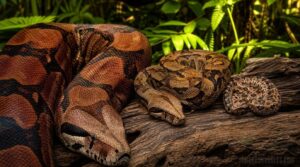
Not all boa constrictors grow the same — and subspecies are the reason. Whether you’re keeping a compact island dwarf or a full-bodied red-tail, knowing your snake’s lineage tells you a lot about where it’s headed.
Here’s how the main subspecies stack up by size.
Common Boa Size
The common boa (Boa imperator) is the subspecies most keepers encounter. Males usually reach 6–8 feet; female boa constrictors average 7–9 feet, with a maximum length near 12 feet in rare cases.
Growth rate slows after year three, shifting toward girth development rather than length.
Body condition scoring and prey availability impacts your boa’s length-to-weight ratio throughout seasonal growth patterns.
Red-tailed Boa Size
The red-tailed boa (Boa constrictor constrictor) grows noticeably larger than B. imperator. Females commonly reach 8–10 feet, with adult size potential pushing toward 13 feet under ideal conditions.
The regional diet’s impact and seasonal growth spurts drive this subspecies’ impressive weight-to-length ratio.
Enclosure dimensions should reflect that growth rate early — this snake doesn’t stay small for long.
Colombian Boa Growth
Colombian boas (Boa constrictor imperator) are smaller than their red-tailed cousins. Females usually top out at 8–9 feet; males stay closer to 6–7 feet. Morphometric data shows genetic influence matters here — prey availability and diet regimens shape the rest.
Captive versus wild comparisons reveal consistent growth rate advantages in captivity, where stable temperatures help regulate growth hormones and adult size potential remains predictable.
Dwarf Island Boas
Unlike their mainland relatives, dwarf island boas stay remarkably compact. Genetic influence from geographic isolation keeps most adults under 30 inches — a sharp contrast to Colombian boas.
Key facts about these miniature constrictors:
- Growth rate peaks early; most reach adult size by age 4–5.
- Dietary needs match their size — smaller prey items work best.
- Minimum tank size starts at 24×18 inches for adults.
- Temperament variations lean calmer than mainland subspecies.
Geographic Size Variation
Where a boa grows up shapes how big it gets. Temperature gradients, habitat productivity, and food availability influence final size differently across regional distribution zones. These environmental factors collectively drive variations in adult length.
| Region | Typical Adult Length |
|---|---|
| Tropical mainland | 8–13 ft |
| Dry/arid habitat | 5–8 ft |
| Island populations | Under 6 ft |
Island dwarfism, latitudinal variation, and subspecies differences—driven by environmental conditions and resource availability—clearly explain these regional disparities.
Factors That Influence Final Length

A boa’s final length isn’t random — several specific factors work together to determine how big your snake actually gets. Genetics, diet, temperature, and health all play a real role in the outcome.
Here’s what you need to know about each one.
Genetics and Lineage
Your boa’s maximum size is written in its DNA before it ever takes its first meal. Mitochondrial haplogroups and Y-chromosome lineages shape growth ceilings differently across subspecies. Boa constrictor imperator carries distinct SNP diversity from Boa constrictor constrictor, producing measurably different adults. Lineage-specific enhancers regulate how growth genes express.
A boa’s maximum size is written in its DNA before it ever takes its first meal
Even CRISPR lineage tracing confirms genetics sets the ceiling; environment only determines how close your snake gets to its genetic potential.
Sex-based Size Differences
Sex reverses the typical script in boas — females often grow larger than males by roughly 30%. This sexual dimorphism operates differently from most mammals. While Hormonal Growth Influence drives females toward greater Genetic Length Potential, males plateau earlier.
These sex differences are stark; a mature female can dwarf her male counterparts entirely, reflecting deep-rooted trends encoded in the boa lineage. Such Sexual Dimorphism Trends underscore a unique evolutionary pattern distinct from mammalian norms.
Feeding Quality
Think of food as your boa’s growth fuel — quality matters as much as quantity. Protein Balance directly shapes tissue development and final length.
Focus on Nutrient Density by selecting appropriate frozen prey and using proper thawing methods to preserve palatability.
Prey Palatability improves intake and reduces feeding stress.
Match prey size selection to body size, maintain consistent Feeding Frequency, and use Supplement Timing strategically to support reptile nutrition.
Temperature and Metabolism
Temperature is your boa’s metabolic engine — get it wrong and growth stalls. Metabolic rate spikes during digestion, so digestive thermoregulation depends on a proper temperature gradient: 75–85°F on the cool side, 86–90°F on the warm side.
Circadian temperature rhythm also matters; cooler nights naturally lower metabolism.
Poor hydration-temperature balance triggers a heat stress response, disrupting thermal regulation and ultimately limiting how long your boa grows.
Health and Parasites
Chronic illness is a silent growth killer. Parasites — internal worms, mites, blood parasitemia — quietly drain nutrients, causing nutritional deficiencies that stunt skeletal development.
Respiratory infections and metabolic disease compound the damage. Therefore, parasite prevention, routine parasite detection, and consistent veterinary care are essential.
Build health monitoring into your care schedule. A healthy boa will grow longer.
Measuring Your Boa Safely
Knowing your boa’s length isn’t just satisfying — it’s practical information that shapes feeding schedules, enclosure upgrades, and health assessments. Getting an accurate measurement, though, takes a little more care than you’d expect with a snake that doesn’t exactly hold still.
Here are five reliable ways to measure your boa safely and accurately.
Use Flexible Measuring Tools
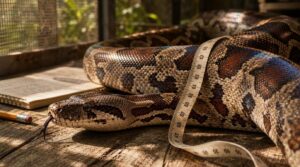
Measuring your boa accurately starts with the right tool. A flexible fabric or plastic tape — the kind with a locking mechanism — conforms to your snake’s natural curves without forcing it straight.
These portable tapes work reliably in field applications and usually measure within 1–2 mm, making them ideal for consistent growth tracking.
Keep one dedicated to your size estimation records.
Measure Without Stretching
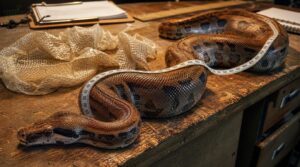
Once you’ve got the right length tools ready, technique matters just as much. Calibrate measuring tape beforehand using a known object.
Never pull your boa straight — measure along its natural curve, snout to tail. Use non-contact estimation from fresh shed skins when possible.
Consistent measurement timing minimizes handling stress. Record error notes for any tail-hiding or coiling, keeping your size estimation and growth tracking clean.
Track Shed Length Carefully
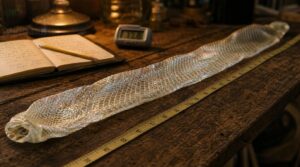
Fresh shed skins are your best low-stress measurement tool. After your boa completes the shedding process, lay the skin flat and measure snout to tail with a flexible tape — no handling required.
Note the date, ambient temperature (temperature effects can skew accuracy), and any growth variability.
Store readings in digital log templates for easy weight and length charts comparison over time.
Record Growth Monthly

Once your shed measurements are logged, build your monthly growth logs from there. Pick one fixed day each month — same date, same method. Then calculate the month‑over‑month rate: subtract last month’s length, divide by it, multiply by 100.
- Log date, length, and weight every month
- Flag anomalies — sudden spikes hint at overfeeding
- Chart visualization trends to spot growth rate by age
- Compare weight and length charts against subspecies benchmarks
Even recordbreaking sizes like recordholder Fluffy reaching 24 feet started with consistent measurement schedules.
Handle Large Boas Safely
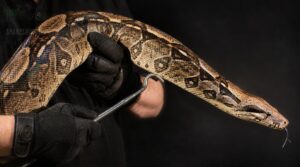
Handling a large boa safely turns a risky moment into a controlled routine. Watch for stress indicators — tail flicking, tight coiling, or hissing — and pause immediately.
Tool selection matters: use a snake hook first, then bring in assistant support for snakes over 7 feet.
Gentle positioning keeps the midsection supported throughout handling.
Always end with after-handling rest — a minimum of 24 hours back in the enclosure.
Enclosure Size for Growing Boas
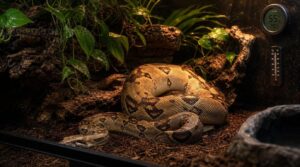
As your boa grows, its enclosure needs to grow with it. Getting the space right at each stage makes a real difference in how healthy and relaxed your snake stays.
Here’s what you need to know about sizing the habitat correctly.
Juvenile Enclosure Needs
Young boas explore every inch of their space — and then some. A juvenile’s enclosure design needs escape-proof lids and smooth wall surfaces to prevent injury.
Add adjustable climbing platforms spaced safely apart, and deep burrowing substrate for natural digging behavior.
Hidden stress retreats, like cork bark, are essential. Good housing space now builds a calmer, healthier adult later.
Adult Boa Space Requirements
Once your boa reaches adult size, the enclosure design must adapt accordingly. Here’s what constitutes adequate housing:
- Horizontal footprint of at least 8 ft × 3 ft for boas 7–10 ft long
- Vertical climbing space with sturdy branches holding 30–60 lb
- Escape-proof lid — adults are surprisingly strong
- Substrate selection like cypress mulch maintains 60–70% humidity
Lighting considerations also matter. A consistent photoperiod promotes healthy metabolism.
Large Female Habitats
Large females—often growing larger than males by 30%—demand serious housing space. Your enclosure must provide at least 12 feet of linear length and 6 feet of vertical climbing room.
Hydration stations ensure smooth shedding, while chew-proof walls prevent escapes. A bioactive substrate naturally regulates humidity.
Adding seasonal enrichment reduces stress, supporting overall well-being.
These habitat requirements aren’t optional—they’re essential.
Temperature Gradient Setup
Think of your enclosure’s thermal gradient as a thermostat your boa controls by moving around. Set the warm side to 86–90 °F and the cool side to 75–85 °F. Temperature regulation isn’t optional—it drives digestion and immune health.
- Zonal Heater Layout – Space heaters to avoid hotspots
- Sensor Feedback Loops – Probes confirm accurate readings
- Safety Interlocks – Cut power if temperatures spike dangerously
Humidity for Healthy Growth
Humidity quietly drives everything from shedding to respiratory health. Maintain your enclosure’s humidity levels between 60–70%—if it drops below 40%, dehydration follows, and if it climbs above 70%, mold takes hold.
A hygrometer is your go-to tool for monitoring humidity, and bioactive substrates like cypress mulch naturally buffer fluctuations.
| Factor | Ideal Humidity Range | Risk |
|---|---|---|
| Shedding Support | 60–70% | Retained shed below 40% |
| Respiratory Health | 60–70% | Infection above 70% |
| Mold Prevention | Below 70% | Active mold above 70% |
Top 5 Boa Length Comparison Toys
Sometimes the best way to grasp how long your boa actually is is to hold something that size in your hands.
These five toys and plush replicas give you a real-world feel for boa lengths without needing the snake itself.
Here’s what made the cut.
1. Hozzi Giant Boa Constrictor Plush
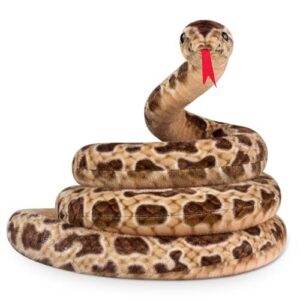
The Hozzi Giant Boa Constrictor Plush stretches to 80 inches — roughly the length of a wild-caught B. c. imperator in its prime. This makes it a genuinely useful visual reference for explaining boa size to kids or first-time owners.
Its soft, flexible, and poseable design mimics how a real boa coils, enhancing its educational value. The printed scale pattern adds realism, sparking curiosity while maintaining accuracy.
Don’t underestimate it — a tangible comparison tool often teaches size and scale faster than charts or abstract descriptions.
| Best For | Parents, teachers, and reptile enthusiasts who want a fun, hands-on way to show just how big a real boa constrictor gets. |
|---|---|
| Material | Polyester/Polypropylene |
| Length | 80 inches |
| Prank Use | Yes |
| Realistic Design | Moderate |
| Washable | Spot clean only |
| Recommended Age | All ages |
| Additional Features |
|
- At 80 inches long, it gives you a true sense of scale that no photo or chart can match.
- The flexible design lets it coil and pose like the real thing, which makes it way more convincing as a prop or teaching tool.
- Soft enough to double as an oversized pillow or couch cushion when it’s not scaring anyone.
- It’s massive, so finding somewhere to store it (or even display it) can be a headache in smaller spaces.
- Spot-clean only — if it gets dirty, you’re in for a tedious cleanup rather than a quick machine wash.
- The bulk makes it awkward to travel with, so it’s really more of a stay-at-home prop.
2. Higherbros Realistic Plastic Python Snake
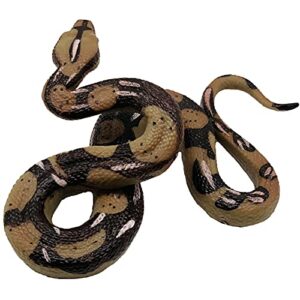
Not everything needs to be 80 inches long to do the job. The Higherbros Realistic Plastic Python Snake takes a different approach — compact at roughly 8–12 inches, rigid, and built from durable ABS plastic and rubber. It won’t fool anyone up close, but at a glance, the raised scale texture and tapered tail do the trick.
At $9.99, it’s a solid low-cost prop for classroom displays or quick size comparisons with younger kids learning what a python actually looks like.
| Best For | Teachers, parents, and party planners who want a cheap, realistic-looking python prop for classroom learning, pranks, or Halloween décor without breaking the bank. |
|---|---|
| Material | Rubber/ABS Plastic |
| Length | 5.9 inches |
| Prank Use | Yes |
| Realistic Design | Moderate |
| Washable | Wipe clean |
| Recommended Age | Children |
| Additional Features |
|
- At $9.99, it’s easy to buy in bulk for classroom rewards, party favors, or gag gifts
- Certified child-safe (ASTM, ICTI) so you don’t have to worry about handing it to kids
- Durable rubber and ABS plastic holds up outdoors and through repeated handling
- Rigid and non-poseable, so don’t expect to drape it over anything for a more convincing scare
- The compact size (under 6 inches wide) limits how well it works as a prank prop
- Up close, the plastic feel gives it away fast — realism only holds from a distance
3. HyDren Giant Boa Constrictor Plush
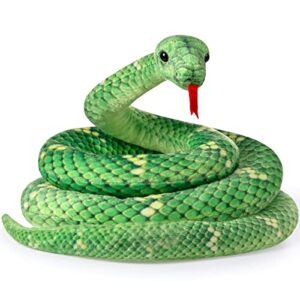
The HyDren Giant Boa Constrictor Plush measures 80 inches — roughly 203 cm, aligning with the size of an adult Boa constrictor imperator. Its flexible design allows it to coil or stretch flat, while the scale-pattern print enhances its lifelike appearance.
This plush serves as an educational tool, helping children visualize what "six feet of snake" truly feels like. Its realistic features make it particularly effective for teaching purposes.
Rated for ages 12 and up, the toy caters to older, more serious young enthusiasts, blending accuracy with engaging play.
| Best For | Kids and reptile fans who want a giant, huggable snake for play, pranks, or room décor. |
|---|---|
| Material | Polyester/Polypropylene |
| Length | 80 inches |
| Prank Use | Yes |
| Realistic Design | Moderate |
| Washable | Machine washable |
| Recommended Age | Children |
| Additional Features |
|
- At 80 inches long, it’s genuinely life-size — great for imaginative play or showing kids just how big a boa constrictor really is
- Flexible enough to coil around shoulders, drape over furniture, or curl into a prank-ready pile
- Machine-washable and holds its shape well, so it actually survives kid-level chaos
- The polypropylene stuffing can shift and clump over time, making it feel uneven
- Six and a half feet of plush snake takes up real space — storage gets tricky fast
- No internal wire means it won’t hold a posed position on its own, which limits display options
4. Melissa Doug Giant Boa Constrictor Plush
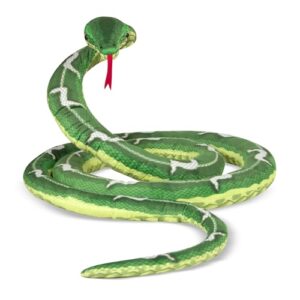
Step up from the HyDren’s six-foot frame, and the Melissa & Doug Giant Boa Constrictor Plush nearly doubles it — stretching over 14 feet (168 inches) fully uncoiled. That places it squarely in Boa constrictor constrictor territory.
At just 1.85 lb, it’s lightweight enough for kids aged three and up to manage. The realistic brown-and-tan patterning mimics actual dorsal markings well, enhancing its lifelike appeal.
It’s surface-washable and durably stitched, ensuring longevity. This plush offers a tangible sense of just how long a large adult boa actually gets, blending play with educational insight.
| Best For | Kids (and curious adults) who want a true-to-life sense of how massive a real boa constrictor actually gets — great for imaginative play, snake lovers, and educational fun. |
|---|---|
| Material | Plush/Soft Fill |
| Length | 168 inches |
| Prank Use | No |
| Realistic Design | High |
| Washable | Surface washable |
| Recommended Age | 3 years and up |
| Additional Features |
|
- At 14 feet long, it gives kids a genuine feel for real boa constrictor size — no other plush comes close.
- Lightweight at under 2 lbs, so even little ones can drag it around without a struggle.
- Realistic markings and durable stitching make it look great and hold up to rough play.
- It’s a big toy for a big space — small rooms and compact storage can make this one tricky to manage.
- The soft, floppy fill won’t satisfy kids who like their stuffed animals with a little more structure.
- It runs pricier than most jumbo plushes, so it’s more of a splurge than an impulse buy.
5. Uandme Realistic Rubber Snake Toy
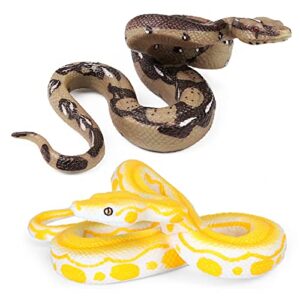
At roughly 60 centimeters, the Uandme Realistic Rubber Snake Toy sits at the smaller end of the comparison scale—closer to a neonate Boa constrictor fresh from birth. Its rigid hard plastic construction means it is not poseable rubber, so do not expect to reposition it.
Each pack includes two figures, making side-by-side comparisons practical. Placing one beside your juvenile boa reveals the size difference, offering a clear indicator of how much growth remains ahead.
| Best For | Snake enthusiasts, pranksters, or anyone who wants a low-cost garden deterrent or a fun prop for Halloween and April Fool’s gags. |
|---|---|
| Material | Hard Plastic |
| Length | 5.83 inches |
| Prank Use | Yes |
| Realistic Design | High |
| Washable | Wipe clean |
| Recommended Age | Adult |
| Additional Features |
|
- Comes with two figures, so you get double the value and can place them in multiple spots
- Made from safe, phthalate- and lead-free plastic that holds up well outdoors
- Realistic enough to spook birds, squirrels, and unsuspecting friends
- Smaller than it looks in photos, which can feel like a letdown when it arrives
- Completely rigid, so you can’t bend or reposition it to change the look
- The coloring isn’t always spot-on compared to a real boa, which may matter if you’re using it as a reference
Frequently Asked Questions (FAQs)
Do boa constrictors recognize their owners?
Boa constrictors don’t recognize owners the way dogs do. They use scent through the vomeronasal organ to identify familiar handlers. Regular handling builds habituation, reducing defensive behaviors over time.
How cold is too cold for a boa?
Below 70°F (21°C) is where trouble starts. Your boa’s metabolism slows, appetite drops, and respiratory infections become a real risk. Don’t let temps stay that low for long.
How often do boa constrictors shed their skin?
Young boas shed every 4–6 weeks. Adults slow down to about 4–5 times per year. Faster growth means more frequent sheds. Stable humidity keeps the cycle healthy and consistent.
How long do boa constrictors typically live?
Captive boas are veritable Methuselahs of the reptile world. With good care, yours can live 20 to 30 years — sometimes reaching
Can two boa constrictors be housed together?
No, housing two boa constrictors together isn’t recommended. One snake often becomes dominant, leading to stress, feeding competition, and injury risk.
Separate enclosures keep both animals healthier and easier to monitor.
Do boas stop eating during the winter?
Like a bear settling in for winter, your boa may simply lose interest in food. Many skip meals for 4–8 weeks as metabolism slows with cooler temperatures. That’s completely normal.
At what age do boa constrictors reach sexual maturity?
Male boas hit sexual maturity around 2–3 years old. Females take a bit longer, usually 3–4 years. By then, most reach 5–8 feet — ready to breed.
Conclusion
Picture a 2-inch hatchling draped across your palm—then imagine that same animal stretching past your front door seven years later. That’s the reality of how long boa constrictors grow, and it demands honest preparation.
Know your subspecies. Match your enclosure to your snake’s trajectory, not its current size.
Feed correctly, maintain temperatures, and track monthly growth. Every decision you make today shapes the animal living in your care tomorrow.