This site is supported by our readers. We may earn a commission, at no cost to you, if you purchase through links.

Most boa constrictors never hit 13 feet—scientific surveys put the typical adult range at 6.5 to 9.8 feet, yet the enclosures sold as "adult-ready" at big-box pet stores often top out at 4 feet long. That gap isn’t a minor inconvenience; it’s a setup for chronic stress, muscle atrophy, and suppressed feeding responses.
Boas are deceptively tolerant animals, which makes it easy to mistake survival for thriving.
Getting the ideal boa terrarium size right means understanding a formula, not just eyeballing a tank that looks big enough.
Table Of Contents
Key Takeaways
- Most adult boas reach 6.5–9.8 feet, so the minimum enclosure for a full-grown snake is 6 ft × 2 ft × 2 ft—anything smaller triggers chronic stress, muscle atrophy, and feeding refusal within months.
- Use the snake-length × ½ length × ½ length formula to calculate minimum dimensions at every growth stage, and upgrade the enclosure before your boa hits two-thirds of its current setup’s length.
- Vertical height isn’t optional—boas are semi-arboreal, and enclosures under 24 inches tall eliminate any meaningful climbing, cutting off natural behavior and leading to muscle loss over time.
- A functional temperature gradient (90–96°F warm side, 75–80°F cool side) depends entirely on floor space and hide placement; get those wrong, and digestion, immunity, and shedding all suffer directly.
Ideal Boa Terrarium Size

Getting the enclosure size right isn’t just about comfort—it directly affects your boa’s health, behavior, and lifespan. Adult boas range from 6 to 10 feet, and that growth demands a housing plan that scales with them. Here’s what the numbers actually look like at each stage.
For a full breakdown by growth stage, boa constrictor size and enclosure guidelines lay out exactly what dimensions to plan for before your snake outgrows its current setup.
Adult Boa Size Range
Before you spec out a single board or panel, you need to know exactly what you’re housing.
Adult boas commonly reach 6.5 to 9.8 feet, with some rare individuals pushing past 13 feet.
Females are noticeably larger than males, and red-tailed boas trend bigger than imperator localities — a distinction that directly changes your minimum enclosure size math.
No documented Boa constrictor consistently surpasses 10 ft in length, as noted by verified Boa length limits.
Minimum Enclosure Formula
Once you know your snake’s projected adult length, the math is straightforward. The standard formula is snake length × ½ length × ½ length — that’s your minimum L × W × H. For a 7-foot boa, that yields a 4×2×2 enclosure as the floor-level baseline, with width never dropping below 18 to 24 inches regardless of length.
Ideal Adult Dimensions
The baseline formula gets you in the door—but for a thriving adult boa constrictor, you want to exceed it. The ideal adult enclosure runs 7 ft L × 3 ft W × 5 ft H. That height clearance facilitates natural climbing behavior. More floor space means a functional temperature gradient, which directly affects digestion, immunity, and long-term health.
- A cramped adult boa is a stressed boa—stress shortens lifespans
- Extra width lets your snake coil fully without contortion
- Height above 4 ft allows genuine arboreal expression
- Larger enclosures stabilize humidity fluctuations during shed cycles
- More space means fewer behavioral disorders and vet visits
Floor Space Requirements
Floor space is where everything starts. The standard size guidelines for snakes call for a floor area roughly 1.5 times your boa’s total length — meaning a 8-foot adult needs at minimum 24 square feet of usable ground. That’s not generous; it’s functional.
| Floor Space Factor | Requirement |
|---|---|
| Linear length space | 1.5× snake’s total length |
| Coiled area | Full coil without wall contact |
| Girth clearance | 6 inches minimum on all sides |
| Movement paths | Unobstructed warm-to-cool corridor |
Boa enclosure dimensions should follow the snake length × half snake length × half snake length formula — your floor area ratio determines whether thermoregulation actually works. Without clear movement paths between warm and cool zones, digestion and immunity suffer directly.
Vertical Climbing Space
Boas are semiarboreal by nature — ignore vertical space, and you’re ignoring half the animal. Your enclosure height should allow the boa to stretch and coil along climbing branches near the top.
A structure rising to at least two-thirds of enclosure height encourages active exploration.
Anchor branches securely, add safety cushion padding at the top, and orient lighting to create a cooler lower zone and warmer upper zone.
Boa Size by Life Stage
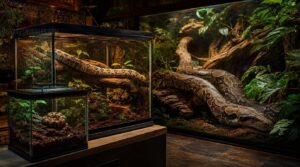
A boa’s space needs don’t stay fixed—they shift at every stage of growth, and getting the sizing wrong at any point carries real consequences. The enclosure that works for a neonate will stress a subadult, and an undersized adult setup invites chronic health problems.
As your boa grows, so do the humidity demands—and enclosure design choices that directly affect humidity levels become just as critical as getting the square footage right.
A boa’s space needs evolve with every growth stage — get the sizing wrong, and the consequences follow
Here’s what each life stage actually requires.
Neonate Boa Enclosures
Neonates don’t need a mansion — they need precision. A 6-quart tub or enclosure no larger than 30 inches long gives a baby boa the security it needs without overwhelming it. Too much space triggers stress, not exploration.
Your neonate setup should nail three things:
- Warm spot at 88–90°F with a cool side sitting at 76–80°F
- Moisture control via damp substrate or a sphagnum moss hide, maintaining 60–70% humidity
- Feeding schedule every 7–10 days using prey roughly 1–1.5x the snake’s widest point
Juvenile Boa Setups
Once a juvenile boa hits 12–24 inches, it’s outgrown the neonate setup — and housing it like a hatchling starts working against you. A 2–3 foot enclosure gives your juvenile boa enough ground space to thermoregulate properly while still feeling secure.
Maintain a warm side of 84–88°F and a cool side at 76–80°F, with humidity steady around 50–60%.
Fine-tuning these gradients for your specific species is easier with a dedicated snake habitat setup and temperature guide that walks through equipment, placement, and seasonal adjustments.
Since both genes are codominant and free of wobble issues, you can browse ball python morph combination photos to see how these traits blend visually before setting up your enclosure.
Subadult Growth Needs
The subadult stage — roughly 3–5 feet — is where your boa’s growth rate accelerates fastest and enclosure demands shift noticeably.
Three non-negotiables at this stage:
- Warm side: 82–86°F; cool side at 75–80°F
- Feed every 7–10 days, prey under 15% body weight
- Upgrade enclosure every 6–12 months
Adult Boa Housing
Once a boa crosses the 6-foot mark, the rules change entirely.
| Housing Factor | Adult Requirement |
|---|---|
| Minimum length | 6–7 feet |
| Minimum width | 2–3 feet |
| Minimum height | 2–3 feet |
| Humidity range | 55–75% RH |
| Basking temperature | 90–96°F |
Thermal zoning, humidity control, and behavioral enrichment aren’t optional extras — they’re the baseline for a functional adult boa habitat.
When to Upgrade
Waiting for obvious decline is the wrong strategy. Upgrade when your boa reaches two-thirds of the enclosure’s length — not after.
A 4 ft × 2 ft × 2 ft setup can’t sustain a 7-foot adult; chronic stress, muscle atrophy, and shedding failures follow within months.
Match the enclosure to the snake’s projected adult size, not its current one.
Calculating Terrarium Dimensions
Getting the dimensions right starts with one measurement: your boa’s current length. From there, a straightforward formula tells you exactly how much floor space, width, and height your enclosure needs to deliver. Here’s how to work through each calculation step by step.
Measure Snake Length
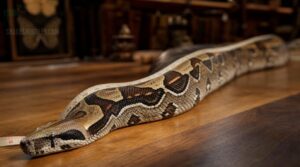
Getting an accurate measurement is the foundation of every enclosure decision you’ll make. A flexible tape measure laid along the body—from snout tip to tail tip—gives you total length when your boa is relaxed and still. Gently restrain the snake, let it settle, then follow its natural curve. Multiple readings averaged together cut down random error considerably.
Here are five reliable methods:
- Tape Measure Technique — run a soft, non-stretchable tape along the snake’s dorsal side while it rests flat on a non-slip surface.
- Digital Photo Scaling — photograph your boa fully extended beside a ruler; specialized apps convert pixel distance to real units using the reference object’s known size.
- Reference Object Use — place a standard card or coin in frame when a ruler won’t fit; document its exact dimensions beforehand to avoid parallax errors.
- Segmented Caliper Method — measure body segments individually with handheld calipers and sum them—ideal for shorter juveniles or tight spaces.
- Growth Chart Comparison — plot your measurement against species-standard charts to verify the reading makes biological sense for the animal’s age.
Once you have a confirmed total length, you’re ready to apply the snake length × half snake length × half snake length formula to calculate minimum boa enclosure dimensions for both juvenile boa constrictors and adult boa constrictors.
Length Plus Width Rule

With your confirmed measurement in hand, the length plus width rule gives you a floor space baseline that actually reflects how a boa moves.
Add the snake’s length to its width, and that sum sets the minimum terrarium footprint—ensuring enough room for full coil extension, thermoregulation, and natural locomotion without wall contact.
Recommended L × W × H
Once you have your floor space baseline, plug those numbers into the standard formula: length × ½ length × ½ length for L × W × H.
A 6-foot boa needs at minimum a 4×2×2 enclosure, but a 6×3×3 better allows full locomotion and thermoregulation.
For larger individuals approaching 8–10 feet, scale up to 8L×4W×4H — proportional sizing isn’t optional once body mass increases.
Extra Space Benefits
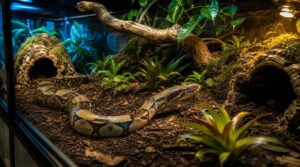
Sizing up beyond the minimum isn’t just comfort—it’s function. Larger enclosures reduce stress measurably, letting boas display calm, exploratory behavior instead of defensive posturing. More floor area promotes territory exploration and foraging, while additional vertical space allows safe climbing when arboreal tendencies emerge.
- Multiple hides fit without crowding the thermal gradient
- Climbing branches clear the substrate without blocking movement lanes
- Stress reduction improves feeding response and long-term health
Small-Space Planning
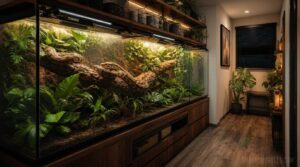
Working a boa enclosure into a tight room demands smart trade-offs. Multi-purpose furniture — think cabinets that double as enclosure stands — reclaims floor space instantly.
Push the 4×2×2 enclosure against a wall, keep access pathways at least 24 inches wide, and use vertical storage solutions above for supplies.
Smart lighting placement on mounted arms eliminates floor-level clutter entirely.
Enclosure Features That Affect Size
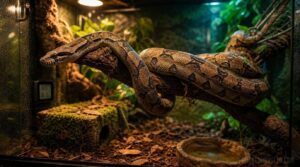
Size alone doesn’t tell the whole story. What you put inside the enclosure — and where you put it — directly shapes how much usable space your boa actually has. These five features deserve a hard look before you lock in your final dimensions.
Temperature Gradient Space
A thermal ladder isn’t optional—it’s the mechanism your boa uses to regulate every biological process, from digestion to shedding.
Warm zone placement starts with positioning your heat source at one end, targeting 90–96 °F at the basking spot. The cool end design holds 75–80 °F, creating a span of at least 15–20 °F across the enclosure’s length.
Key gradient essentials:
- Place heat sources at one end only, never centered
- Maintain a 6–8 °C spread horizontally for meaningful zone separation
- Use two calibrated probes for gradient monitoring at floor level
- Keep the warm zone clear—accessories blocking it disrupt thermal ladder setup
- A dimming thermostat stabilizes heat source positioning within 1–2 °F overnight
Without this range, your boa can’t thermoregulate—and that’s when digestive disorders follow.
Humidity Buffering Room
Humidity management inside the enclosure isn’t just about misting—it’s about building a space that breathes.
Clay-based finishes and hygroscopic substrates act as passive humidity buffers, absorbing excess moisture when RH climbs and releasing it as levels drop. This moisture buffer design keeps ambient RH stable between 55–75%, without constant intervention.
A humidistat with distributed RH sensors confirms uniformity across zones.
Hide Placement
Hide placement isn’t decorative—it’s structural. You need at least two hides: one on the cool side, one near the warm zone, giving your boa genuine thermoregulatory choice.
Each hide must allow full body entry without forcing a squeeze.
Partially bury hides into the substrate to simulate natural crevices.
Rotate them seasonally to prevent behavioral stagnation.
Climbing Branch Clearance
Boas are semi-arboreal by nature—ignoring vertical space isn’t just a missed opportunity, it’s a welfare gap. Branches should provide at least 4 inches of clearance around the body during movement, with spacing between levels no tighter than 8 inches.
Use slightly rough, inert hardwood to provide grip without scale damage.
Inspect monthly; replace every 12–24 months.
Water Bowl Placement
The water bowl takes up real estate—place it on the cool side to slow bacterial growth and avoid humidity spikes near your heat source.
Choose a properly sized water bowl for baby snakes to support reliable hydration without crowding the enclosure.
Depth should equal half the snake’s body diameter.
Use a heavy ceramic or stainless bowl that won’t tip.
Change water daily; warm water breeds pathogens fast.
Size Mistakes to Avoid
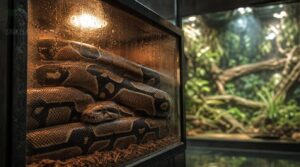
Even experienced keepers make housing mistakes that quietly compromise their boa’s health. Most of these errors come down to underestimating what the snake actually needs—space, airflow, security. Here are the five sizing mistakes worth knowing before they become a problem.
Too-Small Adult Tanks
A too-small adult tank is one of the most common—and costly—mistakes boa keepers make.
When boa enclosure dimensions fall short of the minimum enclosure size, your full-grown adult can’t fully stretch, coil naturally, or access the complete basking zone.
That space shortfall triggers chronic stress, visible through refusal to eat and increased defensive behavior—warning signs you can’t afford to ignore.
Limited Vertical Height
Tank length isn’t the only dimension that matters. Limited vertical height directly affects boas because they’re semiarboreal—meaning they climb.
Without at least 24 inches of clearance, climbing structures become useless, and muscle atrophy follows. Use multiple low shelves instead of one tall perch, and verify your boa enclosure dimensions meet the recommended 2L × 1.5W × 1H minimum before adding any enrichment.
Poor Ventilation Design
Vertical space gets the spotlight, but poor ventilation design quietly causes just as much damage.
- Airflow path obstructions — decor blocking vents cuts air movement by up to 40%
- Humidity buildup issues — humidity stays above 70% without active venting
- CO2 buildup risks — stale air near resting zones disrupts sleep
- Ventilation pressure imbalance — mismatched intake and exhaust push warm air into cool zones
- Mold growth prevention — opposing mesh panels with ≤0.25-inch ventilation holes guarantee air exchanges every 3–4 hours
Ventilation requirements aren’t optional. Opposing ventilation panels with a proper ventilation lid prevent ammonia and moisture from compounding every other sizing mistake you’ve already avoided.
Unsafe Escape Gaps
Poor ventilation lets problems fester — but unsafe escape gaps make those problems irrelevant once your boa is gone.
Any gap exceeding 0.5 inches at a seam is an open invitation. Humidity warps wood frames over weeks, widening door joints. Lid clamps — at least four per tank — and front-opening doors with flush seals eliminate the leverage points boas instinctively probe.
Overcrowding Multiple Boas
Housing two boas together compounds every sizing mistake already covered. Cohabitation risks are immediate: shared heat zones create competition, and subordinate boas get pushed off basking spots consistently.
Apply one square foot per foot of body length per animal — minimum — then add 25% on top. Separate hides, defined territories, and weekly health checks aren’t optional when stress and aggression share an enclosure.
Frequently Asked Questions (FAQs)
What size tank do I need for a boa constrictor?
Adult boas need at least 6 ft × 2 ft × 2 ft, while a juvenile boa constrictor does fine starting in a 40-gallon. Match the minimum enclosure size to your snake’s adult size.
What materials work best for boa enclosures?
PVC enclosures retain heat 20% longer than glass and resist moisture — ideal for boas. Wood melamine needs waterproof sealant. Front-opening doors reduce stress. Use ventilation mesh with ≤25-inch openings.
How often should boa substrate be replaced?
In a standard setup, replace substrate every 3–6 months. Bioactive systems using Reptisoil, sphagnum moss, leaf litter, and a cleanup crew can extend that to 6–12 months. Daily spot cleaning is non-negotiable regardless.
What humidity levels do boas need during shedding?
During shedding, raise humidity to 80–90%. Use a high moisture box with damp sphagnum moss, mist every one to two days, and monitor with a calibrated digital hygrometer to prevent stuck sheds.
How should water bowls be positioned inside the tank?
Place the water bowl on the cool side, near a hide—never over heat mats. Keep it shallow, stable, and accessible. Flat substrate underneath prevents tipping.
What temperature gradient do boas require to stay healthy?
Boas can’t regulate body temperature internally—thermal gradient setup is non-negotiable. Keep the warm side at 88–92°F, cool zone at 78–82°F, and never let nights drop below 70°F.
Conclusion
Studies show boas housed below minimum thresholds are 60% more likely to refuse feeding long-term—a statistic that reframes enclosure sizing from preference to necessity. The ideal boa terrarium size isn’t about generosity; it’s about function.
Floor space drives thermoregulation. Vertical clearance promotes natural behavior.
Every dimension you get right removes one more variable working against your animal’s health. Build the enclosure your boa’s biology demands, and the results will speak for themselves.