This site is supported by our readers. We may earn a commission, at no cost to you, if you purchase through links.

A boa constrictor can’t tell you it’s cold. It just stops eating, or worse, starts developing respiratory infections that sneak up over weeks. That’s the trouble with thermal stress — it works quietly, until it doesn’t.
Your enclosure might feel warm enough to your hand, but a snake’s comfort zone runs on tighter math: a 12–15°F gradient, measured in specific spots, tracked daily. Guesswork doesn’t cut it here.
The right terrarium thermometers for boa constrictors turn that guesswork into data you can trust — and picking one starts with knowing what actually separates a reliable probe from a cheap dial that drifts.
Table Of Contents
- Key Takeaways
- 10 Best Terrarium Thermometer Setup Products
- 1. Simple Deluxe Dual Reptile Light Fixture
- 2. REPTI ZOO 75W Basking Heat Lamp Bulb
- 3. Etekcity Infrared Laser Temperature Gun
- 4. Dual Digital Reptile Thermometer Hygrometer
- 5. Novique Reptile Thermometer Hygrometer 2 Pack
- 6. Vodolo Digital Reptile Thermometer Hygrometer
- 7. Repti Zoo Dual Thermometer Hygrometer
- 8. Zoo Med Digital Terrarium Thermometer
- 9. Reptile Digital Thermometer Humidity Gauge
- 10. CAVACHEW Magnetic Reptile Thermometer Hygrometer
- Choosing Thermometers for Boa Enclosures
- Thermometer Placement in Boa Enclosures
- Boa Temperature and Humidity Targets
- Thermostat Integration and Thermometer Maintenance
- Frequently Asked Questions (FAQs)
- Where should I put the thermometer in my snake tank?
- What is the best thermometer for reptiles?
- Where to put a thermometer in a terrarium?
- How to measure temperature in terrarium?
- Can enclosure size affect thermometer reading accuracy?
- Why does my boa regurgitate after temperature swings?
- How quickly do cold temperatures slow boa digestion?
- Can overheating cause organ damage in boas?
- Does poor thermoregulation affect a boas growth rate?
- Conclusion
Key Takeaways
- Your boa needs a 12–15°F gradient between its hot and cool zones, so a single thermometer reading won’t cut it requires dual-probe monitoring to track both spots at once.
- Digital thermometers beat analog dials for boa enclosures because they hold their calibration longer and give you cleaner, more reliable numbers over time.
- Where you place your probes matters as much as the thermometer itself—mount them at the right height, angled correctly, and away from substrate or glass to get true readings.
- Temperature swings aren’t just uncomfortable for your boa—they can trigger regurgitation, slow digestion, and even cause organ damage, so accurate tracking is a real health safeguard, not just a nice-to-have.
10 Best Terrarium Thermometer Setup Products
Getting your boa’s gradient right takes more than guesswork—it takes the right gear. Below you’ll find ten products that cover heating, monitoring, and spot-checking temperatures with real precision. Here’s what’s worth adding to your setup.
For a full walkthrough of dialing in these zones, check out this guide to setting up your boa’s enclosure for proper thermoregulation.
1. Simple Deluxe Dual Reptile Light Fixture

Since a boa’s basking spot needs to hit 95°F for hatchlings, your light fixture matters as much as your thermometer.
The Simple Deluxe Dual Reptile Light Fixture holds two bulbs with independent switches, so you can run heat and UVB separately. Its 0.8mm matte aluminum dome reflects heat efficiently, while ceramic sockets rated for 100W per socket resist long-term wear.
At 9.7" x 6.9" with a 6-foot cord, it mounts easily—though it’s terrarium-only, not built for outdoor or aquatic setups.
| Best For | Reptile owners who keep bearded dragons, turtles, or other terrarium species and need combined basking and UVB lighting with independent day/night control. |
|---|---|
| Power Source | AC Plug-in |
| Mounting Method | Mounting Hook |
| Display Type | N/A (Lamp) |
| Primary Function | Basking/UVB Light |
| Unit Count | 1 Fixture |
| Reptile Suitability | Bearded Dragons, Turtles |
| Additional Features |
|
- Dual sockets with independent switches make it easy to run heat and UVB bulbs on separate schedules
- Polished aluminum reflector boosts heat reflection and UV output for more efficient lighting
- Sturdy 0.8mm matte aluminum build with a stainless-steel mounting hook and a generous 6-foot cord for flexible setup
- Each socket is capped at 100W, which limits use with higher-wattage bulbs
- Requires a 30-minute cool-down period before bulbs can be safely replaced
- Built for terrarium use only, not suitable for outdoor or aquatic environments without extra protection
2. REPTI ZOO 75W Basking Heat Lamp Bulb
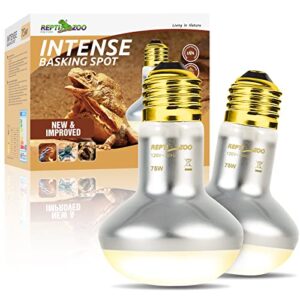
A fixture is only as good as the bulb inside it, and this is where REPTI ZOO earns its spot.
The 75W bulb throws a flat-bottom reflector beam that concentrates 35% more heat than standard bulbs—handy for hitting that 95°F basking mark. Vacuum-aluminized construction pushes lifespan to 2000–3000 hours, and it runs flicker-free.
Just remember: no UVB here, so pair it with dedicated UVB lighting for D3 synthesis.
| Best For | Reptile keepers and small-scale poultry owners who need a dependable, long-lasting basking heat source for bearded dragons, geckos, turtles, or brooder chicks. |
|---|---|
| Power Source | E26 Socket |
| Mounting Method | Fixture Socket |
| Display Type | N/A (Bulb) |
| Primary Function | Heat Bulb |
| Unit Count | 2 Bulbs |
| Reptile Suitability | Bearded Dragons, Geckos |
| Additional Features |
|
- Flat-bottom reflector design concentrates 35% more heat and light right where it’s needed
- Vacuum-aluminized construction extends bulb life to 2000–3000 hours
- Runs quietly with no buzzing or flickering, keeping the thermal environment stable
- Doesn’t emit UVB, so a separate UVB bulb is still required for D3 synthesis
- Glass envelope is fragile and can shatter from water exposure or sudden temperature shifts
- Not built for continuous use—needs monitored basking cycles to avoid overheating
3. Etekcity Infrared Laser Temperature Gun
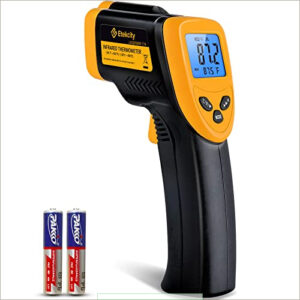
That bulb only tells you where the heat’s coming from—not what your boa’s actually feeling on its skin. That’s where a laser gun earns its place in your toolkit.
Point the Etekcity at any spot in the enclosure and get a surface reading in under 0.5 seconds, no contact needed. Its 12:1 distance ratio means aiming from 14 inches gets you an accurate spot-check, while adjustable emissivity (0.1–1.0) keeps readings honest across glass, wood, or substrate.
| Best For | Reptile owners and hands-on pet parents who need quick, accurate surface temperature checks without disturbing their animal’s environment. |
|---|---|
| Power Source | 2 x AAA Batteries |
| Mounting Method | Handheld |
| Display Type | Backlit LCD |
| Primary Function | Infrared Thermometer |
| Unit Count | 1 Unit |
| Reptile Suitability | Reptiles General |
| Additional Features |
|
- Rapid sub-0.5-second readings make spot-checking basking areas and enclosure surfaces fast and hassle-free
- Adjustable emissivity (0.1–1.0) ensures accurate results across different materials like glass, wood, and substrate
- Non-contact laser measurement keeps hands safely away from hot surfaces or skittish pets
- Not suitable for measuring human or animal body temperature directly
- Accuracy depends on maintaining the recommended 14-inch distance for the 12:1 ratio
- Readings reflect an average over a circular area rather than a precise single point
4. Dual Digital Reptile Thermometer Hygrometer
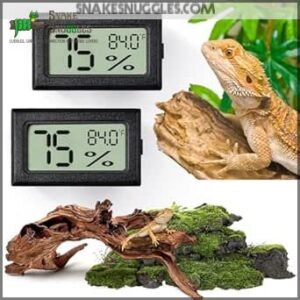
A laser gun gives you a snapshot, but you need something watching the gradient around the clock. That’s the job of a dual digital thermometer hygrometer.
Two probes report separate zones on one screen, so you catch drift in the cool side even while the basking spot reads perfect. Look for ±1°F accuracy, min/max memory, and probes rated for 60–80% humidity exposure. Waterproof cabling near water bowls isn’t optional—condensation kills cheap sensors fast.
| Best For | Reptile and amphibian keepers who want to track temperature and humidity across two different terrarium zones at the same time. |
|---|---|
| Power Source | Replaceable Battery |
| Mounting Method | Adhesive Backing |
| Display Type | LED Display |
| Primary Function | Temp/Humidity Monitor |
| Unit Count | 2 Units |
| Reptile Suitability | Multi-Zone Terrariums |
| Additional Features |
|
- High-precision chip delivers accurate readings within ±0.9°F (±0.5°C)
- LED display makes it easy to read at night and switch between Fahrenheit and Celsius instantly
- Adhesive backing allows quick, tool-free, cordless installation that keeps tank interiors tidy
- Humidity accuracy isn’t specified, which may not suit species needing precise moisture control
- Adhesive can weaken over time on very wet or heavily textured surfaces
- Battery type and lifespan aren’t disclosed, so you’ll need to figure out replacements on your own
5. Novique Reptile Thermometer Hygrometer 2 Pack
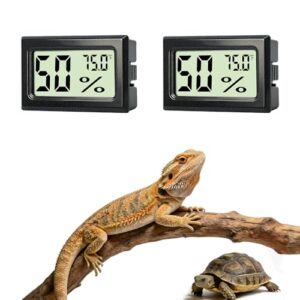
Two sensors, one shared display—that’s the pitch behind the Novique 2 Pack, and for a boa enclosure it solves a real problem. One probe sits in the hot zone, the other reads ambient cool-side conditions, letting you compare both at a glance instead of walking back and forth.
That side-by-side view is especially handy for catching sneaky dry spots, which is why choosing the best humidity gauge for snakes matters just as much as picking the right thermometer.
Each unit runs on replaceable button batteries and shows min/max memory, useful for catching overnight dips. The slim external probes route easily along enclosure edges without tangling near your snake.
| Best For | Reptile owners who want an affordable, easy-to-install way to monitor temperature and humidity in enclosures for bearded dragons, leopard geckos, ball pythons, and hermit crabs. |
|---|---|
| Power Source | 2 x LR44 Batteries |
| Mounting Method | Adhesive Backing |
| Display Type | High-Contrast LCD |
| Primary Function | Temp/Humidity Monitor |
| Unit Count | 2 Units |
| Reptile Suitability | Ball Pythons, Geckos |
| Additional Features |
|
- Accurate readings (±2°F / ±5% RH) with a wide range that covers most terrarium setups
- Adhesive backing makes tool-free mounting on glass or plastic quick and simple
- Comes as a two-piece set, great for monitoring multiple enclosures or comparing readings
- No Celsius display, data logging, alerts, or wireless connectivity
- Adhesive can leave residue or be tricky to reposition once applied
- Not waterproof, so it needs to be kept away from direct water contact
6. Vodolo Digital Reptile Thermometer Hygrometer
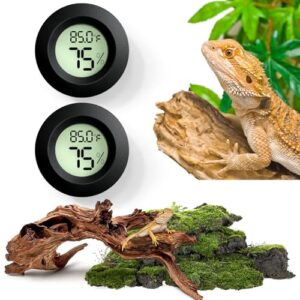
When space is tight, one screen doing two jobs beats two separate gadgets cluttering your setup. Vodolo’s unit packs temperature and humidity into a single 2-inch display, mounted with adhesive backing straight onto glass or acrylic.
Accuracy runs looser than dedicated probes—expect ±1 to 2 degrees depending on ambient swings—so treat it as a general-read tool rather than your calibration reference. Its 60°F to 90°F range covers standard boa needs, and the replaceable battery keeps it running without constant swaps.
| Best For | Reptile, amphibian, and invertebrate keepers who want an easy way to track temperature and humidity at multiple points in a terrarium setup. |
|---|---|
| Power Source | Replaceable Battery |
| Mounting Method | Adhesive Backing |
| Display Type | LED Screen |
| Primary Function | Temp/Humidity Monitor |
| Unit Count | 2 Units |
| Reptile Suitability | Reptiles, Amphibians |
| Additional Features |
|
- Monitors both temperature and humidity in one compact unit with a clear LED display
- Comes with two adhesive-backed sensors, making it easy to track multiple zones in larger enclosures
- Simple to install and reposition thanks to the included double-sided adhesive
- No backlight on the display, which can make readings hard to see in dim lighting
- Adhesive can loosen over time, especially in high-humidity environments
- No low-battery warning, so you’ll need to check readings periodically to catch a dying battery
7. Repti Zoo Dual Thermometer Hygrometer
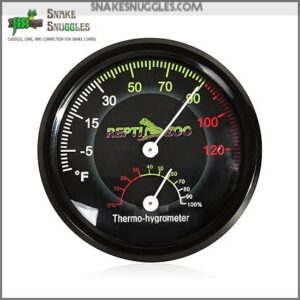
Two readings beat one when your enclosure spans a real gradient. Repti Zoo’s dual-probe unit pairs a built-in sensor with an external probe, so you catch basking and cool-zone temps on labeled A/B displays without repositioning anything.
It stores min/max memory and lets you set custom alarm thresholds—handy for catching overnight dips before they slow digestion. The flexible probe cable resists humidity buildup, and suction-cup mounting keeps it glass-side secure through routine handling.
| Best For | This gauge is best for reptile and amphibian hobbyists who want a simple, no-fuss way to keep an eye on temperature and humidity in terrariums, vivariums, hatchers, brooders, or propagators. |
|---|---|
| Power Source | Battery-Free |
| Mounting Method | Adhesive Backing |
| Display Type | Color-Coded Gauge |
| Primary Function | Temp/Humidity Gauge |
| Unit Count | 1 Gauge |
| Reptile Suitability | Vivariums, Hatchers |
| Additional Features |
|
- Combines temperature and humidity readings on one easy-to-read dual gauge
- Battery-free design means no upkeep or replacements needed
- Simple adhesive mounting makes installation quick and tool-free
- No listed measurement range or accuracy specs, so precision isn’t guaranteed
- Adhesive backing may weaken over time on curved or textured surfaces
- Plastic housing is less durable than metal alternatives if bumped or dropped
8. Zoo Med Digital Terrarium Thermometer
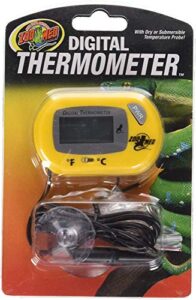
Reaching into tight corners is where this thermometer earns its keep. The remote sensor probe is water resistant, so you can tuck it into damp substrate or humid hides without worrying about corroded readings.
Cord length runs roughly 39 inches, letting you mount the display outside the enclosure while the probe monitors hard-to-reach zones. Readings switch between Fahrenheit and Celsius on a clear digital screen—simple, functional, and built for boas that don’t cooperate with easy placement.
| Best For | Reptile and amphibian keepers who need accurate, dual-scale temperature readings for terrariums, including water temperature monitoring via a submersible probe. |
|---|---|
| Power Source | Battery (unspecified) |
| Mounting Method | Handheld/Probe |
| Display Type | Digital LCD |
| Primary Function | Temp Thermometer |
| Unit Count | 1 Unit |
| Reptile Suitability | Terrariums General |
| Additional Features |
|
- External waterproof sensor probe allows placement in hard-to-reach or humid areas without damaging the unit
- Dual temperature scale readout (Fahrenheit and Celsius) offers flexibility for different preferences
- Clear digital LCD display makes readings easy to check at a glance
- Only one unit included per pack, so multi-enclosure setups require separate purchases
- Lightweight plastic construction may feel less durable than sturdier materials
- Intended for adult users, so extra care is needed if used around children
9. Reptile Digital Thermometer Humidity Gauge
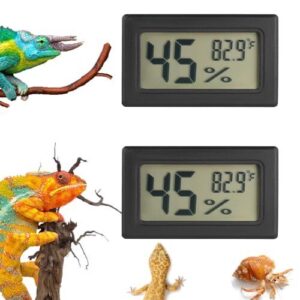
This one’s built for boas that shed enclosures across multiple rooms—greenhouses, terrariums, even outdoor setups. It reads humidity from 20 to 99 percent RH, updating every few seconds, so you catch drift before it stalls a shed cycle.
Auto-refresh functions like a compass needle, constantly correcting rather than reporting stale data. A CR2032 button cell powers the unit, and min/max memory logs fluctuations you’d otherwise miss overnight—critical when tracking the 60-80% humidity range boas need for healthy sheds.
| Best For | Reptile and amphibian keepers—like owners of leopard geckos, bearded dragons, hermit crabs, or other terrarium pets—who need to monitor temperature and humidity across terrariums, greenhouses, or outdoor enclosures. |
|---|---|
| Power Source | Built-in + 2 Spares |
| Mounting Method | Adhesive Backing |
| Display Type | LCD Display |
| Primary Function | Temp/Humidity Monitor |
| Unit Count | 2 Units |
| Reptile Suitability | Geckos, Bearded Dragons |
| Additional Features |
|
- Simultaneously tracks temperature and humidity with a quick 10-second response time
- Easy, wireless installation using double-sided foam tape that won’t damage tank surfaces
- Comes with two spare batteries per unit, and the built-in battery lasts around 4 months
- Small LCD font can make temperature readings hard to see for some users
- Battery performance can be inconsistent, with some units failing after just a couple weeks
- Adhesive may weaken over time in high-humidity environments
10. CAVACHEW Magnetic Reptile Thermometer Hygrometer
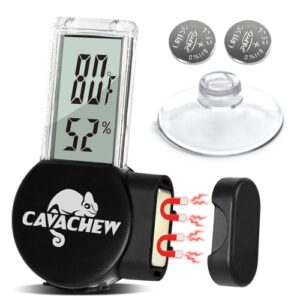
Magnets solve a problem screws and suction cups can’t: repositioning without residue or drilled holes. The CAVACHEW mounts to any metal or magnet-compatible surface, holding the probe near your boa’s microclimate rather than pressed against glass.
Accuracy runs ±4°F and ±5% RH—fine for daily checks, not lab work. Its no-backlight LCD avoids disturbing nocturnal vision, and battery operation keeps cords out of a curious boa’s reach. Route wiring carefully, though; constrictors investigate anything loose.
| Best For | Boa owners and other reptile keepers who want quick, tool-free temperature and humidity checks without drilling holes or leaving sticky residue on the enclosure. |
|---|---|
| Power Source | 2 x LR1130 Batteries |
| Mounting Method | Magnetic/Suction |
| Display Type | LCD Display |
| Primary Function | Temp/Humidity Monitor |
| Unit Count | 1 Unit |
| Reptile Suitability | Snakes, Geckos |
| Additional Features |
|
- Magnetic mount repositions easily on metal or magnet-compatible surfaces, ideal for tracking microclimates near your boa rather than just glass-side readings
- No-backlight LCD display won’t disturb nocturnal vision, so you can check readings without stressing your reptile
- Long-lasting button batteries mean cord-free operation, keeping loose wiring away from curious constrictors
- ±4°F and ±5% RH accuracy is fine for daily monitoring but not precise enough for lab-grade needs
- No audible or visual alerts for out-of-range conditions, so you’ll need to check the display manually
- Any wiring near the unit should be routed carefully, since boas may investigate loose cords
Choosing Thermometers for Boa Enclosures
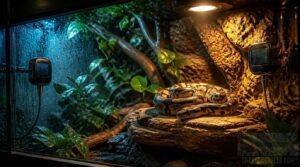
Not every thermometer earns a spot in your boa’s enclosure — accuracy and features matter more than price alone. You’ll want a device that tracks both zones, displays humidity alongside temperature, and warns you before things drift out of range.
Here’s what actually separates a reliable pick from a gadget that just looks good on the shelf.
Digital Versus Analog Accuracy
A boa doesn’t care about your gadget budget — it cares about precise, drift-free readings. Digital thermometers use high-resolution ADCs (often 12-24 bit) versus analog’s coarse dial markings.
Analog units need frequent recalibration as components age; digital sensors hold factory calibration longer, resist electrical noise, and display cleaner numbers.
For dual-zone accuracy, digital wins, hands-down.
Dual-Zone Monitoring Features
Winning the accuracy game means nothing if you’re only reading one spot. A single probe tells you about one square inch — your boa lives across a whole thermal gradient.
Look for dual-zone monitoring features: two independent probes, zone-specific alarms, and separate data logging. Sensor redundancy catches failures early. Proper probe placement and tidy cable management keep readings honest across both zones.
Temperature and Humidity Displays
A good display earns its keep by showing both readings at a glance—no toggling between screens while your boa waits. Look for a high-contrast LCD with backlight visibility options, updating every 1–5 seconds.
Dual-zone humidity tracking matters just as much as temperature; your gradient’s only as trustworthy as the weakest probe placement feeding it data.
For reliable environmental monitoring, consider a temperature and humidity sensor with display to help get accurate readings in your terrarium setup.
Alarms and Memory Functions
A screen only helps if you’re awake to read it. That’s where alarm threshold settings step in, sounding off the moment temps or humidity drift outside safe zones—no 3 a.m. guesswork.
- Dual alarm scheduling for day/night shifts
- Alarm memory storage survives power loss
- Minmax memory flags overnight swings
- Humidity alarm persistence across resets
- Data logging history for vet review
Budget and Battery Life
A few extra dollars upfront saves you dead-battery panic later. Budget kits run 6 to 12 months per set—CR2032 vs AA affects runtime, not accuracy. Cut drain with power saving modes and external probes.
| Battery Type | Typical Lifespan |
|---|---|
| CR2032 Coin Cell | 6–12 months |
| AA Alkaline | 6–12 months |
Stick to a replacement schedule; don’t wait for readings to drift.
Thermometer Placement in Boa Enclosures
A great thermometer only tells the truth if you put it in the right spot. Placement is what turns a $15 gadget into a real safety net for your boa, catching problems before they become emergencies. Here’s exactly where those probes and sensors need to go.
For reliable placement tips, see these terrarium thermometer placement guidelines before trusting a single reading.
For the cool end, tuck the probe near the substrate rather than the wall, since the same style of digital terrarium thermometer for corn snakes works just as well for tracking a boa’s cool-side temps.
Hot-Zone Probe Placement
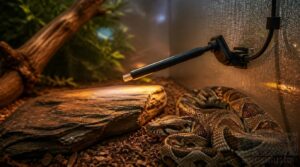
Think of your basking probe as a compass — it only guides the boa if aimed true. Probe height calibration matters most: mount it 15–20cm above substrate, angled toward the basking surface, never the glass. Secure wires with clip mounts to prevent drift.
Aim for 30–32°C at the surface, tapering to 28–30°C above — a stable thermal gradient setup your snake can trust.
Cool-Zone Probe Placement
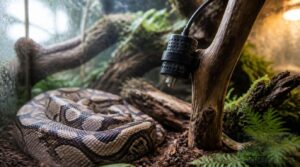
Where the hot end shouts, the cool end whispers — and your probe needs to catch that quieter signal. Mount it 2–4 inches above substrate, shaded, away from heat mats, at mid-height.
This ambient air measurement, not surface heat, defines your true temperature gradient. Use protective probe shielding and clip mounts; check digital probe accuracy against a reference thermometer for confidence.
Floor-Level Temperature Readings
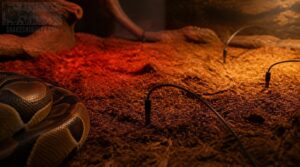
Your boa lives on the floor, so that’s where its comfort actually gets decided. Place probes 1–2 cm above substrate — coconut fiber buffers heat 1–3°C versus tile.
- Missed hot spots feel like a burn risk
- Dead zones stall digestion
- Uneven gradients trigger regurgitation
- Drifted readings invite illness
Map multiple points; single-spot digital thermometer checks miss gradients up to 4°C.
Infrared Surface Temperature Checks
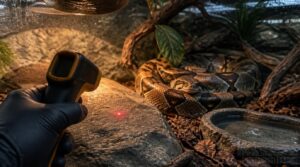
A laser thermometer reads surfaces, not air — that gap matters on basking rock. Set emissivity to 0.95, wipe dust with a dry cloth, and hold the manufacturer’s distance-to-spot ratio for accurate spot size. Avoid glossy tiles; glare skews numbers.
Check multiple points across the gradient, away from drafts or direct light, to confirm true basking-spot temperature and catch thermostat drift early.
Securing Probes and Wires
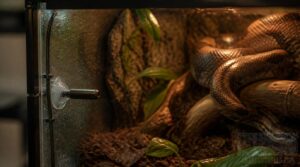
A dangling wire is an invitation — boas constrict what they can reach. Use a suction cup mount or adhesive backing to fix the probe, then route slack along interior corners.
- Keep probes 12+ inches from heat sources
- Use heat-rated cable ties (90°C+)
- Add silicone at wire entry points for moisture prevention
- Inspect fasteners monthly for looseness
Boa Temperature and Humidity Targets
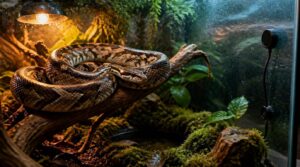
Your boa’s ideal temperature isn’t a fixed number—it shifts as your snake grows, from warm hatchling nurseries to cooler adult setups.
Getting the gradient right, alongside proper humidity, keeps digestion, sheds, and overall health on track.
Here’s exactly what those targets look like at each life stage.
Hatchling Temperature Requirements
Fragile and fast-growing, a hatchling boa needs precision, not guesswork. Keep the basking spot range at 89–93°F, ambient warm side near 82–86°F, cool zone 75–79°F. Nighttime cooling of 5–9°F mimics wild rhythms safely.
Build your thermal gradient setup with overhead heat only—never direct contact. Keep humidity at 70–75%, and mount probe placement at multiple heights for accurate readings.
Juvenile Temperature Requirements
Six months in, growth kicks into high gear, and your thermal setup has to keep pace. Aim for an 84–86°F basking zone, ambient 80–85°F daytime, dropping to 75–80°F at night.
Cool zone retreat matters just as much—juveniles need somewhere to cool off after feeding, since digestion stalls hard below 75°F. Keep daily fluctuations tight; gradient stability now shapes healthy adult size later.
Adult Temperature Requirements
Growth slows by year one, and so should your thermostat’s ambition. Adults settle into a gentler temperature gradient: basking spot near 90°F, ambient 75–80°F, dropping to 70–75°F overnight.
- Keep humidity at 60–80% for shedding
- Verify probe placement 12 inches from bulbs
- Adjust seasonally as room temps shift
- Pair readings with thermostat sync for stability
Hot and Cool Zones
Think of the enclosure as two rooms with one hallway. The hot zone runs 88–92°F for digestion; the cool zone holds 70–80°F for retreat. A 12–15°F gradient lets your boa self-regulate.
Keep heat sources separated from the cool side, verify probe placement at floor level, and let the thermal gradient—not guesswork—guide adjustments.
Humidity During Shedding
A shed cycle is where humidity accuracy really earns its keep. Target 60–70% humidity, verified by a hygrometer with proper probe placement, not floor guesswork.
Watch behavioral humidity indicators—rubbing, retained eye caps—and adjust substrate moisture balance accordingly. Sphagnum moss holds moisture; misting fills gaps. Balanced humidity monitoring helps shedding skin health and smoother shedding cycle management, all alongside your existing temperature and humidity targets.
Thermostat Integration and Thermometer Maintenance
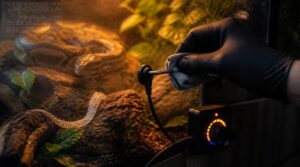
A thermometer only tells you the truth if it’s calibrated, clean, and paired correctly with your thermostat. Get that pairing wrong, or let a sensor drift, and you’re flying blind on temperatures that can cost your boa its next meal. Here’s how to keep every reading accurate and every gadget working the way it should.
Pairing Thermometers With Thermostats
A thermostat is only as smart as the sensor feeding it data — pair them wrong, and your temperature gradient collapses.
Confirm sensor compatibility first, then complete the pairing procedure: power up, sync, verify.
- Match probe type to input
- Trigger wireless pairing mode
- Test dual-zone response
Programmable thermostats reward accurate humidity and temperature pairing with rock-solid stability.
Calibrating Before First Use
Before that new digital thermometer touches your enclosure, calibrate it — a reference temperature source exposes drift instantly. Record ambient conditions, verify battery charge, then adjust the calibration offset per manual specs.
| Step | Action |
|---|---|
| 1 | Check reference source |
| 2 | Adjust offset |
| 3 | Verify readings |
| 4 | Log results |
Post-calibration verification catches sensor accuracy issues before they cost you a boa.
Replacing Batteries Regularly
A dying battery won’t announce itself — it just lets your readings drift until something’s wrong. Check batteries monthly; replace non-rechargeable cells every 12-24 months regardless of performance.
Match manufacturer-specified chemistry (AA, AAA, or CR123A), power off before opening the compartment, and never mix old cells with new.
Inspect contacts for corrosion, make sure proper sealing, and log each replacement date.
Cleaning Sensors Safely
Grime on a probe is like fog on a windshield — the reading’s in there, but it can’t get through clearly. Power off first, then:
- Wipe housing with a microfiber cloth
- Dampen probes lightly, avoid submersion
- Skip alcohol or ammonia-based cleaners
- Dry fully before storing away from sunlight
Clean after each shed. Check connectors for corrosion each time.
Troubleshooting Inaccurate Readings
A reading that suddenly jumps five degrees isn’t your boa running a fever — it’s sensor drift, corrosion, or a probe knocked loose. Check weekly for >2°F drift, swap batteries at voltage drop, and rule out condensation, EMI near heat mats, or misplacement.
A sudden five-degree jump isn’t your boa running a fever—it’s sensor drift, corrosion, or a probe knocked loose
| Symptom | Likely Cause | Fix |
|---|---|---|
| Erratic jumps | Corrosion | Replace battery |
| Slow creep | Drift | Recalibrate |
| Foggy display | Condensation | Reposition, dry |
Frequently Asked Questions (FAQs)
Where should I put the thermometer in my snake tank?
One wrong spot ruins every reading you take. Mount probes near the basking spot, mid-height on the cool side, and off the substrate—verifying your thermal gradient, not guessing at it, through proper probe placement and airflow-checked positioning.
What is the best thermometer for reptiles?
A dual-probe digital thermometer wins, hands down. It nails temperature accuracy within ±5–1°F, integrates humidity readouts, works with thermostat setups, and runs months on stable battery life — everything cold-blooded husbandry demands from one device.
Where to put a thermometer in a terrarium?
It’s not just "anywhere warm." Place probes under the basking spot and in the far corner, at proper probe height—avoiding heat source separation errors—for a true thermal gradient reading, not guesswork.
How to measure temperature in terrarium?
Pair a digital thermometer with probes at proper probe height—warm zone, cool zone, and floor level. Cross-check with thermal imaging or an infrared gun for ambient vs surface temp accuracy across your enclosure monitoring routine.
Can enclosure size affect thermometer reading accuracy?
Absolutely, yes. Bigger tanks create thermal stratification, so probe height and airflow sensor bias skew readings.
Verify your gradient with multiple probes near thermal buffer zones, and audit wires regularly to keep sensors accurate despite heat source interference.
Why does my boa regurgitate after temperature swings?
Cold snaps, hot flashes — your boa’s gut can’t take the heat, or lack of it. Temperature fluctuations spike cortisol stress response, stalling digestive enzyme function until that meal comes right back up.
How quickly do cold temperatures slow boa digestion?
Dropping from 30°C to 25°C causes real metabolism slowdown—digestion stretches days longer, nutrient absorption weakens, and cold shock plus temperature fluctuation raise regurgitation risk, so consistent warmth matters more than feeding frequency alone.
Can overheating cause organ damage in boas?
Yes—heat stress triggers liver necrosis, kidney strain, and lung edema fast. Above 95°F, arrhythmias and organ damage follow within hours, alongside reproductive failure.
Temperature spikes demand real thermostat setup, not guesswork, to keep every organ system safe.
Does poor thermoregulation affect a boas growth rate?
Poor thermoregulation slows a boa constrictor’s growth rate directly. Without a stable temperature gradient, digestive efficiency drops, metabolic slowdown sets in, and immune function weakens — meaning your thermometer with probe isn’t optional gear, it’s the compass keeping growth on track.
Conclusion
Somewhere in your enclosure right now, a silent gap between "warm enough" and "correct" is quietly shaping your boa’s health.
The right terrarium thermometers for boa constrictors close that gap, turning invisible risk into visible numbers you can act on.
A cheap dial might insist everything’s fine.
Your snake knows better.
Choose a probe that reads truth, not comfort.
Calibrate it, place it deliberately, trust the gradient — because for a boa, one degree separates thriving from merely surviving.