This site is supported by our readers. We may earn a commission, at no cost to you, if you purchase through links.
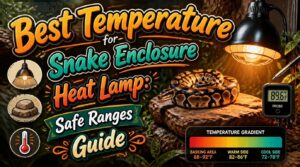
A snake can’t shiver, and it can’t sweat either. Every ounce of digestion, immune defense, and energy your snake runs on depends on you getting the heat right. Guess wrong, and you’re not just risking a sluggish pet—you’re risking impaction, burns, or a slow immune crash that sneaks up over months.
Most keepers check the wrong thing. They trust the bulb’s wattage instead of the actual surface their snake rests on, and that gap causes more health issues than any other husbandry mistake.
Finding the best temperature for snake enclosure heat lamp setups comes down to precise ranges, correct probe placement, and knowing what "normal" looks like for your species. Get the gradient right, and everything else falls into place.
Table Of Contents
- Key Takeaways
- Best Heat Lamp Temperature for Snakes
- Species-Specific Basking Temperature Ranges
- Creating a Safe Temperature Gradient
- Choosing Heat Lamp Type and Wattage
- Controlling and Measuring Temperatures Accurately
- Preventing Burns and Heating Emergencies
- Frequently Asked Questions (FAQs)
- Is 70 degrees too cold for a ball python at night?
- Should I leave my snakes heat lamp on all the time?
- How hot is too hot for a snake enclosure?
- Where to put a heat lamp in a snake enclosure?
- How often should thermostats be calibrated for accuracy?
- How many measurement points are needed for reliable monitoring?
- Whats the difference between proportional and pulse-proportional thermostats?
- How quickly should alarms detect dangerous temperature deviations?
- Conclusion
Key Takeaways
- Always measure the actual basking surface with a contact probe or infrared gun instead of trusting the bulb’s wattage, since that’s the mistake causing most heat-related health problems.
- Aim for a proper gradient rather than one perfect number: basking spots typically need 85–100°F depending on species, with cooler zones around 70–85°F so your snake can move and self-regulate.
- Nighttime heat should drop 5–10°F below daytime levels but never disappear entirely, since continuous round-the-clock heat is just as harmful as letting things get too cold.
- Invest in a proportional or pulse-proportional thermostat with backup alarms and calibrate it monthly, because sudden temperature swings or equipment failure can cause burns, cold stress, or a slow immune decline.
If you’re weighing whether this species suits your setup in the first place, this guide on what makes garter snakes good beginner pets covers the husbandry basics worth knowing before you buy.
Best Heat Lamp Temperature for Snakes
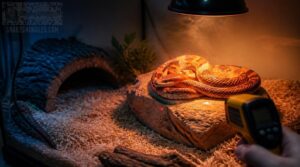
Getting the temperature right isn’t a guessing game—it’s math you can check. Your snake needs a precise range on the basking spot, safe boundaries on both sides of the enclosure, and clear limits once the lights go out. Here’s exactly what those numbers should look like, and how to measure them correctly.
If you’re wondering why these numbers matter so much, why temperature accuracy affects your snake’s health explains the digestion and immune risks of getting it wrong.
Ideal Basking Surface Range
Slate under a snake’s belly, not air near a bulb — that’s what actually matters. Aim for 90–100°F surface temperature at the basking spot, checked with a contact probe where the snake rests. Textured, non-slip material improves heat transfer and safe surface contact.
This sits within a proper temperature gradient, letting your snake choose warmth or retreat as digestion demands. Proper basking temperature is essential for reptile digestion and immune function, as it activates enzymes and helps metabolic processes. proper basking temperature
Safe Warm-Side Temperatures
Basking surface is only half the picture. The warm zone as a whole should hold 75–85°F, giving your snake room to roam without leaving the gradient.
- Keep ambient warm-side air steady, not just the hotspot
- Confirm thermostat settings match actual readings
- Watch for gradient stability day to night
- Verify surface temperature accuracy weekly
- Adjust for seasonal room temperature swings
Safe Cool-Side Temperatures
Cool zone air should sit between 75–82°F, giving your snake real relief from the basking side. Never let it drop below 70°F — that invites thermal stress fast.
| Zone Feature | Safe Range |
|---|---|
| Cool air | 75–82°F |
| Hide temp | Stable, near ambient |
| Min limit | 70°F |
Light substrate and steady ventilation keep this zone from drifting warm.
Nighttime Temperature Limits
Once the sun goes down, your gradient doesn’t disappear — it just shifts. Cap nighttime temps at 78.8°F, or 77°F for sick snakes recovering. Keep fluctuation under 3.6°F across 6-8 hours; stability matters more than any single number.
Ball pythons handle 75°F, corn snakes prefer 73°F. Drops below 72°F slow digestion and spike stress.
Measure Surfaces, Not Bulbs
Since bulb ratings measure output, not what actually reaches your snake, surface temp accuracy matters more. Use infrared temperature guns for infrared verification directly on basking platforms, not lamp housing.
Substrate temperature and material affect surface warmth independently of wattage. Build a surface gradient mapping routine, checking multiple points, to confirm real heat distribution rather than trusting the label.
Species-Specific Basking Temperature Ranges
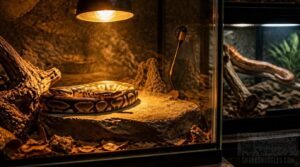
Not every snake needs the same basking temperature, and treating them all the same is a fast track to problems. Species come with their own thermal blueprints, shaped by where they evolved and how their bodies handle heat. Here’s what your basking spot should actually read, species by species.
Ball Python Temperatures
Ball pythons need four distinct zones, not just hot and cold. Your basking spot should hit 88–92°F directly under the lamp. Warm side runs 80–85°F, cool side 76–80°F, ambient around 78–80°F. That gradient of 10–15°F lets your snake move freely and self-regulate. Skip a proper thermal gradient, and digestion, shedding, even appetite suffer.
Since basking heat pushes humidity around the enclosure, placing a properly sized water bowl for desert-adapted reptiles away from the hot spot helps keep moisture levels balanced.
Corn Snake Temperatures
Corn snakes run cooler than ball pythons. Basking surface temp: 85–88°F. Cool zone temp: 72–78°F. Nighttime min temp: stays in the 70s, no lower.
Set your temperature gradient with a thermostat and probe 2–3 cm under substrate. Measure with an infrared gun at the actual basking spot, not the bulb. Juveniles want 85–88°F during growth spurts.
Boa Constrictor Temperatures
Boas run warmer than corn snakes but cooler than you’d guess. Basking surface temp: 86–90°F. Cool side range: 75–80°F. Nighttime limits: never below 68°F.
Build your temperature gradient with:
- Probe 2–3 cm under substrate
- Weekly thermostat calibration
- Multi-point ambient temperature checks
Good thermal gradient design keeps boas shedding cleanly and eating on schedule.
Tropical Species Requirements
Think rainforest floor, not desert rock. Tropical species need basking surfaces at 82–93°F, ambient humidity near 65–75%, and a 12-hour light cycle.
Mist briefly to spike humidity without soaking substrate. Keep ventilation steady to fight mold.
Skip this gradient, and thermal gradient failure hits fast: poor sheds, appetite loss, stressed digestion.
Desert Species Requirements
Rock, not rainforest: desert species like sand boas need dry heat and sharp nighttime cooling.
- Basking spot: 90–100°F, cooler side 75–82°F
- Night drop to 65–75°F mimics desert cooling
- Humidity stays low, 20–40%, preventing respiratory issues
- UVB exposure helps calcium metabolism
Skimping on thermal gradient stability invites shedding problems and lethargy. Dry air isn’t neglect here; it’s the whole point.
Creating a Safe Temperature Gradient
A single temperature reading tells you nothing about whether your snake can actually thermoregulate. Safety comes from the gradient, not the number on one thermometer. Here’s how to set up every part of that gradient correctly.
Safety lives in the gradient, not in a single number on one thermometer
Warm-Side Lamp Placement
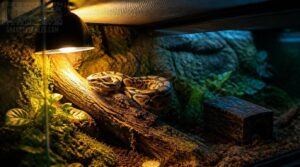
Placement makes or breaks your gradient. Mount the heat lamp above one end only, angled slightly toward the basking spot, with 6–12 inches of height above basking surfaces depending on wattage. Keep clearance from hides so shadows don’t block warmth.
A reflector directs heat where it counts. Don’t cramp airflow — ventilation near lamp fixtures prevents dangerous heat pockets from forming.
Cool-Side Escape Zone
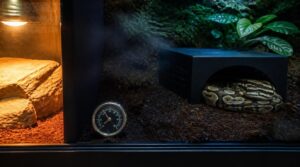
Every gradient needs a retreat. The cool zone should sit between 70–85°F, shielded from lamp light using light blocking panels. Add a ventilated hide design with moisture-retentive substrate for humidity control.
Keep hiding spot placement away from heat creep, and check the gradient shift zone with a thermometer — sudden shifts stress snakes fast.
Basking Surface Setup
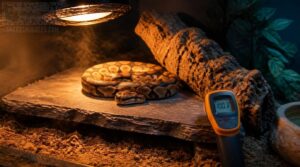
A cool retreat means nothing without a solid basking spot to balance it. Material selection matters: slate absorbs and holds heat well, while cork bark adds grip.
Size the platform to span two-thirds of enclosure width, with a raised lip. Surface texture prevents slips.
Position the heat lamp directly above, targeting 85–95°F, verified by infrared thermometer.
Vertical Temperature Differences
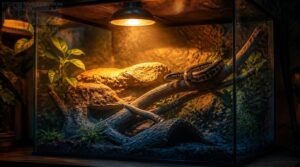
Heat doesn’t just spread side to side — it rises. That basking platform you just built sits inside a column of air with its own thermal layering, hottest near the ceiling.
Map it properly:
- Check floor level near the cool retreat
- Check mid-height at the basking surface
- Check upper enclosure air, especially with tall tanks
Skipping vertical stratification checks means missing real temperature zones your snake actually experiences.
Preventing Enclosure-Wide Overheating
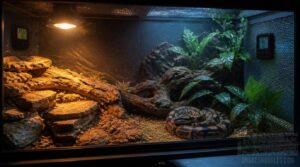
A whole tank shouldn’t feel like a sauna. Keep gradient monitoring active with dual probes, spacing heat sources so ambient air stays below 38°C.
| Sign | Cause | Fix |
|---|---|---|
| Warm side 33°C+ | Poor placement | Raise lamp |
| Cool side 29°C+ | Bad ventilation | Adjust vents |
| No gradient | Cramped enclosure | Upsize housing |
Have emergency cooling protocols ready before crisis hits.
Choosing Heat Lamp Type and Wattage
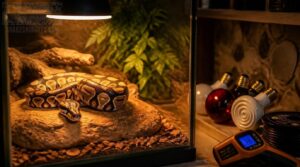
Not every heat source works the same way, and picking the wrong one can throw your whole gradient off. Wattage matters just as much as bulb type, since too little power leaves you cold and too much invites a burn risk. Here’s what you need to know before you buy.
Halogen Basking Bulbs
Want a basking spot that mimics real sun? Halogen bulbs deliver visible light plus infrared heat, hitting 85–95°F basking surfaces at 25–100W depending on enclosure size.
Their halogen dimming compatibility pairs well with proportional thermostats for smooth heat distribution. Bonus: longer filament life than standard incandescents means fewer bulb swaps and steadier gradient control.
Deep Heat Projectors
Deep tissue warming sets these apart. Infrared A and B wavelengths penetrate muscle, not just skin, using 50–80W with a built-in reflector for even heat distribution.
They’re dimming thermostat compatible, preserve night cycles with minimal visible light, and often cut energy use 20–50% versus standard bulbs. Solid choice for consistent basking spots without harsh glare.
Ceramic Heat Emitters
No glow, all warmth: ceramic heat emitters run 60–100W, hitting 120–180°F surface temps without visible light. Three things to know:
- Infrared penetration warms rock and substrate, not just air
- Mount with 1–2 cm clearance to prevent burns
- Pair with a pulse-proportional thermostat (rated to 600W) for stable heat distribution
Corrosion-resistant shells mean years of reliable service—check output monthly.
Enclosure Size and Material
Bigger isn’t just comfier, it’s a heat management problem waiting to happen.
Size your footprint at 1.5–2x your snake’s length, minimum 0.5 square meters for adults.
Glass loses heat fast, needing higher wattage. PVC and wood retain warmth, cutting thermostat cycling.
Tall enclosures demand 40–60% more radiant output, roughly 100–150W for 12–18 inch heights.
Ventilation and Room Temperature
A stuffy enclosure works against your heater before it even warms up. Keep your room temperature baseline at 68–78°F, exchanging stale air every 2–3 hours. Ventilation mesh prevents drafts over basking spots while curbing humidity buildup.
- Match airflow to seasonal shifts
- Avoid direct drafts on the snake
- Check for mold near vents
- Maintain gradient stability enclosure-wide
- Inspect seals monthly
Controlling and Measuring Temperatures Accurately
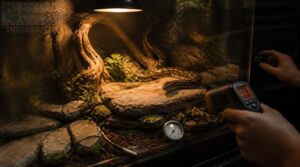
Picking the right heat lamp is only half the job. Without accurate control and monitoring, even the best setup can drift into dangerous territory fast. Here’s what you need to lock in reliable temperatures every single day.
Choosing The Right Thermostat
Skip on/off thermostats—they let temperatures swing 6-12°C before correcting. Choose a proportional or pulse-proportional controller instead; pulse-proportional models handle up to 600W and suit ceramic emitters perfectly.
Before installing anything, run a wattage compatibility check against your bulb. Calibrate monthly against a reference thermometer, keeping accuracy within ±0.5°C. Add secondary probes and redundant heating pathways for backup security.
Thermostat Probe Placement
Where you put that thermostat probe decides whether your whole setup means anything.
Place it 2–3 cm under the substrate, right at the warm end—that’s your true hotspot reading. Add a secondary sensor on the cool side for warm-cool balance across the thermal gradient. Recalibrate monthly against a reference thermometer. Skip this, and your temperature zones become guesswork.
Digital Thermometer Locations
The thermostat probe controls your heater, but a separate digital thermometer confirms what’s actually happening.
- Basking surface probe: Sits directly on the hottest rock or branch
- Cool side monitoring: Confirms the retreat zone stays 75–80°F
- Vertical gradient tracking: Extra probes at different heights catch stratification
Mount probes at multiple heights and away from water bowls for real temperature accuracy.
Infrared Temperature Gun Checks
Fixed probes tell you one spot, continuously. An infrared temperature gun gives you spot checks anywhere, instantly—no wires needed.
Match emissivity to your surface (0.95 for wood, rock, substrate) or readings drift several degrees. Keep the correct spot size ratio: get close for small basking areas.
Remember surface vs air differs—glass and rock read differently than ambient. Cross-check monthly against your probe for calibration accuracy and catch fluctuation early.
Seasonal Heating Adjustments
Rarely does a thermostat setting stay perfect year-round. Winter drafts pull warm air from the enclosure, so nudge setpoints up 1-2°C and check for thermostat drift.
Boost humidity compensation as heating dries the air. Consider insulation upgrades or ventilation adjustment around windows.
Recalibrate monthly. Seasonal acclimation keeps your snake’s temperature gradient stable—thermal stability isn’t automatic, it’s earned through vigilance.
Preventing Burns and Heating Emergencies
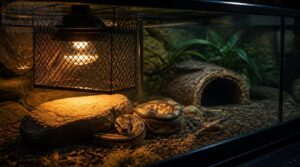
Heat lamps make life better for your snake, but they can also turn dangerous fast. A single unguarded fixture or a silent equipment failure can mean burns, cold shock, or worse. Here’s what you need to watch for and set up to keep both scenarios off the table.
Lamp Guards and Clearance
A snake can’t tell you a bulb is scorching hot — that’s your job to prevent. Never let skin touch the lamp. Use noncontact clearance of 1–2 inches, metal or ceramic guards, and secure screws rated for heat.
- Burned scales
- Melted decor
- Failed inspections
- Preventable house fires
Check clearance monthly. Damaged guard? Replace it before flipping the switch again.
Signs Temperatures Are Too High
Once a snake stops basking and just lies flat and glossy near the lamp, take that seriously.
Watch for rapid, labored breathing, a flushed or reddened head, and refusal to eat.
Burns or raw patches under the hottest spot mean real tissue damage.
Repeated escape attempts from the warm side? That’s not comfort — that’s distress.
Signs Temperatures Are Too Low
A cold snake goes quiet — sluggish, slow to react, unwilling to move toward food.
Watch for cold extremities, a pale or dull body tone, and muscle tension replacing normal coiling.
Behavioral observation matters here: check your thermostat and temperature probe for fluctuation or drift. A stable gradient prevents these dangerous drops before they start.
Safe Nighttime Heating
Darkness doesn’t mean your snake stops needing warmth — it just needs less of it.
Drop nighttime temps 5 to 10°F below daytime peaks, never lower. Set your thermostat’s night mode accordingly, with the temperature probe still resting at basking level.
Keep heat guards secured, clearance intact, and don’t skip surface monitoring just because the lights are off.
Backup Heat and Alerts
Power outages don’t wait for convenient timing. A backup heat alarm, running on a 9V or 12V battery, keeps monitoring even when the grid fails, sounding an 85-decibel siren past 135°F or during rapid rises over 15°F per minute.
Test monthly. Redundant heating pathways cut cold-streak exposure by up to 70%—your snake’s safety net when equipment fails.
Frequently Asked Questions (FAQs)
Is 70 degrees too cold for a ball python at night?
Yes, for extended periods. Keep the warm side at 80–85°F and cool side above 74°F overnight. Brief dips to 70–72°F are tolerable, but sustained cold slows digestion and stresses your ball python.
Should I leave my snakes heat lamp on all the time?
Running a heat lamp nonstop is like never letting your snake sleep. Don’t do it: continuous heat stress disrupts natural night cooling. Use a thermostat and timer for real temperature control, keeping the basking spot warm only during the day.
How hot is too hot for a snake enclosure?
Above 95°F (35°C) on the basking surface risks thermal burns and stress. Keep hotspots at 85–92°F max. A proper gradient with a 75–80°F cool zone prevents overheating and helps with safe thermoregulation.
Where to put a heat lamp in a snake enclosure?
Mount your lamp in a corner, 8–12 inches above the basking surface, to create a proper temperature gradient. Keep 1–2 cm clearance for burn safety. Place your probe between the lamp and surface, targeting the basking spot directly—not ambient air.
How often should thermostats be calibrated for accuracy?
Think of your thermostat as a watchdog that can go blind without checkups. Calibrate annually, at fall’s heating switch and spring’s cooling shift, against a calibrated reference thermometer. Recheck after repairs or battery swaps — drift past 2°F demands immediate manual adjustment.
How many measurement points are needed for reliable monitoring?
Five points give you a reliable temperature map: basking surface, warm midline, cool escape zone, reptile-height, and center air. This sensor placement strategy, paired with continuous logging, catches gradient drift before it harms your snake.
Whats the difference between proportional and pulse-proportional thermostats?
Picture a dimmer switch versus a fast drumbeat: a proportional thermostat smooths power for steady control accuracy, while a pulse-proportional model bursts on-off cycling, giving quicker response time but slightly less temperature stability.
How quickly should alarms detect dangerous temperature deviations?
Fast is non-negotiable: alarm response time should hit 5-15 seconds. Rising heat needs an 8-12 second dwell; drops trigger within 10-15 seconds. Anything past 20 seconds risks real thermal damage to your snake.
Conclusion
A thousand square miles of rainforest boil down to one small patch of belly heat your snake trusts with its life. That’s the weight a single thermostat carries.
The best temperature for snake enclosure heat lamp setups isn’t a number you memorize once—it’s a habit you check nightly. Measure the surface, not the bulb. Respect the gradient. Do that, and your snake gets what wild instinct alone can’t provide: real safety.