This site is supported by our readers. We may earn a commission, at no cost to you, if you purchase through links.

Your snake keeps gaping like it’s yawning through a bad movie, and it won’t touch that basking spot anymore. Sound familiar? Snakes can’t sweat, pant, or move to a shady porch when things get uncomfortable — they’re stuck with whatever gradient you give them.
That’s what makes knowing how to tell if a heat lamp is too hot such a survival skill, not just a nice-to-have. A bulb running just a few degrees over the safe range can quietly cook a snake from the outside in, long before you notice anything’s wrong.
The good news? Your snake’s already showing you the warning signs. You just need to know where to look.
Table Of Contents
- Key Takeaways
- Signs Your Snake’s Heat Lamp is Too Hot
- Measure Safe Enclosure Temperatures
- Fix an Overheating Heat Lamp
- Top 5 Heating Products to Assess
- Frequently Asked Questions (FAQs)
- Can a heat lamp get too hot?
- Should a heat lamp be hot to touch?
- How high should my heat lamp be?
- Is it safe to leave a heat lamp on overnight?
- How often should I replace my reptiles heat bulb?
- Can heat lamps cause fires while Im sleeping?
- Is nighttime heating necessary for tropical reptile species?
- Whats the ideal wattage for a 40-gallon tank?
- Should I turn off heat lamps during summer months?
- Conclusion
Key Takeaways
- Watch your snake’s behavior closely—constant gaping, avoiding the basking spot, and reduced appetite are all early warning signs that the heat lamp is running too hot.
- Don’t rely on guesswork—use an infrared thermometer to check basking surface temps against species-specific ranges, since desert and tropical snakes have very different comfort zones.
- If temps are too high, small fixes like increasing lamp distance, lowering wattage, improving ventilation, or adding a dimming thermostat can restore a safe thermal gradient without replacing your whole setup.
- Always pair your heat lamp with a thermostat, especially overnight, since unregulated heat risks dangerous spikes, fire hazards, and disrupted shedding cycles.
Signs Your Snake’s Heat Lamp is Too Hot
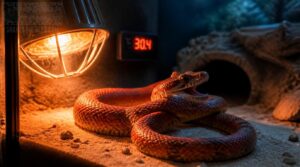
Your snake can’t tell you the heat lamp feels wrong, but its body and behavior will. Think of these signs as your snake’s version of a check engine light, small warnings before things get serious. Here’s what to watch for.
Before those warning signs show up, it helps to match the lamp to your setup—this guide to choosing the best heat lamp for snakes walks through picking the right wattage and style for your enclosure size and substrate.
Constant Gaping or Restlessness
A snake that won’t stop yawning isn’t tired, it’s telling you something’s wrong. Constant gaping signals real thermal stress, sometimes breathing trouble. Watch for:
- Repeated neck stretching
- Shallow, frequent gasps unrelated to feeding
- Jerky thrashing near the basking spot
- Pacing along enclosure walls
- Head-lifting for brief breaths
These aren’t quirks, they’re silent burns warning signs before real injury hits.
Avoiding The Basking Area
Ever notice your snake hugging the cool end like it’s avoiding an ex? That’s behavioral heat avoidance, and it means basking spot temperature exceeds species preference.
When a snake avoids the basking spot like an ex, the temperature has crossed its comfort line
| Signal | What’s Happening | Fix |
|---|---|---|
| Cool-side hiding | Escaping surface burn potential | Increase lamp distance |
| Skipping basking | Broken thermal gradient | Adjust proximity to target |
| Wall-hugging | No safe zone | Improve airflow balance |
Reduced Appetite or Activity
Once wall-hugging stops working, snakes conserve energy. Refusing meals and moving less both signal heat stress, not just a bad mood.
A skipped feeding here and there is normal. But paired with decreased movement and lethargy, it points to a basking spot temperature wrecking the thermal gradient your snake needs to regulate itself. Loss of appetite can signal a hidden medical condition loss of appetite causes
Warped or Scorched Materials
Behavior aside, your snake’s enclosure tells its own story. Brownish scorch marks on walls or ceilings mean sustained overexposure, while warped plastic decor or bowed wood joints show heat soak from a lamp sitting too close.
Discoloration and warping are red flags for fire hazards, not cosmetic issues. Check proximity first, then swap damaged materials.
Hot Cords and Fixtures
Touch matters too. If the fixture, cord, or plug feels hot rather than warm, you’ve crossed Maximum Safe Operating Temps.
- Ceramic fixtures should stay cool to the touch
- Cords need a grounded, UL-marked plug
- Damaged insulation means fire hazard, not "fine for now"
Check Proximity to the Target, then inspect cord routing near substrate or water.
Tracking readings over several days, rather than relying on one check, helps reveal whether humidity trends are actually stable, a pattern this desert snake humidity care guide explains in more depth.
Measure Safe Enclosure Temperatures
Guessing at temperatures is like eyeballing a recipe, you might get close, but close isn’t good enough for your snake’s health. The good news is you don’t need fancy equipment or a science degree to get this right. Here’s exactly what to check and how.
Check Basking Surface Temperature
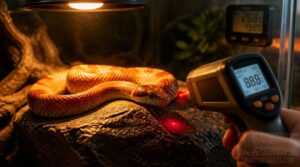
Your snake’s skin can’t tell you it’s uncomfortable, so an infrared thermometer does the talking. Aim it straight at the basking spot, not the platform edge.
| Species | Basking Range | Notes |
|---|---|---|
| Corn snake | 90–95°F | Adjust by age |
| Ball python | 88–92°F | Adults only |
| King snake | 85–92°F | Digestion-linked |
Dark surfaces read hotter than glossy ones—measure accordingly.
Monitor Warm-Side Air
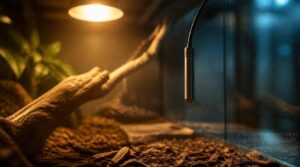
Basking spots aren’t the whole story—what about the air your snake actually breathes? Place your probe at mid-enclosure height, away from lamp glare, for the ideal air range of 78–88°F.
A 5–10°F gradient signals healthy heat distribution. Poor ventilation traps warmth; adjust vents if readings creep past 90°F.
Check thermostat control monthly against a known source.
Compare Species-Specific Requirements
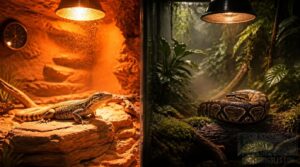
No two species read the thermometer the same way. A ball python and a savannah monitor sunning in the same room would disagree completely on comfort.
Species-specific requirements matter because desert dwellers tolerate 100–120°F baskings, while tropical species thrive at 85–95°F. Check your reptile’s native range before trusting any generic chart—basking spot temperature should match biology, not guesswork.
Track Daytime Temperature Changes
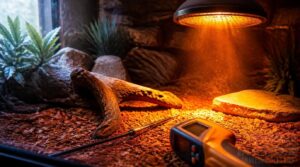
A single reading tells you nothing—your enclosure has a rhythm all its own.
Expect a 6 to 12°C climb from dawn to midmorning, with peaks hitting between 11 am and 2 pm. Direct sun can spike basking spots 3–8°C above ambient. Wind, insulation, and substrate thermal mass all shape those swings, so log readings at several points daily.
Verify Thermostat Accuracy
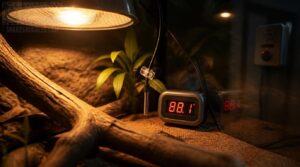
Trust your thermostat blindly, and you’re basically flying with a broken gauge. Verify thermostat sensor placement first: probe 2–3 inches from the lamp, never touching surfaces. Cross-check with a reference thermometer—readings should match within 2°F and stay stable for hours.
Digital thermostat accuracy drifts yearly, so recalibrate, log the offset, and recheck for 15 minutes.
Fix an Overheating Heat Lamp
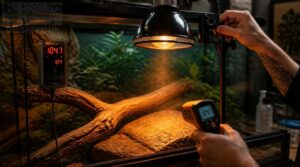
So you’ve confirmed the temps are too high, now what? Good news: fixing an overheating lamp usually takes small tweaks, not a whole new setup. Here are five practical fixes that bring things back into a safe range.
Increase Lamp Distance
Ever notice how stepping back from a campfire cools you fast? Lamps work the same way.
Moving your bulb 6–12 inches back drops surface temperature 1–2°F per inch, restoring your thermal gradient.
- Keep 12–18" for larger snakes
- Boost reflector efficiency to offset distance
- Recheck heat lamp safety distance weekly
This simple heat gradient balance fix beats replacing bulbs entirely.
Reduce Bulb Wattage
Distance isn’t your only lever, wattage matters just as much. Wattage and heat output move together, so dropping wattage 25-50% (think 60W to 13W LED) cuts surface temperature fast. LED vs incandescent heat makes a real difference, less wasted energy as heat. Pair reduced wattage with proper distance for balanced, stable temperature control—no more guesswork, just steady warmth.
Improve Enclosure Ventilation
Wattage isn’t the whole story, airflow matters too. Trapped hot air builds like a car with windows shut, so cross-ventilation cools things fast.
- Low intake, high exhaust vents
- Corner placement for cross flow
- Aluminum screens resist corrosion
Keep vents off the basking zone, better airflow cooling and steadier humidity without soaking or drying your snake’s ambient environment.
Install a Dimming Thermostat
Ventilation fixes airflow, but what about the on/off swing that leaves your snake baking then chilling? A dimming thermostat modulates power instead of just flipping off, smoothing spikes.
Check power rating and compatibility with your lamp type first. Place the sensor at basking level, wire it in per the diagram, then calibrate slowly, watching for overheating protection to kick in if sensors fail.
Create a Cooler Zone
Snakes are wired to choose comfort, not just endure it. Cooler zone setup means restricting heat to one side, opposite the lamp, so a real thermal gradient forms.
Keep that side 75-85°F, using non-porous surfaces and light insulation for temperature gradient control. Skip ceramic emitters here.
Add passive airflow for ventilation optimization, then watch behavior—flat-bodied resting signals success.
Top 5 Heating Products to Assess
Not every heat source behaves the same way, even when the wattage numbers look similar on paper. Some run hotter than expected, some hold steady, and some give you way more control than others. Here are five products worth putting under the microscope before you clip one onto your enclosure.
1. SUNMORY LED Floor Lamp with Remote
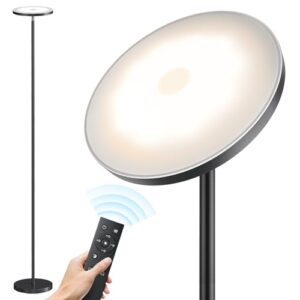
Not every "heat lamp" belongs over a basking spot, and the SUNMORY LED Floor Lamp with Remote proves it. This is a 32W LED torchiere, built for living rooms and offices, not vivariums.
It throws 3000 lumens with dimming from 5% to 100%, plus 3000K–6000K color adjustment. Great for reading light. Terrible for reptiles.
It produces no meaningful infrared heat, so it won’t warm a basking surface at all. Skip this one for your enclosure.
| Best For | People wanting bright, adjustable lighting for reading, working, or relaxing in living rooms, bedrooms, or offices. |
|---|---|
| Base Type | Plug-in cord |
| Power Source | 32W LED |
| Primary Use | Home lighting |
| Adjustability | Dimmable, rotating head |
| Construction Material | Metal and plastic |
| Heat Safety Concern | Low heat output |
| Additional Features |
|
- Stepless dimming (5%–100%) with adjustable color temperature from 3000K to 6000K for customizable ambiance
- Remote control works up to 50 feet away and includes a memory function for convenience
- Energy-efficient with a long 30,000-hour LED lifespan and high CRI for accurate color rendering
- Remote control may feel flimsy based on user feedback
- Weighted base, while stable, may be bulky for very tight spaces
- Assembly requires careful handling of wiring, and the remote’s sticker may leave residue behind
2. Hoakya 275W Infrared Heat Lamp Bulb
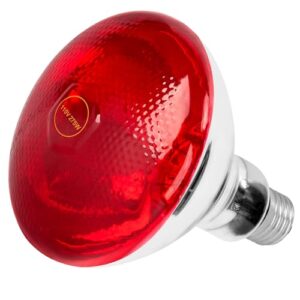
Now here’s a bulb with real muscle behind it. The Hoakya 275W pumps out serious infrared heat through its E27 base, and that 275 watts means business, so pair it only with ceramic sockets rated for the load.
At 6 inches, it’s rated near 1431 mW/cm², though that number hasn’t been independently verified, so treat it as a rough guide, not gospel. Great for larger enclosures needing strong heat; overkill (and risky) for small tanks.
| Best For | Owners of large reptile enclosures, livestock setups, or therapeutic heat applications who need strong, deep-penetrating infrared warmth. |
|---|---|
| Base Type | E26/E27 |
| Power Source | 275W |
| Primary Use | Therapeutic/agricultural heat |
| Adjustability | Fixture-dependent |
| Construction Material | Heat-resistant glass |
| Heat Safety Concern | High surface temp |
| Additional Features |
|
- Powerful 275W output delivers intense, deep-penetrating infrared heat
- Versatile E26/E27 base fits standard fixtures across 100–240V AC
- Well-suited for large-scale uses like agricultural warming and infrared sauna setups
- Irradiance claim of 1431 mW/cm² at 6" isn’t independently verified
- Requires a ceramic socket and properly rated fixture due to high surface temperatures
- Too powerful and risky for small enclosures or tanks
3. Woods Clamp Lamp with Aluminum Reflector
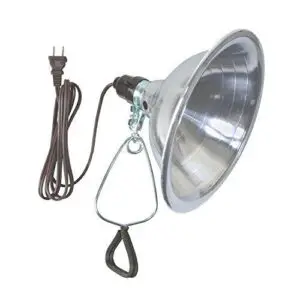
Sometimes the fixture matters more than the bulb. The Woods Clamp Lamp uses an 8.5-inch polished aluminum reflector with a double ball joint, so you can aim heat precisely at your basking zone instead of guessing.
It’s UL listed, works with bulbs up to 150 watts, and the non-marring clamp grips surfaces up to 3 inches thick. Reliable, adjustable, and built for daily repositioning without loosening—exactly what a stable basking setup needs.
| Best For | Hobbyists and small business owners who need adjustable, hands-free task lighting for workshops, garages, home offices, photography setups, or as a grow light fixture. |
|---|---|
| Base Type | E26 (clamp socket) |
| Power Source | Up to 150W bulb |
| Primary Use | Task/grow lighting |
| Adjustability | Clamp, ball joint |
| Construction Material | Aluminum reflector |
| Heat Safety Concern | Reflector heats up |
| Additional Features |
|
- 8.5-inch aluminum reflector with a double ball joint gives precise, adjustable directional lighting
- UL listed and rated for bulbs up to 150 watts, with a non-marring spring clamp that protects surfaces
- 6-foot cord and portable clamp design make it easy to position away from outlets, hands-free
- Metal reflector and housing can get hot during extended use, so care is needed to avoid burns
- Clamp may slip or lose grip under vibration, especially with heavier PAR-style bulbs
- Reflector adjustment mechanism can loosen over time with frequent repositioning
4. Fluker’s Basking Spotlight Bulb for Reptiles
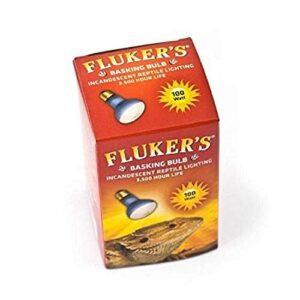
Want a bulb that mimics real sunlight without the guesswork? Fluker’s Basking Spotlight comes in 40, 75, or 100 watts, with the 75W version landing basking surfaces around 85–95°F—perfect for bearded dragons and similar species.
It screws into standard fixtures and pairs nicely with your Woods clamp lamp. Just know this: some owners report premature bulb failure, so keep a spare on hand and check for scorch marks regularly. No UVB included—you’ll still need a separate bulb for that.
| Best For | Reptile owners, such as bearded dragon or turtle keepers, who want a simple screw-in basking bulb to support natural heat regulation and healthy digestion. |
|---|---|
| Base Type | Standard screw-in |
| Power Source | 75W |
| Primary Use | Reptile basking |
| Adjustability | Fixture-dependent |
| Construction Material | Glass bulb |
| Heat Safety Concern | Overheating risk |
| Additional Features |
|
- Stimulates natural basking behavior and supports thermoregulation, digestion, and appetite
- Easy to install in standard screw-in fixtures, including clamp lamps
- Works well for a variety of reptiles like lizards, snakes, and turtles
- Some users report bulbs bursting or failing prematurely within weeks
- Emits a yellowish light that isn’t ideal for setups needing broader-spectrum lighting
- Concentrated heat output means careful positioning is needed to avoid overheating
5. Lucky Herp 150W Ceramic Heat Emitter
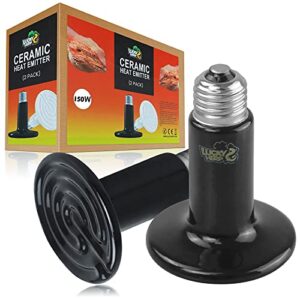
Nocturnal pets need warmth without a bedtime disco, and that’s exactly what this ceramic emitter delivers. At 150 watts, it hits full temperature in about four minutes, radiating heat with zero visible light—so circadian rhythms stay intact.
Built tough, it’s rated for 10,000 hours. Still, that thick ceramic body runs hot enough to burn skin on contact, so mount it in a heat-resistant fixture, keep it 30cm from your pet, and pair it with a thermostat for real control.
| Best For | reptile, amphibian, and small mammal owners who need steady overnight heat without disturbing their nocturnal pet’s natural sleep cycle. |
|---|---|
| Base Type | E26 screw base |
| Power Source | 150W |
| Primary Use | Nocturnal pet heat |
| Adjustability | Fixture-dependent |
| Construction Material | Ceramic |
| Heat Safety Concern | Exceeds safe touch temp |
| Additional Features |
|
- Emits heat with zero visible light, keeping circadian rhythms undisturbed
- Reaches full operating temperature in about four minutes
- Durable ceramic construction rated for up to 10,000 hours of use
- Surface gets hot enough to burn on contact, requiring careful fixture placement and pet distance
- Needs a cool-down period before it can be reactivated
- Frequent on/off cycling shortens its lifespan
Frequently Asked Questions (FAQs)
Can a heat lamp get too hot?
Yes, absolutely, a heat lamp can turn into a silent oven. Surface temps climbing past 95°F, scorch marks, or warped plastic all signal danger, meaning your snake’s basking spot needs immediate attention before injury occurs.
Should a heat lamp be hot to touch?
No, never. A heat lamp shouldn’t burn skin on brief contact. Nearby surfaces can feel warm, but shouldn’t transfer real heat.
Protective guards, ceramic sockets, and sturdy wiring keep touchable areas safe—regular inspections catch exposed wires before they become a problem.
How high should my heat lamp be?
Closer isn’t always better. For small snakes, keep the lamp 12 to 18 inches above basking spots; larger enclosures need 18 to 24 inches. Recheck height whenever you swap bulbs, since wattage changes everything.
Is it safe to leave a heat lamp on overnight?
Only with a thermostat controlling the output, not the lamp’s own switch. Unregulated overnight heat dries out enclosures, disrupts shedding, and risks dangerous highs. Safer bets: ceramic heat emitters or thermostatically controlled under-tank mats, both built for round-the-clock use.
How often should I replace my reptiles heat bulb?
Bulbs fade like flashlight batteries, dim before they’re dead. Infrared bulbs last 6 to 12 months, ceramic emitters stretch to 12 to 24. Track hours, replace on schedule, not just when they burn out.
Can heat lamps cause fires while Im sleeping?
Yes. A lamp too close to bedding, cords touching hot surfaces, or no thermostat shutoff can overheat unattended and ignite nearby materials overnight. Keep 18 inches of clearance and use heat-resistant fixtures for safer sleep.
Is nighttime heating necessary for tropical reptile species?
Night doesn’t always mean cold danger. Most tropical species just need a proper daytime gradient—if room temps stay within range, supplemental heat isn’t required, and skipping it often protects natural sleep cycles and hydration better than adding warmth.
Whats the ideal wattage for a 40-gallon tank?
For a 40-gallon setup, aim for 100 to 200 watts, roughly 5 to 5 watts per gallon. Colder rooms may need the higher end, or two smaller heaters for steadier, more even warmth throughout.
Should I turn off heat lamps during summer months?
Not automatically. Enclosure temperature matters more than the calendar — if your snake’s basking spot stays within its safe range, skip the lamp. Otherwise, add a thermostat to prevent overheating during hot months.
Conclusion
A heat lamp running just five degrees hot can turn a cozy basking spot into a slow-cooking oven, and your snake will never say so in words. That’s exactly why learning how to tell if heat lamp is too hot matters: gaping, avoidance, warped plastic, scorching cords — these are your snake’s only vocabulary.
Grab a thermometer, trust numbers over guesswork, and adjust early. A well-tuned lamp isn’t just equipment. It’s quiet peace of mind, glowing steady above a healthy, thriving snake.