This site is supported by our readers. We may earn a commission, at no cost to you, if you purchase through links.
Watch a corn snake in the wild and you’ll see something captivity often fails to replicate: a body built entirely for climbing. Ventral scales grip bark like tiny cleats, muscles fire in sequence, and the animal moves upward with total confidence. Take that vertical world away, and you’re left with a snake that can survive but never quite thrives.
That’s the gap climbing branches for arboreal species are meant to close. Branches aren’t decoration. They’re the difference between an enclosure that houses a snake and one that lets it behave like a snake, hunting, thermoregulating, and building muscle the way evolution intended.
Get the setup right and you’ll see it in how your snake moves, rests, and explores its space.
Table Of Contents
- Key Takeaways
- Why Arboreal Snakes Need Climbing Branches
- Choose Safe Branch Materials
- Match Branches to Your Snake
- Install Climbing Branches Securely
- Clean and Maintain Enclosure Branches
- Frequently Asked Questions (FAQs)
- What tree branches are safe for birds?
- What trees are good climbing trees?
- What branches are safe for reptiles?
- What do beardies like to climb?
- How do gecko toe pads differ from tree frogs?
- What makes prehensile tails useful for climbing mammals?
- Do all climbing species share similar toe adaptations?
- How do koalas grip branches so effectively?
- Why do some ground predators avoid climbing trees?
- Conclusion
Key Takeaways
- Climbing branches aren’t just decoration—they let arboreal snakes build muscle, regulate temperature, and behave the way nature intended instead of just surviving in a box.
- Not all wood is safe: stick with untreated hardwoods like oak or beech, and steer clear of cedar, pine, and treated lumber, which can seriously harm your snake’s health.
- Getting the fit right matters, from matching branch diameter to your snake’s size and species to securely anchoring both ends so nothing wobbles or gives way mid-climb.
- Ongoing upkeep, disinfecting, checking for mold, inspecting hardware, and swapping out damaged wood promptly, is what keeps a climbing setup safe and usable long-term.
Why Arboreal Snakes Need Climbing Branches
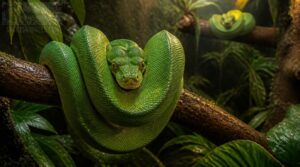
Green tree pythons and emerald tree boas don’t climb for show—it’s how they’re built to live. Give them the right branches, and you’re supporting everything from muscle tone to proper digestion. Here’s what’s actually driving their need to climb, and why your setup should account for each one.
Before you build anything, it’s worth mapping out what a proper large-snake enclosure setup actually costs, since branches, humidity control, and secure housing add up fast.
Natural Climbing Behaviors
Watch a snake ascend a branch and you’re seeing instinct at work. Coiling in S-shaped curves, it grips with ventral scales, using arboreal locomotion to stalk prey, explore territory, and scent-mark favorite perches.
Vertical movement also drives thermoregulation climbing, letting your snake chase sunlit branches or retreat to shade, syncing its whole day to light and temperature cues.
Exercise and Muscle Health
That instinctive climbing does more than satisfy curiosity, it builds real muscular strength. Branch locomotion recruits fast-twitch fibers for quick grips and slow-twitch fibers for perched endurance, roughly a 2:1 ratio in arboreal species.
Regular climbs also boost cardiovascular conditioning, improving capillary density by about 15%, while joint flexibility and neuromuscular coordination sharpen with every branch your snake encounters.
Secure Elevated Resting Spots
All that muscle work means nothing without a place to recover. Secure elevated resting spots, set 30 to 60 cm high with 15 cm wall clearance, let your snake retreat fast. Look for textured grip, not slick bark. Inspect daily, since a loose perch undoes every gain from branch locomotion efficiency.
A secure resting spot means nothing if a loose perch undoes every gain your snake’s climbing has earned
Better Enclosure Enrichment
A resting spot solves recovery, but a static enclosure breeds boredom fast. Rotating branch layouts keep habitat complexity high, forcing fresh branch navigation and testing gripping mechanisms in new ways.
Add scent cues and foraging opportunities near forks and elevated routes. This kind of behavioral stimulation helps genuine arboreal adaptation, turning habitat utilization into something closer to a wild snake’s actual working day.
Incorporating species-specific behaviors into habitat design is essential for promoting psychological well-being in captive primates. Environmental enrichment strategies are critical for reducing stress and encouraging natural activity patterns.
Accessing Temperature Gradients
A branch is more than a perch, it’s a thermostat. Snakes rely on vertical locomotion through canopy habitat to reach warm upper branches and cooler shaded zones, achieving real temperature regulation without moving far.
Climbing morphology makes this possible: gripping scales and muscular control support:
- Confidence to explore new heights
- Comfort during rest and digestion
- Survival instincts fine-tuned by nature
Gradient measurement tools and calibrated sensors help you mirror this in captivity.
Choose Safe Branch Materials
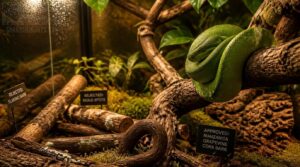
Not every branch belongs in a snake enclosure, no matter how sturdy it looks. The right material affects grip, safety, and long-term health for your arboreal species. Here’s what to look for, and what to leave in the backyard.
Reptile-safe Hardwood Options
Untreated oak, maple, and beech mimic the canopy habitat your snake evolved for, giving real branch texture for vertical locomotion.
Position branches 8–12 inches above the substrate for smaller snakes, and pair them with proper UV lighting placement for arboreal species so basking spots feel as natural as the perches themselves.
Density matters most: heavier hardwoods resist bending under full body weight, while smooth bark won’t snag delicate scales during climbs.
Always choose sustainable sourcing for reptile-safe hardwood options. It guarantees consistent hardness and keeps your enclosure’s climbing branches free of unwanted chemical residue.
Woods and Treatments to Avoid
Since your snake’s grasping limbs evolved for clean bark, not chemicals, wood choice matters.
- Creosote-treated pine releases toxic fumes
- Cedar, juniper oils irritate eyes and mouths
- Pressure-treated lumber leaches arsenic compounds
Painted, stained, or mouldy wood also threatens respiratory health, disrupting adhesion mechanisms and natural arboreal foraging behavior your snake relies on daily.
Natural Versus Artificial Branches
Real wood or synthetic resin? Both work, but they age differently.
Natural branches mimic canopy habitat with authentic scent cues, though humidity warps them over time.
Artificial branches cost more upfront but resist mold, clean easily, and outlast wood by years.
For arboreal species relying on climbing adaptations, mixing both often gives you the best of durability and instinctive appeal.
Smooth, Textured Gripping Surfaces
Grip starts at the surface, not the branch itself. Snakes rely on surface friction levels and belly-scale drag, so bark with 1-3mm irregularities beats sanded-smooth wood every time.
Look for:
- Crosshatch grip texture patterns
- Ridges spaced 2-5mm apart
- Groove depth near 0.5-1.2mm
- Non-slip coating options for artificial branches
- Consistent tactile feedback across the perch
Pesticide-free Branch Sourcing
A branch coated in residue can poison your snake before you even notice symptoms. Always confirm pesticide-free branch sourcing through supplier traceability documents and pesticide residue testing results.
Look for organic wood certification or chain-of-custody records tracing harvest to delivery. Community woodlots and farm gate sampling programs, similar to those protecting arboreal mammals in forest canopy habitat, support sustainable harvest practices you can trust.
Match Branches to Your Snake
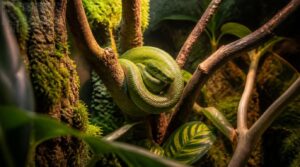
Not every branch works for every snake, and getting the match right takes more than a quick glance at your enclosure. Your snake’s species, size, and natural habits all shape what kind of setup it actually needs. Here’s what to think about before you start arranging branches.
Species-specific Climbing Habits
Not every snake climbs the same way. Green tree pythons rely on prehensile tail wrapping and slow, deliberate movement, while other species favor rapid ascent using claw curvature and grip.
Compare that to squirrel descent techniques or a chameleon’s specialized toe grip, and you’ll see arboreal locomotion varies wildly.
Match your branch setup to your snake’s natural climbing style, not a generic template.
Proper Branch Diameter
Once you’ve matched the climbing style, sizing the branch itself becomes the next call. Aim for 2 to 4 inches for medium species, avoiding anything thinner than the snake’s stretched midsection. Check for flex: a branch that bows under weight invites slipping and throws off center of gravity, undermining even strong claw curvature or opposable digits.
- Measure girth at rest, not stretched
- Test flexibility by hand-pressing the branch
- Avoid branches under 1.5 inches for juveniles
- Choose slight taper for dual-coil grip
- Watch for bowing under active movement
Supporting Full Body Weight
Diameter means little if the wood can’t hold weight under a sudden lunge. Look for bending stiffness near 5000 Nmm at a meter’s length, with compression strength above 30 MPa so bark won’t crush under coiled pressure.
Weight capacity testing at 1.5x body weight, checked for sagging, confirms the branch controls active strikes up to 0.8 m/s without failure.
Horizontal Resting Perches
Once you’ve confirmed a branch can bear the load, think about where your snake actually wants to sit.
Horizontal resting perches mimic the flat limbs snakes use for energy conservation in trees, spanning wall tracks for solid load distribution mounting. Mix rough bark with smoother sections for surface grip variety, and rotate natural branch selection seasonally to keep the canopy feel fresh.
Varied Climbing Angles
Since real branches never grow at one uniform pitch, your setup shouldn’t either. Angle-specific grip techniques shift as pitch increases: shallow inclines let your snake rely on broad muscular pressing, while steep ones demand tail anchoring and precise scute traction.
- Shallow angles ease muscle strain
- Moderate slopes engage tail stabilization
- Steep sections build grip strength
- Mixed pitches mimic natural locomotion adaptation
Install Climbing Branches Securely
Picking the right branch is only half the job; installation determines whether your snake actually uses it. A loose or poorly placed branch can turn a climbing feature into a hazard fast. Here’s what secure setup actually looks like in practice.
Anchor Both Branch Ends
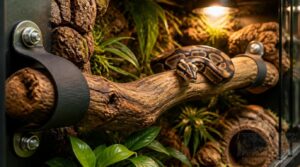
A wobbly branch is a snake’s worst nightmare. Anchor both ends with corrosion-resistant hardware, using bolts and straps for dual anchor stability.
| Anchor Point | Hardware | Check |
|---|---|---|
| End A | Stainless bolt | Load test 20-30N |
| End B | UV strap | Level within 2cm |
| Backing | Locking washer | No wobble |
Proper load distribution testing confirms safe canopy access before your snake climbs.
Create Multiple Climbing Levels

Three vertical zones beat one flat perch every time. Level spacing of 15-20 cm lets snakes move smoothly between tiers, while staggered offsets align with temperature zones, warmer up top, cooler mid-level.
Vary branch diameter and texture per level for real biomechanical engagement. Multiple levels also mean more resting sites, easing stress during handling.
Maintain Safe Fall Distances
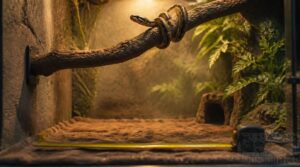
Even a short drop can strain a snake’s spine, so Fall Clearance Zones matter under every branch. Keep 18 inches clear below each perch, with tips at least 6 inches up.
Cushioned mats add real Impact Surface Depth. Run Drop Distance Testing during setup, tracking each fall path for Vertical Drop Safety and catching hazards before your snake ever climbs.
Avoid Heaters and Lighting
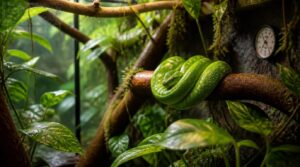
Skip heaters near branches entirely. Arboreal species like green tree pythons rely on ambient temperature gradients, not artificial hotspots, to regulate body heat naturally.
Ditch supplemental lighting too. Indirect room lighting gives you enough visibility while protecting branch surfaces from dangerous heat pockets. Keep a thermometer positioned away from warm objects, and add cool-side branches so your snake can thermoregulate exactly how nature intended.
Test Stability Before Use
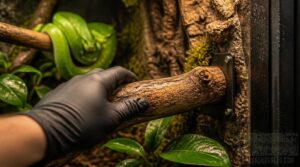
A branch that fails mid-climb undoes every careful setup choice you’ve made. Before your snake ever touches it, run a full safety verification:
- Load bearing test: twice expected weight, held 10 minutes
- Vibration check: door closes, branch stays still
- Environmental stability: 15-30°C, up to 70% humidity
- Post-install inspection: torque check, edge scan, 7-day recheck
Skipping this risks the very locomotion efficiency specialized claws and surface adhesion were built for.
Clean and Maintain Enclosure Branches
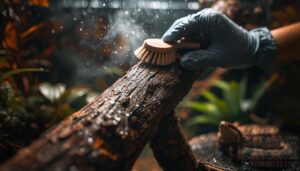
Once your branches are anchored and stable, the work isn’t over. Wood breaks down over time, especially in humid enclosures, and dirty or damaged surfaces can put your snake’s health at risk. Here’s what regular maintenance should cover.
Disinfect Natural Branches Safely
Before any climbing branch enters a snake’s home, it needs a proper scrub. Brush off debris, then soak in a 3% hydrogen peroxide solution for 10 minutes, this kills pathogens without leaving toxic residue. Rinse thoroughly and air dry in sunlight. Skip bleach entirely; fumes irritate arboreal species. Clean branches monthly, storing treated wood separately from untreated stock for 48 hours.
Once the branch is dry, position it thoughtfully within the enclosure’s thermal zones, since understanding heat lamp gradients and bulb types helps ensure the basking area stays safe and properly warmed.
Remove Sharp Edges
A disinfected branch still needs a hands-on check for rough spots. Run your palm along the full length, feeling for splinters or burrs over 0.5mm.
- Sand edges to 120-180 grit
- Round corners to a 5mm radius
- Cap pruning cuts with plastic protectors
Smooth surfaces protect sharp claws and padded toes alike, preventing snags during climbs.
Check for Mold
Smooth branches still hide moisture. Grab a flashlight and check both top and underside surfaces for fuzzy black, green, or white patches.
| Method | Threshold |
|---|---|
| Humidity reading | Above 70% |
| Wood moisture | Above 20% |
| Species ID | Black, gelatinous = concern |
| Visual check | Weekly |
| Removal | Bleach solution, scrub, dry |
Replace moldy branches within 48 hours to protect your snake’s arboreal habits and canopy comfort.
Inspect Mounting Points
Mold isn’t the only thing hiding in plain sight. Give every bracket a hardware corrosion check and confirm fastener thread integrity before your snake climbs again.
- Loose mounts risking a fall
- Rust weakening branches over months
- Wobble stressing your snake’s grip
- Silent failures during quiet nights
Verify mounting point alignment, substrate anchor strength, and load distribution for lasting arboreal safety.
Replace Damaged Branches Promptly
Cracks and splintering don’t wait, so neither should you. Pull damaged branches within 48 hours to stop rot, mold, and pest entry before they spread.
Timely branch replacement keeps your snake’s perches secure and cuts stress from lost climbing options. Rehome new wood within two to five days, and your tree-dwelling species will settle back into confident, natural climbing fast.
Frequently Asked Questions (FAQs)
What tree branches are safe for birds?
Not every stick from your backyard passes muster, sorry, twiggy oak branch. Apple, willow, and birch work best when untreated. Skip conifers and moldy wood. Your bird’s grip depends on it.
What trees are good climbing trees?
Oaks, maples, sycamores, pines, and beeches rank among the best climbing trees, offering thick branches, wide forks, and grippy bark spaced 20 to 40 centimeters apart, ideal for stable footholds and safe ascents.
What branches are safe for reptiles?
Safe means sturdy, safe means clean, safe means chosen with care.
Pesticide-free sourcing, thorough branch drying, and toxic wood avoidance (skip cedar, pine, treated lumber) keep arboreal reptiles secure while climbing, resting, and thriving in their canopy habitat.
What do beardies like to climb?
Bearded dragons favor branches 1 to 2 inches thick with rough bark for secure claw grip. They climb toward elevated perches to survey territory, using natural bends and varied gaps for stable, spine-friendly footholds.
How do gecko toe pads differ from tree frogs?
Think dry glue versus sticky sap: geckos use van der Waals forces for instant, reversible grip on rough bark, while tree frogs rely on wet adhesion, mucus clinging to smooth, humid leaves, detaching slower and losing hold as surfaces dry out.
What makes prehensile tails useful for climbing mammals?
Prehensile tails give climbing mammals a functional fifth limb. Tail grip strength, sensory feedback, and coordinated muscle control let spider monkeys and opossums support body weight, maintain balance, and anchor securely while hands stay free for foraging.
Do all climbing species share similar toe adaptations?
No, toe adaptations vary widely. You’ll see toe pad diversity across geckos, curved claws in snakes, and opposable digits in mammals, each reflecting adaptation variation shaped by branch texture, diameter, and species-specific climbing demands.
How do koalas grip branches so effectively?
Koalas rely on opposable thumbs grip and curved claw penetration into bark. Rough palm pads, muscle strength control, and smart weight distribution let koalas maintain strong gripping abilities while reaching eucalyptus leaves, unlike species using adhesive pads instead.
Why do some ground predators avoid climbing trees?
Picture a fox awkwardly wedged in a tree fork, dignity gone. Not happening. Ground hunting efficiency and injury risk avoidance keep predators grounded, favoring stealth over risky, energy-draining climbs into unfamiliar canopy competition.
Conclusion
A bird in hand is worth two in the bush, but for a snake, one sturdy branch beats an empty floor every time.
Set up climbing branches for arboreal species correctly, and you hand your snake back its instincts: grip, balance, purpose.
Check anchors often. Watch for wear. Adjust angles as your snake grows and settles in.
Do this well, and the enclosure stops being a box. It becomes a tree.