This site is supported by our readers. We may earn a commission, at no cost to you, if you purchase through links.
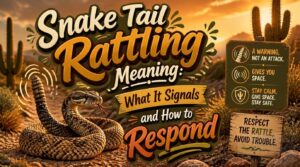
You hear it before you see it: a dry, buzzing hiss rising from the brush, sharp enough to freeze you mid-step. Your instincts know exactly what that sound means, even if your brain hasn’t caught up yet. That reaction is exactly the point.
Snake tail rattling meaning comes down to one thing: communication, not combat. A rattlesnake shaking its tail isn’t winding up for a fight. It’s begging you to walk away before things escalate.
Understanding what’s happening beneath that sound, the biology, the fear response, and the split-second window before a strike, changes how you read every warning a snake gives you.
Table Of Contents
- Key Takeaways
- What Does Snake Tail Rattling Mean?
- Why Pet Snakes Vibrate Their Tails
- How Rattlesnake Rattles Produce Sound
- Read Other Snake Stress Signals
- How to Calm a Rattling Snake
- When Tail Rattling Signals Illness
- Frequently Asked Questions (FAQs)
- What does it mean when a snake rattles its tail?
- What are signs of stress in a snake?
- What is the spiritual meaning of rattle snakes?
- How long does a rattlesnake rattle last?
- Can rattlesnakes control how loud they rattle?
- Does rattle sound differ between rattlesnake species?
- How many segments does a rattle have?
- Can a rattlesnake lose part of its rattle?
- Do other reptiles make warning sounds without rattles?
- Conclusion
Key Takeaways
- A rattling tail is a warning, not an attack—the snake wants you to back off, not to fight, since striking burns energy and venom it would rather save.
- The rattle itself comes from hollow keratin segments clacking together, powered by super-fast shaker muscles that can push the frequency from a lazy 40 Hz up to 70-100 Hz as you get closer, which tricks your ears into thinking the snake is nearer than it actually is.
- Pet snakes without rattles still vibrate their tails to send the same "back off" message, usually because of overhead shadows that look like a predator swooping in, cramped hides, or off temperatures and humidity in their enclosure.
- If you notice jerky or uncoordinated rattling, retained shed at the tail base, mites, swelling, or sudden changes in appetite and behavior, it’s time to call a reptile vet instead of just tweaking the habitat.
What Does Snake Tail Rattling Mean?
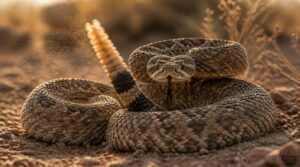
That buzzing sound isn’t random noise, it’s a message with real meaning behind it. Understanding what’s driving that tail means reading the situation correctly instead of guessing. Here’s what you need to know before you respond.
Defensive Warning Behavior
When that tail starts buzzing, you’re witnessing a defensive warning, not an attack in progress. It’s threat assessment in real time: the snake reads your distance, your movement, and answers with acoustic warning meant to deter predators before defensive strike preparation ever kicks in.
Alongside that rattle, snakes often pair raised coils or a flattened hood with faint musky scents, a layered strategy explained in how snakes warn predators before striking.
Stress-induced rattling is the snake’s way of saying "back off," a survival tactic honed to avoid confrontation altogether.
Fear Rather Than Aggression
Read the whole body, not just the noise. Widened eyes, a flattened head, tensed muscles cocked without lunging, these are fearful posture signals, not fury. That elevated front section? Pure bluff. It’s stress fear or overstimulation talking, a nervous system flooded with cortisol and readying muscle for retreat. This is non-aggressive communication, plain and simple: the snake wants space, not a fight.
Warning Before a Possible Strike
That fear you just read in its posture? It has a soundtrack. As threat proximity shrinks, the rattle answers back, faster, louder, a boundary establishment cue telling you the window is closing.
Strike preparation can follow within a second or two once the escalating rattle intensity peaks. Ignore this audible warning signal at your own risk.
Rattles Versus Tail Vibration
Not every quiver counts as a true rattle. Rattle structure relies on hollow keratin segments clacking together, real acoustic aposematism. Plain tail vibration, though, can happen with worn or missing segments, producing softer, incidental noise.
- True rattle: discrete, sharp clacks
- Tail vibration alone: dull, muffled sound
- Rattle needs multiple interlocked segments
- Vibration mechanics work even without them
Segments are formed from retained skin after shedding. Structure of the rattlesnake rattle
Why Pet Snakes Vibrate Their Tails

Your ball python doesn’t need a rattle to send a message, and yet its tail still buzzes against the substrate like it’s trying to tell you something. That vibration isn’t random. Here’s what’s usually driving it.
Predator-like Overhead Approaches
A shadow crossing the glass can flip a switch in your snake’s brain. Overhead motion mimics predator-like descent, the kind hawks use with thermal camouflage and near-silent wingbeats before a strike. Your snake can’t tell you from a raptor targeting its perch.
That instinctive read triggers tail vibration, a defensive display rooted in acoustic aposematism, warning you off before any real threat unfolds.
Inadequate Hides or Enclosure Exposure
A single cramped hide can turn your snake into a nervous wreck, stretched out and exposed at the front glass. Defensive behavior in snakes spikes when retreat options vanish.
Fix the enclosure setup with:
- Multiple hides at varying sizes
- Correct hide size for full-body coiling
- Thermal refuge placement away from hotspots
Proper placement cuts vibration frequency and reduces overall stress.
If you’re unsure whether your setup is helping, these signs your snake is stressed without a hide can guide better placement choices.
Incorrect Temperature or Humidity
When the thermostat drifts, your snake feels it instantly. Thermal gradient imbalance blocks proper thermoregulation, since animals can’t shuttle between 28-32°C basking zones and 22-26°C cool ends.
Humidity matters too. Skipping a humidity stability check invites dehydration below 30% RH or fungal growth above 70%, disrupting shedding and triggering temperature fluctuation stress, often announced through tail vibration.
Species Prone to Tail Vibration
Not every rattling tail belongs to a rattlesnake. Copperhead tail vibration happens fast and low against leaf litter. Gopher snake mimicry fools predators into backing off. Your corn snake tail shake, banana snake stress response, or a rosy boa’s distraction display all mimic that same warning, minus hollow segments, interlocking scales, or a button. Same message, no rattle required.
How Rattlesnake Rattles Produce Sound
That dry, buzzing rattle isn’t magic, it’s biomechanics. Behind every shake sits a tight system of keratin, muscle, and timing built over millions of years. Here’s what’s actually happening inside that tail.
Keratin Segments and Resonance

That dry, buzzing clatter comes from hollow keratin segments loosely interlocked at the tail tip. Each segment acts as a tiny resonant chamber, amplifying every collision.
More segments mean louder sound, much like voices echoing in a cave. Segment vibration against neighboring shells creates layered acoustic resonance, turning simple keratin structure into a genuine warning siren.
Specialized Tail Shaker Muscles

Behind every clatter sits an engine built for speed: the supracostalis lateralis, iliocostalis, and longissimus dorsi muscles firing in rapid bursts.
- High mitochondrial density fuels quick energy
- Fascicle arrangement resists fatigue
- Fast-twitch fibers enable rapid contraction
- Elastic tendons boost energy efficiency
- Neural coordination synchronizes both tail sides
Together, they turn muscle contraction into relentless, controlled power.
Faster Rattling Under Threat
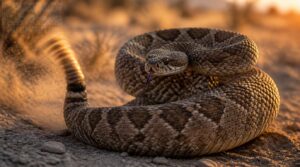
Those shaker muscles don’t fire at one steady speed. As a threat closes in, muscle contraction speed climbs fast, pushing rattle frequency from a lazy 40 Hz to 70-100 Hz in under a second.
That jump alters sound frequency and creates an auditory illusion, tricking predators into thinking the snake stands closer than it does.
A faster rattle creates an auditory illusion, tricking predators into believing the snake is closer than it truly is
Rattle Growth After Shedding
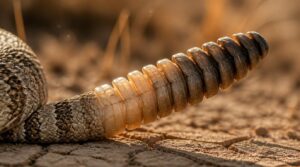
That frequency shift comes from muscle, but rattle length comes from shedding. Each ecdysis deposits a fresh keratin layer at the base, thickening it while older segments fade pale to dark.
Growth slows as shedding frequency drops with age, so juveniles add segments fast while mature snakes stack them at a much slower pace.
Why Newborn Rattles Stay Silent
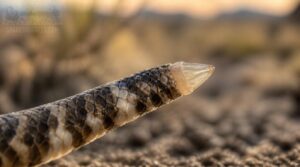
That single stacking segment is called a prebutton, and it can’t rattle at all yet. Muscle development rate lags behind keratin segment maturation, so early ecdysis cycles produce faint tail vibration intensity at best.
- A silence that feels unsettling
- A tail too young to warn you
- Fragile life still finding its voice
Nutrition, hydration, and environmental stress effects shape when that first button finally sounds.
Read Other Snake Stress Signals
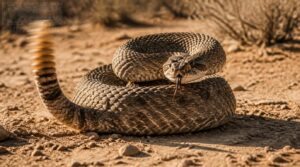
A rattle is just one signal in a much bigger conversation your snake is having with its body. Read that whole conversation, and you’ll know exactly how stressed it really is. Here’s what else to watch for.
Defensive Coiling and Posture
A coiled snake is a loaded spring: Coiled Strike Readiness built into muscle and posture. The head tucks close, Head Tuck Protection for essential organs, while Tail Body Contact keeps balance steady. Muscular Trunk Tautness locks the frame rigid, and Elevated Head Alertness keeps eyes fixed on you.
This defensive posture often pairs with tail rattling, sometimes a hissing sound too.
Hissing and Rapid Breathing
Listen closely and you’ll hear it: a sharp exhale through slightly parted fangs, that classic sibilant warning. This hissing often pairs with visible chest expansion and a faster breathing rate, your snake’s respiratory cues broadcasting rising stress.
Watch for elevated posture and a tense, forward-coiled body. Together, these signals mean one thing: back off, the threat response is escalating fast.
Striking or Escape Attempts
A raised head, tight muscle tension, then a sudden lurch, your snake is preparing to strike, not just posture. Watch the aim: head positioning locks onto the target while tail vibration distracts from that motion.
Escape often follows:
- Body coils for power
- Head tracks the threat
- Tail flicks sideways
- The snake bolts toward cover
Give it space immediately.
Repeated Hiding or Restlessness
Vanishing into a hide for hours, refusing food, or pacing tight loops along glass walls: these are quieter distress signals. Hiding frequency spikes when temperature, humidity, or lighting feels wrong.
Restlessness signs like constant repositioning or burrowing into substrate reveal active shelter seeking. Track these patterns before assuming your snake’s fine, since prolonged concealment often means something in the enclosure setup needs adjusting.
Why Behavioral Context Matters
A single tail flick can mean panic or pure curiosity, depending entirely on behavioral context.
Distance, lighting, handling history, and even your approach angle shape whether tail rattling signals defense or idle exploration.
- Slow, close movement raises defensive posturing
- Overhead shadows increase perceived threat
- Calm environments reduce misread signals
Read the whole scene, not just the tail, before reacting.
How to Calm a Rattling Snake

A rattling snake is telling you exactly what it needs, and your job is to listen. The good news? Calming things down usually comes down to a handful of simple, deliberate moves on your part. Here’s where to start.
Pause Handling Immediately
Your snake’s tail lifts, vibrates, freezes mid-motion. That’s your cue: stop everything now. This is emergency response protocol, not optional courtesy. Handler safety first means withdrawing your hands immediately, no sudden retreats that spook further.
This immediate cessation action gives the animal space to de-escalate. Improper handling under stress compounds risk. Watch for calming stress signals before resuming, animal welfare priority always comes first.
Approach From The Side
A straight-on stare reads as a threat, so let geometry work for you. The lateral observation technique keeps your profile angled, not squared off against the tail and rattle.
Move slow, hands low, always with a safe retreat path ready. This minimal disturbance approach eases defensive posturing without amplifying stress or sound amplification from an agitated rattle.
Provide Snug Hiding Places
Once you’ve backed off, give the enclosure itself a job to do. A den that hugs the body, roughly 4×6 inches for juveniles, delivers instant security no amount of gentle handling can match.
Two hides, one warm, one cool, placed away from drafts and feeding zones, let your snake choose comfort on its own terms.
Check Heat and Humidity
Hides help, but a hidden thermal gradient error can undo all that comfort. Check both ends: basking spot near 88-92°F, cool side 75-85°F, using a calibrated thermometer, not guesswork.
Verify humidity with a hygrometer at snake level, targeting 40-60%. Damp substrate and misting fix low readings fast, restoring your snake’s sense of control.
Allow Time to Acclimate
Getting temps right won’t matter if you’re still handling too soon. Give it time, several days to two weeks, before regular handling begins.
- Skip handling first 72 hours
- Limit sessions after 48 hours
- Keep routines predictable
- Watch rattling decrease gradually
Reduce noise, movement, and light. Patience beats a stopwatch here.
When Tail Rattling Signals Illness

Not every rattle is about stress or startle. Sometimes that tail is telling you something’s physically wrong. Here’s what to watch for so you know when it’s time to call a vet instead of just adjusting the enclosure.
If the rattling pairs with unusual coiling or a hunched, defensive posture, this guide to what different snake coiling positions reveal about health and mood can help you spot the difference between normal behavior and a warning sign.
Sudden Behavioral Changes
A snake that suddenly stops eating, hides constantly, or rattles at the slightest touch isn’t being dramatic, it’s signaling something’s wrong. Watch for behavioral escalation paired with routine disruption: skipped basking, erratic activity, or a normally calm animal turning defensive overnight. These abrupt cognitive shifts and mood changes rarely resolve alone. They warrant closer observation, not dismissal as quirky personality.
Retained Shed Near Tail
Look closely at the tail base. A cloudy, wrinkled patch clinging there days after shedding usually means retained shed, often from low humidity during the cycle. Fix humidity control to 70-80%, try a warm soak for shedding assistance, and do a gentle tail inspection.
Left untreated past two weeks, trapped moisture invites infection, so moisture management matters, and veterinary consultation helps if it won’t budge.
Mites, Swelling, or Wounds
Persistent rattling paired with a dull, dusty tail deserves a hands-on check. Run your fingers along the scales, feeling for grit or firmness.
- Mites: pale specks, dust-like residue
- Swelling: firm, 15%+ diameter increase
- Wounds: ragged edges, foul odor
Treat mites with weekly ivermectin dips, dial humidity to 40-60%, and watch wound closure over 14-21 days. Persistent issues warrant veterinary antibiotics.
Abnormal Neurologic Movements
Rattling that looks jerky or uncoordinated, rather than rhythmic, points to neurologic disease. Watch for muscle twitching, wobbling strikes, or ataxia coordination loss.
| Sign | Appearance | Duration |
|---|---|---|
| Twitching | Rapid jerks | 1-3 sec |
| Seizure-like | Coiling, erratic tail | 10-30 sec |
| Abnormal eye movement | Fixed staring | Variable |
Contacting a Reptile Veterinarian
Trust your gut here. If the tail behavior seems off, don’t wait it out.
Find a board-certified reptile vet through the ARV directory. Bring shed dates, feeding logs, and temperature records. Describe the rattling pattern clearly.
Book routine visits 48 hours ahead; emergencies get seen within 2 hours. Get written discharge instructions before you leave, and follow up if appetite changes.
Frequently Asked Questions (FAQs)
What does it mean when a snake rattles its tail?
That buzzing isn’t aggression, it’s survival math. A rattle is a defense signal, not a threat response, telling you the snake wants distance, not a fight. It conserves venom while signaling danger through acoustic warning, not violence.
What are signs of stress in a snake?
Watch for flicking tongue rapidly, a coiled head tucked low, elevated front body, mouth mucus production, and frequent blinking gaze. These reptile stress signals reveal defensive posturing your husbandry setup and body language habits can help ease.
What is the spiritual meaning of rattle snakes?
Consider the rattlesnake a living alarm bell of the wild. Its spiritual meaning centers on sacred space protection, a boundary setting lesson, intuition amplification, and a fear transformation symbol tied to spiritual renewal cycle, all rooted in this venomous snake’s defense mechanism and predator deterrence.
That rattle isn’t permanent either—curious minds can explore whether rattlesnakes shed their rattles as part of their ongoing cycle of renewal and growth.
How long does a rattlesnake rattle last?
Anywhere from a few seconds to several hours. Rattle duration shifts with threat level, ramping from 40 Hz to over 70 Hz as danger closes in, while muscle fatigue and health eventually slow the tail’s relentless buzz.
Can rattlesnakes control how loud they rattle?
Like a violinist bearing down harder on the bow, a rattlesnake commands its shaker muscles to strike faster and harder. Yes, they can control loudness, driving muscle force variation and frequency shifts to match true threat level.
Does rattle sound differ between rattlesnake species?
Yes. Across the Crotalus genus, segment shape and packing shift pitch frequency and cadence, some species buzz higher and faster, others deeper and slower, with harmonic resonance and segment addition rate shaping each species’ distinct acoustic signature.
How many segments does a rattle have?
Segment count varies widely, from a single button at birth to a dozen or more interlocking segments in wild adults. Each shed adds one keratin piece, so growth rate, species, and captive versus wild conditions all shape the final tally.
Can a rattlesnake lose part of its rattle?
Snag a rattle on rock or vine, and keratin segments snap clean off. Rattle regeneration never happens; interlocking segments are gone for good. The tail stays blunt, but shedding continues, rebuilding length without ever restoring what broke away.
Do other reptiles make warning sounds without rattles?
Absolutely. Geckos hiss, crocodilians bellow, and lizards manage tail thumping, scale clicking, and body drumming against dry ground, proving acoustic signaling in reptile behavior doesn’t require a rattlesnake’s specialized rattle at all.
Conclusion
Rattle and hum: that sound is really a rattlesnake’s plea, not a threat. Snake tail rattling meaning boils down to one truth: it’s a warning built on fear, not fury. Every buzz, every hiss, every coiled posture is a snake asking for space, not a fight.
Respect that signal, and you control the encounter. Ignore it, and you’ve chosen the risk yourself. Give ground, stay calm, and that dry hiss becomes something else entirely: a lesson in restraint.