This site is supported by our readers. We may earn a commission, at no cost to you, if you purchase through links.

A four-foot bull snake strikes in under a quarter second. Bare skin loses that exchange every time. That’s the math driving glove use across zoos, rescues, and private collections.
Why do snake handlers wear gloves? Fangs up to 3.5 cm deep, sustained bites from constrictors, bacteria living on scales — the risks stack up fast, and skin alone can’t cover them. Leather, Kevlar, and chainmail each solve a different piece of that puzzle.
Grab the wrong glove, though, and you’re trading one risk for another. Here’s what actually protects your hands — and where those protections quietly run out.
Table Of Contents
- Key Takeaways
- Why Do Snake Handlers Wear Gloves?
- They Reduce Bites, Germs, and Slips
- How Protective Are Snake Handling Gloves?
- Which Snake Handling Gloves Work Best?
- How Gloves Affect Snake Handling
- How to Use Snake Gloves Safely
- Frequently Asked Questions (FAQs)
- Why don’t snake handlers wear gloves?
- Can snakes recognize their handlers?
- What material can rattlesnakes not bite through?
- What does the Bible say about snake handlers?
- How often should snake handling gloves be replaced?
- Can snake handling gloves be repaired after damage?
- Do gloves work for all snake species equally?
- Are snake handling gloves legally required for professionals?
- Conclusion
Key Takeaways
- Gloves matter because fangs can reach 3.5 cm deep and bites happen in a fraction of a second, so bare skin just can’t keep up with the risks from bacteria, venom, and sustained bites.
- Different materials protect differently: leather resists punctures, Kevlar spreads out fang pressure, and chainmail handles sustained crushing force, so picking the right one depends on what you’re actually handling.
- No glove is bulletproof: seams, cuffs, and micro-cracks from repeated bites are real weak points, and fang length scales with snake size, so bigger species mean bigger risks even with solid gear.
- Gloves change more than just protection: they dull your grip feedback, mask your scent, and can create a false sense of security, so pairing them with hooks, tongs, and regular inspection is what actually keeps you safe.
Why Do Snake Handlers Wear Gloves?

Gloves show up in a handler’s routine for reasons that go beyond avoiding a bite. Some situations call for extra protection, others just demand a steadier grip. Here’s when gloves actually earn their place on your hands.
If you’re unsure which camp you fall into, this guide on when gloves are actually necessary for handling snakes breaks down the situations worth the extra caution.
Handling Defensive Snakes
When a cornered snake hisses and coils, it isn’t bluffing. Defensive strikes happen fast, faster than most reflexes.
Gloves absorb that first contact while you work a snake hook or tongs to establish distance. Combined with escape-proof enclosures and steady hands, they buy the seconds needed to redirect safely, without hand contact ever entering strike range.
Understanding defensive behavior escalation helps handlers anticipate strikes and respond appropriately.
Managing Large Species
Redirecting a coiled defender is one thing. Wrestling an 8-foot Burmese python is another game entirely.
Large constrictors need 20 to 30 percent extra enclosure space, reinforced doors, and heavy flooring to prevent blowouts. Gloves matter here too, since constriction pressure accelerates glove material degradation. Pair them with weight checks, scaled feeding, and enrichment. Transport demands climate-controlled crates with secure latching, no exceptions.
Treating Injured Snakes
A python fresh off enclosure repairs isn’t the only patient you’ll glove up for. Injured snakes need hands-on wound care, and gloves matter for grip control and pathogen barriers alike.
Expect this sequence:
- Assess vitals and measure wound depth
- Flush with warmed saline, then disinfect
- Bandage snugly, medicate, and track healing
Gloves protect you and the patient during every step.
Cleaning Occupied Enclosures
Wound care isn’t the only job that puts your hands near a live snake. Enclosure cleaning does too, and it starts with removing the snake safely before scrubbing anything.
Once the snake is secured, choosing reptile-safe enclosure cleaning supplies keeps harsh chemical residues away from your snake’s skin, lungs, and habitat.
Use dedicated gloves and tools, never bare hands, to disinfect non-porous surfaces and clear waste debris. Rinse, dry, then inspect gloves for wear before storing them properly.
They Reduce Bites, Germs, and Slips

Gloves do more than block a strike. They change what happens at the point of contact, from fangs to bacteria to a snake’s slick scales. Here’s what that protection actually covers.
Fang and Teeth Protection
A snake’s fang is basically a pressurized needle. Hollow, curved, wired to a venom gland, built for one job: penetration.
A snake’s fang is a pressurized needle, hollow and curved, built for one job: penetration
Gloves counter this through bite force distribution, spreading fang tip pressure across a wider surface instead of one point.
Materials matter:
- Full-grain leather resists puncture
- Kevlar deflects recurved teeth
- Chainmail shields against sustained pressure
Barrier Against Reptile Bacteria
Reptile skin carries more than dirt. Salmonella lives on scales and in waste, and bare hands invite transfer straight to your mouth or eyes.
That’s why picking gloves with the right flexibility matters as much as coverage—this guide on choosing the correct thickness for snake handling gloves explains how to stay protected without losing your grip.
| Barrier | Function | Best Practice |
|---|---|---|
| Nitrile gloves | Blocks aqueous bacteria | Wash hands after removal |
| Liner films | Adds skin separation | Discard after use |
| Disposable gloves | Fresh sterile barrier | One per handling session |
Improved Grip on Scales
Wet, muscular, and constantly shifting, scales are harder to hold than they look. Textured palm design with pebbled leather grips scale ridges directly, boosting grip pressure without crushing tactile feedback.
Moisture management pulls sweat away, so hands stay drier mid-hold. Ergonomic fit stops slippage; durable grip surfaces hold up over seasons. Good technique still beats gear—but dexterity loss without it invites false security.
Blocking Skin Irritants
Your skin carries oils, salts, and soap residue—harmless to you, irritating to scaled skin. Natural oils transfer on contact, and leftover soap compounds it.
Gloves stop that exchange cold. Many now use an allergen barrier coating blocking irritant enzymes on contact. Choose hypoallergenic glove materials for scale irritation prevention—it’s basic snake handling safety, no matter the species risk assessment.
Safer Snake Redirection
Redirection beats restraint. A 6-foot handling stick keeps you at a safe distance while guiding the snake instead of gripping it.
Gloves still matter here—thick cut gloves with reinforced palms resist cooperative bite attempts during blunt-tipped tongs work. Pair that with a funnel enclosure or tunnel sleeve, and defensive behavior speed drops fast, cutting strike risk during transport.
How Protective Are Snake Handling Gloves?
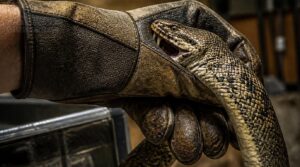
Gloves help, but they’re not magic armor. Fangs, seams, and sustained pressure all test their limits in different ways. Here’s where the real weak points show up.
Fang Length and Pressure
Fang length ranges 1.5 to 3.5 centimeters, and curvature drives fang penetration mechanics—curved tips anchor deep before venom flows.
Strike speed generates real bite force. Pressure injection push venom through hollow canals, and longer fangs mean deeper penetration. Puncture resistance in gloves matters, but glove seams stay weak points where fang depth can still break through.
Sustained Bites and Chewing
A single strike is one thing. Sustained bites are worse—repeated jaw contact, chewing motions lasting seconds to minutes, alternating fangs and secondary teeth.
That grinding action progressively widens wound channels, and puncture resistance built for one hit fatigues fast under it. Material layering helps, but impact fatigue sets in, forming micro-cracks that spread with each chew, undermining fang penetration mechanics gloves were designed to stop.
Vulnerable Seams and Cuffs
Wear doesn’t stop at the palm. Glove seams at the wrist take real punishment—stitching vulnerability points where a bite lands, letting venom seep despite intact leather.
- Elastic cuffs thin at flex points
- Seam allowance exposure near knuckles
- Double stitching adds bulk, reduces seal
- Material layering strengthens weak junctions
- Glove inspection catches frays early
Cuff material selection matters as much as seam reinforcement techniques.
Large Venomous Snake Risks
Cuff damage matters more with big vipers. Fang length correlates with body size, and large species can exceed one-inch fangs, punching through leather under sustained pressure. Strikes reach one-third their body length. Venom yield runs several milligrams per bite.
Delayed treatment risks organ failure—immobilize the limb, get antivenom fast, and inspect gloves immediately after any encounter.
Venom Through Small Punctures
Big fangs aren’t the only threat. Even a shallow nick creates a micro channel where venom absorption rate spikes fast, pulling toxin into capillaries near the surface.
That’s why puncture depth matters less than you’d think:
- Cytotoxins trigger swelling within minutes
- Micro wound healing slows with venom present
- Tissue damage progresses without care
- Clean punctures immediately, then seek help
Which Snake Handling Gloves Work Best?
Not all gloves earn their keep in the field. Material and design decide whether you get real protection or just a false sense of it. Here’s what actually holds up when fangs come calling.
Thick Full-Grain Leather

Old-school for a reason: thick full-grain leather packs tight collagen fibers that resist tears and blunt smaller fangs. At 1.2–1.6mm, it won’t match ANSI cut level A4 kevlar for puncture resistance, but it flexes around tongs, ages into a tough patina, and stays comfortable.
Condition it regularly—dried leather cracks, and cracks are where fangs get through.
Kevlar-Lined Gloves

Regarding puncture resistance, Kevlar-lined gloves hit different. At ANSI cut level A4+, aramid fibers spread fang pressure across the weave instead of one point.
Why they work:
- Cut protection rivals steel mesh
- Heat resistance guards against sudden surface contact
- Chemical resistance blocks solvents and oils
- Moisture management keeps grip dry, reducing fatigue
Reinforced Composite Materials

Where materials science really flexes is composite layering. Fiber reinforced polymers and hybrid composite materials combine woven synthetics with ductile backings, boosting puncture resistance beyond single-material gloves.
| Material Type | Key Trait |
|---|---|
| Ceramic matrix composites | Heat/abrasion resistance |
| Natural fiber composites | Lightweight, breathable |
| Hybrid composites | Balanced flexibility |
| Reinforced seams | Fewer weak points |
| Reinforcement architectures | Directional strength |
Glove material testing standards confirm layered builds outperform basic leather.
Chainmail Puncture Protection
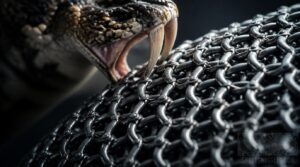
Think medieval armor, scaled down for your fingers. Chainmail gloves use interlocking stainless or carbon steel rings, 2 to 5mm across, in 4-in-1 or 6-in-1 weaves that distribute bite force instead of absorbing it.
Riveted seams beat plain links for fang penetration resistance. Pair mail with leather or Kevlar layering, rinse and oil rings after use, and you’ve got serious puncture defense meeting EN 388 standards.
Gauntlet-Style Forearm Coverage

Your wrist isn’t the only target—a striking snake goes for whatever’s closest, forearm included. Gauntlet-style coverage extends 12 to 24 inches up the arm, closing that gap entirely.
- Full-grain leather panels for puncture resistance
- Reinforced seams at the cuff
- Adjustable wrist closures for secure fit
- Moisture-wicking liners with segmented flexibility panels
Good glove fit and dexterity still matter more than length alone.
How Gloves Affect Snake Handling

Gloves don’t just sit on your hands, they change the entire interaction. Your grip, your scent, even the snake’s stress level shift the moment you put a pair on. Here’s what actually happens once you glove up.
Reduced Tactile Feedback
Gloves buy safety at the cost of feel. Grip sensitivity loss dulls texture perception on scales, and temperature response delay slows your read on a snake’s warning cues.
Thin leather gloves help, but even good glove fit and dexterity can’t fully restore fine motor control. Reduced forearm sensation compounds this — adjust your handling technique accordingly, and never trust gloves over attentiveness.
Grip Pressure Changes
Your grip isn’t static under a glove — it shifts constantly with wrist movement, climbing as the snake resists. Pressure distribution shifts toward finger pads first, then the palm as fatigue builds. A wider grip aperture actually cuts peak pressure by roughly 12%, so relax your hold rather than clenching. Watch for glove deformation — it’s an early stress signal telling you to adjust technique.
- Widen your grip aperture
- Watch for palm pressure buildup
- Reset grip during sudden twists
- Alternate hand position often
Altered Scent and Texture
That glove change changes more than grip — it changes scent cues entirely. Leather, rubber, or synthetic linings mask your natural odor, causing scent contamination the snake reads instantly. Texture feedback shifts too, altering sensory receptor interference against scales.
Repeated exposure builds learned snake responses to specific glove odors. Some species show longer avoidance behavior when synthetic scents linger, so odor transfer matters more than most handlers realize.
False Sense of Security
That scent shift breeds a dangerous side effect: overconfidence in gear. Handlers skip routine checks, trusting leather or Kevlar completely. Misplaced trust delays threat recognition when micro-cracks form.
Layered defenses matter. Hooks, tongs, and occupational safety protocols back up gloves. Never treat any single barrier as foolproof — degraded material fails silently, right when sustained pressure or a fast strike tests it hardest.
Snake Stress Responses
Degraded gear risk ties straight to what’s happening under the scales. A defensive snake under a glove shows extended strike readiness, dilated pupils, and rapid tail whipping — clear stress signals demanding faster reaction time from you. Corticosterone surges spike heart rate and breathing. Appetite drops for days afterward.
Read these defensive signals early; adjust grip pressure before thermal regulation shifts compound the animal’s distress.
How to Use Snake Gloves Safely

Gloves only work if you use them right. Fit, tools, and habits matter as much as the material itself. Here’s what safe glove use actually looks like in practice.
Choose Proper Fit
Fit makes or breaks glove safety. Aim for a wrist seal with no gaps, plus a cuff extending 2 inches past the wrist. Material should stretch 10-15% without losing protection.
Skip one-size-fits-most gloves—run a grip test on a stationary object first. Balance dexterity and comfort, reassess after washing, and inspect regularly during maintenance.
Use Hooks and Tongs
Why rely on gloves alone? Pair them with hooks and tongs for real distance. Hook grip technique lifts the neck while you stay clear; tongs precision control controls limited contact points during relocation.
Non-slip surfaces prevent guiding mishaps. Proper sizing means shorter contact time, less stress on the snake. Tool maintenance tips: wipe down, check joints, store dry alongside your handling gloves.
Inspect After Every Use
Every glove earns a post-session once-over. Run fingers along seams, feeling for soft spots. Do a cuff integrity check and a seam damage scan—stitch failures start small. Assess inner lining moisture and flexibility; stiffness signals glove degradation over time. Check protective insert positioning. Log wear and tear. Skip this, and glove maintenance becomes guesswork, not protection.
Clean and Store Properly
A dirty glove is a weak glove. Rinse with warm water first, then work mild soap into seams and cuffs with a soft brush—don’t skip the rinse, since residue breaks down material over time. Air dry away from heat sources.
Store in breathable, closed containers with 30-50% humidity control. Silica packs help prevent mildew.
Prepare for Snake Bites
Gloves fail. Plan like they will.
Keep a first aid kit stocked and ready:
- Suction device (30 ml venom extraction)
- Pressure bandage calibrated to 30 mmHg
- Poison control card with ER address
- Antivenom vial, stored cold
- Digital thermometer
Run monthly training drills, document bite time and species, immobilize the limb, and get antivenom access confirmed before you ever need it.
Frequently Asked Questions (FAQs)
Why don’t snake handlers wear gloves?
Skip skin altogether? Some handlers do. Bare hand benefits include real-time tactile feedback and habituation trust-building, while scent masking from gloves disrupts sensory familiarity, raising stress. Many prefer hooks and tongs over gloves entirely for control.
Can snakes recognize their handlers?
Yes, through scent memory and handling rhythm. Ball pythons and corn snakes show strongest owner recognition, comparing current odors against stored scent cues.
Sensory familiarity builds via a habituation process, reducing tongue flicking and defensive postures with trusted handlers.
What material can rattlesnakes not bite through?
Solid metal mesh with tight diamond spacing stops fangs cold. Chainmail armor, industrial Kevlar, and thick leather ply (5mm+) resist most strikes too, but rattlesnake fang length can still test bite-resistant construction under sustained pressure.
What does the Bible say about snake handlers?
Sacred scripture sparks the practice: Mark 16:17-18 describes believers handling snakes and drinking poison unharmed as signs of faith. Pentecostal traditions embrace this literally, though scholars dispute the passage’s authenticity and whether it applies universally today.
How often should snake handling gloves be replaced?
Replace gloves every 40 to 60 hours of field use, or sooner. High-risk operations follow a strict 3 to 6 month cycle. Inspect weekly; retire immediately at first cracks, thinning, or seam wear.
Can snake handling gloves be repaired after damage?
A worn glove doesn’t always mean the trash bin. Skilled cobblers apply patch leather and heavy duty stitching to palms and fingertips, while Kevlar-lined gloves get liner replacement — often covered under warranty coverage for manufacturing defects.
Do gloves work for all snake species equally?
No. Species fang variation, handling force, and body shape change the math. Small snakes slip through seams; heavy constrictors crush past dexterity limits. Puncture-resistant fabrics work best matched to specific risk assessments, not universally.
Are snake handling gloves legally required for professionals?
Yes, in most cases. OSHA compliance under 29 CFR 132 mandates PPE, while state regulations, insurance mandates, and certification standards from groups like ASRK often require gloves meeting ANSI/ISEA ratings for professional snake handling.
Conclusion
A knight’s armor never made him invincible; it made him deliberate, forcing every move to count. That’s the real answer to why do snake handlers wear gloves: not invulnerability, but calculated respect for a bite that arrives faster than thought.
Leather stops fangs. Kevlar resists punctures. Chainmail turns skin into steel mesh. None of it replaces judgment. Gloves buy margin, not immunity — and the best handlers never forget that difference.
Respect the gap. Wear the armor. Keep your hands.