This site is supported by our readers. We may earn a commission, at no cost to you, if you purchase through links.
Grab a random bulb off the pet store shelf and you’re gambling with your snake’s life. Too little wattage, and your ball python can’t digest a meal properly. Too much, and you’ve built a reptile oven.
The truth is, best bulb wattage for snake tank setups depends on more than tank size alone. Species, enclosure material, room temperature, even how much ventilation your mesh lid allows, all shift the numbers you need.
Get the wattage right and your snake basks, digests, and thrives without stress. Here’s exactly how to calculate it for your setup.
Table Of Contents
- Key Takeaways
- Best Bulb Wattage by Tank Size
- Match Wattage to Snake Heating Needs
- Compare Snake Tank Bulb Types
- Control Heat and Prevent Overheating
- Top 10 Snake Tank Setup Products
- 1. Zacro Reptile Ceramic Heat Lamp 100W
- 2. Reptile Terrarium Substrate Barrier Mesh
- 3. Reptile Substrate Mesh Barrier
- 4. Zilla Jungle Mix Terrarium Substrate
- 5. Indian Almond Leaf Litter for Terrariums
- 6. OLIISS Stainless Steel Reptile Feeding Tongs
- 7. Riare Organic Expanded Clay Balls 2lb
- 8. Live Moss for Terrarium Bedding
- 9. Exo Terra Silent Mini Terrarium Fan
- 10. Aiicioo Reptile Heating Pad 8 Watt
- Frequently Asked Questions (FAQs)
- Conclusion
Key Takeaways
- Bulb wattage should match your tank size (25W for a 10-gallon up to 150W-plus for a 75-gallon), but you’ll need to adjust up or down based on species, room temperature, and how much ventilation your enclosure has.
- Always pair your heat bulb with a reliable thermostat, since even the right wattage can turn dangerous without one to catch drift or prevent overheating.
- Mount your bulb above one end of the tank rather than the center, so your snake can move between a warm basking spot and a cooler zone to self-regulate.
- Skip mercury vapor bulbs entirely, since a cracked one can release toxic mercury vapor, and stick with halogen or ceramic options instead.
Best Bulb Wattage by Tank Size
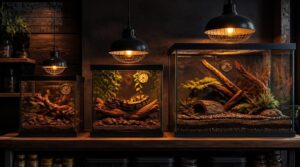
For picking the right bulb, your tank’s size does most of the talking. Bigger enclosures need more watts to push heat across the extra air space, while smaller ones can overheat fast if you go too strong. Here’s how wattage breaks down by common tank sizes, so you can match your setup with confidence.
If you’re unsure where to start, this guide to picking the right heat lamp for your snake’s tank breaks down wattage recommendations by enclosure size.
10. Gallon Tanks: 25–50 Watts
For a 10-gallon enclosure, 25 to 50 watts usually does the job, with 25W suiting warmer rooms and 50W needed once ambient temps drop below 70°F.
- Basking spot: 85-90°F
- Cool side: 75-82°F
- Small tanks heat fast, overheat faster
- A thermostat prevents temperature spikes
- Check readings at floor and basking level
20. Gallon Tanks: 50–75 Watts
Step up to a 20-gallon tank and you’ll need 50 to 75 watts to hold that basking spot near 85-90°F, with ambient temps around 78-82°F.
Mount the bulb 8-12 inches above substrate, one end only, and let a thermostat hold the surface at 88-90°F. Check both zones daily; room temp and lid design shift results fast.
40. Gallon Tanks: 75–100 Watts
Once you’re working with a 40-gallon enclosure, 75 to 100 watts becomes your target range for a basking spot of 90-105°F, measured 6-12 inches above the surface.
Mount the bulb at one end only, pair it with a guarded thermostat, and check daily. Bulbs lose output over time, so replace them every 6-12 months to keep that gradient reliable. Since higher-wattage bulbs draw more power, it’s worth understanding how bulb wattage affects energy costs when budgeting for a larger tank’s heating setup.
55. Gallon Tanks: 100–150 Watts
Jump up to a 55-gallon tank, and 100 to 150 watts becomes your range, capable of pushing a basking spot to 95°F at one end. Keep the cool side near 75-80°F for a working gradient.
A ceramic heat emitter controls overnight warmth well. Place your thermostat probe right at basking height, not the substrate.
75. Gallon Tanks: 150-Plus Watts
At 75 gallons, you’re looking at 150 watts or more, since larger tanks lose heat faster across their volume. Aim for an 88-92°F basking zone with a 78-82°F cool side.
Fine-tuning these ranges by life stage is worth the effort, as the role of precise temperature regulation in boa constrictor health becomes especially critical when juveniles and sub-adults are still developing their thermoregulatory needs.
Pair that wattage with a solid thermostat, always. Mount the fixture 12-18 inches up, and confirm your socket’s rated for the load before flipping the switch.
Match Wattage to Snake Heating Needs
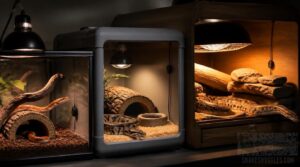
Tank size only tells you part of the story for picking the right bulb. Your snake’s species, the room it lives in, and even what the enclosure is made of all shift how much wattage you actually need. Here’s how to fine-tune your setup based on what your snake really requires.
Ball Python Temperature Requirements
Ball pythons need precise temperature control, thriving with an ambient range of 88-92°F and a basking spot near 95°F.
- Cool zone: 75-80°F, never below 70°F
- Nighttime drop: 70-78°F
- Gradient monitoring: two thermometers, checked daily
This thermal gradient lets your snake self-regulate, so match heat lamp wattage to these ranges for safe, stable warmth.
Corn Snake Temperature Requirements
Corn snakes run cooler than ball pythons, needing a basking surface of 85-90°F for proper digestion. Keep the cool zone in the mid-70s to low 80s, letting nighttime temps drop to 70-75°F naturally.
Always measure surface temperature, not air, since that’s where accurate readings matter most for this thermal gradient.
Boa Constrictor Temperature Requirements
Boas run hotter than corn snakes, needing a basking temperature of 90-95°F, measured at head height. Keep the cool zone steady at 75-80°F for proper digestion and activity.
Set up your basking zone with a fixture 6-12 inches above substrate, paired with thermostat calibration for precise heat output. This temperature gradient allows thermoregulation across the enclosure.
Room Temperature and Climate
Your thermostat isn’t working in isolation, since the room around your snake’s tank shapes how hard that bulb has to work. Indoor climate usually sits between 68-77°F, but drafts, seasonal shifts, and poor enclosure insulation force wattage upward.
Keep readings consistent with regular temperature monitoring, and pair it with steady humidity between 30-60% to protect the entire temperature gradient.
Enclosure Material and Ventilation
What’s your tank actually made of? Glass holds heat steadily, while acrylic loses it faster, and mesh-heavy ventilation increases heat loss dramatically. Wattage calculation must account for:
- Wall material (glass retains heat best)
- Ventilation level (more airflow, more wattage needed)
- Seal quality (gaps disrupt gradient stability)
Reflective interiors and gasketed panels protect your temperature gradient, keeping heat where your snake needs it.
Compare Snake Tank Bulb Types
Wattage tells you how much heat you need, but the bulb type determines how that heat actually reaches your snake. Not every option fits every setup, and picking the wrong one can throw off your day-night cycle or create safety risks you didn’t see coming.
Here’s how the main bulb types stack up, so you can match the right one to your tank.
Halogen Bulbs for Daytime Basking
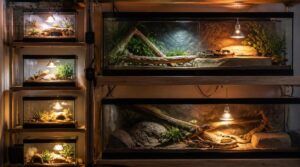
Flip on a halogen basking bulb and you’ll see why keepers favor them: bright light, deep infrared penetration, and quick warm-up.
Match wattage to tank size, 25-50W for 10-gallon setups up to 150W-plus for 75-gallon enclosures, then pair with a thermostat for steady temperature control.
The result is a focused basking spot that meets species needs without guesswork.
Ceramic Emitters for Nighttime Heat
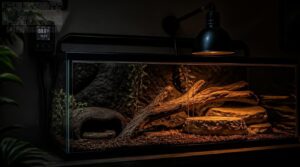
Once the sun goes down, halogen bulbs need to go dark too, which is where a ceramic heat emitter takes over. It radiates infrared warmth with zero light, keeping nocturnal cycles intact while holding your warm end near 28-32°C.
Pair it with a thermostat, mount it 6-8 inches up, and expect 5+ years of reliable service.
Incandescent Bulbs and Light Cycles
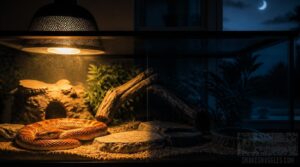
Old-school incandescent bulbs still earn their keep for one reason: light cycle timing. Running roughly 90% of energy as heat, a 60-watt bulb throws off real warmth plus around 800 lumens, useful for a 12-hour on, 12-hour off photoperiod.
Just don’t run them after dark; nocturnal species need true darkness, and disrupted cycles stress snakes and dull feeding response.
Infrared Bulbs for Ambient Warmth

When light cycle timing isn’t the goal, infrared bulbs handle ambient temperature control without the glare. Peaking near 850-940 nanometers, they deliver deep penetrating heat snakes absorb radiantly, moving through the enclosure to self-regulate.
That’s a genuine nighttime heating solution too, since minimal visible light won’t disrupt nocturnal cycles while still holding your radiant heat gradient steady after dark.
Avoiding Mercury Vapor Bulbs
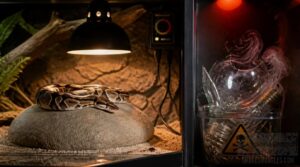
Marketed for heat and UVB together, mercury vapor bulbs carry real downsides: broken outer glass releases toxic mercury vapor and unshielded UV. Skip them for snake tanks regardless of wattage or enclosure size.
Choose ceramic emitters or halogens instead. If one breaks, ventilate, avoid vacuuming, and dispose through certified hazardous waste programs, never household trash.
Control Heat and Prevent Overheating
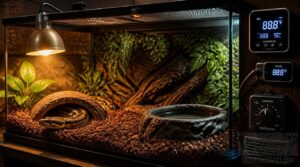
Picking the right wattage only solves half the problem, since even a well-matched bulb can turn dangerous without proper controls in place. Overheating happens fast in a closed enclosure, and the difference between a comfortable basking spot and a medical emergency often comes down to a few simple safeguards.
Here’s what you need to get right to keep your snake’s heat source working for it, not against it.
Use a Reliable Thermostat
A bulb alone can’t manage heat, which is why thermostat control matters more than wattage choice. Look for setpoint accuracy within 1-2°F, sensor calibration, alert systems for drift, and battery backup during outages.
These features protect your snake from silent overheating or nighttime power failures, giving you real thermal regulation instead of guesswork.
Create a Safe Temperature Gradient
Picture your snake choosing its own comfort zone, moving freely between warmth and shade. That’s the goal of a proper temperature gradient: a 10-20°F spread across the enclosure.
To dial it in:
- Map hot/cool zones with probe thermometers
- Keep cool zones between 75-82°F
- Pair with thermostat control for stability
- Check twice daily for drift
Position Bulbs Above One End
Where you mount the bulb matters as much as the wattage you choose. Placing it above one end, not the center, creates a true temperature gradient instead of an evenly baked box.
Keep fixture height 6-8 inches above the basking spot. This end placement helps natural thermoregulation, letting your snake choose warmth or retreat, while simplifying bulb access for safe mounting and maintenance.
Match Fixture and Bulb Ratings
Would you trust a 100-watt bulb to a fixture rated for 60? A wattage compatibility check isn’t optional. Always confirm your fixture’s safety rating equals or exceeds the bulb wattage before installation.
Never trust a bulb to a fixture rated below its wattage; always confirm the rating equals or exceeds it first
Mismatched ratings strain electrical load limits, risking meltdown or fire. Preventing fixture overload means reading labels carefully, since proper wattage matching keeps temperature control safe and your snake’s enclosure running exactly as intended.
Monitor Both Temperature Zones
A single thermometer only tells half the story. You need dual sensor setup readings, one probe at the basking spot and one on the cool side, to confirm your thermal gradient setup actually works.
Log both basking vs cool readings daily at the same time. Consistent zone temperature logging reveals thermal stability monitoring trends before your reptile thermostat’s settings drift into dangerous territory.
Top 10 Snake Tank Setup Products
Once you’ve got your wattage figured out, the right gear makes the whole setup actually work. A good heat lamp is only as good as what surrounds it, from substrate to airflow to how you handle your snake day to day. Here are ten products worth having on your shelf.
1. Zacro Reptile Ceramic Heat Lamp 100W
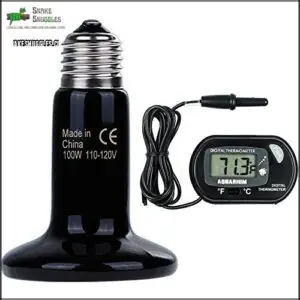
When you need reliable, light-free heat that won’t mess with your snake’s day-night rhythm, the Zacro 100W ceramic emitter delivers. Its 99% thermal efficiency and flat-faced design push infrared warmth deep into tissue rather than just heating air, making it suited for 20-40 gallon enclosures.
It screws into a ceramic E27 socket only, comes with a digital thermometer, and runs on standard 110V. Just don’t touch it while it’s powered; the surface gets scorching hot.
| Best For | Reptile, amphibian, bird, and small mammal owners who need a steady 24-hour heat source without disturbing their pet’s natural sleep cycle. |
|---|---|
| Terrarium Use | Heating |
| Species Suitability | Reptiles/Amphibians/Birds |
| Weight | 100g |
| Bioactive Compatible | Yes |
| Maintenance Level | Low |
| Setup Type | Heating Element |
| Additional Features |
|
- Delivers 99% thermal efficiency with a flat-faced design for efficient, long-lasting heat radiation
- Maintains habitat temperatures up to 20°F above ambient, allowing safe temperature zoning in terrariums and vivariums
- Includes a digital thermometer with LR44 battery for easy temperature monitoring
- Only compatible with ceramic E27 sockets—using a plastic socket can melt or even cause an explosion
- Surface becomes extremely hot during use, so accidental contact poses a burn risk
- Included thermometer doesn’t support switching between Celsius and Fahrenheit
2. Reptile Terrarium Substrate Barrier Mesh
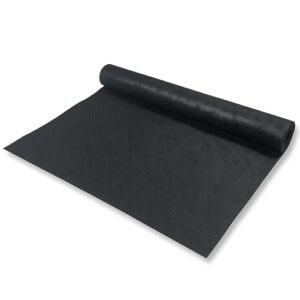
Once your heat source is dialed in, the next safety concern sits below the substrate. This mesh barrier separates loose bedding from the drainage layer, blocking soil and bioactive organisms from clogging your false bottom.
At 36.2" x 18.9" per sheet, it fits tanks up to 50 gallons with room to spare for edge wrapping. The breathable mesh lets water flow through freely while keeping debris out, which means cleaner drainage and steadier humidity for bioactive geckos, frogs, and snakes alike.
| Best For | Keepers building bioactive setups for geckos, frogs, and snakes who want a clean, low-maintenance drainage layer. |
|---|---|
| Terrarium Use | Drainage Barrier |
| Species Suitability | Geckos/Frogs/Snakes |
| Weight | 0.08kg |
| Bioactive Compatible | Yes |
| Maintenance Level | Moderate |
| Setup Type | Substrate Barrier |
| Additional Features |
|
- Keeps substrate and drainage layer separate, maintaining stable humidity
- Breathable mesh allows water to pass through while blocking debris and organisms
- Covers tanks up to 50 gallons with extra material for edge wrapping
- Needs to be cut to fit non-standard tank sizes
- Mesh can degrade over time with constant moisture exposure
- Not a good fit for large burrowing animals that might displace it
3. Reptile Substrate Mesh Barrier

For smaller setups, this mesh option covers two sheets at 24.4" x 18.1" each, better suited to standard 20 and 40-gallon builds than sprawling bioactive tanks.
The flexible black mesh blends into most substrates while resisting tears and degradation over time. It still blocks debris from reaching your drainage layer, though some keepers note water needs a gentle squeeze through rather than draining freely on its own, so factor that into your humidity monitoring routine.
| Best For | Keepers of leopard geckos, crested geckos, ball pythons, frogs, skinks, and other small reptiles or amphibians who want a bioactive-style false bottom without the substrate mixing in. |
|---|---|
| Terrarium Use | Drainage Barrier |
| Species Suitability | Geckos/Pythons/Skinks |
| Weight | 1.76oz |
| Bioactive Compatible | Yes |
| Maintenance Level | Moderate |
| Setup Type | Substrate Barrier |
| Additional Features |
|
- Blocks loose substrate from falling into the drainage layer while still letting water pass through
- Lightweight, flexible black mesh resists degradation and blends in visually with most substrates
- Two generously sized sheets (24.4" x 18.1" each) can be trimmed to fit most standard enclosures
- Some users find the material isn’t very porous and needs to be squeezed for water to drain properly
- Cutting it down to fit smaller tanks can leave excess material going to waste
- The black color can make substrate dust and debris more noticeable over time
4. Zilla Jungle Mix Terrarium Substrate
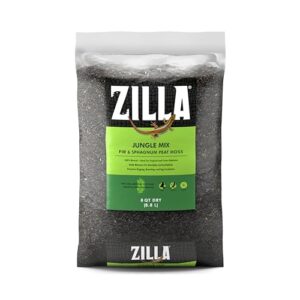
Once that mesh barrier is down, what goes on top of it matters just as much. Zilla Jungle Mix blends aged Douglas fir bark and sphagnum peat moss, holding many times its weight in water to keep humidity stable between mistings.
If you’re weighing bark, coco fiber, or bioactive setups for a young snake, this guide to substrate materials for juvenile snakes breaks down which options suit your species best.
Even with a moisture-retentive mix like this, daily monitoring still matters, so pair it with a solid beginner’s guide to choosing snake substrate to catch damp clumps or mold before they become a problem.
At a 1 to 2 inch depth, it allows for digging and nesting while staying gentle underfoot. Expect to fully replace it every three months, spot-cleaning daily to curb mold and odor buildup.
| Best For | This substrate is best for owners of frogs, rainforest geckos, toads, and snakes who want to keep humidity stable in tropical or bioactive vivarium setups. |
|---|---|
| Terrarium Use | Substrate |
| Species Suitability | Frogs/Geckos/Snakes |
| Weight | 5.8lbs |
| Bioactive Compatible | Yes |
| Maintenance Level | Monthly |
| Setup Type | Substrate Layer |
| Additional Features |
|
- Made from 100% organic aged Douglas fir bark and sphagnum peat moss
- Helps maintain steady humidity levels in tropical and forest enclosures
- Encourages natural behaviors like digging, breeding, and nesting
- Can produce splinters if handled while dry
- Needs monthly replacement or more often depending on soiling
- Only works well within a narrow 1 to 2 inch depth range for best results
5. Indian Almond Leaf Litter for Terrariums

Scatter a few Catappa leaves across that substrate and you’ve got yourself a genuine forest floor. Each pack brings 80 dried, 4-inch leaves rich in tannins that tint water amber while conditioning it naturally.
Rinse before use since they arrive unsterilized, occasionally carrying trace debris. Start light: one leaf per 10 gallons, letting them slowly decay into food for cleanup-crew invertebrates.
They stabilize humidity too, easing evaporation while supporting isopods and beneficial microfauna throughout your enclosure.
| Best For | Keepers of shrimp, bettas, isopods, and other invertebrates who want to recreate natural blackwater conditions and enrich a bioactive vivarium. |
|---|---|
| Terrarium Use | Enrichment |
| Species Suitability | Isopods/Shrimp/Betta |
| Weight | 10g |
| Bioactive Compatible | Yes |
| Maintenance Level | Low |
| Setup Type | Botanical Add-in |
| Additional Features |
|
- Naturally rich in tannins that condition water and create soft, dark blackwater ideal for shrimp and bettas
- Breaks down over time into a food source for isopods and other cleanup-crew invertebrates
- Sustainably harvested and sized generously at 4 inches per leaf, with 80 leaves per pack
- Leaves aren’t pre-sterilized, so rinsing or boiling is recommended before adding them to sensitive setups
- Some leaves may arrive with minor insect silk or bits of debris
- Leaf size can vary, with some pieces measuring closer to 2.5–3 inches instead of the full 4 inches
6. OLIISS Stainless Steel Reptile Feeding Tongs
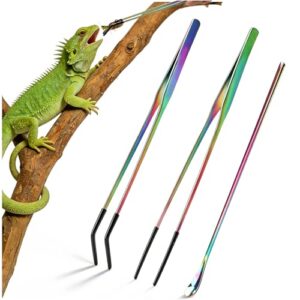
Feeding time gets a lot less nerve-wracking once you swap bare hands for a proper tool. This three-piece stainless steel set includes straight and curved tweezers plus a spoon, all with rubber-tipped ends that grip prey securely without harming delicate mouths.
At 10.6 inches, you keep safe distance from bites or defensive strikes. Works well across bearded dragons, snakes, and turtles alike. Just watch for units showing magnetic pull, a sign of lower-grade steel.
| Best For | Reptile and shrimp keepers who want a safer, more hygienic way to feed and rearrange plants in bioactive terrariums and aquariums. |
|---|---|
| Terrarium Use | Feeding Tool |
| Species Suitability | Lizards/Turtles/Snakes |
| Weight | 0.1kg |
| Bioactive Compatible | Yes |
| Maintenance Level | Low |
| Setup Type | Handling Tool |
| Additional Features |
|
- Rubber-tipped ends grip food securely without hurting your pet’s mouth
- 10.6-inch length keeps your hand safely away from bites or defensive strikes
- Three-piece set (straight tweezers, curved tweezers, spoon) covers feeding, supplements, and plant care
- Some units show magnetic attraction, a sign of lower-grade stainless steel
- Rubber tips can wear down over time with heavy use or heat exposure
- Not built for very large prey that need a heavier-duty tool
7. Riare Organic Expanded Clay Balls 2lb
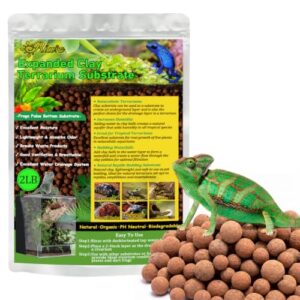
Drainage matters more than most keepers realize, especially in bioactive builds where excess moisture invites mold and bacterial growth. These baked clay pellets, ranging 4-16mm in diameter, create a porous false-bottom layer that channels water away from your substrate while staying pH neutral.
At 2 pounds per pouch, they’re reusable indefinitely with a simple rinse. Just separate them from soil layers using mesh, since loose clay balls will float and mix into your substrate otherwise.
| Best For | reptile and amphibian keepers building bioactive terrariums who need a reliable, reusable drainage layer to keep excess moisture away from the substrate. |
|---|---|
| Terrarium Use | Drainage Layer |
| Species Suitability | Plants/Terrarium Fauna |
| Weight | 2lbs |
| Bioactive Compatible | Yes |
| Maintenance Level | Low |
| Setup Type | Drainage Medium |
| Additional Features |
|
- Baked for durability and safe to rinse and reuse indefinitely without breaking down
- PH neutral composition won’t disrupt water chemistry or plant root health
- Lightweight, low-maintenance option that helps prevent mold and bacterial buildup in enclosures
- Balls can float and mix into substrate if not separated with a mesh barrier
- Requires a thorough rinse before use to avoid clouding water
- Particle size can vary, with some batches running larger than the listed 4-16mm range
8. Live Moss for Terrarium Bedding

A humid hide isn’t complete without something soft underfoot, and this is where live moss earns its keep. Covering roughly 50 square inches per portion, it can be trimmed or layered to fit curved enclosure floors, holding humidity around 80 percent when properly misted.
It won’t spread much once placed, so buy enough for full coverage upfront. Mist regularly to prevent browning, and expect it to arrive dry, needing rehydration before your snake ever touches it.
| Best For | Reptile and amphibian keepers looking to create a natural, humid forest-floor bedding for frogs, geckos, turtles, snakes, and other small reptiles. |
|---|---|
| Terrarium Use | Bedding |
| Species Suitability | Frogs/Geckos/Turtles/Snakes |
| Weight | N/A |
| Bioactive Compatible | Yes |
| Maintenance Level | Regular Misting |
| Setup Type | Live Cover |
| Additional Features |
|
- Covers about 50 square inches per portion and can be trimmed or layered to fit curved enclosure floors
- Helps retain humidity and supports moisture regulation in bioactive setups
- Safe to use around frogs, geckos, turtles, snakes, and other small reptiles
- Often arrives dry or compressed, requiring rehydration before use
- Doesn’t grow or spread much once placed, so extra portions may be needed for full coverage
- Needs consistent misting to maintain color and moisture, or it may brown and dry out
9. Exo Terra Silent Mini Terrarium Fan
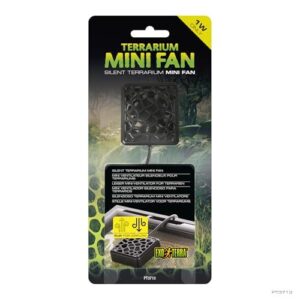
Stagnant air breeds trouble in tropical setups, and this little unit grips it without disturbing your snake’s peace. The Exo Terra Silent Mini Terrarium Fan mounts on your screen top, exchanging air quietly to cut condensation and fog buildup.
Flip its position for front intake or rear extraction, tailoring airflow to your gradient needs. Running on roughly 1 watt via USB, it won’t spike your electric bill.
It’s ideal for humid, planted tanks where stale air invites mold.
| Best For | keepers of humid, planted terrariums and paludariums who need gentle, quiet air circulation to prevent mold, condensation, and fog buildup without disturbing shy or skittish reptiles and amphibians. |
|---|---|
| Terrarium Use | Ventilation |
| Species Suitability | Reptiles/Amphibians |
| Weight | 0.08kg |
| Bioactive Compatible | Yes |
| Maintenance Level | Low |
| Setup Type | Air Circulation |
| Additional Features |
|
- Reversible airflow lets you switch between intake and exhaust to match your enclosure’s gradient needs
- Compact, low-power design fits neatly into small setups without adding noticeable heat or electric cost
- Works well with smart home systems like HomeAssistant for automated, hands-off control
- Small size means limited airflow volume, so it may not be enough for larger enclosures
- Needs an external power source or controller to run automated schedules
- Fan noise, while generally quiet, may still be noticeable in a bedroom or other quiet space
10. Aiicioo Reptile Heating Pad 8 Watt
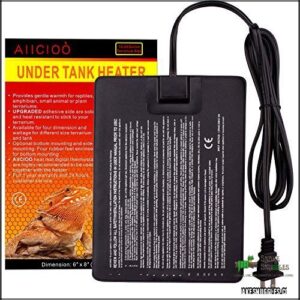
Not every heat source belongs at the top of the tank. The Aiicioo Reptile Heating Pad delivers a low, steady 8 watts, mounting to the tank’s underside or side for gentle background warmth rather than a hard basking spot.
Its nichrome wire and PVC housing resist moisture, and rubber feet keep airflow beneath the pad for even dissipation. Best suited to 10-20 gallon setups, it lacks a built-in thermostat, so pair it with one for safe, consistent temperature control.
| Best For | Keepers of small to medium tropical reptiles, amphibians, or invertebrates—like leopard geckos, hermit crabs, or small tarantulas—who need gentle, round-the-clock background warmth for a 10-20 gallon enclosure. |
|---|---|
| Terrarium Use | Heating |
| Species Suitability | Geckos/Pythons/Tarantulas |
| Weight | 6.4oz |
| Bioactive Compatible | Yes |
| Maintenance Level | Low |
| Setup Type | Heating Mat |
| Additional Features |
|
- Low 8-watt draw keeps energy costs down during continuous, 24-hour use
- Durable nichrome wire construction and moisture-resistant housing make it easy to clean and built to last
- Rubber feet promote even heat dissipation and help the pad avoid direct contact with surfaces below
- No built-in thermostat, so you’ll need a separate temperature controller for safe use
- Adhesive can weaken over time, especially in humid environments, requiring occasional repositioning
- Not suitable for plastic, acrylic, or water-filled tanks due to heat transfer risks
Frequently Asked Questions (FAQs)
How often should you replace snake heat bulbs?
Like Prometheus’s flame, heat bulbs don’t burn forever. Check every 3 months for dimming, and replace incandescent bulbs every 6-12 months. Swap burned-out bulbs immediately, since sudden cold snaps stress your snake fast.
Can you use two heat bulbs at once?
Yes, but only with careful wattage planning. Combine both bulbs’ wattage, stay within your enclosure’s safe range, and use a thermostat to prevent the basking zone from creeping past species-specific temperature limits.
How do you clean heat lamp fixtures safely?
It won’t take long: unplug the fixture, let it cool 30 minutes, then wipe with a damp cloth. Use vinegar for grime, avoid ammonia cleaners, and always test operation before reinstalling.
Whats the best way to track tank temperatures?
Pair a digital probe thermometer on the basking spot with a second one on the cool side, and log readings daily. This catches drift early and confirms your gradient stays accurate within 1-2°F.
Do heat bulbs affect enclosure humidity levels?
Heat bulbs don’t add moisture directly, but they raise temperature, which speeds up evaporation from water and substrate. With poor airflow, humidity can spike; in well-ventilated tanks, warmer air actually lowers relative humidity.
Conclusion
A basking bulb is like a compass, guiding your snake toward warmth, safety, and instinct fulfilled. Get the best bulb wattage for snake tank setups right, and you’ve built more than a heat source. You’ve built trust between species.
Your python or corn snake doesn’t need ideal, just consistency: a safe gradient, a reliable thermostat, and a bulb matched to its world. Master that balance, and every basking session becomes proof your care is working.