This site is supported by our readers. We may earn a commission, at no cost to you, if you purchase through links.

Pick up a shed snakeskin and drag your finger across it. What feels like a row of tiny shingles is continuous skin, folded and thickened into overlapping keratin plates that flex without tearing. The same protein building your fingernails creates one of nature’s most underrated protective systems.
Most people picture scales as rigid armor, but that misses what makes them special. They waterproof, absorb UV radiation, and generate friction for locomotion. In some species, they detect heat with near-surgical precision.
Understanding how snake scales work reveals a design so refined it’s spent 100 million years without needing a major update.
Table Of Contents
- Key Takeaways
- Snake Scales Work as Flexible Armor
- Different Snake Scales Serve Different Jobs
- How Scales Help Snakes Move
- Scales Adapt Snakes to Habitats
- How Shedding Renews Snake Scales
- Frequently Asked Questions (FAQs)
- Do snakes grow back if they lose a scale?
- Is there a snake with no scales?
- How do snake scales feel?
- Can you tell if a snake is poisonous by its scales?
- How do snakes sense their surrounding environment?
- Can snakes feel touch through their scales?
- Do all snakes have the same number of scales?
- How long does a snake live between sheds?
- Are baby snakes born with fully formed scales?
- Conclusion
Key Takeaways
- Snake scales aren’t rigid armor—they’re overlapping keratin plates engineered to flex, waterproof, absorb UV, and even detect heat, making them one of nature’s most multifunctional structures.
- Different scale types do completely different jobs: ventral scales grip the ground for locomotion, keeled scales add traction on rough terrain, and pit scales sense infrared heat with near-surgical precision.
- Shedding isn’t just cosmetic—it’s a full biological reset that renews UV protection, repairs damaged tissue, restores moisture barriers, and physically strips away parasites in a single clean molt.
- This system has run virtually unchanged for 100 million years, proof that when nature lands on a design that works across armor, locomotion, camouflage, and sensory detection all at once, it doesn’t tinker with it.
Snake Scales Work as Flexible Armor
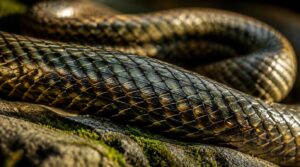
Snake scales aren’t just a pretty pattern—they’re a finely engineered defense system that keeps snakes alive in some of the harshest environments on Earth. Built from tough keratin and arranged with surprising precision, each scale plays a specific role in protecting the animal beneath. Here’s what makes that armor work so well.
Understanding how these layers work together—from keratin plates to the deeper dermal tissue—helps explain why snake scale health and shedding matters so much to a snake’s overall resilience.
Keratin Creates Durable Protection
Snake scales owe their toughness to a single protein: keratin. The same fibrous material forming your fingernails, it undergoes epidermal keratinization, hardening into filaments reinforced by disulfide bonds.
These bonds resist tearing, repel contaminants, and withstand abrasion. Trace minerals bind within the matrix, increasing surface hardness without adding weight.
That’s why snake scales function as remarkably durable natural armor.
Overlapping Scales Preserve Flexibility
Keratin gives scales their toughness, but the overlapping arrangement gives them freedom to move.
Each scale slides over the one beneath, letting the body bend without exposing tissue. That’s how snakes maintain both muscular control and flexibility. Understanding how animals interact with their environment mirrors how students benefit from data-centered reading approaches that shift focus from passive text consumption to active observation.
Why it works:
- Scale types vary by region, matching local bending needs
- Ventral scales move independently for locomotion
- Beveled margins allow micro-movements without friction
Skin Barriers Reduce Water Loss
Flexibility isn’t the whole story. The protective integument seals moisture in ways you’d rarely expect, stopping evaporation before it starts.
Cutaneous water loss prevention relies on the hydrophobic surface of the scales.
| Barrier Layer | Role |
|---|---|
| Ceramides | Fill lipid gaps between cells |
| Occlusives | Block water escape at surface |
Each shedding cycle renews these defenses. Scale texture analysis confirms it.
Pigments Provide UV Protection
Beyond sealing in water, scale color also helps with sunlight. Photoprotection in reptiles depends partly on melanin, which absorbs UV radiation and dissipates energy before it damages cells.
- Melanin aids melaninbased thermoregulation.
- Carotenoids filter high-energy blue wavelengths.
- Iron oxides scatter ultraviolet light.
- Pigments reduce free-radical stress.
Scale pigmentation and environment: darker dorsal surfaces broaden protection across UVA and UVB exposure.
Scales Defend Against Injury
When you watch a snake push through rocky terrain or squeeze past thorny vegetation, what you’re really seeing is a living defense system hard at work. Keratin scale morphology spreads physical trauma across overlapping margins, cutting down localized injury.
Reinforced plates along the head resist bites and blunt impacts, while scale repair restores the protective matrix during each shed cycle.
Different Snake Scales Serve Different Jobs
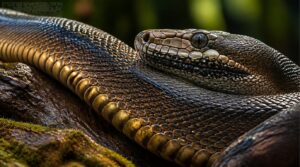
Not every scale on a snake’s body does the same thing—each type has a specific role, and together they make the snake remarkably well-equipped for survival.
Belly scales, for instance, grip the ground for locomotion, while specialized head scales offer protection — a distinction that becomes especially clear when you explore how rattlesnake scales adapt to water movement.
Think of it like a toolkit where every piece has its own purpose, from gripping rough terrain to sensing the world around them.
Here’s a closer look at the five main scale types and what each one actually does.
Dorsal Scales Cover The Back
Think of dorsal scales as a snake’s built-in back armor. These overlapping keratin plates run the body’s length, providing protection from abrasion, supporting locomotion, and carrying pigments for camouflage:
- Guard skin from scrapes and minor impacts
- Spread force across many overlapping plates
- Create air gaps that aid insulation
- Carry pigments enabling habitat camouflage
- Vary in size, largest near the midsection
Ventral Scales Grip Surfaces
The underside of a snake is always working. Ventral scales, broad transverse plates, contact the ground directly and enable ventral locomotion through directional friction, a mechanism that resists backward sliding while permitting forward glide. This friction asymmetry makes ventral scale grip effective across sand, mud, and leaf litter.
| Terrain | Ventral Scale Grip | Friction Behavior |
|---|---|---|
| Sand | Moderate | Forward-biased sliding |
| Mud | Strong | Peak friction asymmetry |
| Leaf litter | Variable | Adjusts with body lift |
| Rock | Firm | Consistent traction |
| Bark | High | Maximum grip engagement |
Keeled Scales Increase Traction
A rough file grips better than a smooth one, and keeled scales work the same way. Each central ridge adds textural friction, helping snakes hold their ground on difficult surfaces.
These ridges boost traction on:
- Rocky surfaces
- Loose sand
- Bark and branches
- Inclined terrain
Ventral scales use friction asymmetry, but keeled scales directly add texture supporting locomotion on challenging terrain.
Spectacle Scales Protect Eyes
If you look closely at a snake’s face, you won’t find eyelids. Instead, the ocular spectacle, a fixed, transparent shield built from keratin, sits fused directly over the cornea. This eye scale filters UV light, retains corneal moisture, and deflects debris during movement. During shedding, it peels cleanly away with the old skin, restoring optical clarity beneath. Since the ocular spectacle naturally filters UV light, pairing your enclosure with a quality reptile UVB lamp bulb ensures the rest of the eye stays healthy beneath that protective shield.
| Function | How It Protects |
|---|---|
| UV filtering | Absorbs ultraviolet light before it reaches corneal tissue |
| Moisture retention | Reduces tear film evaporation in dry or windy conditions |
| Abrasion resistance | Deflects debris and particles away from the eye surface |
| Impact distribution | Spreads minor forces to prevent localized corneal damage |
Pit Scales Detect Heat
Some snakes sense warmth itself. Pit scales detect heat through a thin membrane lined with infrared-sensitive neurons, giving pit vipers a thermal map even in total darkness.
Infrared thermoreception lets the snake track warm prey by temperature alone, with infrared detection in pit vipers registering changes below 0.01 degrees Celsius. Hobbyists mimicking this precision often turn to a reptile infrared thermometer to monitor their pet’s enclosure temperatures with similar non-contact accuracy.
Heat-sensing pits rank among nature’s most precise biological sensors.
How Scales Help Snakes Move
Snake scales don’t just protect — they’re the engine behind every move a snake makes. The secret lies in a surprisingly clever set of physical mechanisms, from microscopic surface ridges to whole-body locomotion strategies. Here’s how each one works.
Microscopic Ridges Create Friction
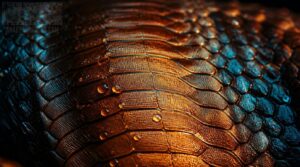
Your average snake doesn’t slip because its scale microstructure does something remarkably clever. Tiny ridges on ventral scales create anisotropic friction, meaning resistance varies by direction of movement. Backward-facing ridges grip surfaces while forward motion remains smooth. This friction-based propulsion lets snakes push off almost any terrain effectively. Scale keeling amplifies this effect, adding traction where smooth scales simply couldn’t.
Snake scales grip backward and glide forward, turning microscopic ridges into a frictionbased propulsion system across any terrain
Lateral Undulation Pushes Forward
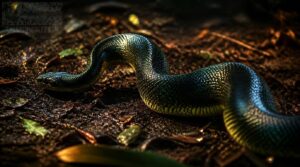
Those microscopic ridges set the stage for something bigger. Lateral undulation is how you’ll see most snakes move: a wave travels from head to tail, pushing contact points against the ground:
- Muscular coordination fires segment by segment
- Ventral scales grip at each bend
- Friction-based propulsion converts effort into forward motion
Scale overlap preserves the flexibility that keeps the wave continuous.
Rectilinear Movement Shifts Skin
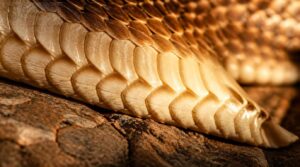
Unlike lateral undulation, rectilinear movement barely ripples the body. The ventral skin slides forward in small steps while scales grip and release the ground.
| Feature | Function |
|---|---|
| Skin sliding | Advances body without full lift |
| Ventral scales | Grip substrate during each shift |
| Scale overlap | Preserves flexibility mid-motion |
| Muscular waves | Coordinate incremental forward push |
Scale overlap keeps the skin intact through each shift.
Concertina Movement Anchors The Body
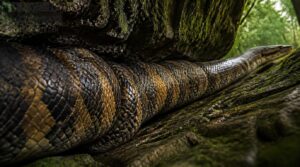
Where rectilinear motion uses subtle skin shifts, concertina movement acts like a spring. The body coils, pressing chest and abdomen down while ventral scales anchor before each extension. Body wave propagation lets you see muscular coordination working in clear, sequential stages.
Anchoring forces:
- Friction-based propulsion from scale contact
- Coordinated muscular waves along each coil
- Tail stabilization at the push-off point
Sidewinding Limits Sand Contact
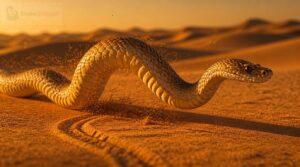
When loose sand threatens to drag a snake down, sidewinding is the answer. Ventral scales and scale keeling generate friction-based propulsion while raised loops let sand pass beneath. This terrain adaptation keeps snakes gliding, not sinking.
| Sand Type | Scale Role | Movement Benefit |
|---|---|---|
| Fine dry | Ventral spread | Reduces sinkage |
| Damp, sticky | Lift phases | Prevents sticking |
| Hot desert | Heat-tolerant scales | Protects tissue |
Scales Adapt Snakes to Habitats

Snake scales aren’t just protective gear — they’re precision tools shaped by millions of years of habitat pressure.
Whether a snake lives in shifting desert sands, dense forest canopies, or open water, its scales have evolved to meet the specific demands of that environment.
Here’s how different scale adaptations help snakes thrive exactly where they live.
Color Supports Camouflage
A snake’s scale color isn’t random.
Background matching camouflage is the main camouflage mechanism, aligning body tones with the substrate directly beneath the snake. When you look at dark scales, they match shadowed leaf litter, while light scales mirror sunlit sandy patches. Irregular blotches and bands break up the snake’s outline, making it nearly invisible against complex, mottled backgrounds.
Pigmentation Influences Heat Absorption
Color does double duty. Pigmentation directly shapes heat absorption, influencing thermoregulation across the body. A reptile basking heat lamp helps darker-scaled snakes reach optimal body temperature faster by mimicking the intense solar radiation their pigmentation is naturally built to absorb.
- Dark scales absorb more radiation, warming the snake faster
- Light scales reflect solar energy, reducing heat gain
- Melanin density varies by region, creating distinct thermal zones
- You’ll find darker patches where warming speed matters most
- Seasonal pigment shifts adjust this balance as temperatures change
Keeled Scales Improve Terrain Grip
Think of keeled scales as nature’s cleats. Each scale carries a central ridge that creates microscale friction, giving snakes terrain grip on rocks and leaf litter where smooth scales would slide. That raised contact height reduces slip during rotation.
| Function | Mechanism |
|---|---|
| Increased friction | Central ridge creates microscale ridges |
| Wet surface grip | Ridge channels air pockets, breaking surface tension |
| Reduced slip | Raised contact height stabilizes rotation |
Ventral scales manage flat ground, but keeled scales drive locomotion across rugged, unpredictable terrain.
Aquatic Scales Reduce Drag
Water-adapted snakes have evolved scales that actively manage drag rather than just tolerate it. Crescent-shaped microstructures on scale surfaces trap a thin lubricating film, reducing skin friction as the snake moves through water.
Overlapping scale rows channel flow along the body, keeping turbulence low and propulsion efficient. That’s what lets aquatic species like water snakes maintain speed with minimal energy loss.
Nanostructures Create Iridescence
If you’ve watched an iridescent snake shift colors in sunlight, you’ve seen nanoscale light interference at work. Tiny structures within scale layers scatter light into hues that change with viewing angle, not pigment.
These photonic crystal arrangements space nanostructures at precise intervals, diffracting specific wavelengths by geometry. The result: a living shimmer that startles predators or signals species identity.
How Shedding Renews Snake Scales
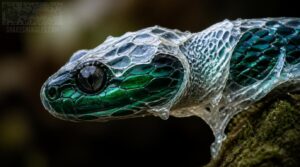
Shedding isn’t just a quirk of snake biology—it’s a full-scale renewal system that keeps their skin functional and healthy. The process unfolds in distinct, fascinating stages, each one serving a specific purpose. Here’s how it actually works, from the inside out.
New Skin Develops Underneath
Before a snake sheds, its body is already building a replacement. Deep in the basal epidermal layer, cells divide and push upward during ecdysis, forming fresh tissue beneath the aging scales. Melanocytes gradually restore pigmentation, and blood vessels deliver the nutrients needed to support scale regeneration. This quiet ecdysial skin renewal is already complete before you’d ever notice anything changing.
Fluid Separates Skin Layers
Once the new epidermis is ready, a thin layer of interstitial fluid accumulates between old and new skin. Specialized enzymes use it to loosen protein adhesions at the shedding plane, creating a controlled separation that protects the fresh keratin forming beneath during ecdysis.
This hydraulic cushion basically floats the aging layer away, making scale regeneration possible without tearing.
Old Scales Shed Together
Once that fluid does its job, the scale shedding cycle reaches its most visible and dramatic phase.
You can picture ecdysis as the old skin lifting at the neck first, peeling progressively toward the tail as a single contoured sheath. The ecdysial process coordinates every scale in one clean molting sweep, and the entire shedding completes as a coordinated unit.
Shedding Removes Parasites
That single molting sweep does more than just refresh the skin. When the old sheath peels away, it carries unwanted hitchhikers right along with it.
External parasites like mites often burrow beneath scales and along scale edges, but ecdysis physically strips them off. Frequent shedding reduces parasite load, replacing contaminated tissue with clean, uninfected skin before infestations can take hold.
Damaged Scales Can Regrow
Damage doesn’t have to stay permanent. The damaged epidermis naturally helps scale injury and repair through four orderly stages:
- Basal cells migrate quickly to cover exposed dermis
- Keratinocytes actively make keratin structural proteins
- Scale tissue matures gradually beneath damaged layers
- Shedding then reveals fully restored skin
Scale regeneration depends on temperature, hydration, and species, so juveniles tend to recover faster.
Frequently Asked Questions (FAQs)
Do snakes grow back if they lose a scale?
When a scale meets an early exit, the surrounding epidermis moves quickly to seal the exposed gap. Complete scale restoration only happens at the next molt, when fresh scales grow back in their natural pattern.
Is there a snake with no scales?
Yes, scaleless snakes exist, though they’re rare. Genetic mutations in keratin pathways disrupt normal scale morphology, leaving skin exposed. These individuals, including scaleless ball pythons and corn snakes, survive in captivity but require specialized care.
How do snake scales feel?
When you touch a snake for the first time, scale texture surprises most people. Smooth scales feel dry and smooth, almost glassy. Keeled scales catch like fine ridges, while ventral scales feel broad and firm.
Can you tell if a snake is poisonous by its scales?
Relying on scales alone to judge venom status is like reading a book by its cover. Head shape, eye pits, and behavioral cues are far more reliable than scale texture, color, or pattern.
How do snakes sense their surrounding environment?
Snakes detect surroundings through Snake Sensory Scales, forked-tongue chemistry, and Heatsensing Pits that track warm prey.
The Ocular Spectacle in Snakes shields each eye, while Scale Transparency in Vision and Sensory Pits complete the toolkit.
Can snakes feel touch through their scales?
Like tiny antennae woven across living armor, scale sensilla detect pressure, vibration, and texture, giving snakes a distributed sense of touch that actively guides movement through tight gaps and uneven terrain even in complete darkness.
Do all snakes have the same number of scales?
No, they don’t. Scale row enumeration varies widely across species, with midbody dorsal rows ranging from about 10 in slender species to over 70 in large pythons, reflecting real differences in body size and lineage.
How long does a snake live between sheds?
The gap between sheds ranges from 4 to 6 weeks in fast-growing juveniles to several months in mature adults, with species, temperature, and diet all influencing the pace.
Are baby snakes born with fully formed scales?
Yes, hatchlings emerge with fully patterned scales already in place. These juvenile scales are softer than adult ones but functionally complete, and shedding begins almost immediately as new layers develop beneath.
Conclusion
What other structure in nature quietly acts as armor, locomotion engine, UV shield, and heat sensor all at once? That’s exactly what makes how snake scales work so worth understanding. They aren’t decorative plates stuck to a body. They’re an integrated system that’s been field-tested for 100 million years. Every shed is proof the blueprint still holds. Nature rarely touches what doesn’t need fixing, and these scales have clearly needed almost nothing at all.