This site is supported by our readers. We may earn a commission, at no cost to you, if you purchase through links.

A snake can’t digest its last meal if it’s too cold. Not slowly. It can’t process food at all, and the rotting prey sitting in its gut becomes a death sentence.
Temperature regulation in snakes isn’t about comfort. Every biological process, digestion, immune response, nerve function, runs on heat borrowed from the environment. Drop it five degrees below ideal and you’ve quietly switched off systems the animal depends on to survive.
Getting this right in captivity means understanding what your snake’s body actually needs, and why a proper thermal gradient matters far more than most keepers realize.
Table Of Contents
Key Takeaways
- Snakes can’t generate their own body heat, so every biological process—digestion, immunity, immunity, nerve function—depends entirely on the temperature you provide in their enclosure.
- A proper thermal gradient with a warm basking zone and a cool retreat isn’t optional; without it, your snake can’t thermoregulate behaviorally, and its health deteriorates fast.
- Even small, consistent temperature drops compound into serious harm: impaired digestion, suppressed immunity, disrupted shedding, and eventually irreversible neurological damage.
- Controlling your enclosure’s heat requires the right source matched to your species, a PID-capable thermostat with probes at snake level, and a power-outage backup plan ready before you need it.
Why Do Snakes Need Temperature Regulation?

Because snakes can’t generate their own body heat, every biological process, from digestion to immune function, depends entirely on the temperature around them. That’s ectothermic thermoregulation: the animal uses its environment as its engine.
Even small temperature drops can have outsized consequences, as explored in this guide to understanding your snake’s temperature regulation needs.
In the wild, a snake moves through a thermal gradient, shifting between sun-warmed rock and cool shade to hit its species-specific temperature requirements. This is behavioral thermoregulation, and it’s not optional. It’s how enzymes fire, how food gets processed, how hormones cycle.
A snake’s shift between sun-warmed rock and cool shade isn’t instinct—it’s survival engineering
Your enclosure must replicate that. Give your snake a warm basking zone and a cool retreat, and you hand it the tools it needs to thrive. Avoiding temperature extremes in either direction starts with building this range correctly.
How Improper Temperatures Harm Snake Health

When that thermal engine fails, the consequences stack fast. Metabolic impairment hits first: digestion slows, appetite drops, and growth stalls. From there, the damage compounds:
- Immune suppression opens the door to bacterial and fungal infections, and respiratory infection prevention breaks down entirely, turning minor exposures into serious illness.
- Cold temperatures reduce enzymatic gut activity, raising impaction risk after large or fatty meals.
- Chronic heat fluctuations increase corticosterone, disrupting shedding cycles and leaving skin vulnerable to pathogens.
- Prolonged thermal stress drives neurological damage, impairing reflexes, prey handling, and coordinated movement.
Thermal injury prevention isn’t just about avoiding burns. It’s about holding that biological window steady. Let the temperature drift consistently, and every system in your snake’s body suffers for it.
Getting the details right—gradient zones, basking spots, nighttime dips—is exactly where a solid ball python temperature, humidity, and lighting guide earns its keep.
Designing an Effective Enclosure Temperature Gradient
Getting the gradient right starts with understanding two non-negotiable zones: a warm side where your snake can crank up its metabolism and a cool side where it can dial back down. Every design choice you make—hides, substrate depth, ventilation placement—either helps that thermal shuttle or undermines it.
Here’s what each element needs to do.
Warm and Cool Zones

A well-designed thermal gradient gives your snake real choices. Your basking spot needs to reach species-appropriate warmth, while the cool zone drops enough to support digestion pauses. That temperature gradient drives feeding readiness and immune function. Lock both ends with consistent thermostat control.
| Zone | Target Range |
|---|---|
| Warm zone | 26–32°C (80–90°F) |
| Basking spot | 30–32°C (86–90°F) |
| Cool zone | 22–26°C (72–78°F) |
Hides, Substrate, and Ventilation

Your thermal gradient only works when your snake can fully access it. Hide placement, substrate type, and ventilation all determine whether behavioral thermoregulation actually happens.
For a deeper look at how hide placement and substrate choice affect thermoregulation in practice, boa constrictor enclosure setup and care tips walks through the specifics of building a gradient that actually gets used.
- Position hides at both gradient ends
- Use moisture-buffering substrate for shedding stability
- Avoid compacted bedding; it restricts burrowing
- Size hides generously for stable microclimates
- Maintain ventilation to prevent heat and mold buildup
Choosing and Controlling Safe Heat Sources
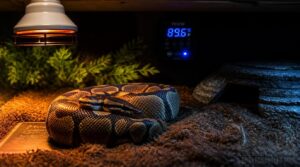
Choosing the right heat source shapes everything your gradient can do. Not all options work the same way, and picking the wrong one can undermine even a well-designed enclosure. Here’s what you need to know about the three main categories worth considering.
Wattage and bulb type work together more than most keepers realize, so reviewing heat lamp temperature guidelines for snake enclosures before you shop can save you from a costly trial-and-error spiral.
Mats, Tape, and Cables
Under-tank heat mats create consistent surface warmth, but they need a calibrated thermostat with precise probe placement to prevent burns. Self-adhesive tape heats enclosure edges well yet risks hot spots at overlapping joints.
Cable systems offer wider coverage but secure them against chewing. Keep every element dry; moisture compromises substrate thermal conductivity and turns any safe setup into a hazard.
Emitters, Panels, and Lamps
Because each heat source behaves differently, matching it to your setup shapes everything.
Ceramic heat emitters produce invisible, steady heat, reaching 32-38°C without disrupting day-night cycles.
Radiant heat panels deliver uniform warmth across a basking zone, ideal for tropical species.
Heat lamps add visible light and UV support but run hotter, so keep them 25-40 cm above your basking spot.
Thermostats and Digital Monitors
How confident are you that your enclosure’s readings actually reflect your snake’s experience? Digital thermometers with hourly logging expose drift that analog guesswork can’t catch. Keep probes at snake level, not near the element’s edge.
Automated temperature control through a PID-capable thermostat eliminates dangerous overshoot. Set your smart thermostat to alert you when temps deviate beyond 2°C.
Adapting Temperatures for Species, Seasons, and Outages

One setup doesn’t fit every species. A ball python thrives around 32°C, but a hognose is comfortable several degrees cooler, and a vine snake needs stable humidity alongside its cooler range. Know your animal’s species-specific temperature requirements before adjusting anything.
Seasons matter too. Winterizing species need cooler nights and shorter photoperiods to stay healthy long-term. Make seasonal adjustments gradually, and watch feeding behavior as your first cue to course-correct.
Then there’s the scenario nobody wants: a power outage. Wrap the enclosure in foil or blankets immediately to buy two to six hours of warmth. Keep a power failure preparedness kit ready, with hand warmers and a backup probe, so you can maintain your thermal gradient until thermostat control is restored. (https://everysimply.com/hand+warmers+emergency+heat+pack+reptile/search/snakesnuggles0s-20/) are worth stocking ahead of time, since standard hand warmers can run too hot and stress your snake.
Frequently Asked Questions (FAQs)
Can snakes overheat from too much basking?
Yes, they absolutely can get too warm. Without a proper thermal gradient, a snake lingers at the basking spot past its safe limit. Behavioral thermotaxis fails when there’s nowhere cooler to retreat from temperature extremes.
Do wild snakes thermoregulate differently than captive ones?
Wild snakes thermoregulate across heterogeneous microhabitats, fine-tuning body temperature by shifting posture, orientation, and shelter selection. Captive snakes rely entirely on your enclosure’s fixed thermal gradient instead, making proper zone design critical to their survival.
How does temperature affect a snakes shedding cycle?
Temperature drives the entire shed cycle. A properly heated basking spot accelerates enzymatic activity, shortening pre-shed by several days. Drop below the ideal range and you risk retained skin, partial sheds, and serious health complications.
At what age do juvenile snakes need different temperatures?
It’s no coincidence that your hatchling’s feeding drops just as temps fall short. From birth through the first 6-12 months, juveniles need warmer basking zones than adults to support rapid digestion and overall healthy growth.
Can stress mimic the symptoms of incorrect temperatures?
Stress absolutely can. Elevated cortisol triggers restlessness, appetite loss, and abnormal movement toward thermal gradients, mirroring classic thermal stress biomarkers. Before adjusting heat, rule out recent handling, enclosure disturbance, or crowding as the real culprit.
Conclusion
A snake living in the wrong thermal environment isn’t merely struggling. It’s quietly shutting down, system by system, until there’s nothing left to save.
Why snakes need temperature regulation comes down to this: their biology is entirely borrowed from the sun. Get the gradient right, and your animal thrives. Get it wrong, and you won’t see the damage until it’s too late. Temperature isn’t a comfort feature. It’s the silent foundation everything else depends on.