This site is supported by our readers. We may earn a commission, at no cost to you, if you purchase through links.
You pair a Pastel with a normal, and half the clutch comes out glowing yellow. Pair two Pied carriers, and you might hatch zero Pieds. Same species, same clutch size, wildly different math. That’s the heart of codominant vs recessive ball pythons, and it trips up more new breeders than any husbandry issue ever will.
Here’s the thing: codominant genes wear their hearts on their scales. One copy and you see it. Recessive genes are sleeper agents, hiding in perfectly normal-looking snakes for generations until two carriers meet. Get the difference wrong and you’ll spend years and thousands of dollars chasing odds you never understood. Get it right, and you can predict your clutch before the eggs ever hit the substrate.
Table Of Contents
- Key Takeaways
- Codominant Vs Recessive Ball Python Genetics
- How Codominant Ball Python Morphs Work
- How Recessive Ball Python Morphs Work
- Predicting Morph Breeding Outcomes
- Choosing Healthy, Ethical Morph Pairings
- Frequently Asked Questions (FAQs)
- Which ball python morphs to avoid?
- What is a holy grail ball python?
- What’s the rarest ball python morph?
- What are the best ball python morphs to breed?
- Can a codominant morph carry recessive genes too?
- How do I prove my ball python is het without breeding?
- What happens when you breed two visual recessives together?
- Are codominant morphs more profitable than recessive morphs?
- Conclusion
Key Takeaways
- Codominant morphs (like Pastel) show visually with one copy and produce a super form when two copies pair up, while recessive morphs (like Pied) hide completely in normal-looking "het" carriers until two carriers are bred together.
- The key odds to memorize: visual × normal codominant gives 50% visuals, het × het recessive gives only 25% visuals, and pairing two different recessive hets yields zero visual offspring—just hidden carriers.
- Punnett squares turn breeding into calculated bets rather than coin flips, but remember the percentages apply per egg, so a 25% chance can still produce a clutch with no visuals at all.
- Ethical breeding requires more than good math: avoid morphs with neurological defects like Spider, screen breeders for health issues, and keep detailed lineage records to prevent inbreeding and hidden recessive surprises.
Codominant Vs Recessive Ball Python Genetics

Here’s where ball python genetics gets fun: some morphs show up on cue, while others hide in the shadows. Codominant genes announce themselves with a single copy, but recessive genes play sleeper agent until two copies team up.
If you’re not sure which category a morph falls into, this ball python morph identification guide breaks down the visual tells for both.
Below, we’ll break down visual versus hidden traits and the key inheritance differences that’ll change how you plan every pairing.
Visual Versus Hidden Traits
The first thing you’ll notice: visual morphs announce themselves. Codominant traits show up in single copy, so a Pastel looks like a Pastel. Recessive traits play sleeper agent. A heterozygous carrier looks normal until bred.
| Trait type | Visual? | Example |
|---|---|---|
| Codominant | Yes, one copy | Pastel |
| Super form | Yes, two copies | Super Pastel |
| Recessive | No, hidden | Pied het |
| Visual recessive | Yes, two copies | Pied |
Hidden traits demand bookkeeping.
Key Inheritance Differences
That visual split translates directly into inheritance math. Codominant traits pass visibly: one copy shows, two copies create a super form. Recessive traits demand patience; heterozygous carriers hide the allele, and only homozygous pairings produce visuals.
| Pairing | Codominant result | Recessive result |
|---|---|---|
| Visual x normal | 50% visual | 100% het |
| Visual x het | 75% visual | 50% visual |
| Super x normal | 100% visual | 100% het |
| Het x het | n/a | 25% visual |
No allelic interaction between separate genes, either; they stack independently.
For a closer look at how stacked genes create one-of-a-kind markings, this guide to ball python morphs with unique patterns breaks down the best combos.
How Codominant Ball Python Morphs Work
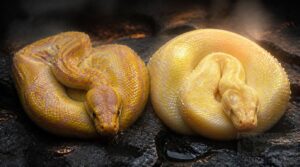
Codominant morphs are the best of both worlds: one copy gives you a visual, two copies give you something extra. Think of them as loaded dice that always show your number. Here’s how single-copy expression and super forms actually play out.
Single-copy Visual Expression
Think of a single-copy codominant gene as a spotlight with a dimmer switch: one copy turns the light on at half power. Your heterozygous ball python shows the morph immediately, no pairing required. That’s single-copy visual expression in action.
Unlike recessive genes lurking as sleeper agents, codominant genes announce themselves. Genotype versus phenotype? Here they match, making identification refreshingly simple.
Homozygous Super Forms
Push that dimmer switch to full power and you get a super form. Breed two single-copy visuals and your breeding odds deliver 25% supers, 50% visuals, 25% normals. Here’s what changes:
- Amplified pattern, think Pastel to Super Pastel.
- Genotype versus phenotype still match, so no guessing.
- Unlike homozygous recessive projects, supers breed true.
How Recessive Ball Python Morphs Work

Recessive morphs play by different rules than their codominant cousins. Here, the gene can hide completely, making het carriers the perfect sleeper agents in your collection. Let’s break down visuals, hets, and normals, then cover how to spot those hidden carriers before you breed.
Pairing two hets gives you roughly a one-in-four chance of visual offspring, and our guide to ball python common morph types walks through the math.
Visuals, Hets, and Normals
Hets are sleeper agents: they carry a recessive gene but look completely normal. Your Punnett squares reveal what eyes can’t. A genetics Punnett square chart makes those het-to-visual odds easy to see at a glance.
| Snake | Genotype | Looks Like |
|---|---|---|
| Visual | homozygous | Albino, Pied, Clown |
| Het | heterozygous | Normal |
| Possible het | unproven | Normal |
| Normal | no gene | Normal |
| Pairing clue | het x het | 25% visuals |
Remember, odds are loaded dice, not guarantees. For example, a Het Albino × Het Albino pairing produces 25% Albino, 50% Het Albino, and 25% Normal, which you can verify with a Ball Python Morph Calculator.
Identifying Hidden Carriers
Identifying hidden carriers starts with your paperwork. A three-generation pedigree exposes sleeper agents that phenotype alone can’t. Pair that with genetic testing: DNA from a shed or blood sample confirms carrier status in heterozygous animals. Tail scale quirks sometimes hint, but don’t bet on them. Combine records, molecular assays, and smart breeding strategies, and recessive traits stop surprising you.
Predicting Morph Breeding Outcomes
Breeding without math is just gambling with your females’ health. Punnett squares turn guesswork into a plan, whether you’re chasing a single recessive or stacking multiple genes. Here’s how to predict your odds before you ever pair your snakes.
Breeding without math is just gambling with your females’ health—Punnett squares turn guesswork into a plan
Punnett Square Basics
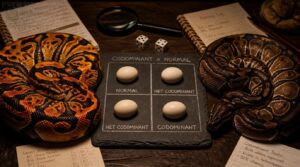
Ever wonder why your clutch defies your gut feeling? Math doesn’t lie. A Punnett square turns guesswork into genotype prediction. List each parent’s gametes, build your 2×2 grid, then count outcomes. For recessive traits, pair two heterozygous carriers and you’ll see 25% visual, 50% het, 25% normal. Codominant expression shows itself immediately, no hiding.
- Gametes first: one allele per parent, per square.
- Four squares, four equal odds: each egg rolls its own loaded dice.
- Count genotypes, then translate to phenotypes.
- Percentages are per-egg, not per-clutch guarantees.
- Stack genes by expanding your grid, one locus at a time.
Double Recessive Odds
Here’s the kicker: two hets paired together give you just 6.25% odds (1 in 16) of a double recessive baby when both loci assort independently. Your Punnett square is your loaded dice.
| Pairing | Single recessive | Double recessive |
|---|---|---|
| Het × Het | 25% | 6.25% |
| Visual × Het | 50% | 12.5% |
| Visual × Visual | 100% | 25% |
Two different recessive morphs bred together? Zero visuals, all hidden carriers. Breeding odds only pay off when both parents carry the same recessive traits.
Multi-gene Breeding Projects

Multi-gene projects are loaded dice. Stack a codominant like Pastel with recessive hets, and your odds multiply fast. Solid breeding project planning follows four steps:
- Confirm each parent’s zygosity requirements.
- Pair for morph compatibility, not just looks.
- Track gene stacking across clutches.
- Select holdbacks showing stable phenotypic variation.
Document everything. Your future self will thank you.
Choosing Healthy, Ethical Morph Pairings
You’ve got the odds down, so now let’s talk responsibility. Not every morph pairing is a good idea, and some combos carry serious genetic health risks you need to spot before you ever pair a snake. Here’s what to watch for and how to keep your bloodlines strong and diverse.
Avoiding Genetic Health Risks
Some morphs hide genetic landmines. Spider and champagne carry neurological issues, and certain combos produce lethal genes or nonviable offspring.
So run health screening before every pairing: vet checks for spinal alignment, jaw structure, and respiratory function, plus baseline blood work. Screen your breeders, not just your odds. A gorgeous clutch with wobble defects isn’t a win, it’s a liability.
A reptile blood test kit makes it easy to establish those baselines and catch hidden issues before pairing.
Tracking Lineage and Diversity
Health screening catches defects, but good records prevent them. Lineage tracking is your insurance policy. Keep it tight:
- Log every pairing, hatch date, and parent-offspring pair with unique IDs.
- Track genetic diversity using heterozygosity and effective population size estimates.
- Audit records against microchips and phenotypes yearly.
Recessive traits hide in pedigrees like sleeper agents. Know your genotype before your phenotype surprises you.
Frequently Asked Questions (FAQs)
Which ball python morphs to avoid?
Avoid Spider morphs entirely. Spider wobble syndrome causes lifelong neurological defects. Skip Super Sables? No. Skip pastel lines with eye defects, like certain Silver Streaks. Prioritize inbreeding avoidance and transparent pedigrees.
What is a holy grail ball python?
What is a holy grail ball python? It’s the unicorn of your collection: a rare, stunning multi-gene morph you can reliably reproduce. Think documented lineage, vivid color, and genetics that pay off every clutch.
What’s the rarest ball python morph?
The rarest is usually the Monsoon, an ultra-rare recessive morph with tiny lineage frequency. True morph rarity depends on genetics: double recessive traits are scarcer than codominants, since hidden heterozygous carriers look completely normal.
What are the best ball python morphs to breed?
What are the best ball python morphs to breed? Start with hardy, proven genetics: Pastel, Mojave, and Clown. These recessive traits pair beautifully with dominant traits, boosting odds, demand, and healthy, diverse lineages.
Can a codominant morph carry recessive genes too?
Absolutely, and it happens constantly. A Pastel can carry Pied invisibly. That hidden heterozygous allele is a sleeper agent, invisible in the phenotype but lurking in the genotype, ready to produce recessive traits in offspring.
How do I prove my ball python is het without breeding?
You can’t prove carrier status visually. Your options: DNA testing (a cheek swab or shed sample screens for specific recessive alleles), or paperwork from the breeder. Breeding trials remain the old-school confirmation.
What happens when you breed two visual recessives together?
Breed two visual recessives and every offspring gets two copies of the recessive allele. That means 100% visual recessive babies, no hets, no surprises. Your genotype odds are locked in, unlike a visual-to-het cross.
Are codominant morphs more profitable than recessive morphs?
Often, yes. Codominant traits pay faster: you sell visuals from the first clutch, no het roulette. Recessive traits tie up capital in heterozygous "sleeper agents" for years. But rare recessive combos can outsell common codominants.
Conclusion
Picture a Pastel bred to a Pastel: half the clutch glows Pastel, a quarter comes out Super Pastel, and the math sits right there in the Punnett square.
Now breed two Pied hets, and only one in four eggs carries the visual you’re chasing. That’s the whole game of codominant vs recessive ball pythons in two clutches. Learn your odds, track your lines, and every egg becomes a calculated bet, not a coin flip.