This site is supported by our readers. We may earn a commission, at no cost to you, if you purchase through links.

A misting bottle can only do so much. If your reptile’s enclosure humidity crashes an hour after every spray, you’re treating symptoms instead of fixing the system. Most keepers reach for foggers when the real problem is bare substrate, leaky seams, or water sitting where air never moves.
The good news: natural ways to increase enclosure humidity rely on physics and plants, not gadgets. Moisture-holding moss, smart water placement, and a warm room can hold 60% to 70% humidity steady for days. Here’s how to build that stability, starting with what you measure.
Table Of Contents
- Key Takeaways
- Measure Species-Specific Humidity Before Adjusting
- Use Substrate, Moss, and Safe Plants
- Boost Evaporation With Water and Heat
- Seal Gaps Without Sacrificing Ventilation
- Top 4 Enclosure Humidity Support Products
- Frequently Asked Questions (FAQs)
- How do I make my enclosure more humid?
- How to naturally raise humidity?
- What absorbs humidity naturally?
- How to humidify a room naturally?
- Can I use a spray bottle to raise humidity?
- How often should I mist my enclosure daily?
- Does fogging equipment work better than manual misting?
- What humidity level is dangerous for wooden furniture?
- Why does humidity drop overnight in my enclosure?
- Conclusion
Key Takeaways
- Measure first with calibrated hygrometers at your animal’s height for 7–14 days to establish a baseline, since trends matter more than single readings.
- Build humidity naturally with 3–5 cm of coconut coir substrate, sphagnum moss (which holds up to 20x its weight in water), and transpiring plants like Fittonia.
- Boost evaporation by placing shallow water trays in airflow paths and warming the air 2–3°C, since every 1°C bump increases evaporation by 6–10%.
- Seal gaps with weatherstripping and brush seals—using a smoke or soap test to find leaks—while keeping at least 0.3 air changes per minute of ventilation.
Measure Species-Specific Humidity Before Adjusting
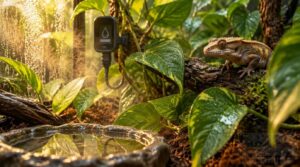
The biggest mistake keepers make is guessing. Before you add water, moss, or gadgets, spend 24 to 48 hours measuring your enclosure’s species-specific humidity with a calibrated hygrometer. Place sensors at the water dish, substrate surface, and dense foliage, positioned at your animal’s torso or head height.
Record the hygrometer reading range, noting daytime and nighttime values. Most reptiles tolerate higher night humidity and drier days, so a single snapshot won’t cut it. Aim for a 7 to 14 day baseline to catch natural swings from plant transpiration and heating cycles.
A quality hygrometer with data logging and ±2–3% accuracy, like the ones covered in this guide to snake thermometers for quarantine setups, makes tracking those swings far easier.
Compare your numbers to published preferences, then define an acceptable band, like 60 to 70% for many tropical species. Log timestamped readings, because trends matter more than one lucky relative humidity spike.
Use Substrate, Moss, and Safe Plants
With your baseline logged, build humidity from the ground up. Lay 3 to 5 cm of substrate, coconut coir works well, because it retains moisture and buffers pH. Tuck expanded clay or akadama balls underneath to keep air pockets open while slow evaporation feeds the surface.
Then add moss. Sphagnum moss holds up to 20x its weight in water, so mix a handful into the top layer for instant passive humidification. Java moss tolerates 60 to 90% humidity and thrives in low light, while flame moss dies fast if it dries out, so match the species to your setup.
Sphagnum moss holds up to 20 times its weight in water, so mix a handful into your substrate for instant passive humidification
Finish with safe houseplants like Peperomia caperata or Fittonia. Their transpiration adds steady moisture, and you’ll watch leaf turgor weekly as your living gauge.
Boost Evaporation With Water and Heat

Your plants and moss do the quiet work, but you can speed things up with smart water placement and gentle heat. Position a shallow water tray where airflow passes over it, and the evaporation rate roughly doubles within an hour or two.
Try these quick wins:
- Raise water containers to mid-enclosure height, aligned with airflow paths
- Use several small reservoirs instead of one big dish
- Add a bubbler or drip line for gentle continuous micro-currents
- Warm the air 2 to 3°C with an oil-filled radiator to raise water vapor pressure
- Keep ventilation moderate, around 0.5 to 2 air changes per hour
Every 1°C bump boosts evaporation by 6 to 10%, turning your tray into steady passive humidification. Just verify temperatures stay within your species’ tolerance before you adjust anything. These natural ways beat foggers for consistency.
If you’re unsure what humidity range your species actually needs, our guide to ideal reptile humidity levels breaks it down by species so you can dial things in safely.
Seal Gaps Without Sacrificing Ventilation
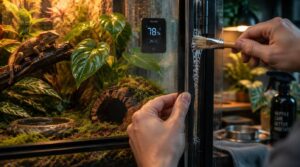
All that evaporation work means little if moist air leaks out through every seam. Start with a smoke test or a soap-and-water swipe along suspect seams; continuous bubbly trails show you exactly where air sealing is needed. Focus on door jams, hinge lines, and corners first.
Use gasketed or brush-seal strips on doors, and compress foam weatherstripping to 1–2 mm so gaps close without choking airflow. Keep your ventilation strategies intact: your enclosure should still exchange at least 0.3 air changes per minute, so add small adjustable vents near humid zones if readings climb.
"Seal the macro leaks first, then fine gaps," as reptile keepers say. Run a 12–24 hour hygrometer check afterward, aiming for a +5–15% RH gain while protecting your indoor air quality and home humidity balance.
Top 4 Enclosure Humidity Support Products
You’ve sealed the gaps and dialed in your substrate, so now let’s talk gear. The right support products make maintaining that 30–50% range far less fussy. Here are four reliable picks I’d keep on any reptile keeper’s shelf.
1. SEISSO Digital Indoor Hygrometer 4-Pack
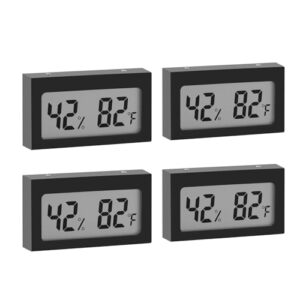
You can’t fix what you can’t measure, so start with the SEISSO Digital Indoor Hygrometer 4-Pack.
Four independent units let you cross-check readings in one enclosure, so you’ll spot a drifting sensor fast.
Each displays RH to the nearest percent with ±2% typical accuracy, and a 45-degree bracket keeps the readout stable on a table.
Calibrate before trusting them, place sensors at mid-height away from misting, and average readings when they’re within 5%.
| Best For | Anyone who needs affordable, compact humidity and temperature monitoring in multiple small spaces like humidors, greenhouses, refrigerators, or guitar cases. |
|---|---|
| Humidity Monitoring | 10%–99% RH |
| Temperature Monitoring | 14°F–122°F |
| Display | Digital Display |
| Compact Size | 2.24″ x 1.25″ |
| Timer Function | N/A |
| Placement Options | Table Placement |
| Additional Features |
|
- Comes as a 4-pack, letting you monitor several rooms or cross-check readings in one enclosure
- Updates temperature and humidity every 10 seconds with switchable Fahrenheit/Celsius units
- Compact 2.24" x 1.25" size with a 45-degree bracket for stable tabletop placement
- Some customers report units failing within a month of use
- Readings can deviate by up to 5 percentage points from reference hygrometers
- Not designed for outdoor use, limiting placement options
2. AcuRite Digital Indoor Hygrometer Thermometer
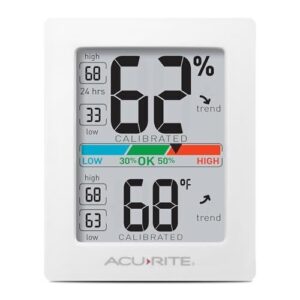
For accurate readings, mount the AcuRite Digital Indoor Hygrometer at your animal’s head level, at least six inches from vents or fans. It samples humidity every 10 seconds, tracks 24-hour and all-time highs and lows, and measures within ±2% RH accuracy from 10–90% RH.
Use the sliding comfort arrow for quick checks, but calibrate against your species’ known ranges. Remember, temperature swings can skew readings, so validate it against a second hygrometer for 24–48 hours.
| Best For | Reptile and small-animal owners who need frequent, accurate humidity and temperature monitoring in terrariums or controlled pet environments. |
|---|---|
| Humidity Monitoring | 10%–90% RH |
| Temperature Monitoring | ±0.5°F Accuracy |
| Display | Digital Display |
| Compact Size | 3″ x 2.5″ |
| Timer Function | N/A |
| Placement Options | Table, Wall, Magnet |
| Additional Features |
|
- Samples humidity every 10 seconds and tracks 24-hour and all-time highs and lows for reliable trend monitoring.
- Offers ±2% RH accuracy (10–90% RH) with self-calibration for both temperature and humidity sensors.
- Flexible placement options via tabletop stand, wall mount, or rear magnets, plus a sliding comfort arrow for quick checks.
- Display lacks a backlight and shows whole numbers only, which can limit precision.
- Temperature readings lag when moved between locations with significant temperature differences.
- Battery life is inconsistent, with some units failing within months despite low power draw.
3. PELONIS Champagne Oil-Filled Radiator Heater
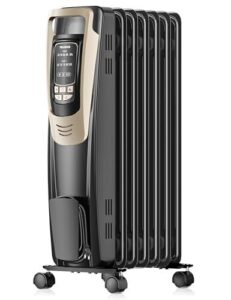
A keeper I know couldn’t hold 70% humidity in her ball python’s tank until she warmed the room itself. That’s where the PELONIS Champagne Oil-Filled Radiator Heater earns its spot.
Its fanless, oil-filled design circulates heat quietly through fins, so it won’t stress light-sensitive reptiles. Choose 600W, 900W, or 1500W modes, set the thermostat between 65°F and 85°F, and use the 10-hour timer for overnight cycles.
Keep it on a heat-resistant stand, away from water dishes, and verify surfaces stay below 95°F.
| Best For | Reptile keepers and pet owners who need quiet, steady background heat for a medium-sized room without disturbing light-sensitive animals. |
|---|---|
| Humidity Monitoring | N/A |
| Temperature Monitoring | 65°F–85°F Settings |
| Display | LED Display |
| Compact Size | 14.17″ x 25.20″ |
| Timer Function | 10-Hour Timer |
| Placement Options | Freestanding |
| Additional Features |
|
- Fanless oil-filled design circulates heat quietly through fins, making it ideal for bedrooms, offices, and rooms with reptiles.
- Three heating modes (600W, 900W, 1500W) plus ECO mode let you balance warmth and energy savings.
- Remote control, LED display, and 10-hour timer make overnight and hands-off operation convenient.
- Some customers report units breaking down within a year, raising durability concerns.
- The thermostat struggles to hold temperatures above 75°F, which may limit colder-climate use.
- Carries a California Proposition 65 warning, requiring safety disclosure for certain materials.
4. Humi-Care 4oz Cigar Humidifier
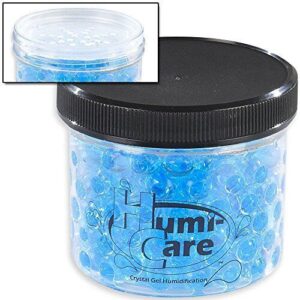
What if you could borrow a cigar keeper’s trick for your terrarium?
The Humi-Care 4oz humidifier uses passive gel beads that hold a steady 69–73% relative humidity, humidifying spaces up to 150 cigars, plenty for compact reptile or invertebrate enclosures.
Unlike open pucks, it won’t leak water onto substrate. Watch the beads swell to know when rehydration’s due. Refill with distilled water, keep it off heat sources, and note the vented plate can pop loose during setup.
| Best For | Terrarium or vivarium keepers with small reptile or invertebrate enclosures who want a leak-free, low-maintenance humidity source. |
|---|---|
| Humidity Monitoring | 69%–73% RH |
| Temperature Monitoring | N/A |
| Display | N/A |
| Compact Size | 2.5″ x 2.63″ |
| Timer Function | N/A |
| Placement Options | Humidor Placement |
| Additional Features |
|
- Maintains a steady 69–73% relative humidity passively
- Won’t leak water onto substrate like open puck humidifiers
- Visible bead swelling shows when rehydration is needed
- Vented plate can pop loose during setup
- Beads may spill out if the lid is opened incorrectly
- Printed instructions on the container are hard to read
Frequently Asked Questions (FAQs)
How do I make my enclosure more humid?
Start with a hygrometer at enclosure center for 24–72 hours. Then layer 2–4 cm substrate, add live moss, place shallow water dishes on opposite sides, and mist twice daily. Natural evaporation does the rest.
How to naturally raise humidity?
Raising humidity naturally means layering moisture-retentive substrate, live moss, and safe plants, then adding shallow water pools.
Boost evaporation with gentle daytime warmth, and seal drafty gaps without blocking ventilation.
Monitor everything with calibrated hygrometers.
What absorbs humidity naturally?
Practically everything in a bioactive setup absorbs moisture! Sphagnum moss, coconut coir, and rich soil are hygroscopic materials. Java moss and ferns pull moisture from air via transpiration, while damp wood and other plantbased furniture provide gentle natural humidification.
How to humidify a room naturally?
To increase humidity in a dry house, boil water on the stove, cluster houseplants together, and leave shower doors open. Check results with a humidity gauge, especially during winter dryness, and aim for 40–50% RH.
Can I use a spray bottle to raise humidity?
Yes, but treat your water spray bottle as a short-term fix. A fine mist raises indoor humidity 5–15 points briefly. Spray surfaces, not your animal, use 2–5 mL per square decimeter, and rely on natural evaporation for lasting results.
How often should I mist my enclosure daily?
Check your hygrometer first: most pets need 2–4 misting events daily when ambient RH sits at 40–60%. Mist with your water spray bottle whenever readings drop below your species’ lower bound on two consecutive checks.
Does fogging equipment work better than manual misting?
It depends on your setup. Fogging equipment delivers uniform 5–20 µm droplets and holds humidity for 6–12 hours, ideal for large planted enclosures. Manual misting suits small tanks needing quick, targeted adjustments.
What humidity level is dangerous for wooden furniture?
Keep relative humidity below 60% for interior furniture, and below 70% for wood in garages or outdoors. Sustained moisture above those thresholds causes wood grain to swell, warp, and eventually shrink and crack.
Why does humidity drop overnight in my enclosure?
Funny how your enclosure can hit a perfect 70% all day, then quietly lose humidity the moment you sleep. Cooler air slows evaporation, lowers vapor pressure, and ventilation leaks pull moisture out. Prioritize humidity monitoring.
Conclusion
Take a ball python tank that sits at 45% despite twice-daily misting. Switch to deep coco fiber, tuck damp sphagnum under a hide, and move the water bowl onto the warm side. Within a week, you’re holding steady at 65%.
That’s the promise of natural ways to increase enclosure humidity: you fix the system, not the symptom. Measure first, layer moisture wisely, seal smart, and your hygrometer will do the bragging for you.
- https://www.furrycritter.com/pages/articles/reptiles/substrate_humidity.htm
- https://www.reptiles.swelluk.com/reptile-supplies/reptile-decor-and-substrate/reptile-substrates/reptile-moss?product_list_dir=desc&product_list_order=customer_rating
- https://reptilinks.com/blogs/news/humidity-how-to-increasing-or-decreasing-moisture-in-your-enclosures