This site is supported by our readers. We may earn a commission, at no cost to you, if you purchase through links.

Snake hooks are safe for snakes when used correctly, and dangerous when they aren’t. A hook that’s too narrow for the snake’s girth concentrates the animal’s full body weight onto a single vertebral point, causing internal bruising before any external sign appears.
Most injuries don’t come from the tool itself. They come from moving too fast, choosing the wrong size, or hooking an already-agitated animal. Vertebral misalignment, scale abrasion, and chronic stress are all documented consequences of poor technique.
Correct hook selection and handling mechanics make the difference between a safe interaction and a veterinary emergency.
Table Of Contents
Key Takeaways
- Hook safety depends entirely on technique: the wrong size, speed, or approach turns a useful tool into a source of hidden internal injury before any visible damage appears.
- Supporting a snake’s body at multiple points—spaced at least 10–15 cm apart—cuts restraint time and stress significantly compared to single-contact holds.
- Never hook a snake that’s actively defensive, mid-shed, or showing signs of illness, as these conditions make hook contact genuinely harmful rather than just stressful.
- Matching hook width to your snake’s body girth is the single most critical equipment decision, since an undersized hook concentrates full body weight on one vertebral point.
Are Snake Hooks Safe for Snakes?

How safe snake hooks are depends almost entirely on your technique. Used correctly, they’re among the most effective tools for safe handling, letting you manage the animal at a controlled distance and minimizing direct contact stress. Snake handling safety comes down to method, not the tool itself.
Refining your grip placement and approach angle makes all the difference, as outlined in these venomous snake handling best practices.
Ventral scale compression is the real danger. A hook that pinches rather than holds can damage delicate underscales and the organs directly beneath them. Single-point contact concentrates load onto one narrow region instead of spreading it, compounding injury risk.
Snake behavior is your clearest feedback loop. A calm, fluid response to hook pressure means your contact is correct. Tight coiling or thrashing tells you to ease up, slow down, and reconsider your approach.
Your snake’s calm tells you everything—thrashing and coiling mean stop, slow down, and reconsider
When Snake Hooks Reduce Handling Stress

Hooks earn their place when your technique is already sound. Multi-point body support cuts restraint time by 20 to 40 percent in calm specimens compared to single-point holds, and that reduction matters. Less time under physical load means less cortisol buildup and a faster return to baseline behavior.
Young or skittish species benefit most during initial enclosure introductions, where unfamiliar scent and environment already spike alert responses. A hook keeps your hands entirely clear of the threat zone, letting the snake settle without targeting you.
Territorial species that show defensive strikes post-feeding respond markedly better to hook handling than direct contact. Build positive associations early: expose your snake to the hook inside the enclosure over several days before any lift.
How Snake Hooks Can Hurt Snakes

When your technique fails, the hook becomes a liability. Poor form converts a useful tool into a genuine source of injury, even on otherwise routine lifts.
Three mechanisms cause the most damage:
- Scale abrasion from hard steel dragged across the dorsum during repositioning or lifting
- Vertebral misalignment from sudden jerks when the snake resists or strikes mid-lift
- Stress accumulation from repeated sessions that suppress immune function and delay normal feeding
Incorrect hook size is the primary mechanical failure. A hook that’s too narrow for the snake’s girth concentrates force on a single vertebral region, undermining spinal support. Internal bruising can develop well before any external sign appears. Matching hook width to body girth is critical, and a snake hook sizing guide can help you select the right tool before internal damage quietly accumulates.
A defensive response mid-lift multiplies torque directly at the anchor point almost instantly.
How to Choose and Use Snake Hooks Safely
Choosing the right hook matters as much as knowing how to use it. Hook selection and handling technique work together to protect both you and the animal. These four principles cover everything from sizing to sanitation.
Match Hook to Snake Size

Think of a hook as a lever arm. Too short and the snake’s midbody mass overwhelms your control; too long and you’re waving deadweight.
For more on safe snake handling techniques and building confidence, finding that balance early makes every session calmer for both you and the snake.
Hook length selection starts with girth. Under 10 cm diameter, a 6-8 cm reach gives you precise grip without excess mechanical advantage. Larger snakes over 25 cm need 20-30 cm hooks. A well-balanced snake hook reptile tool with a non-slip grip makes hitting that ideal reach far more consistent across different species.
Incorrect hook size costs you control.
Support Multiple Body Points
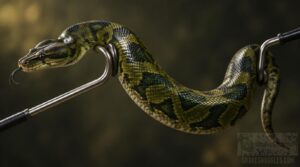
Your hook contacts the snake’s body at a single pressure point. That’s not enough.
Add a second body support position at least 10 to 15 cm away, farther on larger snakes. Target the midbody and tail regions, never the neck.
Torso support at one-third back splits the bending load cleanly between two anchor points, cutting torsion and reducing slippage risk.
Lift Slowly Without Jerking

When you lift slowly, you give the snake time to redistribute its weight without triggering reflex thrashing. Keep your hook moving under 5 cm per second. For extra confidence during those slow, deliberate lifts, thick reptile handling gloves reduce the instinct to flinch—helping you maintain that steady sub-5 cm pace even with an unpredictable animal.
- Maintain a steady body support position throughout the lift
- Prevent dangling by supporting at least three contact points
- Use a gentle lifting technique, never jerking upward
Rushing your handling technique guarantees immediate stress responses.
Sanitize Between Snakes
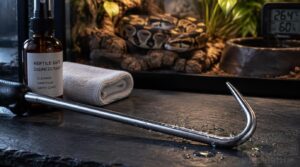
Every contact point on your hook is a transfer vehicle. Saliva, shed residue, and microbes cling to the tip, ready to ride to the next snake. A dedicated reptile-safe disinfectant spray cuts through biological residue on hook tips without leaving harmful chemical traces behind.
Sanitize between snakes every session. Wipe debris first, apply disinfectant, and hold wet contact time before reuse. This single step in reptile husbandry stops crosscontamination and protects every animal in your snake handling rotation.
When Should You Avoid Hook Handling?

Snake hooks excel at snake bite prevention during routine handling, but the same tool can stress out snakes or cause genuine injury when conditions aren’t right. Context matters as much as technique.
Drop the hook if any of these apply:
- A snake in active defensive posturing, striking or lunging at the hook
- Visible wounds, swelling, or any sign of compromised respiration
- A snake mid-shed with visibly retained skin
A snake locked in defensive coiling isn’t settling; it’s escalating. Pressing into the strike zone of an already agitated animal compounds stress without giving you control. Medically compromised snakes face added risk because hook friction worsens existing tissue damage. Recognize those warning signs early, step back, and choose a safer handling method.
Top 5 Snake Hooks for Safe Handling
Choosing the right hook depends on your snake’s size, temperament, and handling context. These five options cover a solid range of size, material, and build quality to match different species and skill levels. Each pick prioritizes snake welfare and handler control.
1. REPTI ZOO Collapsible Stainless Steel Snake Hook
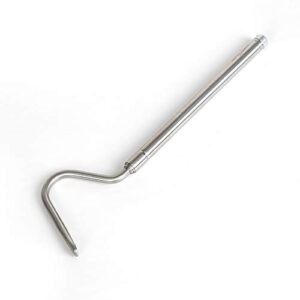
Portability matters when you’re in the field. The REPTI ZOO collapses to 7.8 inches, fitting a jacket pocket without the bulk of a rigid hook, then extends to 23.6 inches when you need reach. At 0.2 lbs, it won’t fatigue your grip.
Stainless steel construction resists corrosion and sanitizes cleanly between animals, but watch the collapsible hinge: it can pinch a snake’s body if extended carelessly. Rated for snakes up to 2.2 lbs, so keep it to small species only.
| Best For | Reptile enthusiasts, hobbyists, and field handlers who work with small, non-venomous snakes and need a lightweight, pocketable hook for safe handling or terrarium maintenance. |
|---|---|
| Material | Stainless Steel |
| Weight | 0.2 lbs |
| Max Length | 23.6 in |
| Min Length | 7.8 in |
| Snake Size | Small (up to 2.2 lbs) |
| Handle Grip | N/A |
| Additional Features |
|
- Collapses to 7.8 inches for true pocket portability, then extends to nearly two feet of reach when you need it
- Stainless steel construction holds up to outdoor use and wipes down easily between animals
- Weighs just 0.2 lbs, so it’s comfortable to carry and use for extended periods
- Collapsible hinge can pinch a snake’s body if you’re not careful when extending it
- Limited to snakes under 2.2 lbs, making it unsuitable for medium or large specimens
- Some users find the hook size too small, which may limit its usefulness depending on the species you’re handling
2. AQUANEAT 26-Inch Stainless Steel Snake Hook
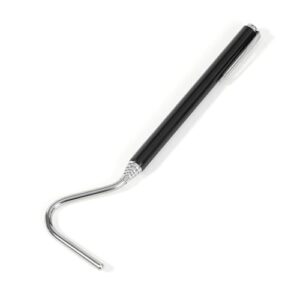
The telescoping reach here is the real asset. AQUANEAT extends from 7 to 26 inches, giving you enough distance to work confidently without crowding the animal. The round-headed hook tip minimizes snagging risk against scales during the lift.
At 1.76 ounces, it’s light enough to hold steady, but watch the hook: users report it spins under weight, which compromises control mid-handle. Stick to smaller species where torque stays manageable and that spinning stays a minor annoyance rather than a liability.
| Best For | Beginners or casual handlers who work exclusively with small snakes and want a lightweight, pocketable hook for occasional use. |
|---|---|
| Material | Stainless Steel |
| Weight | 1.76 oz |
| Max Length | 26 in |
| Min Length | 7 in |
| Snake Size | Small snakes only |
| Handle Grip | N/A |
| Additional Features |
|
- Telescopes from 7 to 26 inches, giving you comfortable working distance without crowding the animal
- Round-headed hook tip reduces snagging risk against scales during lifts
- Weighs just 1.76 ounces and collapses small enough to pocket
- The hook spins under weight, reducing control at the worst possible moment
- Only suitable for small snakes — larger species make the spinning problem genuinely dangerous
- Some users report durability issues, including breakage
3. Bytcew 61 Telescopic Snake Hook
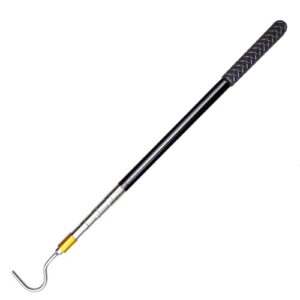
The Bytcew steps up where the AQUANEAT stops. That 16-to-61-inch telescoping range gives you reach the shorter hook simply can’t match, and the five-section locking mechanism holds each position firm without the spin problem. Each section clicks solidly, giving you real control at full extension.
The rivet-nut reinforced head won’t detach under tension, which matters when a heavier snake shifts mid-lift. At 5.6 ounces, it stays manageable. Just watch the 2-pound load cap: this hook isn’t built for large constrictors.
| Best For | Herpers and wildlife handlers who need extended reach to safely manage small-to-medium snakes in the field. |
|---|---|
| Material | Stainless Steel |
| Weight | 5.6 oz |
| Max Length | 61 in |
| Min Length | 16 in |
| Snake Size | Small (up to 2 lbs) |
| Handle Grip | Rubber grip |
| Additional Features |
|
- Telescopes from 16 to 61 inches, giving you serious reach when you need distance from a snake
- Five-section locking mechanism holds each position firm with no spinning or slipping
- Rivet-nut reinforced head stays secure under tension, so you won’t lose your grip mid-lift
- 2-pound load cap rules it out for large constrictors or heavier reptiles
- Small hook size limits compatibility with bigger snakes
- The closure mechanism can be stubborn and slow to collapse when you’re done
4. DocSeward Copperhead Stainless Steel Snake Hook
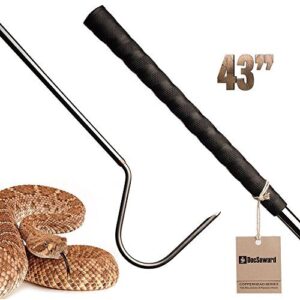
If you’re working with heavy-bodied venomous species like Crotalus horridus, the DocSeward Copperhead easily earns its $61.00 price tag.
The solid copper ferrule locks hook to shaft for balanced weight distribution, eliminating flex that undermines control mid-lift. At 43 inches and 8 ounces, it’s heavier than aluminum, but it’s built to outlast it.
The slender curved tip cradles body mass without pinching musculature. Made entirely in the USA from stainless steel and copper, it resists corrosive field conditions without degrading.
| Best For | Serious reptile handlers and herpetologists who regularly work with large, heavy-bodied venomous species and need a hook built for long-term field use. |
|---|---|
| Material | Copper & Stainless Steel |
| Weight | 8 oz |
| Max Length | 43 in |
| Min Length | N/A |
| Snake Size | Large/heavy-bodied |
| Handle Grip | Rubber grip |
| Additional Features |
|
- Solid copper ferrule provides balanced weight distribution and eliminates flex during lifts
- Stainless steel construction resists corrosion and outlasts aluminum alternatives in demanding field conditions
- Made entirely in the USA from quality materials, with a slender curved tip that cradles body mass without pinching
- At $61.00, it costs noticeably more than basic aluminum hooks
- Heavier than aluminum options, which may cause fatigue during extended handling sessions
- The field length and cage length versions are sold separately, so getting both adds to the overall cost
5. JIHAQUA Stainless Steel Snake Hook
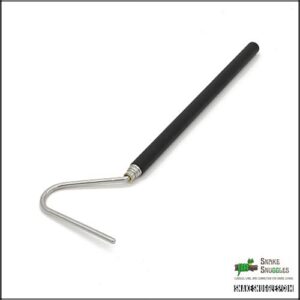
The DocSeward is built for specialists. The JIHAQUA is built for budget-minded keepers who need basic reach on a starter setup.
At $7.99, it extends to 39 inches, weighs 3.84 ounces, and includes a rubber grip handle. Use it for small, non-venomous species during routine enclosure work.
But buyer reports flag brittle handle plastic and a loose hook mount, so don’t push it under load. Sanitize with 70% isopropyl between animals. Treat it as a starter tool, not a workhorse.
| Best For | Budget-conscious beginner reptile keepers who need basic reach for handling small, non-venomous snakes in a starter setup. |
|---|---|
| Material | Stainless Steel |
| Weight | 3.84 oz |
| Max Length | 39 in |
| Min Length | 12.75 in |
| Snake Size | Small snakes |
| Handle Grip | Rubber grip |
| Additional Features |
|
- Very affordable at $7.99, making it a low-risk entry point for new keepers
- Extends to 39 inches with a rubber grip handle for comfortable, safe reach
- Lightweight at 3.84 ounces, easy to maneuver during routine enclosure maintenance
- Handle plastic is reported as flimsy and prone to breaking under pressure
- The hook mount can wiggle, reducing precision and control
- Durability is inconsistent — some users report bending or snapping on first use
Frequently Asked Questions (FAQs)
Do snake hooks hurt snakes?
Snake hooks won’t hurt your snake if you use them correctly. Bad snake handling protocols, not the tool itself, cause injury. Reptile handling safety demands smooth, supported lifts that prevent defensive strike response and strain.
What material can snakes not bite through?
Stainless steel stops fangs cold. With hardness reaching HRC 50-60, it’s impenetrable to even large viper strikes. 316 stainless steel also delivers excellent corrosion resistance, keeping your tools reliable across wet, field, and enclosure conditions.
What can I use instead of a snake hook?
Need hook-free options for safe handling? Soft cotton-tipped probes redirect a snake’s attention without direct contact. Long, blunt forceps give you controlled restraint on defensive animals. Snake carriers with containment eliminate handling entirely during transport.
What is most effective to keep snakes away?
The theory that commercial repellents actually work is largely false. Habitat modification is your most effective tool. Remove attractants, seal entry points, maintain year-round sanitation, and install physical barriers for up to 80% fewer encounters.
Can beginners safely learn to use snake hooks?
Every surgeon trains on models first. Yes, you can, but start small: practice snake hook handling on calm, non-reactive species, perfect your controlled lift, and build real muscle memory under direct supervision before moving up.
Do snake hooks work for arboreal or aquatic species?
Think of a hook as a scaffold, not a scoop. For arboreal species, engage the body mid-coil, never tail-only. For aquatic snakes, always adjust your hook angle to avoid ventral pinching on slippery, grip-reduced skin.
What happens if a snake falls off the hook?
Falls don’t always cause immediate injury, but sudden deceleration stresses the spine hard. A dropped snake will thrash, strike defensively, and risk bruising on impact. Lift slowly and support multiple body points to prevent slipping.
Conclusion
A keeper moving a nervous boa too fast once turned a routine transfer into a spinal injury, all because the hook slipped under one thin point of the animal’s body.
Snake hooks are safe for snakes only when you match the tool to the animal, support the body correctly, and keep your movements deliberate. Get those mechanics right, and the hook becomes protection, not a liability. Get them wrong, and the damage is silent until it isn’t.