This site is supported by our readers. We may earn a commission, at no cost to you, if you purchase through links.
A snake’s pattern isn’t decoration. Every stripe, blotch, and speckle has a precise biological function, shaped by millions of years of predation pressure, thermoregulation demands, and habitat-specific camouflage.
Snake scale pattern meaning goes deeper than identification. A corn snake’s saddle markings fracture its outline against leaf litter so effectively that predators perceive scattered shapes rather than a single animal. A milk snake’s vivid red-and-black banding borrows its danger signal from the coral snake, deterring attacks without venom.
Understanding these patterns turns casual observation into real diagnostic skill, whether you’re working with wild specimens or checking captive animals for signs of stress.
Table Of Contents
- Key Takeaways
- What Snake Scale Patterns Mean
- Snake Scale Types and Anatomy
- How Color Patterns Develop
- Common Snake Pattern Types
- How Scale Patterns Aid Survival
- Identifying Health and Species Through Scales
- Frequently Asked Questions (FAQs)
- What is the pattern of scales on a snake?
- How to identify snake patterns?
- What is the meaning of scale in snakes?
- What are the different scales that make up snake patterns?
- Do snake scale patterns change as they age?
- Do male and female snakes differ in patterning?
- How do geographic regions influence snake scale patterns?
- Can environmental conditions alter a snakes scale patterns?
- What cultural symbolism is associated with snake patterns?
- Conclusion
Key Takeaways
- A snake’s color pattern encodes survival strategy — stripes signal speed and motion-based concealment, blotches indicate ambush hunters, and vivid banding mimics venomous species to deter predators without actual venom.
- Scale patterns result from two layered mechanisms: pigment chemistry (melanin for dark tones, pteridines for yellows and oranges) and structural physics (nanoscale keratin layers producing iridescence), both controlled by genetics and shaped by local habitat pressures.
- You can read a snake’s health directly from its scales — dull or faded gloss signals dehydration or malnutrition, blisters or irregular shed gaps point to fungal or metabolic infection, and localized discoloration indicates injury beneath the surface.
- Geographic environment drives pattern variation more than sex or age does, with arid habitats selecting for tight banding, forested regions favoring high-contrast blotches, and isolated island populations diverging fastest due to limited gene flow.
What Snake Scale Patterns Mean

When you look at a snake’s scale patterns, you’re reading a biological record of how that animal survives. Colors and arrangements encode habitat use, predator relationships, and behavioral strategy, not random decoration.
Scale coloration often doubles as camouflage and warning signal simultaneously, as explained in this guide to identifying snake species by appearance and behavior.
A snake’s scale patterns are not decoration—they are a biological record of survival
Biological camouflage is the primary function most people recognize first. Scale morphology and surface patterning work together to fracture a snake’s outline against leaf litter, bark, or rock. But some species take the opposite approach, using aposematic signaling to advertise danger through vivid, high-contrast banding that actively deters predators.
Understanding these signals sharpens your snake identification skills considerably. Irregular, high-contrast patterns often point to ambush predators; longitudinal stripes usually suggest fast-moving species. You can read behavioral context from pattern alone, before you’ve even confirmed what you’re looking at.
Snake Scale Types and Anatomy
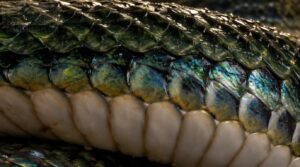
Those patterns rest on a structural foundation worth knowing. Snake scale anatomy shapes how a pattern is expressed, and understanding it sharpens your fieldwork.
Scales aren’t uniform. Dorsal scales cover the back and sides, forming the patterned surface you examine first. Ventral scales are broad scutes along the belly, built for locomotion. Keeled scales carry a central ridge that adds grip and disrupts light reflection, while smooth scales favor faster escape movement. A reptile magnifier loupe lets you distinguish keeled from smooth scales at a glance, turning subtle ridge details into clear, confident field ID.
Snake scale nomenclature gives you a consistent system for identification:
- Dorsal scales: back and side scales carrying the pattern
- Ventral scutes: broad belly plates for locomotion
- Keeled scales: ridged scales for bark traction
- Smooth scales: low-friction scales for rapid movement
- Fused heterodont scales: mixed types for arboreal climbing
How Color Patterns Develop

Snake color patterns aren’t random—they’re the product of pigment chemistry and structural physics working together, shaped by genetics passed down through generations. Understanding how these two forces interact tells you a lot about why a species looks the way it does and what that appearance does for survival.
Rat snakes offer a striking example of this interplay, where color patterns and regional genetics directly reflect the pressures of local habitat and climate.
Here are the two main mechanisms behind how color patterns develop.
Pigments and Structural Color
Hold a rainbow boa under direct light and shift your angle. The scales move from brown to electric blue in seconds. That’s physics, not just paint. A dedicated rainbow boa husbandry guide can help you recreate the high-humidity conditions that keep those iridescent scales at their most vivid.
| Color Mechanism | Source | Effect on Scale Patterns |
|---|---|---|
| Melanin | Pigment cells | Dark shading, black borders |
| Pteridines | Pigment cells | Yellow to orange hues |
| Structural color | Keratin layers | Angle-dependent iridescence |
| Pigment + structure | Combined layers | Enhanced saturation, shimmer |
Pigment deposition sets the base: melanin drives dark shading, while pteridines push yellows and oranges. Structural color from nanoscale keratin layers then adds iridescence, shaping scale patterns and the cryptic coloration that conceals species.
Allele interactions among melanin, carotenoid, and iridophore pathways make each Okeetee uniquely vivid, as explored in this deep dive into Okeetee corn snake color genetics.
Genetics and Pattern Inheritance
Those pigments don’t deposit randomly. Genetic mechanisms control exactly where color appears and when.
Three drivers you need to understand:
- Polygenic inheritance governs gradual shifts in band width and spot size.
- Epistatic interactions between pigment genes alter scale border timing.
- Temperature during development can shift lateral pattern symmetry.
Selective breeding can fix uncommon alleles within just five to eight generations.
Common Snake Pattern Types
Snake scale patterns fall into a handful of distinct categories, each with its own functional logic. Pattern type often signals behavior, habitat preference, and even threat level before you’ve identified the species. Here are the four main pattern types you’ll encounter in the field.
Stripes and Bands

Stripes run parallel to the body axis, aligning with dorsal scale rows where chromatophore density shifts at segment boundaries. This backs up cryptic coloration, blurring the snake’s outline during movement through tall grasses or dense leaf litter.
Some species deploy bright contrasting bands as warning coloration. Check stripe width and continuity across molts to confirm species identity and flag scale discoloration.
Blotches and Saddles
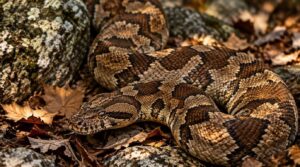
Blotches are large, contiguous pigmented blocks that run dorsally along the body. Saddles extend those blocks laterally, wrapping the sides and creating a chain-link scale pattern that disrupts the snake’s outline on leaf litter or rock. You’ll spot darker, well-defined borders around lighter centers.
This cryptic coloration helps the animal disappear against granular terrain, confusing both predators and prey alike.
Spots and Speckles

Spots signal chaos and concealment at once. In snake identification keys, you’ll find speckles mark species like the speckled kingsnake with precision. These irregular dorsal scale patterns scatter melanin to match leaf litter, disrupting your eye’s ability to track a silhouette beyond two meters.
Juveniles wear proportionally larger spots, so their cryptic coloration and camouflage abilities peak earliest in life.
Solid and Iridescent Scales
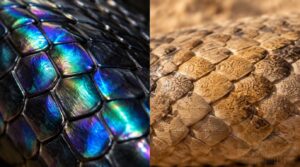
Hold a black racer in direct sunlight and watch its scales ignite into a shifting blue-green fire. That’s structural color at work: microscopic keratin lamellae refracting light rather than absorbing it. Iridescent scales shift hue with viewing angle, not pigment concentration.
Solid snake scales, by contrast, reflect a single stable tone, reducing glare in arid habitats where concealment matters most.
How Scale Patterns Aid Survival
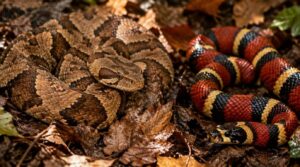
Every scale pattern a snake carries has a specific survival job. Cryptic coloration lets a copperhead vanish against leaf litter before a threat registers. Crossbands break up the body’s outline, so predators perceive fragments rather than a whole animal.
Some snakes use warning coloration to signal toxicity, real or mimicked. A milk snake’s banding imitates a coral snake’s, earning safety through deception.
Here’s what your snake’s pattern achieves:
- Disrupts body outline to defeat visual predators
- Aligns with grass stems for motion camouflage
- Mimics venomous species to deter attacks
- Redirects strikes toward less critical regions using eye-like markings
- Absorbs or reflects heat to manage body temperature
Predator avoidance and thermoregulation work together, making camouflage just one piece of a larger strategy.
Identifying Health and Species Through Scales

A snake’s scales are a field guide if you know how to read them. Dorsal scale row counts and arrangement separate colubrid families from boas at a glance, while keeled versus smooth textures narrow identification further. Supralabial scale patterns align with species-specific facial morphology, giving you a reliable diagnostic marker even in poor field conditions. A quality herpetology reptile identification handbook can help you cross-reference dorsal scale counts and labial patterns against verified species descriptions in seconds.
Health reads just as clearly. Dull, faded scale gloss points to dehydration or malnutrition, while blisters or irregular shedding gaps suggest fungal or metabolic infection. Split scale margins indicate environmental abrasion. Uniform color across body segments is your baseline; any localized discoloration signals injury or infection underneath.
Always check scale microstructure at the edges to confirm hydration status and shedding readiness before diagnosing anything further. A reptile shedding aid spray paired with a humid hide keeps those scale edges supple and supports clean, complete sheds.
Frequently Asked Questions (FAQs)
What is the pattern of scales on a snake?
Like tiles on a Roman floor, snake scales lie in two longitudinal rows along the dorsal midline, with 10 to 12 rows crossing the body, overlapping like interlocking armor to form a tight, protective pattern.
How to identify snake patterns?
Picture the scales as a map. You’re reading pattern regularity first: consistent bands suggest viperid lineage, while blotches point toward colubrids. Check keeled versus smooth scale texture to confirm habitat and narrow your identification further.
What is the meaning of scale in snakes?
Experienced field herpetologists can identify a snake’s genus from a single shed. Snake scales are keratinized epidermal structures serving locomotion, thermoregulation, camouflage, sensory input, and tissue protection, each shaped by biological adaptation to local environment.
What are the different scales that make up snake patterns?
Two main scale types build every visible pattern. Dorsal scales run along the back in species-specific row counts, while ventral scales line the belly. Their shape, either hexagonal or rhomboid, determines how pattern elements align.
Do snake scale patterns change as they age?
Yes and no. Juvenile snakes commonly shift patterns through early ecdysis cycles. By the time adult snakes reach full maturity, though, their snake scales and scale morphology largely stabilize, so you won’t see dramatic changes.
Do male and female snakes differ in patterning?
Hold a male and female rattlesnake together and you’d struggle to tell them apart by pattern alone. Sexual dimorphism in snake coloration is rare; most snake physical characteristics like pattern are species-specific, not sex-specific traits.
How do geographic regions influence snake scale patterns?
Geography is your first clue when reading a snake’s scale patterns. Arid climates select for tight dorsal banding; dense forests favor high-contrast blotches. Island populations diverge fastest, driven by founder effects and limited gene flow.
Can environmental conditions alter a snakes scale patterns?
Picture a corn snake after a nutritional-stress molt: patches of scale discoloration appear where pigment faltered. Temperature, moisture, and diet can shift color intensity and scale texture, but they won’t redraw your snake’s base pattern.
What cultural symbolism is associated with snake patterns?
Like armor plating, scale patterns have carried protective meaning across cultures, appearing in talismans and heraldry. Warning coloration and visual signaling informed ceremonial textiles, while distinctive markings linked serpents to guardianship, transformation, and sacred wisdom.
Conclusion
Scale patterns are a field manual written in biology. Every stripe, blotch, and speckle encodes survival data that took millions of years to produce. Understanding snake scale pattern meaning lets you read that data accurately, whether you’re reading wild behavior or monitoring a captive animal’s health.
What you see on a snake’s body isn’t random. It’s a precise record of pressure, adaptation, and time. Learn to read it, and every encounter becomes informative.