This site is supported by our readers. We may earn a commission, at no cost to you, if you purchase through links.

A ball python can slip through a 2mm gap, and most escapes start with a door nobody thought to check. Owners find empty tanks, then spend weeks searching behind appliances.
The right essential accessories for ball python terrarium setups prevent that panic and protect your snake’s health too. Every heat source needs a thermostat, with the basking spot holding 88-92°F and the cool side at 75-80°F. Your hides, water dish, and climbing structures shape how your snake behaves, eats, and sheds.
Below, you’ll find three 2026 picks that deliver security, humidity control, and enrichment, plus a checklist to confirm your setup before move-in day.
Table Of Contents
- Key Takeaways
- Choose a Secure Ball Python Terrarium
- Heating, Lighting, Thermostats, and Humidity Monitors
- Substrate, Hides, Water Bowls, and Enrichment
- Top 3 Ball Python Terrarium Products
- Ball Python Accessory Setup and Safety Checklist
- Frequently Asked Questions (FAQs)
- What are the best accessories for a ball python enclosure?
- What do I need for a ball python terrarium?
- What do ball pythons like in their enclosures?
- Is 72 degrees too cold for a ball python?
- How often should I clean a ball python terrarium?
- Can ball pythons live together in one enclosure?
- Do ball pythons need UVB lighting at all?
- How do I handle my ball python safely?
- What should I feed my ball python, and when?
- Conclusion
Key Takeaways
- Lock down your enclosure by keeping door gaps at 2mm or less, adding locks to sliding doors, and clipping every lid corner, because a ball python can squeeze through tiny openings.
- Run every heat source through a thermostat with the probe at snake level, and hold the basking spot at 88-92°F, the cool side at 75-80°F, and humidity at 50-60%.
- Give your snake 3 to 4 inches of coconut husk, two identical snug hides (one warm, one cool), and a soaking-size water dish on the cool side so it can burrow, feel secure, and shed well.
- Choose a roomy front-opening PVC tank of at least 4’x2’x2′, since it holds humidity better than glass, and add climbing enrichment like branches, cork bark, or rings to keep your snake active.
Choose a Secure Ball Python Terrarium
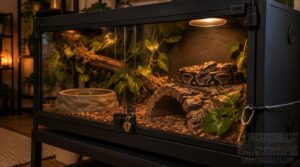
A secure enclosure starts with how it opens. Choose a front-opening tank with sliding glass doors, since they’re harder for your snake to push through and easier on you during handling. Whichever model you pick, check that its interior length is at least equal to your snake’s stretched length, since the usable internal dimensions are often smaller than the nominal size on the label.
Enclosure security comes down to small details. Keep door gaps at 2mm or less, add a wire lock or keyed lock to the sliding doors, and swap wire grommets for solid ones. On glass tanks with screen tops, a secure lid needs heavy-duty clips on every corner.
Once the lid and doors are sorted, it’s worth walking through a full snake enclosure setup guide to check that heat, humidity, and hides don’t create new escape routes.
PVC suits an escapeproof design well. It’s lightweight, holds humidity and stays opaque on three sides, which helps your snake feel safe. Cover glass walls with construction paper for the same calming effect. Calm snakes rarely test seams in an escapeproof enclosure.
Heating, Lighting, Thermostats, and Humidity Monitors
Once your enclosure is locked down, the climate inside it needs the same attention. Every heat source should run through a thermostat, which keeps surface temperatures below 104°F and ambient air under 95°F. A dependable reptile thermostat for heat mats cuts power once the surface hits your set temperature, so the mat never overheats.
- Aim for 88-92°F at the basking spot and 75-80°F on the cool side.
- Place the thermostat probe at snake level, never on the heat source.
- Add UVB lighting on a timer for a steady day cycle.
- Keep a digital hygrometer at snake level, targeting 50-60% humidity.
- Allow a 5-8°F nighttime drop.
Overhead heat sources dry the air, so plan for extra humidity management, during shed cycles when you can raise levels to 70-80%. Check readings daily, and adjust the heat source before your snake shows you trouble.
Substrate, Hides, Water Bowls, and Enrichment
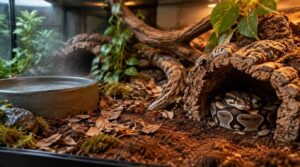
Humidity starts at the floor.
Spread 3 to 4 inches of loose coconut husk across the enclosure. The lower layers stay damp while the top dries, giving your snake a natural moisture gradient and room to burrow. Spot clean daily, and replace the whole bed every three to four months.
If you keep a species that needs steadier humidity, such as a ball python or boa, this guide to choosing the right snake substrate explains which bedding to avoid and why.
Add a snug hide on each side, warm and cool. Make them identical so your snake picks by temperature, not by style. Each should fit tightly enough that your snake touches the walls and ceiling when coiled inside.
Set a water dish on the cool side, big enough for a full soak. Evaporation lifts humidity without disturbing your heat gradient.
Finish with enrichment: sturdy branches, cork bark, and leaf litter.
Top 3 Ball Python Terrarium Products
You’ve covered the basics, so now it’s time to pick gear that fits your setup. The three products below support safety, control, and enrichment in your ball python’s home. Each one earns its spot by making your daily care routine easier and more reliable.
1. WOLEDOE Fake Monstera Reptile Terrarium Plant
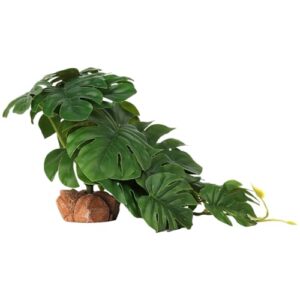
Like a patch of jungle dropped into a glass box, the WOLEDOE Fake Monstera gives your ball python instant cover. Its plastic leaves look lifelike, and the rock-shaped weighted base keeps it anchored in your terrarium.
At 8.7 inches wide and deep, and 5.5 inches tall, it’s compact, so check your layout first. Your snake can hide beneath it or climb through it. Wipe it clean with a damp cloth.
Some buyers say it runs small, and leaves can pop off, so test its stability first.
| Best For | Reptile keepers with ball pythons, crested geckos, or similar small to medium pets who want a low-maintenance, realistic-looking hiding spot in a compact terrarium. |
|---|---|
| Material | Plastic |
| Dimensions | 8.7 x 8.7 x 5.5 inches |
| Ball Python Suitable | Yes |
| Other Compatible Species | Crested geckos, bearded dragons, tortoises |
| Easy Cleaning | Damp cloth wipe |
| Reported Drawback | Smaller than expected |
| Additional Features |
|
- Lifelike leaf texture and vivid color give the terrarium a natural look without the upkeep of a live plant.
- The weighted, rock-shaped base blends into the enclosure and helps anchor the plant.
- A damp cloth is all it takes to clean, and it offers hiding and climbing spots for many reptile species.
- Some customers say it is smaller than expected, so it may not fit larger enclosures or bigger animals.
- Leaves can come off the stem easily, according to user feedback.
- Stability is mixed despite the weighted base, so it may need testing before you rely on it.
2. Snake Climbing Rings Enrichment Toy
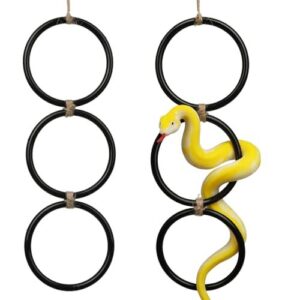
A set of interlocking rings gives your ball python something to climb besides the glass. Each rounded ABS ring measures 4.6 inches across, and the triple-ring design opens up six or more directional paths. Hooks clip to a mesh lid, and you can link the rings into a 28-inch tunnel.
At just 4.2 ounces, the set is easy to reposition. It suits ball pythons up to five feet and corn snakes. Some snakes ignore them, and rings may hinder striking.
| Best For | Owners of ball pythons up to 5 feet, corn snakes, and similar reptiles who want to add climbing enrichment to a mesh-lidded terrarium. |
|---|---|
| Material | ABS plastic |
| Dimensions | 9.25 x 5.2 x 1.46 inches |
| Ball Python Suitable | Yes, up to 5ft |
| Other Compatible Species | Corn snakes, other reptiles |
| Easy Cleaning | N/A |
| Reported Drawback | May go unused |
| Additional Features |
|
- The interlocking triple-ring design creates six or more climbing paths and can link into a 28-inch tunnel.
- Rounded ABS rings with reinforced joints are sturdy, and at 4.2 ounces the set is easy to reposition.
- Included hooks attach securely to mesh terrarium lids.
- Some snakes may not use the rings right away, or at all.
- The rings may interfere with striking behavior during feeding.
- The twine components may wear down over time in high-humidity enclosures.
3. REPTI ZOO 120 Gallon PVC Reptile Tank
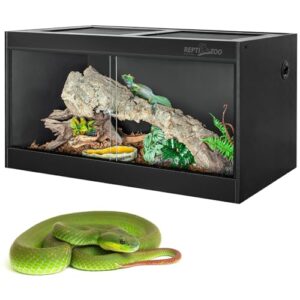
The REPTI ZOO 120 Gallon PVC Reptile Tank gives your ball python a roomy 48 x 24 x 24 inch home that holds humidity better than glass. The removable tempered glass door locks for safety, and the detachable mesh top lets you fine-tune ventilation.
Know the trade-offs before you buy. Some units arrive with fiberglass strands, so wear protective gear while assembling. Several owners report loose door locks over time, and bioactive or water-heavy setups may need the bottom sealed.
| Best For | Keepers of ball pythons and other humidity-loving reptiles who want a roomy 48 x 24 x 24 inch enclosure that holds moisture better than glass and are comfortable with a little assembly prep. |
|---|---|
| Material | PVC |
| Dimensions | 48 x 24 x 24 inches |
| Ball Python Suitable | Yes |
| Other Compatible Species | Bearded dragons, geckos, tarantulas |
| Easy Cleaning | Smooth PVC surfaces |
| Reported Drawback | Loose door locks |
| Additional Features |
|
- Holds humidity better than glass, with moisture-resistant PVC that suits high-humidity habitats
- Removable tempered glass door locks for safety, and the detachable mesh top lets you fine-tune ventilation and light
- Smooth PVC surfaces make it easy to clean and maintain
- Some units arrive with fiberglass strands, so protective gear is needed during assembly
- Several owners report the sliding door lock loosening over time
- Bioactive or water-heavy setups may need the bottom sealed to prevent leaks
Ball Python Accessory Setup and Safety Checklist
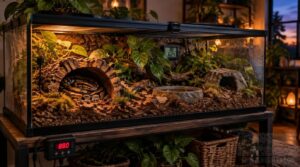
Imagine this: you set up a new 120-gallon tank on Friday, plug in the heat mat, and head out. By Saturday, the mat’s running at 110°F because nothing’s regulating it. That’s exactly what this checklist prevents.
Plug in an unregulated heat mat and walk away, and by morning your snake’s home can hit 110°F
Start with size and space. Adult ball pythons need at least 4’x2’x2′ to stretch out and thermoregulate. Next, confirm your enclosure is secure, with locking lids and no gaps a curious snake could exploit. Ventilation matters too, so balance airflow against humidity retention.
Run through these before your snake moves in:
- Every heat source connects to a thermostat, with the probe in the warm hide at snake level.
- Hiding spots: two snug hides, one warm and one cool.
- Temperature monitoring: digital hygrometer mid-tank, 50-60% humidity.
- No heat rocks, ever.
Frequently Asked Questions (FAQs)
What are the best accessories for a ball python enclosure?
Wondering what really earns a place in your ball python’s home? Start with the REPTI ZOO 120 Gallon PVC Reptile Tank, then add ReptiChip coconut substrate, WOLEDOE plants, climbing rings, and a Moistenland mister.
What do I need for a ball python terrarium?
Ready to build a setup your snake won’t outgrow? Start with a secure enclosure, ideally a front-opening PVC tank. Add a temperature gradient, coco coir substrate, digital hygrometer, two hides, and a soaking bowl.
What do ball pythons like in their enclosures?
Picture a nervous ball python wedged into a tight hide after a long day. That’s what yours wants: secure hides on both ends, a warm 88-92°F side, cooler 78-80°F, humidity near 50-60%, and cypress mulch.
Is 72 degrees too cold for a ball python?
Seventy-two degrees is borderline. It’s fine as the cool side of your temperature gradient, but not as the whole enclosure. Use a thermostat on your heat source, and check both zones with digital thermometers. Keep the hygrometer reading in range, too.
How often should I clean a ball python terrarium?
Spot clean daily, removing waste and wet substrate right away. Do a full clean about monthly. Keep reptile-safe cleaning supplies ready, and make habitat maintenance part of your enclosure maintenance routine and reptile hygiene practices.
Can ball pythons live together in one enclosure?
No, don’t house them together. Ball pythons are solitary, so sharing a secure enclosure breeds stress, hiding behavior, and feeding fights. Give each snake its own species-specific habitat, meeting terrarium size requirements and escape prevention.
Do ball pythons need UVB lighting at all?
Your ball python has survived millions of years without your UVB exposure benefits spreadsheet. So no, it doesn’t need UVB to live, since dietary D3 covers survival. Still, a low-output T5 HO tube improves your habitat setup.
How do I handle my ball python safely?
Wash your hands, then slide one hand under the middle third of your snake’s body, supporting its full weight. Never grab the head or tail.
Skip handling within 48 hours of meals or during shedding.
What should I feed my ball python, and when?
Your 600g juvenile eyes a rat pup. Offer frozen-thawed prey with feeding tongs.
Follow a feeding schedule: juveniles every 7-10 days, adults 10- Record meals in your reptile care log, and keep the temperature gradient.
Conclusion
A great enclosure is a fortress with a heartbeat inside it. Build yours around the essential accessories for ball python terrarium owners rely on: a locking lid, a thermostat on every heat source, snug hides, a heavy water bowl, and climbing structures that invite exploring.
Before move-in, test every latch, check your basking spot temperature, and confirm humidity holds. Do that, and you won’t be hunting behind appliances. You’ll be watching your snake settle in.