This site is supported by our readers. We may earn a commission, at no cost to you, if you purchase through links.

A single ball python can live longer than most family dogs—and outlast a few cats, too. Python regius, native to the grasslands and forests of Sub-Saharan Africa, routinely reaches 20 to 30 years in captivity when cared for properly.
That’s a serious commitment, and one that catches many first-time owners off guard.
Beyond their longevity, these snakes carry over 7,500 documented color variations produced through selective breeding, a genetic range that rivals almost any domesticated species.
Understanding core ball python species information—their biology, behavioral needs, and health requirements—makes the difference between a thriving animal and a struggling one.
Table Of Contents
- Key Takeaways
- Ball Python Overview
- Ball Python Biology
- Ball Python Care Tips
- Ball Python Health Issues
- Ball Python Conservation
- Frequently Asked Questions (FAQs)
- What are some facts about ball pythons?
- How many types of ball pythons are there?
- Do ball pythons blink?
- What are 5 interesting facts about ball pythons?
- How many species of ball python are there?
- What is a ball python?
- Are ball pythons venomous?
- Are ball pythons a common species?
- Are ball pythons small?
- Do ball pythons live in Africa?
- Conclusion
Key Takeaways
- Ball pythons (Python regius) can live 20–30 years in captivity, so owning one is a decades-long commitment that goes far beyond setting up a tank.
- With over 7,500 documented color morphs produced through selective breeding, no other captive reptile comes close to matching their genetic variety—though some combinations like the Spider morph carry real neurological risks.
- Getting the environment right—warm side at 88–92°F, cool side at 75–80°F, and humidity at 50–60% (rising to 70–80% during shedding)—is the single biggest factor separating a thriving snake from a sick one.
- Wild populations are listed as Near Threatened by the IUCN, driven by habitat loss and heavy collection for the pet trade, which means choosing captive-bred animals and responsible breeders genuinely matters for conservation.
Ball Python Overview
Ball pythons are one of the most rewarding reptiles you can keep, but understanding what makes them tick starts with knowing the basics.
Their calm temperament and manageable size make them a favorite among reptile enthusiasts, and if you’re just starting out, easy-to-breed snake species for beginners can help you understand exactly why ball pythons top that list.
Before you set up an enclosure or choose a morph, it helps to get familiar with their physical traits, color variations, and how long they’ll actually be part of your life.
Here’s what you need to know about their overview.
Physical Characteristics
Ball pythons (Python regius) have a body built for ambush. Their stocky frame grows up to 182 cm, with a width of 3 to 7 cm at mid‑body — thick enough to feel substantial in your hands.
The head stays small but packs heavy jaw muscles along the sides. Heat‑sensing pits line both jaws, detecting warmth from nearby prey.
Smooth dorsal scales create that signature glossy look, while round pupils — protected by a fixed spectacle scale — track movement without blinking.
The species possesses a three‑chambered heart that powers its cold‑blooded metabolism.
Color Morphs
Beyond the physical frame, Python regius offers something truly notable — a genetic palette unlike almost any other reptile in captivity. Morph genetics have produced over 7,500 documented variations, driven by decades of selective breeding strategies that continue shaping market trends today.
Here are five morphs worth knowing in ball python care and maintenance:
- Albino — zero melanin, pure yellows and whites, red eyes
- Piebald — irregular white patches covering 25–90% of the body
- Pastel — amplified yellow tones through co‑dominant inheritance
- Clown — bold puzzle‑piece patterning on lighter backgrounds
- Spider — web‑like lines with documented neurological health impacts
Understanding variation history helps you make smarter decisions in snake husbandry and reptile care. The species exhibits unparalleled genetic variation that supports the vast morph diversity.
Size and Lifespan
Size follows a clear pattern with Python regius. Females reach 3–5 feet and outweigh males, which usually top out around 2–3 feet — a textbook case of sexual dimorphism.
Growth rate peaks in year one, then slows noticeably by year three.
With proper reptile care, lifespan easily hits 20–30 years, making snake health and wellness a genuine long-term investment.
Ball Python Biology
Ball pythons are fascinating animals with biology shaped by millions of years of evolution in central and western Africa. Understanding how they live, eat, and reproduce makes you a much better keeper.
Seasonal shifts matter too—tweaking meals during cooler months, as outlined in this winter snake feeding schedule for ball pythons, mirrors how they’d naturally slow down in the wild.
Here’s what you need to know about their biology.
Classification and Habitat

Classified as Python regius within the family Pythonidae, this species holds a fascinating ecological niche across Sub-Saharan Africa.
Its geographic distribution spans roughly 20 countries, stretching from Senegal to Uganda, covering grasslands, open forests, and farmland cleared from forest edges.
These habitat types make it a highly adaptable reptile.
For shelter, it prefers mammal burrows, rocky outcrops, and underground retreats — each choice reflecting smart survival instincts shaped by millions of years of natural selection.
Behavior and Diet

Nocturnal hunting defines how your ball python experiences the world. After dark, it flicks its tongue rapidly — a behavior called tongue flicking — to carry scent particles to the Jacobson’s organ, basically "tasting" the air for prey.
Snake behavior and ecology center on patience, not pursuit.
Here’s what shapes ball python biology and reptile husbandry around diet:
- Prey selection targets rodents sized 1 to 1.25 times the snake’s midbody width.
- Feeding frequency shifts with age — hatchlings eat every 5–7 days; adults every 10–21 days.
- Defensive balling can suppress appetite, so minimize handling before meals.
- Frozen-thawed rodents reduce injury risk while supporting healthy foraging habits.
Reproduction and Conservation

Ball python mating season runs from mid-September through November, aligning with West Africa’s rainy season. Females usually produce clutches of 6 to 11 eggs, incubated at 88°F–92°F for 55 to 60 days.
Hatchling survival depends entirely on those first independent weeks — no parental care follows. Trade impact remains serious; IUCN lists this species as Near Threatened, with CITES Appendix II now regulating international collection.
Ball Python Care Tips
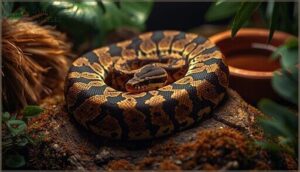
Getting ball python care right comes down to a few key areas that work together to keep your snake healthy and comfortable.
You don’t need to be an expert from day one, but knowing the basics makes a real difference. Here’s what you need to set up properly.
Enclosure and Temperature
Think of python’s enclosure as its entire world — every temperature zone matters.
Adult ball pythons thrive in a minimum 48 × 24 × 24‑inch tank setup, where Heat Gradient Zones range from a warm hide at 88–92 °F down to a cool side around 75–80 °F.
Thermostat Calibration keeps those readings consistent, preventing dangerous spikes.
Ventilation Strategies reduce stale air without dropping your temperature gradient.
Substrate Heat Retention improves when you layer appropriate bedding over heat mats covering roughly one-third of the floor.
Humidity and Lighting
Humidity is the silent variable that makes or breaks your reptile husbandry routine. For Python regius, maintaining a steady humidity level of 50–60% across the tank setup is your baseline. Humidity matters most during active shed cycles — raise it to 70–80% using targeted misting to a moist hide, creating a localized Humidity Gradient without saturating the whole enclosure.
Here’s your humidity and lighting checklist:
- Track humidity at both ends of the temperature gradient using digital hygrometers
- Follow a misting schedule of two to three times weekly on the warm side
- Run a consistent 12-hour Night Cycle with full darkness to support natural rhythms
- Consider low‑strength UVB Benefits — a UV index of 2.0–3.0 supports overall health
- Avoid colored “moonlight” bulbs, which disrupt rest patterns
Feeding and Substrate
Getting the feeding schedule right makes a real difference for your snake’s long-term health.
Juveniles under 500 grams follow Feeding Frequency Charts closely — they eat every 7 days, with prey sized to Prey Size Guidelines of 10–15% of body weight. Adults shift to every 10–14 days.
For Safe Substrate Materials, choose coconut husk or cypress mulch — both support Substrate Moisture Management without risking impaction.
Frozen‑thawed prey, warmed to 100°F and wiggled with tongs using Feeding Enrichment Techniques, encourages a reliable feeding response and prevents diet‑related health issues.
Ball Python Health Issues
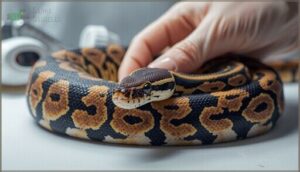
Even with the best care, ball pythons can run into health problems — and knowing what to watch for makes all the difference. Like most reptiles, they’re good at hiding signs of illness until things get serious.
Here are the most common health concerns you’ll want to stay ahead of.
Common Health Concerns
Your ball python won’t always show obvious signs when something’s wrong — that’s why staying observant is one of the most important parts of reptile care. Common health issues often start small, so catching them early makes all the difference in animal health and wellness. Watch closely for these key concerns:
- Scale Rot — darkened, swollen belly scales from damp substrate
- Shedding Issues — retained eye caps or tail skin from low humidity
- External Parasites — tiny mites causing lethargy and excessive soaking
- Nutritional Deficiencies — linked to improper feeding intervals or prey size
Stress Indicators, like reduced appetite or unusual hiding patterns are your earliest warning system for developing health problems in snake care.
Respiratory Infections
Respiratory infections are among the most serious health problems you’ll face in snake care, and they don’t always announce themselves loudly. A soft wheeze, some bubbling mucus near the mouth, or your python breathing with its head tilted upward — these are early signals worth acting on fast.
Poor Temperature Management is often the starting point. When nighttime temps drop below 26 °C, your snake’s immune system weakens noticeably. Humidity Control matters equally — levels below 60 % dry out the airways, making infection easy to establish.
If you spot symptoms, raise your warm side to 31–33 °C and your humidity level to around 70–80 %. Strict Quarantine Protocols protect your other animals. A vet may prescribe Antibiotic Therapy or Nebulization Treatment, depending on severity — don’t delay that call.
Mouth Rot and Obesity
Beyond respiratory infections, two more health problems deserve your attention: mouth rot and obesity.
Stomatitis often starts when poor enclosure hygiene lets bacteria reach small cuts in the gums.
Temperature stress and low humidity levels weaken immunity, speeding up infection.
Obesity creeps in through a too-frequent feeding schedule and oversized prey size.
Track weight monitoring regularly and match feeding frequency and prey size to your python’s body condition.
Ball Python Conservation

Ball pythons are listed as Near Threatened on the IUCN Red List, and their numbers in the wild are dropping due to habitat loss and heavy collection for the pet trade.
Understanding what’s putting pressure on wild populations helps you make smarter choices as a keeper.
Here’s what you need to know about the key conservation concerns surrounding this species.
Threats and Population Decline
Wild ball pythons (Python regius) face mounting pressure from multiple directions. Illegal trade removes thousands of animals annually from West African populations, often exceeding CITES‑approved quotas. Habitat loss from expanding agriculture eliminates the burrows and termite mounds they depend on. Here’s what’s driving their declining conservation status:
Illegal trade and vanishing habitats are quietly erasing wild ball pythons from West Africa
- Overharvest of neonates and gravid females collapses future breeding potential
- Climate change disrupts nesting success and seasonal activity patterns
- Pesticide exposure poisons prey and contaminates snakes directly
- Pet trade demand sustains financial incentives for continued wild capture
- Localized extirpations signal collapse in formerly healthy habitats
Wildlife conservation and reptile conservation efforts can’t wait.
Habitat Protection and Regulation
Stopping the decline of Python regius takes more than good intentions — it takes coordinated action. CITES Quotas cap annual exports from Ghana, Togo, and Benin, while Trade Monitoring flags shipments that exceed declared limits.
Protected Area Management shields key grassland and forest‑edge habitats, and Habitat Corridor Planning keeps fragmented populations connected. Community Forests, Habitat Preservation, and growing Environmental Awareness together support long‑term Reptile Conservation and Species Preservation across West Africa.
Responsible Breeding Practices
Captive breeding aids reptile conservation and management, but only when breeders hold themselves to a real standard.
Ethical pairing means waiting until females reach 1,200–1,500 grams before any introductions.
Genetic health requires avoiding morph combinations linked to neurological problems.
Breeding scale should match actual demand, not increase clutches.
Husbandry timing keeps feeding cycles stable through the season.
Hatchling placement comes last — screen buyers carefully, provide care sheets, and don’t rush sales.
That’s exotic pet ownership and responsibility done right.
Frequently Asked Questions (FAQs)
What are some facts about ball pythons?
Think of the ball python as nature’s quiet architect — nocturnal activity, heat‑sensing pits, and lifespan variability up to 30 years make Python regius a remarkably adaptive species worth understanding deeply.
How many types of ball pythons are there?
There’s technically one species — Python regius. But reptile keepers recognize over 300 base morphs, with genetic combination potential reaching millions. Hobby vs science definitions differ considerably in herpetology.
Do ball pythons blink?
No, ball pythons don’t blink. They have a fixed spectacle eye scale instead of eyelids, so their eyes stay open always — even during sleep.
What are 5 interesting facts about ball pythons?
These shy constrictors curl into tight defensive balls when threatened — that’s literally how they got their name. Here are five facts worth knowing.
- Longevity records are impressive: with proper care, ball pythons commonly live 20 to 30 years in captivity, far outlasting most pets.
- Heat-sensing pits line their upper lip, detecting infrared radiation from warm‑blooded prey even in total darkness — nocturnal hunting at its most refined.
- Morph breeding has produced over 4,000 named color and pattern variations from roughly 18 base genetic traits, making them endlessly collectible.
- Trade statistics are staggering — more than three million individuals have been exported from West Africa alone over recent decades, raising real conservation concerns.
- Their ecological importance is often underestimated: by controlling rodent populations, they protect crops and reduce disease spread, saving local communities tens of millions annually.
How many species of ball python are there?
There’s only one recognized species: Python regius. Taxonomic consensus confirms no valid subspecies exist.
The thousands of captive morphs, like albino or piebald, represent genetic variations within that single species, not separate ones.
What is a ball python?
Meet Python regius — royal python.
nonvenomous constrictor‘s calm temperament and manageable size have made it a favorite pet snake among reptile keepers worldwide, native to West and Central Africa‘s grasslands.
Are ball pythons venomous?
No, ball pythons aren’t venomous. Python regius lacks venom glands entirely, relying on constriction to subdue prey.
A bite may scratch skin, but carries no toxin — just clean the wound and monitor for infection.
Are ball pythons a common species?
Rare in the wild yet thriving in living rooms worldwide, ball pythons rank among the most common pet snakes kept today, with roughly 2 million owned in the U.S. alone.
Are ball pythons small?
Ball pythons are considered medium-sized snakes, usually reaching 3 to 5 feet. Males stay closer to 2 to 3 feet, while females grow larger. Compared to other pythons, they’re quite manageable for most keepers.
Do ball pythons live in Africa?
Yes, ball pythons are native to SubSaharan Africa.
Their African range spans West Africa and Central Africa, covering savanna habitats from Senegal to Uganda, where seasonal activity peaks during wet months when prey is most abundant.
Conclusion
Ball pythons demand decades of commitment, yet reward that patience with a calm, quiet presence unlike almost any other pet.
Mastering ball python species information isn’t about memorizing facts—it’s about reading your animal’s subtle signals before problems escalate.
The snake that refuses a meal one week may thrive for 25 more years with the right adjustments.
Treat this relationship like the long game it is, and you’ll rarely find a more low-maintenance, genuinely fascinating companion.