This site is supported by our readers. We may earn a commission, at no cost to you, if you purchase through links.
A hatchling that looks orange one year can turn near-black by its third birthday. That’s not a health problem, it’s ontogenetic color change, and it’s just one quirk that trips up new keepers of this Indonesian species. Confined to roughly 60 square miles on Savu Island, these pythons adapted to grassland, rocky outcrops, and even flooded rice paddies, which explains why they tolerate captivity better than pickier relatives.
This savu python care sheet breaks down what actually matters: enclosure sizing by age, basking temps, feeding schedules, and the warning signs that separate a stressed snake from a sick one.
Table Of Contents
- Key Takeaways
- Savu Python Overview, Size, and Temperament
- Savu Python Enclosure Setup and Furnishings
- Savu Python Temperature, Humidity, and Lighting
- Savu Python Feeding and Nutrition Guidelines
- Savu Python Health, Cleaning, and Handling
- Frequently Asked Questions (FAQs)
- How to care for a reticulated python?
- What is the temperament of a Savu Python?
- What is the average lifespan of a Savu python?
- How can I tell the gender of my Savu python?
- How big will the eggs be if I breed my Savu pythons?
- What signs of illness should I watch out for with my Savu python?
- How often do Savu pythons shed their skin?
- Can Savu pythons be housed with other snakes?
- What breeding age and season for Savu pythons?
- Do Savu pythons require veterinary checkups regularly?
- Conclusion
Key Takeaways
- Your hatchling’s shift from orange to near-black isn’t a health scare, it’s normal ontogenetic color change that finishes by adulthood.
- Match your enclosure to your snake’s life stage, from a 5-10 gallon hatchling tub up to a 2.0 square meter adult space with secure, non-friction-fit locks.
- Keep a real thermal gradient going: 85-95°F basking spot, 75-80°F cool end, and 60-70% humidity during sheds, checked with calibrated probes and thermometers.
- Feed by size and age, not guesswork, and watch weight, shed cycles, and breathing for early signs something’s off before it becomes an emergency.
Savu Python Overview, Size, and Temperament
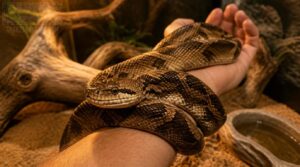
Before you set up a tank or pick a feeding schedule, you need to know what you’re actually working with. Savu pythons carry a distinct island history, a manageable adult size, and a calm temperament that makes them a favorite among keepers who want a hands-on snake.
Their gentle disposition echoes what many keepers love about ball pythons, so it’s worth browsing this ball python temperament guide before bringing either species home.
Here’s what defines this species from hatchling to adult.
Origin and Natural Habitat
Picture a 60-square-mile speck in Indonesia’s Lesser Sunda chain—that’s the entire world for this Savu Island endemic. Grassland savanna habitat, rocky outcrop microhabitats, and rice fields shape its range:
- Sun-baked savanna grass
- Weathered rocky crevices
- Flooded rice paddies
- Scrubby forest edges
- Human-modified landscapes
Rice field adaptation and human-modified landscape tolerance let it thrive despite habitat loss.
Adult Size and Lifespan
That isolation shapes a modest-sized ectotherm. Most Savu pythons reach 3 to 4 feet, with some females stretching toward 5 feet. Rapid growth marks the first 12 to 18 months, then plateaus by age 3.
Sexual maturity hits around 18-24 months. With stable thermoregulation and vet care, expect a lifespan near 20 years.
Juvenile Color Changes
Hatchlings hatch bright orange or reddish-brown, then undergo ontogenetic color shift toward near-black with cream freckling. This melanin deposition ramps up within months, tracking growth rate and nutrition:
- Boosts camouflage adaptation in leaf litter
- Signals healthy development
- Varies by sex-based color variation
- Stabilizes permanently by adulthood
Watch for emerging scale iridescence alongside these juvenile color changes—it’s a good health indicator. The ontogenetic colour change enhances camouflage effectiveness in different habitats as the snake matures. Ontogenetic colour change is a key adaptive trait in pythons for predator avoidance.
Identifying Physical Features
Beyond color, check the head shape: broad, rounded, with a neck collar. Eyes sit midway on the skull, showing large white irises and vertical pupils.
| Feature | Juvenile | Adult |
|---|---|---|
| Body color | Orange/reddish-brown | Near-black, cream freckling |
| Scales | Matte | Iridescent sheen |
| Belly | Pale | White, checkerboard |
Dorsal scales stay smooth and tightly overlapping throughout.
Temperament and Activity Patterns
Watch your Savu python at dusk, and you’ll catch its daily activity peaks—purposeful boundary patrols, slow head-turns near basking sites. Temperament runs calm but alert: new objects get investigated within 5-15 minutes, then baseline resumes.
These dusk-and-dawn rituals mirror the gentle, predictable nature covered in this guide to why children’s pythons make such docile pet snakes, a close relative sharing the Savu python’s easygoing temperament.
Handling temperament stays relaxed if sessions stay short and predictable. Sudden noise triggers brief pauses, not panic—stress response behavior fades quickly once the enclosure feels secure again.
Savu Python Enclosure Setup and Furnishings
Your Savu python’s enclosure does more than hold a snake, it shapes how well the animal thermoregulates, digests, and feels secure. Getting the setup right means matching tank size to age and choosing furnishings that support natural behavior. Here’s what you need to know, from sizing to substrate to hides.
Enclosure Sizes by Age

Size it for the snake it’ll become, not the one it is today. Hatchling housing fits 5-10 gallon tubs; juvenile growth space needs 20 gallons after doubling in length. Subadult enclosure length runs 90-120 cm.
Adult floor area hits 2.0 square meters, with vertical height requirements of 120-180 cm for climbing and thermoregulation across your temperature gradient.
Secure Enclosure Design
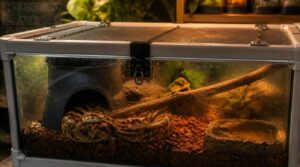
Escape artists, that’s what Savu pythons are. Locking mechanisms matter—use tank clips or latching lids, not friction-fit tops.
Choose material strength built to last: PVC or glass resists warping under humidity. Screen tops need secure clips since these snakes push relentlessly.
Ventilation preserves your thermal gradient without creating drafts. Skip gaps near hides; escaped pythons chill fast outside their 75-90°F range.
Safe Substrate Options
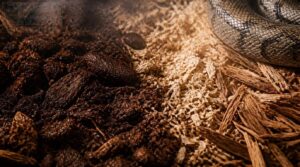
What’s under their belly matters as much as what’s overhead. Pick coconut fiber and coir chunk mix or plain reptichip for solid moisture retention without dust.
Aspen bedding suits drier setups but molds fast if damp.
- Coconut fiber (humidity + cushioning)
- Paper towels (cheap, low-risk)
- Cypress mulch (pesticide-free, dry-kept)
Spot-clean weekly; full swaps every 2-6 weeks.
Hides and Water Bowls
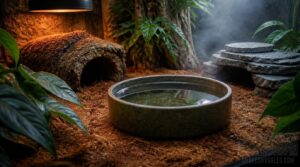
A snake without a hide is a snake in a state of constant stress. Place two—warm and cool side—in quiet corners with snug, restricted entrances.
A snake without a hide lives in constant stress, so give it two snug, secure retreats on both the warm and cool ends
Water bowls need weight: heavy ceramic resists tipping. Set them on stable substrate, away from heat, refilled daily.
| Feature | Requirement |
|---|---|
| Hide entrance | Snug, secure fit |
| Bowl size | Full-body submersion |
Climbing Features and Enrichment
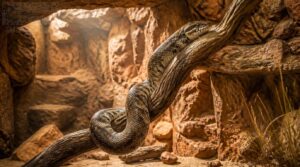
Boredom is a welfare issue, not just a behavioral quirk. Add vertical hold challenges and overhang resistance sections to mimic rocky outcrops from their native range.
- Side path traversal routes
- Curved balance-testing branches
- Weekly hold rotation for novelty
- Naturalistic terrain replicating savanna terrain
This behavioral enrichment helps natural climbing drives, keeping your python engaged, active, and thriving.
Savu Python Temperature, Humidity, and Lighting
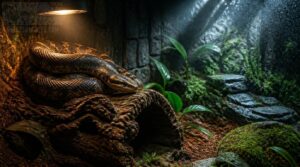
Your Savu python is an ectotherm, so it depends entirely on you to regulate its body temperature. Getting the thermal gradient and humidity right isn’t optional, it’s what keeps digestion, shedding, and overall health on track. Here’s what you need to dial in that environment correctly.
Warm and Cool Zones
Because Savu pythons are ectotherms, your enclosure setup needs a real thermal gradient—hot spot 85-95°F, cool end 75-80°F. Warm zone heating comes from ceramic emitters; cool zones need airflow, not chillers.
| Zone | Temp Range | Purpose |
|---|---|---|
| Warm | 85-95°F | Digestion |
| Cool | 75-80°F | Recovery |
| In-between | Gradual | Prevents shock |
Monitoring equipment (dual probes) keeps temperature regulation honest, day after day.
Basking Surface Temperature
That warm end isn’t just ambient air—it’s a focal point. Basking surface temperature should hit 90-95°F, checked with an infrared thermometer aimed right at the spot, not the surrounding air.
- Ceramic tiles or slate hold heat evenly
- Position ceramic emitters a few inches above the surface
- Watch for quick retreats—that signals overheating
Thermostats and Monitoring Equipment
Eyeballing that basking spot only gets you so far. A thermostat with remote probe control—like a Spyder Robotics Herpstat—cuts power automatically once setpoint’s reached.
Place probes directly on basking surfaces, away from drafts. Pair with a digital thermometer, infrared heat gun, and hygrometer for cross-checks. Set alarm thresholds for swings, and calibrate sensors monthly against a known reference.
Humidity and Shedding Support
Calibrated probes tell you the temperature’s right, but humidity needs its own monitoring routine. Keep levels at 60-70% during the shedding cycle using a hygrometer near the basking spot.
Add a humid hide with damp sphagnum moss for localized moisture. Mist twice daily, and watch for dull skin or loosened eye caps signaling shedding readiness—your snake’s asking for support.
Day and Night Cycle
Rarely do keepers realize light timing shapes behavior as much as temperature does. Set basking lights on a 12-hour photoperiod, syncing thermal gradients with natural cycles.
- Basking Light Schedule: 12 hours on, 12 off
- Humidity Night Drop: mild dip is normal
- Feeding Activity Peaks: dusk and early night
- Shelter Use Cycle: hides used most at night
Expect nocturnal behavior—your python’s rhythm mirrors wild ancestors.
Savu Python Feeding and Nutrition Guidelines
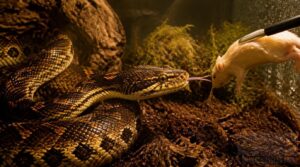
Feeding a Savu python isn’t complicated, but getting it wrong can cost your snake’s health. As an ectotherm, your python’s metabolism and appetite shift with age, size, and season. Here’s what you need to know to feed with confidence, from prey size to plate.
Prey Size by Age
Match prey to your snake’s girth, not its age in months. Hatchlings take hopper mice, juveniles graduate to small adults, subadults handle small rats, and adults manage medium-large rats. This mirrors natural predator size matching—your python’s gape limits safe prey, so oversized rodents risk injury regardless of confidence.
Beyond feeding size, understanding your ball python’s overall growth patterns and care needs—as outlined in this complete ball python care guide—helps you fine-tune prey size as your snake matures.
| Life Stage | Appropriate Prey |
|---|---|
| Hatchling | Hopper mice |
| Juvenile | Small adult mice |
| Adult | Medium-large rats |
Age-Based Feeding Schedule
Hatchlings feed every 5 to 7 days through 6 months, fueling rapid growth in tight hatchling housing. Juveniles shift to every 7 to 10 days from 6-12 months as growth rates slow.
Adults over 24 months eat every 14 to 21 days, stretching to 21-28 days during cooler months (November-February). Warm-season feeding tightens to every 12-14 days—adjust seasonally, and track changes in a feeding log.
Frozen-Thawed Prey Preparation
Thaw frozen prey the safe way: overnight in the fridge, never microwaved or boiled. Warm it in water to 28-34°C before offering, checking with a thermometer.
- Discard spoiled prey (off smell, sliminess)
- Never refreeze thawed items
- Use dedicated, sanitized containers
Live prey vs frozen-thawed isn’t close—thawed wins for safety every time.
Safe Feeding Practices
Feeding time isn’t a free-for-all—it’s a controlled routine. Use a separate feeding tub away from hides and water bowls, offer prey with tongs, and never handle the head. Wait 15 minutes before rescheduling.
| Age | Frequency | Prey Size |
|---|---|---|
| Juvenile | 7-10 days | ≤10% body weight |
| Adult | 10-14 days | ≤20% body weight |
Watch for 24 hours post-feeding for regurgitation.
Monitoring Weight and Body Condition
Numbers don’t lie, and your python’s body will tell you the truth long before symptoms show.
- Weigh on a calibrated digital scale (1g resolution) weekly for juveniles, monthly for adults
- Score body condition 1-9; aim for 4-5 with palpable ribs, faint spine
- Track length gain—5-8cm monthly for juveniles
- Log weight, humidity, temperature together
- Flag >5% monthly gain as overfeeding
Savu Python Health, Cleaning, and Handling
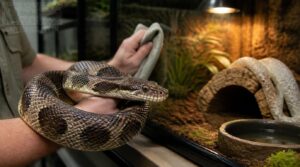
A clean enclosure keeps your Savu python healthy, but husbandry alone won’t catch every problem. As an ectotherm, your snake hides illness well, so you need to know what to watch for. Here’s what daily care, shedding, vet visits, and handling should look like.
Respiratory trouble is among the most common hidden problems, so it helps to know the early signs of pneumonia in snakes, like wheezing, mucus, and open-mouth breathing.
Spot Cleaning and Sanitation
Your enclosure’s cleanliness dictates your snake’s health, so spot clean daily rather than waiting for a full teardown. Scoop waste, replace soiled substrate locally, and wipe glass with F10 solution.
Tool sanitization matters too—disinfect scoops between uses. Handle water dish care daily to curb biofilm, and disinfect monthly for deeper substrate management and enclosure ventilation, keeping bacteria from gaining a foothold.
Healthy Shedding and Hydration
A clean enclosure sets the stage, but hydration keeps the shed cycle running smoothly. Juveniles shed every 4 to 6 weeks; adults every 8 to 12. Watch for milky eyes and dulled skin—early cues.
Keep humidity at 45-60%, with a humid hide of damp sphagnum moss near the warm side.
- Position water bowls on the cool side
- Refresh moss every 3-4 days
- Check for bright eyes, glossy skin
Common Illness Warning Signs
Bright eyes and glossy scales mean shedding’s on track—but other cues signal trouble. Watch for open-mouth breathing, wheezing, or clicking, along with dulled, grayish skin.
Appetite loss across multiple feedings, sluggish movement, or a thinning tail base all warrant attention. Weight loss despite proper husbandry isn’t normal.
Catching these signs early keeps small problems from becoming emergencies.
Preventative Veterinary Care
Waiting for symptoms wastes time. Schedule a reptile-experienced vet exam every six months, plus quarterly fecal checks for parasites.
Adults three years and older need annual bloodwork; vaccination boosters run every two years after the initial series.
New snakes require quarantine before joining your collection—thirty to ninety days, isolated, to catch respiratory infections or parasites before they spread.
During isolation, monitor for snake mite skin damage and infestation signs while maintaining proper humidity and sanitation.
Stress-Free Handling Techniques
Approach slowly, letting your Savu python see you coming before contact.
Gentle handling builds trust—short sessions, calm voice, minimal restraint.
- Support the body fully, never pin it.
- Stop at first sign of stress.
- End sessions positively.
This desensitization approach turns handling safety into routine, not a battle.
Frequently Asked Questions (FAQs)
How to care for a reticulated python?
Don’t let their size fool you into skipping prep. Reticulated pythons need massive escape-proof enclosures, strict thermal regulation, humidity control, and frozen-thawed feeding schedules. This husbandry commitment far exceeds a Savu python’s needs, so consider that gap before choosing this giant species.
What is the temperament of a Savu Python?
Savu pythons show low to moderate defensiveness and settle quickly once lifted. Temperament varies by individual, but consistent handling, secure hides, and stable heat build calm, cooperative behavior—juveniles stay skittish longer than settled, predictable adults.
What is the average lifespan of a Savu python?
With solid husbandry, captive lifespan commonly reaches 20 to 25 years, some individuals topping Wild pythons rarely exceed 15 to 20 years, since predation and habitat pressures cut longevity well below protected, well-fed enclosure life.
How can I tell the gender of my Savu python?
Like reading tea leaves, tail-thickness guessing rarely nails python sex determination. Trust cloacal probing or surgical popping by a licensed vet, or run genetic sex testing—especially valuable for captive breeding programs and hatchlings.
How big will the eggs be if I breed my Savu pythons?
Picture a grape with a slightly leathery shell. Expect 28 to 35 grams per egg, 2 to 5 inches long. Well-conditioned mothers produce bigger eggs, and smaller clutches yield larger, hardier offspring at hatching.
What signs of illness should I watch out for with my Savu python?
Watch for wheezing or open-mouth breathing, retained shed, watery stool, or a swollen abdomen—these signal respiratory, skin, or digestive trouble. Lethargy and unexplained weight loss matter too. Schedule annual vet checkups with parasite screening to catch problems early.
How often do Savu pythons shed their skin?
Some hatchlings shed every two weeks flat during early growth spurts.
Shedding frequency tracks age: juveniles cycle every 4-6 weeks, adults every 2-4 months.
Watch humidity levels—60-70% keeps sheds complete, preventing retained skin and irregular cycles.
Can Savu pythons be housed with other snakes?
Keep them solo. Cohabitation risks run high—Savu pythons may see tankmates as prey, and shared quarters raise stress, disease spread, and feeding-time aggression. Stick with enclosure separation and strict quarantine protocol; your snake’s health depends on it.
What breeding age and season for Savu pythons?
Females hit breeding readiness around 3-5 years, near 800-1200 grams; males mature faster, at 2-4 years. Cool nights to 72-74°F, then warm back up—courtship and ovulation follow, peaking May through June.
Do Savu pythons require veterinary checkups regularly?
Yes—annual exams, twice-yearly parasite screening, and shed checks catch problems early. Add a baseline assessment after purchase and prompt emergency visits for illness. This routine prevents respiratory infections, skin issues, and parasites before they threaten your snake’s health.
Conclusion
You might think a snake that changes color from orange to black is unstable by nature—it isn’t. That shift is just growth, nothing more.
Master the basics in this savu python care sheet, and you’ll find these pythons reward consistency: stable temps, clean water, regular meals. They don’t ask for flawlessness. They ask for pattern. Give them that rhythm, and decades of steady companionship follow. That’s the whole secret.