This site is supported by our readers. We may earn a commission, at no cost to you, if you purchase through links.
Pin one down near a Central Coast marsh and you’ll spot flashes of red barely visible between the scales—easy to miss, unmistakable once you catch it. That’s your tell for Thamnophis sirtalis infernalis, a subspecies carrying tetrodotoxin in its liver from a lifetime of eating toxic newts most predators won’t touch.
This species profile of the California red-sided garter snake breaks down what separates it from other garter snakes sharing its range, coastal wetlands stretching from Humboldt to San Diego with gaps you’ll want to know about.
You’ll learn to read its markings, trace its diet, and understand why its future depends on cattails and stream banks holding their ground.
Table Of Contents
- Key Takeaways
- What is The California Red-Sided Garter Snake?
- How to Identify a California Red-Sided Garter Snake
- California Range and Preferred Habitats
- Diet, Aquatic Behavior, and Toxin Resistance
- Reproduction, Conservation, and Legal Protection
- Frequently Asked Questions (FAQs)
- Are California red-sided garter snakes poisonous?
- What are the characteristics of a Red-sided Garter Snake?
- Are red-sided garter snakes poisonous in California?
- How big are California red-sided garter snakes?
- What does a California garter snake look like?
- What conservation efforts are in place?
- How long do they typically live?
- Are they found as household pets?
- What predators pose threats to them?
- How many subspecies are recognized?
- Conclusion
Key Takeaways
- You can identify a California red-sided garter snake by its red side bars, yellow or blue dorsal stripe, keeled scales, and bluish-gray belly, with adults typically measuring 18 to 26 inches long.
- This snake’s liver stores tetrodotoxin from eating toxic newts, and sodium channel mutations let it handle a toxin that would be lethal to most other predators.
- You’ll find it in disjunct coastal wetland pockets from Humboldt to San Diego, but over 70% of that habitat has disappeared since the 1850s, cutting off populations from each other.
- It only holds federal "species of concern" status, weaker protection than its close relative the San Francisco garter snake, so its future depends heavily on wetland restoration and connectivity efforts.
What is The California Red-Sided Garter Snake?
You’ll want to know exactly what you’re looking at before you go calling any garter snake "red-sided." This subspecies carries a specific scientific identity, a place in the garter snake family tree, and a few taxonomic quirks worth sorting out. Here’s what sets it apart, piece by piece.
Its scientific name, Thamnophis sirtalis parietalis, ties it to a broader lineup you can explore in this guide to common snake species found across North America.
Scientific Name and Classification
A name tells a story, and yours starts with Thamnophis sirtalis infernalis—genus, species, subspecies under the Linnaean naming system.
- Genus Thamnophis: slender-bodied garters
- Species: sirtalis, common garter snake
- Subspecies: infernalis, California’s fiery-flanked native
- Family: Colubridae, reptile taxonomy’s largest branch
- Genetic divergence evidence backs this endangered subspecies’s distinct status
Common Garter Snake Relationship
That fiery name traces back to one wide-ranging parent species: Thamnophis sirtalis, found across North America. Your California red-sided garter snake is one regional bloodline within it, shaped by denning behavior and mating aggregations where males compete fiercely.
Pheromone signaling drives courtship, and multi-paternity broods boost genetic diversity—setting the stage for the subspecies comparisons ahead.
These snakes exhibit an ovoviviparous reproduction strategy, with females retaining eggs internally for two to three months.
California Subspecies Comparisons
Three subspecies share California’s map, and you’ll spot genetic divergence patterns setting Thamnophis sirtalis infernalis apart through red blotches and a checkerboard pattern.
Compare it against T. s. fitchi and T. s. tetrataenia—morphological variation regions emerge fast. Habitat preference differences matter too: your California red-sided garter snake favors coastal wetland habitats, while intergradation zone patterns blur boundaries where ranges overlap.
San Francisco Garter Snake Differences
Confusion often creeps in here, so let’s clear it up. The San Francisco garter snake wears distinctive orange-red crowns, not the red blotches and checkerboard pattern marking your California red-sided garter snake.
Genetic divergence patterns separate these subspecies clearly—Thamnophis sirtalis infernalis stays coastal-wetland-bound, while its cousin occupies San Mateo’s narrow range.
Habitat fragmentation effects hit both hard, which is why citizen science projects and population monitoring strategies matter for tracking climate change impacts ahead.
Taxonomy and Range Uncertainties
Where does one subspecies end and another begin? You won’t find a clean line—subspecies delimitation challenges plague Thamnophis sirtalis infernalis, with clinal variation and gene flow blurring boundaries.
- Hybrid zones mix diagnostic traits
- Disjunct, fragmented populations complicate range mapping
- Conservation taxonomy impact shapes legal protections
Range intergradation patterns mean your California red-sided garter snake’s true geographic range stays genuinely debated among herpetologists.
How to Identify a California Red-Sided Garter Snake
Spotting this snake in the field comes down to a handful of reliable field marks, not guesswork. You’ll want to check color, scale texture, and body proportions together, since any single trait can vary between populations. Here’s what to look for, feature by feature.
Since these snakes favor tight, sheltered spots in the wild, checking out best hiding caves for pet snakes can reveal the same instincts driving where to look for them in the field.
Red Side Bars and Head
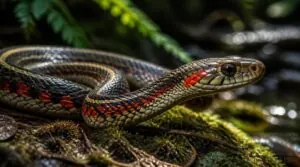
Look at the neck first: you’ll spot red side bars framing the shoulders, narrow but bold, running toward mid-body. Juveniles flash vibrant red; adults dull slightly with age.
Then check the head—narrow, large-eyed, crowned with a distinctive orange-red patch near the postocular region. That facial pattern varies just enough for individual recognition among snakes you’ll observe repeatedly.
Yellow or Blue Dorsal Stripe
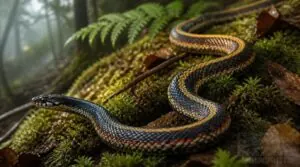
Once you’ve checked the head, run your eyes down the spine: you’ll find a dorsal stripe in yellow or blue, 2–5mm wide, marking the vertebral line. Coastal populations lean blue, inland ones yellow and broader. Sunlight shifts the hue—blue washes out, yellow pops. It’s a striking field mark separating this subspecies from cohabiting relatives.
Keeled Scales and Matte Texture
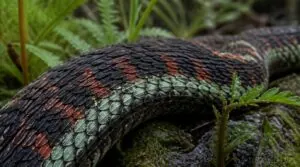
Run a finger along the back and you’ll feel it instantly: keeled dorsal scales, ridged and rough, nothing like glossy pet-shop snakes. Thamnophis sirtalis infernalis wears this texture for real reasons—
- Cuts glare, aiding camouflage in dappled light
- Improves grip on wet stream banks
- Diffuses reflection under overcast skies
- Suits muddy, vegetated habitat demands
That matte texture isn’t decorative. It’s survival gear, stitched into scale structure.
Bluish Gray Belly Coloration
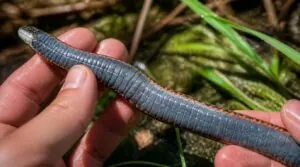
Flip one over and the belly tells its own story: a uniform bluish gray, sometimes speckled, unlike orange-bellied morphs. Pigmentation plus light-scattering scale structure produce this hue. It stays stable from juvenile through adult, barely shifting after molts—reliable for field identification even when dorsal patterns fade or wear thin.
| Trait | Juvenile | Adult |
|---|---|---|
| Hue | Lighter gray | Deeper slate |
| Pattern | Faint speckling | Stable speckling |
| Stability | Post-molt shift | Minimal change |
Adult Size and Body Shape
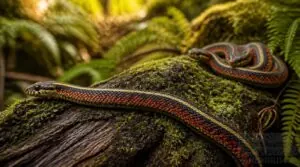
Size alone won’t nail the ID, but it narrows things fast. You’ll find most adults measuring 18 to 26 inches, with an average length hovering near two feet—rarely pushing past three feet long.
Body shape stays slender, cylindrical, tapering toward the tail. You’ll notice females running larger than males, a subtle case of sexual dimorphism worth clocking.
California Range and Preferred Habitats
You’ll find this snake scattered across a narrow stretch of northern California, from Humboldt County down to Monterey, though never in one continuous population.
Habitat fragmentation has pushed it into pockets of land where water and cover still meet its needs.
Here’s where you’re most likely to spot one, and why each of these places matters.
California Range and Geographic Variation
A patchwork, not a single ribbon—that’s how you’d describe this snake’s range. The California redsided garter snake shows a disjunct distribution: two separate coastal segments running Humboldt to Monterey and Santa Barbara to San Diego, with inland pockets between.
You’ll notice color variation zones and intergradation boundaries as populations mix, while elevation range limits keep most snakes below 1,500 meters.
Wetlands, Ponds, and Stream Edges
Water’s where this snake truly belongs. You’ll find it working marsh edges, cattail stands, and slow streams, hunting amphibians while wetland plants offer cover. Over 70% of coastal wetlands vanished since the 1850s—habitat loss that hits hard.
| Habitat | Feature | Use |
|---|---|---|
| Marsh | Cattails | Cover |
| Pond | Shallows | Foraging |
| Stream | Banks | Basking |
Grasslands, Woodlands, and Chaparral
Beyond the marsh edge, you’ll cross into grasslands, woodlands, and chaparral—edge effects boosting diversity where these meet. Purple needlegrass anchors slopes; oak woodland canopy filters light; chaparral fire cycles renew shrub cover.
- Edges link habitats, aiding movement
- Grassland restoration rebuilds corridors
- Fire shapes structure, not destruction
- Climate adaptability depends on connectivity
Protecting this patchwork sustains the California gartersnake’s range.
Basking Sites and Aquatic Cover
That patchwork of grassland and chaparral only matters if it connects back to water, and this is where basking comes in.
You’ll find snakes on sunlit rocks and logs within a meter of water, scales heating in minutes, with escape routes into the shallows always close—your safety net, and theirs, against predators.
Range Gaps and Intergradation Zones
Follow that shoreline far enough and you’ll hit blank stretches—disjunct distribution carved out by fragmented wetlands.
Where T. s. infernalis meets T. s. fitchi, you’ll spot muddled colors: hybrid zone patterns blur clean IDs. That’s genetic isolation in action, driven by patchy habitat and weak dispersal corridors. Climate shifts and restoration work can reopen these gaps, easing subspecies cohabitation risks over time.
Diet, Aquatic Behavior, and Toxin Resistance
You’ll find this snake is more than a pretty pattern—it’s a sharp hunter with a few biological tricks up its sleeve. Water shapes almost everything it does, from what it eats to how it escapes trouble. Here’s what makes its daily habits and defenses worth a closer look.
Frogs, Newts, Fish, and Invertebrates
Ever wonder what’s actually on the menu? Frogs make up roughly 60% of your garter snake’s diet, but you’ll also find newts, fish, and invertebrates rounding things out:
- Frogs and tadpoles
- Toxic newts
- Small stream fish
- Aquatic invertebrates
- Amphipods and larvae
Wetland food webs stay balanced through this varied predation—you’re watching an efficient aquatic predator at work.
Daytime Foraging Near Water
Since these snakes are daytime hunters, you’ll spot them patrolling shallow margins at midday, basking briefly before sliding into cover. You’ll notice sharp strike precision timing, using ripples for aquatic prey detection along muddy edges and reed-lined riparian prey channels.
Sunlit rocks aid water edge basking, keeping foraging brisk—a thermal foraging balance that fuels growth, especially in hungry juveniles.
Tetrodotoxin Resistance and Newt Predation
Here’s a biochemical trick worth knowing: this snake can eat something lethal enough to kill you, and walk away unbothered. That’s TTX resistance at work—sodium channel mutations blocking tetrodotoxin from toxic newts.
This snake devours lethal newt toxin and walks away unscathed, its sodium channels immune to tetrodotoxin
You’ll find toxic prey make up just 3% of its diet, yet resistance lets it store 42 µg of TTX in liver tissue, evidence of a genuine predator-prey arms race.
Swimming and Water Escape
Water’s this snake’s fastest exit strategy. You’ll watch it enter cautiously at shallow edges, then switch to an eel-like S-shaped glide, paddling with ribs and ventral scales.
Startled, you’ll see quick tail flicks launch it toward reed beds or submerged cover, holding still underwater for minutes—a slick mix of aquatic locomotion and predator avoidance built right into its terrestrial life.
Musk, Striking, and Defensive Displays
Cornered, this snake doesn’t bluff quietly. You’ll see it flatten its neck into a triangular silhouette, gape wide, and release musk while holding a rigid threat posture.
- Triangular head flare
- Musk emission bursts
- Rapid defensive strike
- Fixed, unblinking gaze
- Coiled tail anchor
Contact often starts lower-jaw first—a calculated defensive strike, not a feeding bite.
Reproduction, Conservation, and Legal Protection
You’ll see a species walking a tightrope between survival and vanishing, where every spring mating aggregation and every protected wetland acre matters.
Reproduction here follows its own rhythm, distinct from its more famous San Francisco cousin, and the law treats each subspecies differently.
Here’s what you need to know about how this snake breeds, where it’s protected, and what the rules mean for you.
Spring Mating and Courtship
Watch a wetland edge in March, and you’ll catch males emerging first, forming mating aggregations up to 100-strong around a single female.
You’ll notice pheromonal cues driving the frenzy—cloacal secretions signaling readiness—while thermal cues from warming days sync the whole event.
Courtship dances (head-lifts, coiling, sweeping circuits) and male competition determine access, with copulation lasting minutes to an hour.
Live Birth and Litter Size
All that spring courtship pays off with live young, not eggs. Females give birth to 8–20 neonates after a gestation stretching several months, timed to warm weather and rising prey numbers.
Litter size hinges on maternal body size and health—bigger females produce bigger clutches. Early survival depends on food access, temperature, and how fast each precious newborn finds shelter.
Wetland Protection and Habitat Connectivity
Newborns need somewhere to go, and that’s where wetland connectivity matters most. Fragmented marshes isolate populations—so corridor restoration, buffer zones, and connectivity monitoring keep gene flow alive. Climate-resilient wetlands act as refugia during droughts.
- Vanishing cattail marshes where young snakes once thrived
- Dikes cutting off ancient migration routes
- Fragile populations losing genetic diversity
- Restored corridors offering a fighting chance
Federal Status Versus San Francisco Subspecies
Corridors help populations, but paperwork decides their fate. Your California Red-Sided Garter Snake carries federal species of concern status—less protection than the San Francisco garter snake’s stricter federal listing.
| Subspecies | Federal Status |
|---|---|
| Red-Sided | Species of concern |
| San Francisco | Listed, protected |
Genetic distinctiveness debates and habitat fragmentation shape conservation prioritization, funding, and which populations get real protection.
Current Collection and Possession Rules
Because no dedicated species legislation exists, you’ll rely on general wildlife permitting: applications specify collection sites, methods, and purpose. Possession limits cap at two per permit, requiring annual renewal and licensed breeder compliance.
- Fines that drain your wallet
- Confiscated snakes you’ll never see again
- Permit revocation ending your collecting days
Illegal collection pressure invites steep penalties—know the rules before you reach for that precious garter snake.
Frequently Asked Questions (FAQs)
Are California red-sided garter snakes poisonous?
Here’s the twist: technically yes, but you’ll rarely notice. You’ll find a mild neurotoxic venom delivered by chewing, not fangs, causing at most soreness or swelling—harmless to humans venom despite this snake’s impressive tetrodotoxin sequestration from toxic newts.
What are the characteristics of a Red-sided Garter Snake?
You’ll spot a vibrant appearance right away — red side bars, a yellow or blue dorsal stripe, keeled scales, a bluish-gray belly, and a slender body reaching up to 80 centimeters, built for coastal wetlands and agile aquatic hunting.
Are red-sided garter snakes poisonous in California?
You might picture fangs and swelling, but that’s not this snake’s story. It’s not poisonous to people—no medically significant venom, just mild toxins for subduing frogs and fish, plus tetrodotoxin resistance from eating newts. Bites cause minor irritation, nothing more.
How big are California red-sided garter snakes?
You’ll spot males averaging 65–75 cm, while females run larger at 90–100 cm — roughly 30% bigger. Rare individuals exceed 130 cm. Growth slows after 2–3 years, once sexual maturity sets in.
What does a California garter snake look like?
You’ll spot red blotches breaking up a dark, keeled body, paired with a vibrant dorsal stripe—yellow or blue—running head to tail, plus a narrow head, large eyes, and often a reddish blush near the jaw.
What conservation efforts are in place?
You’ll rely on wetland conservation, habitat restoration, and population monitoring working together—since this endangered subspecies has lost over 70% of its coastal marshland since the 1850s, legal protections and captive breeding remain your best safeguards against extinction.
How long do they typically live?
Funny thing—longevity here mirrors the newt toxins they survive: wild lifespan runs 6–8 years, captivity stretches it to 12– Females outlast males; habitat quality and predation, not some fixed reptile lifespan ceiling, decide who reaches double digits.
Are they found as household pets?
You’ll rarely find these snakes suited to household captivity—strict permits, tricky enclosure needs, and conservation priorities discourage it. Observe them in wetlands instead; watching a wild population thrive beats any snake enclosure you could build at home.
What predators pose threats to them?
Danger comes from above and below. You’ll face hawk hatchling predation, raccoon nest raiding, skunk den foraging, coyote opportunistic hunting, cat urban edge threats, plus snapping turtles and aquatic predators lurking near every basking site you find.
How many subspecies are recognized?
You’ll find three recognized subspecies: red-sided (Thamnophis sirtalis infernalis), Valley (T. s. fitchi), and San Francisco (T. s. tetrataenia). Though genetic thresholds and disjunct distribution keep taxonomic consensus somewhat fluid among herpetologists studying regional variation.
Conclusion
That borrowed toxin isn’t malice—it’s inheritance, a quiet defense earned one newt at a time.
This species profile of the California red-sided garter snake shows you a survivor built on quiet strength: red flashes, keeled scales, a body tuned to marshes and stream banks. You’ll find it wherever cattails still stand and water still moves, proof that endurance often hides in plain sight.
Protect the wetlands, and the snake protects itself.