This site is supported by our readers. We may earn a commission, at no cost to you, if you purchase through links.
Most snakes would rather vanish into leaf litter than confront a cat, but that retreat does not mean they recognize cats as a predator. A snake reads the encounter through scent particles, ground vibrations, and sudden movement, then makes a fast risk calculation with little room for error.
That distinction matters when your cat corners a snake beside a woodpile. Are snakes afraid of cats? In behavioral terms, many avoid a potential threat, while others freeze, flee, coil, or strike. Species, size, and nearby cover can turn the same backyard meeting dangerous. Understanding signals protects both animals better than folklore.
Table Of Contents
- Key Takeaways
- Are Snakes Afraid of Cats?
- How Snakes Detect Nearby Cats
- How Snakes React to Cats
- Why Cats Approach or Attack Snakes
- When Snake-Cat Encounters Become Dangerous
- Can Cats Keep Snakes Away?
- Top 3 Items That Won’t Deter Snakes
- Protecting Cats and Pet Snakes
- Frequently Asked Questions (FAQs)
- Conclusion
Key Takeaways
- Snakes don’t actually fear cats — what you’re seeing when a snake retreats is hardwired threat-avoidance behavior driven by sensory detection, not emotion or conscious recognition of danger.
- A cat won’t reliably keep snakes out of your yard; snakes respond far more predictably to shelter, food sources, and entry points than to any resident predator.
- The real danger runs both ways — a curious or bold cat can provoke a defensive strike from a venomous snake, and even a brief encounter warrants immediate veterinary attention if symptoms like swelling, weakness, or labored breathing appear.
- Your best protection is environmental: clear woodpiles and debris, control rodents, and seal gaps larger than a quarter inch, because physical exclusion beats any scent-based repellent or feline patrol.
Are Snakes Afraid of Cats?
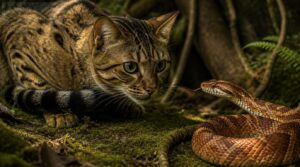
Snakes don’t experience fear the way mammals do—but that doesn’t mean a cat’s presence goes unnoticed. What’s actually happening is more subtle, and the difference matters if you want to understand how these animals truly behave around each other. Here’s what the science and the biology actually tell us.
Watch for subtle snake discomfort signs after handling, such as freezing, rapid retreat, or defensive posturing.
Snakes may not fear cats like mammals do, but they still detect and respond to their presence
The Short Answer
No, snakes aren’t afraid of cats the way you might think. What they exhibit is threat-driven avoidance behavior, a deeply hardwired instinctual response to a nearby predator.
When a cat enters a snake’s sensory range, most snakes detect it and quickly retreat. Don’t mistake that snake reaction for genuine emotion, though; it’s calculated survival mechanics, not conscious fear at all.
Fear Versus Threat Avoidance
A snake’s fear response is rapid: autonomic arousal triggers freezing, fleeing, or defense. But threat perception is usually an assessment, not panic.
- Distance
- Movement speed
- Size
- Escape cover
- Prior experience
Predator avoidance may mean Avoidance and Hiding or Snake habitat avoidance, especially when cover offers a safer route than confrontation. Threat distance can shape freezing and flight responses, with escape more likely when a predator is close.
Why The Myth Persists
Because threat avoidance can look dramatic, the myth persists. A cat corners a snake, the snake retreats, and observers interpret retreat as predator deterrence rather than a search for escape cover.
Rare videos make that impression stronger. Folklore, personal anecdotes, and sensational media favor defensive posturing and warning signals, while everyday non-encounters go unseen. Cat behavior variability also makes every encounter look like proof.
Individual Snake Reactions Vary
No two encounters produce the same Snake Reaction. A small, skittish colubrid may vanish into cover; another individual may freeze, tongue-flick, and assess the cat before moving.
Fear and Curiosity reflect Experience Level, species, size, hunger, and prior exposure.
- Bold snakes may hold position
- Wary snakes retreat sooner
- Familiar domestic scents can blunt alarm
That variability limits conclusions about predator deterrence.
Cats Are Unreliable Deterrents
Although a cat can trigger threat perception, it cannot reliably protect your yard. In this predatorprey relationship, a snake may use an evasion strategy, freeze, or defend itself; vibration sensitivity also lets it detect approach from several directions.
| Cat behavior | Likely snake response |
|---|---|
| Stalking | Hide or flee |
| Cornering | Strike defensively |
How Snakes Detect Nearby Cats
Snakes don’t need to see a cat clearly to register its presence. Their senses gather clues from the air, ground, and the cat’s movements, then trigger rapid threat assessment. The key detection mechanisms are listed below.
Cat Scent and Jacobson’s Organ

Cat scent can function as a chemical calling card. A snake tongue-flicks, transfers particles to Jacobsons organ, and interprets Pheromone Signaling through specialized Vomeronasal Function pathways.
Urine, facial secretions, and gland odors may reveal that a mammalian predator recently occupied the area. This Predator Detection system doesn’t produce human-like fear, but it helps the snake assess risk.
Ground Vibrations and Movement
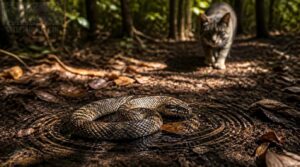
Before a snake sees a cat, Ground Vibrations and Movement can signal its approach through soil, leaf litter, or floorboards. The snake’s body detects particle motion, supporting Predator Detection without relying on airborne sound.
- Footfalls
- Pouncing
- Scratching
- Tail Vibration
- Rattle Mechanics
These cues may trigger freezing, retreat, or Defensive Posturing. Response strength depends on substrate and movement from nearby cats.
Size, Speed, and Proximity
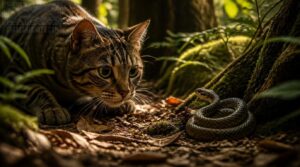
Size variation shapes every encounter. A large, agile cat can close one to three meters quickly, while a pencil-thin juvenile snake may vanish through cover almost instantly.
For desert snake identification and safety tips, consider both body size and defensive behavior before deciding how much distance to give.
Swift movements matter more than bravado. Snakes use flexibility and body build to redirect, coil, or retreat; a cat’s rapid approach leaves little room for safe avoidance.
Physiological Stress Responses

Once a snake registers a nearby predator, its stress response can switch on within seconds. A rapid physiological cascade raises heart rate, blood pressure, and glucose availability, placing the animal in a hyperalert state. This defensive physiology helps immediate escape or resistance.
Repeated exposure may also produce neural adaptation, changing how strongly its body mobilizes during future encounters with cats.
Familiar Versus Unfamiliar Threats

Experience changes behavior. A snake repeatedly detecting cats can classify scent and footfalls, then hide instead. Familiar threat cues may soften stress, but contact is dangerous.
With unfamiliar animals, snake communication signals, freezing, musking, rattling, or striking, become warning signals that trigger escape. Cat behavior and psychology are unpredictable; predator-prey relationships mean predator deterrence reduces risk, never guarantees safety in practice.
How Snakes React to Cats

A cat’s presence doesn’t produce one predictable response from every snake. Species, distance, cover, and the cat’s behavior all shape what happens next. The most common reactions range from quiet withdrawal to unmistakable defensive warnings:
Avoidance and Hiding
When a cat approaches, snakes usually prioritize predator avoidance by slipping into leaf litter, rock gaps, fallen logs, or burrows. These Snake Refuge sites reduce visibility and protect the body from paws and claws.
- Dense grass becomes a shelter
- Crevices create security
- Shade limits exertion
- Stillness helps stealth behavior
- Cover allows evasive maneuvers
Such Defensive Mechanisms keep encounters brief and reduce injury risk.
Freezing or Rapid Escape
From cover, a snake may become momentarily motionless when a cat appears. This predator avoidance response keeps its outline low while tense muscles preserve readiness for evasive maneuvers.
If the threat closes in, instinctdriven reactions favor rapid escape. Ventral scales grip the ground, driving the body toward grass, gaps, or burrows. Freezing or rapid escape usually prevents contact without defensive posturing.
Defensive Postures and Striking
When escape fails, a snake may adopt defensive posturing: it coils tightly, elevates its head and neck, and fixes its gaze on the approaching cat. These aggressive displays are usually last-resort threat signals, not attempts to hunt.
- Coils shorten strike distance
- Raised heads improve targeting
- Rattlesnake tails provide warning signals
- Forward lunges defend space
- A strike can injure either animal
Musk and Threat Signaling
After a failed strike display, some snakes release defensive musk from glands near the cloaca. This pungent secretion can coat a cat’s fur or nose, creating an unpleasant surprise that encourages distance.
It’s one of several Chemical Defenses, alongside posture and escape. Think of it as Threat Signaling: a direct warning, not an attack. These Defensive Mechanisms encourage retreat.
Rattling as a Warning
When a rattlesnake detects a nearby cat, its rattling tail may become nature’s siren. Rattle mechanics rely on rapid tail vibration, which snaps hollow keratin segments together into a dry, staccato buzz.
These warning signals trigger before a bite. If the cat remains close, tail vibration speeds up, often alongside coiling and a raised head. Back away calmly, keep your cat indoors, and never test whether the warning is a bluff.
Why Cats Approach or Attack Snakes
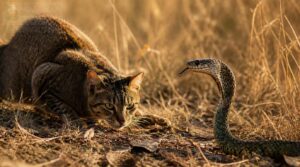
Cats don’t approach snakes for one simple reason. Curiosity, prey drive, past experience, and individual temperament can all shape what happens next. The factors below explain why one cat investigates while another attacks—or keeps its distance.
Curiosity Versus Hunting Instinct
A snake’s movement can act like nature’s siren to a cat. Curiosity triggers investigation: scent, motion, and unfamiliar shapes invite pawing or close inspection.
- Slow, irregular movement attracts attention
- Sudden motion activates Hunting Instinct
- Cornered snakes may deploy snake defense mechanisms
Feline hunting behavior can turn play into predator-prey relationships within seconds. The cat may stalk, swat, or bite, while the snake freezes, flees, strikes, or warns.
Temperament and Prey Drive
A cat’s response depends heavily on Temperament and Prey Drive. A bold, highly reactive cat may orient, stalk, and swat at a moving snake, while a cautious cat may watch from distance or retreat.
This is instinctual behavior, not bravery. Strong Feline Hunting Behavior can turn motion into a target, rapidly intensifying Predator-Prey interaction and raising injury risk for both animals.
Indoor Versus Feral Experience
An Indooronly cat may approach a snake through curiosity, yet lack experience judging its speed or defensive range. Predictable homes also reduce exposure to unfamiliar wildlife cues.
A Feral cat or Outdoor Pet often develops sharper threat assessment through repeated encounters, variable terrain, and hunting. Still, Domestication and Experience, not Cat Type alone, shape risk. Feral life teaches caution, but it also creates frequent dangerous contact.
Play Behavior Can Escalate
A paw tap can turn dangerous in seconds. Play Behavior Can Escalate when quick stalking, pouncing, or poking activates Predator-Prey Interactions and the snake’s Instinct-Driven Reactions.
Cat Hunting Skills favor rapid, repeated movements near the head. The snake may freeze, flee, coil, musk, or strike through Snake Defense Mechanisms. Never let curiosity become contact: separate the animals calmly and immediately.
Personality Outweighs Cat Breed
Individual temperament drives risk more than breed. Cat Breed and Temperament overlap only loosely: a bold, highly active house cat may stalk a snake, while a sociable breed-mate retreats.
Watch your cat’s feline behavior, domestication level, and response to moving prey. In predatorprey relationships, curiosity can become pursuit quickly. Personality Outweighs Cat Breed, so separate any cat that fixates, crouches, or repeatedly approaches.
When Snake-Cat Encounters Become Dangerous
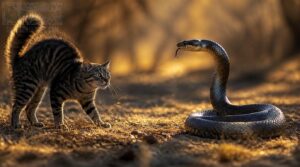
A cat and snake can both shift from caution to conflict in seconds. The outcome depends on the species involved, each animal’s size, and the setting around them. These are the factors that make an encounter genuinely dangerous.
Snake Species and Size
Snake species and size shape the danger far more than a cat’s confidence. A 40 to 60 cm garter snake usually presents little physical threat, while a 2.5 to 3.5 m black mamba or a large boa demands distance. Species classification, venom levels, and environment and habitat determine outcomes.
Large snakes also create a serious constrictor threat through sheer strength.
Venomous Bite Risks
A venomous bite can overwhelm a cat quickly, even after a brief encounter. Venom levels and venom toxicity vary by species, but swelling symptom, weakness, bleeding, dilated pupils, or labored breathing demand immediate emergency veterinary care.
Pit-viper envenomation damages blood and tissue; coral-snake venom can paralyze breathing. The safest rule is simple: treat every suspected bite as an envenomation risk.
Large Constrictor Risks
Unlike venomous species, a large python or boa may injure a cat through constriction danger rather than toxins. In predator-prey relationships, cat behavior variability matters: a bold cat that corners a snake in its habitat can trigger coiling.
Constrictors over 15 feet and 100 pounds can compress the chest, impair breathing, and turn an enclosure escape into a silent emergency.
Cat Claws and Teeth
Cat claws and teeth are precision weapons. A single swipe can lacerate snake scales, triggering an immediate fear response even in venomous species. That’s why predator deterrence isn’t automatic; cats actively inflict serious damage.
- Retractable claws pierce scale tissue
- Bite force crushes smaller snakes
- Strikes disrupt snake communication signals
- Venomous species still strike back
- Both animals sustain injuries in contact
Habitat Shapes Encounter Outcomes
The environment where an encounter happens shapes everything. Dense ground cover gives snakes quick escape routes, while open cleared ground leaves them exposed and puts cats at a distinct advantage. Rock piles and log stacks concentrate both animals in tight spaces, raising injury risk considerably. Where your cat roams matters as much as what it encounters.
Can Cats Keep Snakes Away?
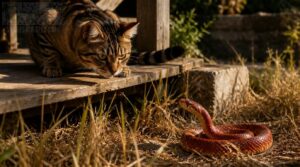
A cat’s presence may unsettle some snakes, but it won’t reliably keep them out of your yard or home. Snakes respond far more predictably to shelter, food sources, and accessible entry points. The measures below offer safer, more effective ways to reduce snake encounters.
Why Deterrence is Unreliable
A resident cat provides unreliable snake deterrence. Snake responses fall across a cat reaction spectrum:
- Some retreat from movement or scent.
- Others freeze, hide, or remain unnoticed.
- Defensive snakes may strike when cornered.
- Venomous species can pose risk regardless of feline presence.
Predatorprey relationships are situational, not a barrier. Your safer strategy is habitat modification, not trusting a cat to patrol.
Remove Snake Hiding Places
The safer strategy is habitat modification. Remove woodpiles, rock stacks, leaf litter, dense mulch, and stored materials from near walls, decks, and sheds. These features create cool, protected refuge sites within otherwise exposed snake habitat.
Keep grass short, trim low shrubs, and maintain a clear gravel border around foundations. Open sightlines disrupt concealment while supporting natural balance.
Control Rodents and Food
Snakes follow prey, not feline bravado. Control rodents and accessible Food around buildings, and you interrupt predatorprey relationships before a snake arrives. In wildlife ecology, abundant mice can override a cat’s hunting instincts.
- Clean grain spills promptly
- Store feed in metal bins
- Keep waste tightly covered
- Rotate stored goods regularly
Sanitation cuts rodent activity 40 percent.
Seal Gaps and Entry Points
Exclusion beats deterrence. Seal openings larger than ¼ inch, because many small snakes can exploit narrow cracks. Install door sweeps, caulk window and siding joints, screen vents with metal mesh, and close crawlspace access panels.
This habitat modification removes shelter routes shaped by environmental factors and predator-prey relationships. Check foundations, utility pipes, rooflines, and basement windows each season.
Avoid Scent-based Repellents
Avoid scent-based repellents. Chemical cues can prompt brief investigation or snake habitat avoidance, but they rarely create reliable predator deterrence. Wind, humidity, and sunlight disperse odors quickly, while repeated exposure may reduce a snake’s response.
Cat urine, ammonia, sulfur products, and similar remedies can irritate pets and people without changing feline behavior or blocking entry routes. Focus on physical exclusion and habitat cleanup instead.
Top 3 Items That Won’t Deter Snakes
Cats aren’t reliable snake repellents, and neither are ordinary household products. Snakes respond to shelter, prey, access points, and immediate threats—not unrelated items left nearby. The following three products won’t deter snakes from your property.
1. Nabisco Cookie and Cracker Variety Pack

A Nabisco Cookie and Cracker Variety Pack is not a snake repellent. Its 50 single-serve packs, including OREO Mini, CHIPS AHOY! Mini, RITZ Bits Cheese, Nutter Butter Bites, and Wheat Thins, offer no chemical, visual, or vibration-based cue that tells a snake to leave.
Leaving snacks outdoors can create a problem: crumbs may support rodents, and rodents are prey for many snakes. Keep food waste secured, clean up spills, and use habitat exclusion rather than pantry items to deter snakes.
| Best For | Families, offices, classrooms, and event hosts who want a convenient mix of individually portioned sweet and savory snacks. |
|---|---|
| Pack Count | 50 snack packs |
| Bulk Format | Variety multipack |
| Special Feature | 5-brand assortment |
| Primary Use | On-the-go snacking |
| Shelf Life | Freshness-sealed packs |
| Key Limitation | Contains common allergens |
| Additional Features |
|
- Includes 50 single-serve packs with five popular Nabisco snack varieties.
- Offers both sweet cookies and savory crackers for different preferences.
- Convenient for lunches, office snack stations, party favors, and travel.
- Contains common allergens, including wheat, soy, milk, and peanuts.
- Individual packs are small and may not be filling for everyone.
- Some customers report inconsistent freshness in certain packs.
2. Duracell Messi AAA Batteries Limited Edition

Neither a 28-pack of Duracell Messi AAA Batteries nor its limited-edition tattoo artwork will discourage a snake. The batteries produce no scent, substrate vibration, heat pattern, or visual signal that a snake would interpret as a predator.
Their POWER BOOST ingredients and 12-year storage guarantee may help power flashlights during storm preparation, but they do nothing to alter snake behavior. Keep batteries for household devices, not yard defense. Snake risk requires physical barriers, tidy habitat, and supervision, not collectible packaging.
| Best For | Messi fans and households that want dependable AAA batteries for everyday, low- to moderate-drain devices with long-term storage readiness. |
|---|---|
| Pack Count | 28 batteries |
| Bulk Format | Large quantity pack |
| Special Feature | Messi tattoo motif |
| Primary Use | Powering household devices |
| Shelf Life | 12-year storage life |
| Key Limitation | Non-rechargeable single-use |
| Additional Features |
|
- Limited-edition Lionel Messi tattoo-inspired design makes the pack collectible.
- POWER BOOST ingredients provide reliable performance for remotes, clocks, toys, and flashlights.
- 12-year storage guarantee helps keep batteries ready for emergencies and seasonal use.
- Higher cost and limited availability compared with standard Coppertop AAA batteries.
- Not rechargeable, so they are intended for single use only.
- May not perform as well in high-drain devices as batteries designed specifically for that purpose.
3. Cottonelle Ultra Clean 1ply Family Mega Rolls
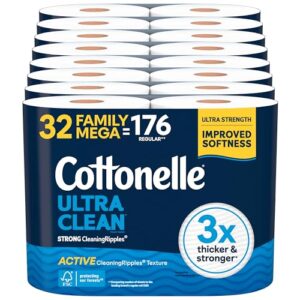
A bulk pack of Cottonelle Ultra Clean 1ply Family Mega Rolls will not repel snakes. Its 32 rolls, 353 sheets per roll, CleaningRipples texture, and perfume-free design provide household hygiene, not a predator cue.
Snakes do not interpret toilet paper as danger. The material produces no meaningful cat scent, heat signature, movement pattern, or ground vibration. Even its septic-safe, fast-breaking fibers have no relevance outdoors.
Use it in the bathroom, not around sheds, gardens, or snake-prone entryways. Physical exclusion and habitat cleanup remain the reliable tools.
| Best For | Households wanting a long-lasting, strong, perfume-free toilet paper option that is safe for septic systems and bought in bulk. |
|---|---|
| Pack Count | 32 rolls |
| Bulk Format | Family Mega pack |
| Special Feature | CleaningRipples texture |
| Primary Use | Personal hygiene |
| Shelf Life | Long-lasting bulk supply |
| Key Limitation | Single-ply construction |
| Additional Features |
|
- Thick, strong CleaningRipples texture helps remove more with fewer sheets.
- Large 32-roll pack reduces how often households need to repurchase.
- Septic-safe and free of added perfumes and dyes, making it suitable for sensitive skin.
- Single-ply construction may not provide the plush feel some users prefer.
- Some users find the rolls narrower than traditional toilet paper rolls.
- Bulk package needs substantial storage space.
Protecting Cats and Pet Snakes

Cats and snakes should never be left to manage an encounter on their own. A secure setup protects both animals from instinctive reactions that can turn dangerous in seconds. Use the following safeguards to reduce risk at home.
Secure Pet Snake Enclosures
Secure Pet Snake Enclosures protect both animals by preventing a cat from turning a glass tank into a stress trigger. Build the snake habitat around four essentials:
- Locking lid with clips or latches
- No gaps at hinges or vents
- Thermostated heat and daily monitoring
- Stable hides and decor
Use cross-ventilation, species-appropriate humidity, and an enclosure at least two-thirds of your snake’s length. Thoughtful habitat modification limits escape routes, contact with predators, and unnecessary snake defense mechanisms.
Keep Cats Safely Indoors
Because the predatorprey relationship can shift in seconds, Keep Cats Safely Indoors whenever possible. Prey drive in cats makes a moving snake unusually compelling, while snake habitat avoidance reduces surprise encounters.
| Risk | Practical control |
|---|---|
| Open windows | Lock screens |
| Doors | Post reminders |
| Yards | Use outdoor supervision |
| Climbing | Add shelves |
Puzzle feeders, scratching posts, and separated resources in multi-cat homes redirect attention.
Never Stage Animal Encounters
Never Stage Animal Encounters for a video, lesson, or curiosity test. Predatorprey behavior can shift instantly: feline behavior may trigger stalking or swatting, while a snake may flee, freeze, or strike defensively.
Respect snake habitat avoidance and prevent crossspecies interaction through barriers, separate housing, and remote cameras. A calm-looking encounter can still produce severe stress.
Check Cats for Bite Symptoms
Inspect your cat after any snake encounter, even if no wound is obvious beneath fur. Watch for snake bite symptoms that may progress quickly:
- Sudden yelping, hiding, or weakness
- Fang punctures, bleeding, bruising, or swelling
- Swelling of the cat’s face, especially around the muzzle
- Excess drooling, vomiting, labored breathing, dilated pupils, or pale gums
These symptoms of snake bite demand close attention.
Seek Emergency Veterinary Care
Treat any suspected bite as a veterinary emergency. Symptoms of snake bite can worsen before a wound is visible, particularly after venom exposure. Swelling of the cat’s face, labored breathing, pale gums, collapse, vomiting, or marked weakness warrant immediate action.
Call ahead, keep your cat quiet in a carrier, and seek emergency veterinary care without giving human medication right away.
Frequently Asked Questions (FAQs)
Will a cat keep snakes away?
Like a medieval watchman, a cat is Plan B, not reliable yard security. It may chase a snake, but clear debris, mow grass, seal gaps, and reduce rodents. Curious cats can suffer dangerous bites too.
Can cats smell snakes in the house?
Yes, your cat can detect snakes by smell alone. With up to 200 million scent receptors, their chemosensory system picks up chemical cues from snake scent glands, alerting them well before any direct visual contact.
What do snakes fear the most?
For a creature so feared, snakes ironically have plenty to fear themselves. Large predators like eagles, jackals, and foxes trigger the strongest chemical threat response, sending snakes into rapid retreat and immediate, instinctive shelter-seeking behavior.
Does a cat kill snakes?
Cats can and do kill snakes, though success depends on the snake’s size and species. Their hunting instincts fuel this predator-prey relationship, but venomous species pose a serious risk to any cat that strikes first.
Why do cats avoid snakes?
Why would a natural predator hesitate mid-stalk? Survival instinct drives that pause.
Snakes can deliver a fast, accurate strike, and cats instinctively read that risk. Fear response triggers caution before any dangerous confrontation fully unfolds.
Are snakes scared of cats?
Not exactly. Snakes don’t experience fear the way mammals do. What drives them away from cats is instinct-driven threat avoidance, a hardwired survival response rooted in predator-prey relationships, not emotional dread or conscious recognition.
Are snakes dangerous to cats?
Snakes are nature’s loaded wire. A venomous bite floods your cat’s system with toxins within minutes, triggering rapid swelling, intense pain, and systemic collapse. Risks of envenomation are real, fast, and potentially fatal.
Do cats attack snakes?
Do cats attack snakes? Most do. Feline behavior drives cats to stalk or attack snakes on pure instinct. Predator-prey relationships don’t pause for caution, and near venomous species, that instinct risks a dangerous snake bite.
Do snakes like cats?
The idea of a snake "liking" a cat is roughly as realistic as a houseplant enjoying jazz. Snakes don’t form social bonds, and they simply process cats as potential threats, not companions.
What makes a cat scary for a snake?
It’s basically a layered sensory alarm for the snake. When your cat enters the picture, its feline odors, rapid unpredictable movements, and sheer body mass all signal one thing: a predator large enough to win.
Conclusion
Slithering silently through sun-warmed shadows, snakes don’t calculate fear the way you might expect. So are snakes afraid of cats? Not exactly. They register threat, not terror, and their next move depends on species, size, and the nearest escape route. Knowing this protects both animals. Keep your cat safely indoors, clear all woodpile cover, and stop relying on instinct to do what prevention controls far better. Nature didn’t build either animal to keep the peace.