This site is supported by our readers. We may earn a commission, at no cost to you, if you purchase through links.
Wrong substrate choice lands more boas in the vet’s office than most keepers realize. A substrate that’s too dry cracks their scales during shedding; one that’s too wet breeds the bacteria that cause respiratory infections and scale rot.
The best bedding for boa constrictors does more than line the bottom of an enclosure—it regulates humidity, encourages natural burrowing behavior, and signals when something’s off with your snake’s health. Nine substrates stand out from the rest, and the differences between them matter more than the price tag.
Table Of Contents
- Key Takeaways
- Best Bedding Types for Boa Constrictors
- Top 9 Boa Bedding Picks
- 1. Repti360 Coconut Chip Substrate
- 2. Galápagos Aspen Digs Natural Bedding
- 3. Flukers Tropical Cypress Reptile Bedding
- 4. ZooMed Aspen Snake Bedding
- 5. Zoo Med Forest Floor Bedding
- 6. Zilla Reptile Terrarium Substrate
- 7. GICHUGI Boa Constrictor Pillow Cover
- 8. Zilla Reptile Paper Bedding
- 9. Sukh Natural Aspen Reptile Bedding
- Bedding That Holds Boa Humidity
- Bedding Materials Boa Constrictors Should Avoid
- Juvenile Boa Bedding and Quarantine
- Cleaning Boa Bedding The Right Way
- DIY and Bioactive Boa Substrates
- Frequently Asked Questions (FAQs)
- What bedding do boa constrictors like?
- What not to use for snake bedding?
- What substrate is best for a boa?
- What should I put at the bottom of my snake enclosure?
- What is the best material for a boa enclosure?
- What is the best substrate for Colombian boas?
- What bedding is the best for snakes?
- What do boas like in their cage?
- What is the best substrate for common boas?
- What kind of bedding is best for snakes?
- Conclusion
Key Takeaways
- Substrate choice directly impacts your boa’s health — too dry cracks scales during shedding, too wet breeds bacteria that cause respiratory infections and scale rot.
- Cypress mulch and coconut husk are your best all-around options, hitting the 55–75% humidity sweet spot while supporting natural burrowing behavior.
- Avoid sand, walnut shell, pine, and cedar entirely — they cause impaction, respiratory irritation, and scale damage that can land your snake at the vet.
- For hatchlings and quarantine setups, paper towels are the safest choice — they’re easy to swap daily, keep bacteria low, and make waste monitoring simple.
Best Bedding Types for Boa Constrictors
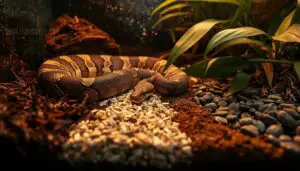
every substrate works the same way, and what’s fine for one boa setup can be a problem in another. The right pick depends on boa’s age, your humidity goals, and how much maintenance you’re willing to do.
Getting the substrate right is just one piece of a healthy setup—boa constrictor enrichment with climbing branches also plays a big role in keeping your snake active and thriving.
Here are the five bedding types that consistently deliver for boa keepers.
Cypress Mulch for Adult Humidity Control
Cypress mulch is one of the best choices for adult boa constrictors that need reliable humidity control. Its fibrous texture creates natural moisture gradient management — damp at the surface, moist deeper down — which mirrors a wild forest floor.
The substrate’s natural humidity gradient management helps maintain stable conditions.
- Slows evaporation for long-term humidity stability between misting sessions
- Gradual mulch decomposition benefits the substrate by adding organic matter over time
- Facilitates burrow habitat creation with a recommended 2–4 inch depth
- Surface dampness monitoring keeps conditions ideal without waterlogging
Aspen Shavings for Dry, Clean Setups
If your aspen shavings doesn’t need high humidity, aspen shavings are a smart pick. This dry substrate stays loose, absorbs waste well, and makes spot cleaning straightforward. It’s non-toxic, easy to clean, and budget-friendly — low cost without cutting corners.
| Feature | Detail | Benefit |
|---|---|---|
| Dust-Free Surface | Kiln-dried processing | Safer respiratory environment |
| Odor Neutralization | Absorbs moisture-driven odors | Cleaner enclosure longer |
| Easy Replacement | Widely available bags | Consistent, smooth restocking |
Temperature stability stays reliable since aspen won’t trap excess moisture that throws off your thermal gradient.
Coconut Husk and Coir for Moisture Retention
Unlike aspen, coconut husk and coir thrive where humidity matters most. Coir Water Retention is impressive—coco pith holds up to seven times its dry weight in water, releasing it slowly so your enclosure stays consistently moist without getting soggy. Coconut Husk Airflow stays strong too, since the chunky texture resists compaction.
- Coir pH Buffering keeps conditions stable between cleanings.
- Coconut Husk Porosity facilitates steady moisture distribution.
- Coir Mold Resistance improves with proper ventilation.
Paper Towel and Newspaper Setups for Quarantine
When you’re quarantining new boa, skip the fancy substrate. Paper towels and newspaper are your best tools here.
They act as Disposable Barrier Layers, making Sanitary Waste Management simple — swap them out daily, seal the old ones, done.
You get Quick Inspection Access to monitor feces and shed, plus solid Pathogen Isolation Benefits.
Moisture Control Tips apply too: keep towels dry to prevent mold.
Bioactive Substrate Options for Naturalistic Enclosures
A bioactive substrate takes your enclosure a step further — it actually works for you. Mixes like Bio Dude Terra Firma, pair coconut fiber with activated charcoal for odor control through Charcoal Filtration and solid Substrate Aeration.
Microfauna Populations of detritivore insects — your cleanup crew — handle waste naturally through Nutrient Cycling. Fungal Colonization helps break down organic matter, keeping the whole system balanced long-term.
Top 9 Boa Bedding Picks
Here are nine substrates worth a serious look for your boa’s enclosure. Each one brings something different to the table — humidity retention, burrowing depth, ease of cleanup, or budget-friendliness.
Work through the list and see which one fits your setup best.
Comparing humidity output, tank size compatibility, and noise levels side by side will help narrow things down, and this guide to choosing a humidifier for boa enclosures breaks down exactly what to weigh before you buy.
1. Repti360 Coconut Chip Substrate
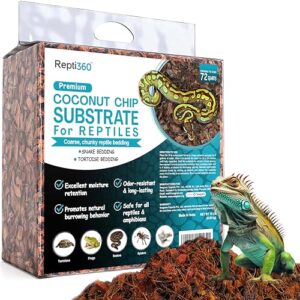
One compressed block, and you’ve got enough substrate to fill multiple enclosures. That’s the real selling point of the Repti360 Coconut Chip Substrate.
Each 10-lb block expands to roughly 72 quarts — plenty for a generously sized boa enclosure.
The coconut husk chips hold humidity well, support burrowing, and cushion your boa’s scales without harsh edges.
It’s bioactive-compatible, too. Just plan ahead: initial hydration takes a few hours, and moisture levels need monitoring to prevent mold.
| Best For | Reptile and amphibian owners who need a humidity-friendly, natural substrate that stretches across multiple enclosures without breaking the bank. |
|---|---|
| Material | Coconut husk chips |
| Dust Level | Low dust |
| Humidity Suitability | High humidity |
| Burrowing Support | Yes |
| Biodegradable | Yes |
| Odor Control | Moderate |
| Additional Features |
|
- One 10-lb block expands to 72 quarts — enough to fill several enclosures at once, making it genuinely cost-effective.
- Holds moisture well and supports healthy shedding, burrowing, and bioactive setups.
- Low dust, natural material, and no synthetic additives — easy on your animals and easy to clean up.
- Breaking the compressed block into smaller portions can be a hassle — you may need to pry it apart at the edges.
- Full hydration takes a few hours, so it’s not a quick, last-minute substrate swap.
- Not a great fit for desert species that need dry, sandy conditions, and over-watering can lead to mold if you’re not keeping an eye on moisture levels.
2. Galápagos Aspen Digs Natural Bedding
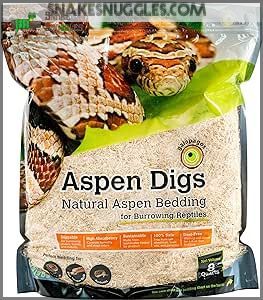
Galápagos Aspen Digs is a solid choice when you want a clean, dry setup without fussing over humidity. The 100% pure aspen shavings are low-dust, chemical-free, and soft enough to protect your boa’s scales.
At around $8.99 for an 8-quart bag, it won’t strain your budget.
It facilitates natural burrowing, and spot-cleaning is quick.
Just keep in mind: aspen dries out fast, so it’s better suited for dryer setups rather than tropical humidity requirements.
| Best For | Pet owners housing snakes, lizards, hamsters, or guinea pigs who need a clean, dry, and affordable bedding option. |
|---|---|
| Material | Aspen wood shavings |
| Dust Level | Low dust |
| Humidity Suitability | Low humidity |
| Burrowing Support | Yes |
| Biodegradable | Yes |
| Odor Control | High |
| Additional Features |
|
- 100% pure aspen with no added chemicals — safe for sensitive animals
- Low-dust formula helps protect your pet’s respiratory health
- Lightweight, easy to spot-clean, and budget-friendly at $8.99
- Dries out quickly — not a good fit for tropical species that need higher humidity
- Some buyers find the bag smaller than expected for larger enclosures
- May have residual dust that needs sifting before use
3. Flukers Tropical Cypress Reptile Bedding
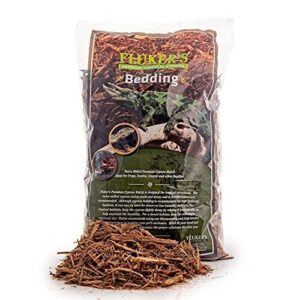
Fluker’s Tropical Cypress hits a sweet spot for adult boa keepers who want reliable humidity without constant misting. Made from 100% twice-milled cypress, it holds moisture well and releases it slowly — keeping that 55–75% humidity range stable between spray sessions.
At $6.96 for a 1.76 lb bag, it’s affordable for smaller enclosures.
It’s also low-dust and free from pine or cedar resins.
Best used as a mix-in with coconut coir if your boa needs consistently high moisture levels.
| Best For | Reptile keepers who want an affordable, natural substrate that helps maintain moderate humidity in smaller enclosures for snakes, lizards, and tortoises. |
|---|---|
| Material | Cypress mulch |
| Dust Level | Low dust |
| Humidity Suitability | Tropical and desert |
| Burrowing Support | Yes |
| Biodegradable | Yes |
| Odor Control | Moderate |
| Additional Features |
|
- Holds moisture well and releases it slowly, helping keep humidity steady between misting sessions
- Low dust and free from pine or cedar resins, so it’s safe for all life stages
- Versatile enough to use solo or mixed with coconut coir for species that need higher moisture levels
- Small bag for the price — won’t go far in larger enclosures
- Can dry out quickly if not misted regularly, making it less reliable as a stand-alone substrate in high-humidity setups
- Occasional sharp or pointy pieces have been reported, which could be a concern depending on your animal
4. ZooMed Aspen Snake Bedding
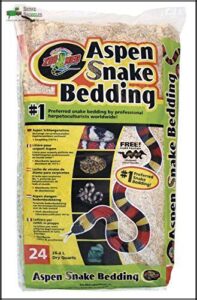
ZooMed Aspen Snake Bedding is the go-to for keepers who want a clean, dry setup without overthinking it.
Made from aspen wood — not cedar or pine — it’s free of the toxic oils that can irritate your boa’s respiratory system.
It absorbs well and stays nearly odorless between cleanings.
The 99.9% dust-free claim holds up for most users, though sifting the bag first doesn’t hurt.
Just keep in mind: aspen won’t hold humidity well, so it’s best for drier enclosure builds.
| Best For | Keepers of snakes, lizards, tortoises, and other dry-habitat reptiles who want a low-maintenance, non-toxic substrate that’s easy to spot-clean. |
|---|---|
| Material | Aspen wood shavings |
| Dust Level | 99.9% dust-free |
| Humidity Suitability | Low to moderate |
| Burrowing Support | Yes |
| Biodegradable | Yes |
| Odor Control | High |
| Additional Features |
|
- Free of cedar and pine oils, so no respiratory risk for sensitive reptiles
- Absorbs well and keeps enclosures dry and nearly odor-free between cleanings
- Low dust means less irritation for both your animals and you
- Doesn’t hold humidity, so it’s a poor fit for species that need a moist environment
- Some bags come out dustier than expected — worth sifting before use
- Pricier than generic options, which adds up fast if you’re running multiple enclosures
5. Zoo Med Forest Floor Bedding
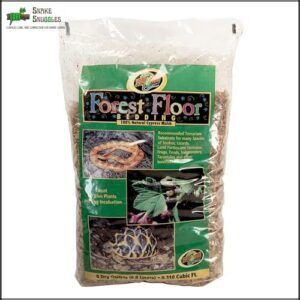
Zoo Med Forest Floor Bedding is 100% natural cypress mulch — no dyes, no synthetics. It holds moisture well, which makes it a strong pick for tropical boa setups where you’re targeting 55–75% humidity.
The soft texture lets your boa burrow naturally, and it resists mold better than most loose organics. Larger mulch pieces occasionally show up in the bag, so do a quick hand-sort before use.
| Best For | Reptile and amphibian owners keeping tropical or humidity-dependent species like boas, tree frogs, or salamanders who want a natural-looking substrate that actually holds moisture. |
|---|---|
| Material | Aspen wood shavings |
| Dust Level | 99.9% dust-free |
| Humidity Suitability | Low to moderate |
| Burrowing Support | Yes |
| Biodegradable | Yes |
| Odor Control | High |
| Additional Features |
|
- Holds humidity well, making it easy to keep tropical enclosures in that 55–75% sweet spot
- Low dust compared to most bark substrates, so less irritation for your animals (and you)
- Soft enough for burrowing species to dig around naturally
- Costs more per volume than a lot of alternatives, which adds up fast in larger enclosures
- Occasional oversized mulch chunks in the bag that you’ll want to pick out before use
- Can grow mold if you’re heavy-handed with the misting and not keeping an eye on moisture levels
6. Zilla Reptile Terrarium Substrate
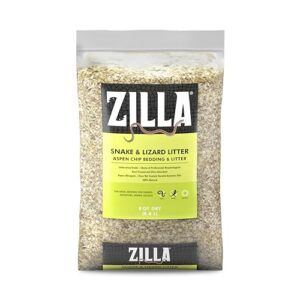
If Zoo Med Forest Floor gives you solid moisture retention with cypress, Zilla Jungle Mix takes a slightly different approach — it blends sphagnum moss with fir shavings to hit that same 55–75% humidity target your boa needs.
Applied 1–2 inches deep, it absorbs well and stays soft underfoot.
It’s marketed for tropical species like frogs and rainforest snakes, so it fits a forest-floor boa setup reasonably well.
Keep it damp but not soaked — if you can squeeze water out, it’s too wet.
| Best For | Snake and lizard keepers who want a clean, low-dust substrate that makes spot-cleaning quick and easy. |
|---|---|
| Material | Cypress mulch |
| Dust Level | Low dust |
| Humidity Suitability | Tropical |
| Burrowing Support | Yes |
| Biodegradable | Yes |
| Odor Control | Moderate |
| Additional Features |
|
- Ultra-absorbent chips soak up moisture fast, keeping odors down and cutting back on how often you need a full substrate swap.
- Low dust means less respiratory irritation for your reptiles — big win for snakes and lizards that are sensitive to airborne particles.
- Small chip size makes spotting and scooping waste a breeze, so daily maintenance doesn’t feel like a chore.
- Fine chips can cling to feeder prey, which makes this a risky choice for hatchlings or any species eating small whole food items.
- Not great for heavy burrowers — if your reptile loves to dig deep tunnels, this substrate won’t hold up the way a coarser mix would.
- It costs more than bulk aspen shavings, and a few buyers have noted the bag itself feels a little flimsy.
7. GICHUGI Boa Constrictor Pillow Cover
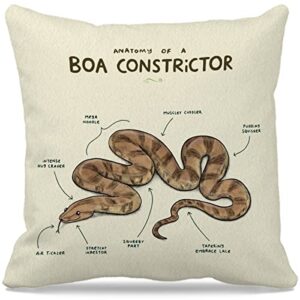
Not every item on this list is a substrate — and that’s intentional.
The GICHUGI Boa Constrictor Pillow Cover is an 18×18-inch flannel polyester throw cover with a hidden zipper and a vibrant boa graphic. It won’t line your enclosure, but it’s a solid gift pick for snake keepers or a fun accent for your reptile room.
Machine-wash cold, skip the bleach, and tumble dry low.
Note: no insert included — you’ll need to grab one separately.
| Best For | Snake lovers, reptile enthusiasts, or anyone looking for a fun, affordable gift that adds a little personality to a room. |
|---|---|
| Material | Aspen chips |
| Dust Level | Low dust |
| Humidity Suitability | Low to moderate |
| Burrowing Support | Yes |
| Biodegradable | Yes |
| Odor Control | High |
| Additional Features |
|
- Soft flannel fabric feels nice against the skin and holds up well with regular use
- The hidden zipper gives it a clean, polished look
- Easy to toss in the washing machine — low maintenance all around
- No pillow insert included, so you’ll need to buy one separately
- Only comes in one size (18×18), so it won’t work with larger cushions
- Flannel can pill or shrink if you’re not careful with the wash cycle
8. Zilla Reptile Paper Bedding
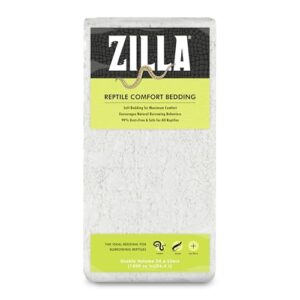
Back to business — if you need a no-frills substrate that makes cleanup almost easy, Zilla Reptile Paper Bedding earns its spot. Made from 100% natural, dye-free paper, it’s low-dust and safe for adult boas and quarantine setups alike.
The bright white color is a practical win — waste stands out immediately.
At $11.99 for 24.6 liters, it’s budget-friendly.
Just note: it won’t hold humidity, so pair it with a large water dish.
| Best For | Keepers who want a clean, low-maintenance substrate for adult snakes, desert reptiles, or quarantine setups where easy waste detection matters most. |
|---|---|
| Material | Polyester flannel |
| Dust Level | Not applicable |
| Humidity Suitability | Not applicable |
| Burrowing Support | No |
| Biodegradable | No |
| Odor Control | Not applicable |
| Additional Features |
|
- Bright white color makes spot cleaning quick — waste is impossible to miss
- Low-dust formula keeps air quality decent for both you and your animal
- Budget-friendly at $11.99 for 24.6 liters, so replacing it regularly won’t hurt your wallet
- Bag isn’t resealable, so you’ll need a separate container to store leftover bedding
- Breaks down fast in humid setups — mold can show up quickly if moisture builds up
- Not a great fit for heavy diggers long-term, since the paper compresses and loses its cushioning over time
9. Sukh Natural Aspen Reptile Bedding
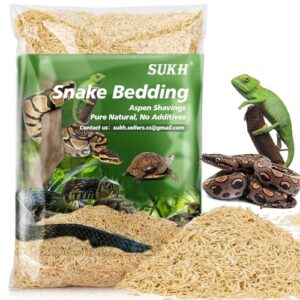
Sukh Natural Aspen Reptile Bedding is a solid pick for clean, affordable dry setups. It’s made of 100% untreated aspen—no added oils or chemicals—making it safer for your boa’s respiratory health compared to cedar or pine.
The bedding offers decent absorbency for odor control, though it maintains low humidity retention, which suits arid environments.
One caution: the shavings are denser than typical aspen brands, so closely monitor juvenile boas to prevent ingestion risks.
| Best For | Reptile and small animal owners who want a natural, chemical-free bedding for dry or arid setups on a budget. |
|---|---|
| Material | Natural paper |
| Dust Level | Low dust |
| Humidity Suitability | Low humidity |
| Burrowing Support | Yes |
| Biodegradable | Yes |
| Odor Control | Moderate |
| Additional Features |
|
- 100% untreated aspen with no added oils or chemicals — safer for your animals’ respiratory health than cedar or pine
- Good absorbency helps control odors and keeps enclosures fresher between cleanings
- Works for a wide range of species, from snakes and lizards to hamsters, rabbits, and birds
- Shavings are denser and more splinter-like than typical aspen brands, which could be a risk if ingested — especially by juveniles
- Low humidity retention makes it a poor fit for tropical or humidity-dependent species
- Vacuum-sealed packaging means you’ll need to fluff it before use, and one bag may not be enough to fill even a 10-gallon tank
Bedding That Holds Boa Humidity
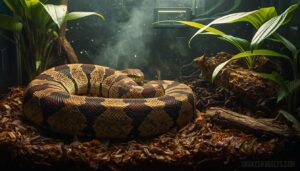
Humidity is one of the most important factors in keeping a boa healthy, and the right bedding does most of the heavy lifting. Your target range is 55%–75%, and some substrates hold moisture far better than others.
Here’s what you need to know to keep those levels steady.
Ideal Humidity Range for Boa Constrictors
Boa constrictors need humidity levels between 60 and 70 percent day-to-day — that’s the sweet spot for healthy skin and smooth sheds.
Humidity gradient management matters here: don’t aim for one flat reading across the whole enclosure.
Key targets to keep in mind:
- Maintain ideal moisture levels at 60–70% normally
- Bump to 75–85% during active sheds
- Drop slightly to 55–65% for juveniles to avoid respiratory issues
Humidity sensor placement is critical — put a digital hygrometer on both the warm and cool sides.
Temperature-humidity correlation is real: warmer zones dry out faster, so monitor both together.
How Substrate Depth Affects Moisture
Deeper substrate does more than fill space — it actively regulates moisture. Through capillary rise, lower layers wick water upward, creating a natural moisture gradient that your boa benefits from daily.
| Depth | Evaporation Rate | Compaction Effects |
|---|---|---|
| 2–3 cm | High | Minimal |
| 6–10 cm | Moderate | Low |
| 12–15 cm | Low | Monitor regularly |
Depth-weight balance matters: go too deep, and compaction effects reduce airflow, undermining substrate moisture retention entirely.
Using Sphagnum Moss to Boost Humidity
Sphagnum moss is one of the most effective tools for microclimate creation inside your boa constrictor’s enclosure. A thin moss layer thickness, about 1–2 cm, on top of your substrate can push humidity levels to 60–80% in localized pockets.
Its moss water retention capacity is impressive — it holds up to 20 times its own weight in water. Stick to a simple moss mist scheduling routine every few days, and replace it every 1–2 months to prevent bacterial buildup.
Leaf Litter for Moisture and Cover
Dead leaves do more than look natural — a 1–2 cm layer on your substrate surface can cut soil evaporation by up to 40 %, stabilizing humidity levels between 55–75 % for your boa constrictor.
- Microclimate Moisture: Leaf pockets trap and slowly release moisture retention underneath
- Thermal Insulation: Buffers soil temps 3–6 °F cooler during warm periods
- Burrow Concealment: Creates low‑profile hides supporting natural burrowing behavior
- Decomposition Nutrients: Breakdown enriches bioactive substrate microbial life
- Mold Prevention: Replace dead leaves every 4–6 weeks to keep air fresh
Balancing Damp Substrate With Airflow
Think of your enclosure like a layered cake — drier on top, moister below. That moisture gradient lets air circulate through the coconut fiber while preserving humidity levels at 60–75%.
Vent placement opposite each other prevents hot spots.
Check sensor calibration monthly so readings stay accurate.
Surface drying is normal; it signals good porosity management and healthy substrate layering techniques for your boa constrictor.
Bedding Materials Boa Constrictors Should Avoid
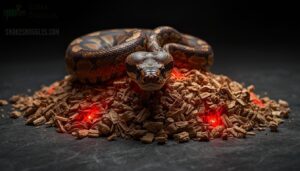
Not every substrate you’ll find at the pet store is safe for your boa. Some materials look fine on the shelf but can seriously harm your snake once they’re inside the enclosure.
Here’s what to skip — and why it matters.
Reptile Carpet and Impaction Risk
Reptile carpet looks tidy, but it’s one of the worst choices for boas.
Fiber ingestion is a real risk — boas mouth their enclosure constantly, and loose threads from edge fraying go down easily.
Add biofilm build-up from trapped waste, off-gassing chemicals under heat lamps, and low traction during feeding, and you’ve got a recipe for impaction.
Skip it entirely.
Sand, Walnut Shell, and Gravel Hazards
Sand, crushed walnut shell, and gravel all share one problem: they don’t belong in a boa enclosure.
- Silica Dust Hazard — dry sand kicks up fine particles that trigger respiratory irritation fast
- Walnut Shell Abrasion — rough edges scrape soft tissue during normal movement
- Gravel Particle Impaction — hard fragments cause serious GI blockage if swallowed
All three make impaction prevention nearly impossible and raise the risk of mold growth when damp.
Pine and Cedar Shavings Dangers
pine and cedar shavings look harmless, but both release aromatic oil exposure and acidic residue effects that damage your boa’s airways over time. fine dust inhalation from dry shavings carries respiratory irritants deep into lung tissue. skin dermatitis risk is real too — direct contact inflames scales and soft tissue.
substrate toxicity from these softwoods builds gradually, making pine shavings and cedar shavings genuinely unsafe choices.
Why Loose Particles Are Risky for Juveniles
Loose particles hit juvenile boas harder than adults — their smaller airways make Respiratory Irritation from airborne dust a faster problem.
During feeding, sand or wood-based substrates stick to prey, raising Ingestion Impaction risk substantially. Fine bits also cause Mouth Abrasions and Foreign Body Lodging in tight nasal passages.
Disturbed bedding spreads waste too, increasing Pathogen Spread before you even notice contamination building.
Signs a Substrate is Too Abrasive or Dry
Beyond the risks to juveniles, substrate quality affects every boa at every age.
Run your fingers across the bedding — a Gritty Surface Feel or Cracked Substrate Layer signals trouble. Dust Cloud Formation during handling, Skin Abrasion Marks on scales, and Burrow Instability all point to sand‑dry conditions.
Moist versus dry substrate for boa constrictors directly shapes shedding support, humidity levels, and the impaction risk and prevention in snakes.
Juvenile Boa Bedding and Quarantine
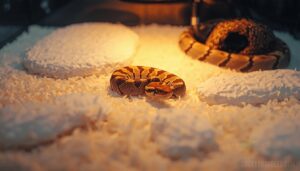
Young boas and newly acquired snakes need a different approach than adults — one that puts safety and visibility first. The substrate choices below are built around that priority, covering everything from hatchling setups to full quarantine situations.
Here’s what works best at each stage.
Paper-based Bedding for Hatchlings
Hatchling boa constrictors need a clean, forgiving start — and paper towels deliver exactly that. These absorbent paper layers make disposable humidity control simple: dampen slightly, swap daily, done.
Crumpled newspaper or butcher paper works too, giving tiny boas a lightweight burrowing surface to explore. This sterile paper substrate keeps bacteria low and makes easy litter replacement stress‑free while you monitor feeding and early sheds closely.
Low-risk Substrates for Young Boas
Once your hatchling outgrows paper towels, choosing an appropriate boa constrictor substrate becomes the next real decision.
Coconut fiber and cypress mulch both offer soft substrate texture, low dust content, and solid moisture control — all without the health implications of improper substrate choices like sand or walnut shell. Both support safe ingestion if accidentally swallowed, and a 2–3‑inch layer aids impaction prevention naturally.
Temporary Quarantine Enclosure Bedding
Quarantine calls for simplicity above everything else. Paper towels and coconut fiber are your two best quarantine substrate recommendations — easy to swap, low-dust, and safe if accidentally ingested.
Keep control tight with these three steps:
- Use a Disposable Bag System for fast waste removal
- Add Moisture Indicator Strips to track humidity without guessing
- Apply Color-Coded Bedding labels for quick medical identification
A waterproof Liner Material Choice underneath, paired with a Ventilation Slot Design on the enclosure lid, keeps cleaning and maintenance of reptile enclosures straightforward and stress-free.
Monitoring Feeding and Shedding on Loose Substrate
Loose substrate tells you a lot — if you’re paying attention. Keep a Feeding Log and track Digging Behavior, Stool Consistency, and your Shedding Timeline after each session.
| Signal | What It Means | Action |
|---|---|---|
| Digging post-feed | Substrate stress | Check Moisture Gauge |
| Partial shed | Low humidity | Improve substrate absorption |
| Loose stool | Impaction risk | Review reptile digestion health |
A balanced humidity management routine protects the entire shedding process.
When to Move Juveniles to Deeper Bedding
Moving too soon can stress a juvenile just as much as waiting too long. Watch for burrowing onset cues — consistent digging signals readiness.
Confirm these five checkpoints first:
- Weight stability threshold: within 5% over two weeks
- Clean shedding cycle avoidance during any change
- Steady feeding response shift with no refusals
- Ventilation monitoring to prevent mold in deeper substrate
- Impaction risk cleared by avoiding wood-based particles
Cleaning Boa Bedding The Right Way
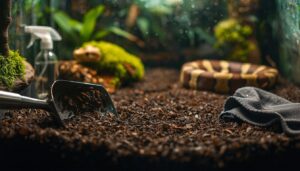
Even the best substrate turns into a health hazard if you’re not cleaning it consistently. A solid routine keeps bacteria, mold, and odor from building up before you ever notice a problem.
Here’s exactly how to stay on top of it.
Daily Waste Removal and Spot Cleaning
Daily waste removal is the backbone of any solid Enclosure Sanitation Routine. Pull feces and soiled substrate every day — don’t wait.
Use a reptile-safe brush and tongs as your core Spot Cleaning Tools. Keep a simple Waste Log Tracking sheet to stay consistent.
This daily habit is your best Mold Prevention Strategy and keeps deeper cleaning protocols less overwhelming overall.
How Often to Replace Substrate
Spot cleaning buys you time, but it doesn’t reset the enclosure. For standard setups, replace all substrate every 3–4 months.
Your Maintenance Log is your best Replacement Timing tool — track Waste Accumulation Indicators like odor or discoloration.
Make Seasonal Adjustments when humidity or temperature shifts.
Habitat Monitoring between changes tells you whether your substrate replacement schedule needs tightening sooner.
Deep-cleaning Schedules for Standard Enclosures
Replacing substrate every 3–4 months pairs naturally with a quarterly cleaning cycle — meaning full deep cleaning happens at the same time. Strip everything out, disinfect all surfaces with 10% bleach or F10SC, then rinse until fumes are completely gone.
Your cleaning log template should capture:
- Date and enclosure ID
- Substrate type removed
- Disinfectant used
- Mold prevention timing notes
- Humidity reset protocol steps completed
Managing Odor, Mold, and Bacteria
Once the enclosure is clean, keeping it that way comes down to airflow and timing. Ventilation strategies matter more than most keepers realize — stagnant air is where odor control breaks down fast.
Add activated carbon filtration near vents to absorb lingering smells.
Do mold spot checks weekly, and rotate substrate before bacterial load monitoring reveals a problem. Consistent substrate rotation frequency stops fungal control issues before they start.
Resetting Humidity After Each Cleaning
Airflow adjustment and water reservoir refill come right after disinfectant use — don’t wait. Humidity levels should rebound to 55–75% within two hours.
Misting timing matters: mist lightly right after restocking substrate, not before. Understanding substrate composition and moisture retention tells you how much water each layer needs.
Post-cleaning observation over the next hour confirms recovery. Recalibrate sensors monthly — sensor calibration keeps your readings honest.
DIY and Bioactive Boa Substrates
Building your own substrate mix or going full bioactive takes a bit more planning, but the results are worth it. Whether you’re mixing your own blend or setting up a living ecosystem, each approach has real advantages for your boa’s health and comfort.
Here’s what you need to know before choosing the right path for your setup.
DIY Topsoil, Coconut Fiber, and Sand Mix
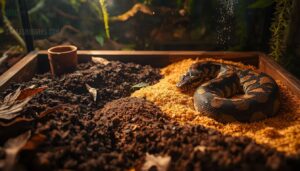
Building your own substrate costs less and gives you full control. A proven DIY mix — 40% plain topsoil, 40% coconut fiber, and 20% play sand — balances moisture balancing, burrowing support, and drainage in one blend.
Ratio adjustments shift performance: more coco fiber raises humidity, more play sand improves drainage. Particle size matters too — keep everything coarse.
Mix longevity runs 4–6 months, making these cost-effective DIY substrate mixes hard to beat.
Bioactive Setups With Clean-up Crews
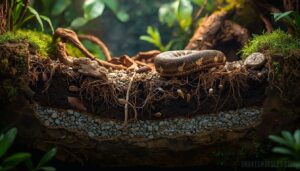
A bioactive substrate turns your enclosure into a self-cleaning system. Isopods and springtails — cleanup crew — consume waste, mold, and decaying matter continuously.
Springtail habitat creation and isopod population management depend on substrate layering techniques for naturalistic enclosures: a drainage base, living soil, then loose top material.
Microbial inoculation strategies seed beneficial bacteria, while detritivore food sources like leaf litter keep detritivore insects thriving and moisture gradient design stable.
Why Natural Substrates Support Burrowing
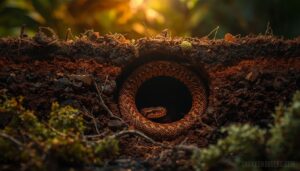
Natural substrates work because their granular structure gives your boa something to actually push against. Variable particle sizes — like those in a coconut husk and soil blend — create pockets that hold tunnel longevity far better than aspen shavings alone.
A healthy moisture gradient keeps those tunnels intact. Microfauna interaction in natural bedding materials further stabilizes soil composition, making burrowing feel instinctive rather than forced.
Layering Substrate for a Forest-floor Look
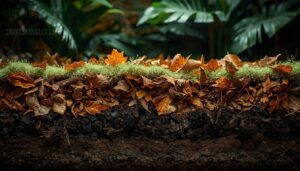
Think of it as building a miniature forest floor from the ground up.
Start with a 2–3‑inch base layer depth of coconut fiber or rich soil.
Add 1–2‑inch of shredded bark for bark crevice design, then scatter organic debris like oak or maple leaves unevenly.
Finish with a thin moss layer thickness of ¼–½‑inch sphagnum.
This substrate humidity gradient creates a genuinely naturalistic enclosure.
Cost, Lifespan, and Maintenance Tradeoffs
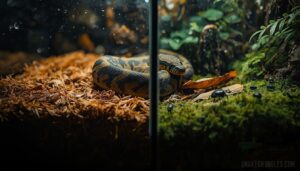
Upfront investment separates these two paths quickly. A cost-effective DIY substrate mix runs a few dollars per batch, but you’re replacing it every 3–4 months. Bioactive setups cost $20–$40 per square foot to build — but they last years.
DIY substrate costs pennies per batch, but bioactive setups — built once — can last years
Here’s how the tradeoffs break down:
- Replacement Frequency — Standard substrates need swapping quarterly; bioactive systems rarely do
- Labor Intensity — DIY mixes demand a stricter cleaning and maintenance schedule for snake enclosures; bioactive crews handle much of it
- Humidity Management Cost — Coconut coir ($8–$15/cu ft) holds moisture longer, cutting long-term savings on misting supplies
Frequently Asked Questions (FAQs)
What bedding do boa constrictors like?
Boas thrive on substrates that feel like a forest floor — slightly moist, deep enough to burrow, and soft underfoot. Cypress mulch, coconut husk, and aspen shavings are their top picks.
What not to use for snake bedding?
Skip anything with chemical additives, toxic inks, synthetic fibers, sharp plastic fragments, or mold‑prone organics.
Sand, crushed walnut shell, pine, and cedar all rank as the worst bedding materials to avoid for snakes.
What substrate is best for a boa?
Coconut husk hits the sweet spot — strong Burrowing Behavior support, solid Impact on Shedding, and reliable humidity.
It balances Temperature Compatibility, Substrate Cost Efficiency, and low Maintenance Frequency in one practical choice.
What should I put at the bottom of my snake enclosure?
For the bottom of your snake enclosure, use a drainage layer, then a plastic liner, topped with coconut fiber or aspen shavings. Skip sand — it causes impaction.
Choosing appropriate boa constrictor substrate matters more than most keepers realize.
What is the best material for a boa enclosure?
Cypress mulch and coconut husk lead as reptile safe bedding for choosing appropriate boa constrictor substrate — both support moisture monitoring, burrow architecture, temperature stability, and cost efficiency without risking impaction.
What is the best substrate for Colombian boas?
Cypress mulch or coconut fiber works best for Colombian boas — both support humidity levels, safe burrowing, and healthy thermoregulation.
Either keeps impaction risk low while offering solid natural aesthetic appeal at a reasonable substrate cost.
What bedding is the best for snakes?
Spoiler: there’s no single "best" bedding for all snakes. Temperature compatibility, substrate weight, cost efficiency, and species needs all matter.
For boas specifically, cypress mulch and coconut husk lead the pack.
What do boas like in their cage?
Boas thrive with Multiple Hide Spots, Climbing Branches, a properly sized Water Bowl Size, a solid Temperature Gradient, and Enrichment Objects — all working together to keep your snake active, stress-free, and healthy.
What is the best substrate for common boas?
There’s no single perfect answer — every boa setup is different.
Coconut husk wins for moisture retention and burrowing preference, while aspen suits drier setups.
Match substrate to your boa’s humidity levels and temperature compatibility.
What kind of bedding is best for snakes?
For boa constrictors, coconut husk and cypress mulch top the list. Both support ideal humidity levels, suit temperature compatibility needs, and promote reptile health — making them smart, cost-efficient substrate choices.
Conclusion
The floor beneath your boa does quiet, constant work—regulating moisture, supporting instinct, and signaling health before symptoms surface. Choosing the best bedding for boa constrictors isn’t about aesthetics; it’s about creating conditions where your snake doesn’t just survive but genuinely thrives.
Match the substrate to your species, your humidity targets, and your cleaning routine. Get that foundation right, and nearly everything else in the enclosure falls into place around it.