This site is supported by our readers. We may earn a commission, at no cost to you, if you purchase through links.

Six months below freezing, no food, no water to speak of, and yet come April, garter snakes pour out of rock crevices by the thousands, alive and ready to breed. That survival hinges on a den chosen with precision: soil below the frost line, groundwater hovering near 4–6°C, entrances angled just so against the wind.
Boreal forest snake winter survival isn’t dumb luck or deep sleep. It’s active physiological management—suppressed metabolism, fat reserves converted to ketones, heart rate dialed down to a whisper. Get the den wrong, and none of that biology matters. Here’s how these cold-blooded survivors read the landscape, and their own bodies, to make it through.
Table Of Contents
- Key Takeaways
- How Boreal Snakes Survive Winter
- Choosing Safe Winter Hibernacula
- Communal Dens and Scent Trails
- Water, Fasting, and Winter Activity
- Boreal Threats to Winter Survival
- Frequently Asked Questions (FAQs)
- Is there a snake that can survive the cold?
- Can garter snakes survive being frozen?
- Which snakes can survive in the winter?
- Can a snake freeze in the winter?
- What do Canadian snakes do in the winter?
- Can salamanders survive winter?
- What role do snake predators play in winter?
- How do snakes find hibernation sites?
- What is the frequency of snake hibernation?
- How does diet affect snake winter survival?
- Conclusion
Key Takeaways
- Boreal snakes survive winter through active physiological control—slowing heart rate and breathing, converting fat to ketones, and suppressing metabolism—rather than simple dormancy.
- Successful hibernacula require precise conditions: soil below the frost line, groundwater near 4–6°C, and wind-resistant entrances, since getting the den wrong overrides any biological adaptation.
- Snakes often gather by the hundreds in shared dens, using scent trails and kinship bonds for warmth and predator defense, with juveniles learning routes from older snakes’ chemical trails.
- Climate change and habitat fragmentation threaten winter survival by disrupting stable microclimates, shrinking available den sites, and creating unpredictable warm spells or flooding risks.
How Boreal Snakes Survive Winter
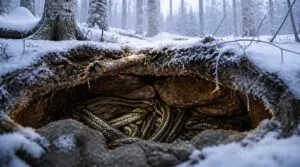
Winter in the boreal forest isn’t survivable through sheer toughness alone—it takes a full-body shutdown.
Snakes rely on a set of physiological tricks that let them wait out months of cold without eating, barely breathing, or freezing outright.
From lowered metabolic rates to antifreeze-like compounds in their blood, snake hibernation habits reveal just how finely tuned these survival strategies really are.
Here’s what actually happens inside them when temperatures drop.
Brumation Versus True Hibernation
Because you’re an ectotherm, your body temperature drifts with the environment rather than staying fixed like a mammal’s. That’s the main split: hibernation shuts endotherms down almost entirely, burning stored fat for months.
Brumation is gentler—metabolic suppression stays partial, you retain awareness, and you’ll rouse for water or sun. Same goal, different biology built for northern latitudes’ severe winters.
Research shows that photoperiod cues trigger brumation even when temperatures stay steady.
Reduced Breathing and Heart Rate
Your heart rate and breathing don’t just slow randomly—they’re tightly regulated by autonomic nervous control, dropping to whatever pace keeps cells alive.
This metabolic rate maintenance conserves oxygen while stabilizing blood pressure, much like slow breathing techniques boost cardiovascular stability in humans.
For cold-climate wildlife facing subarctic winters, this quiet efficiency isn’t dormancy; it’s calculated survival, keeping cellular maintenance requirements met until spring returns.
Months Without Feeding
Slowed pulse and breath buy time, but survival through a subarctic winter still demands fuel management. Boreal snakes rely on fat reserve management, shifting to lipid-based metabolism once glycogen runs low.
- Muscle tissue sparing protects mobility for spring
- Ketone body utilization fuels organs when glucose fades
- Fat stores taper first, easing post-fast recovery
Unlike migrating boreal birds, these snakes simply wait, fasting through the boreal biome’s leanest months.
Slow Movement When Disturbed
Even mid-fast, a boreal snake won’t ignore a threat. Disturbance triggers locomotor velocity reduction, not flight—coiling within seconds into a low-energy ambush stance while minimizing vibration trails.
| Response | Purpose |
|---|---|
| Coiled posture | Substrate camouflage |
| Short 2–8cm steps | Thermal gradient movement |
| Suppressed tail flicks | Predator evasion |
| Shallow breathing | Energy conservation |
That patience mirrors cold-climate adaptation seen throughout northern regions’ environment hardiness.
Energy Conservation in Cold
Winter forces a physiological bargain: survive on almost nothing. Metabolic rate reduction drops oxygen consumption dramatically, sparing just enough for cellular maintenance energy.
- Slower cellular repair, sustained just enough
- Fat reserves stretched across subarctic climate months
- Body mass preservation despite zero intake
- Ectothermic survival limits tested, not exceeded
This cold climate adaptation reflects a broader energy–water exchange shaping natural system strength alongside cold-adapted vegetation across the boreal landscape.
With permafrost locking the ground hundreds of meters down, it’s no surprise this region ranks among the cold, snake-free landscapes worldwide where reptiles simply can’t survive.
Choosing Safe Winter Hibernacula
Finding the right den can mean the difference between life and death once temperatures drop. Not every burrow or crevice will do the job, so you need to know what actually keeps a snake safe through winter. Here’s what qualifies as a suitable hibernaculum.
Below The Frost Line
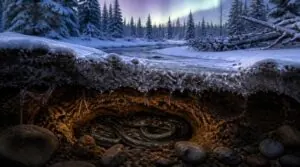
Ground doesn’t freeze uniformly, and that fact keeps snakes alive. Below the seasonal frost depth, soil temperature stays above freezing regardless of surface conditions, even as permafrost and snow cover grip the boreal forest above.
Frost heave, driven by soil freezing process and roughly nine percent water expansion, threatens shallow shelters. Snakes instinctively avoid this zone, relying on subsurface moisture flow and stable ground temperature for subarctic survival.
Burrows and Rock Crevices
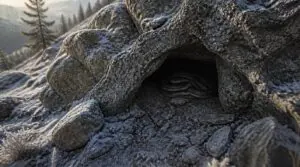
A rocky slope in mountainous terrain offers something a mudbank never can: cavities that don’t collapse. Snakes favor crevice networks for microclimate stability and predator defense—narrow openings limit entry while multiple routes allow escape.
Good burrows share traits:
- Oval, wind-resistant entrance design
- Loose, well-drained substrate composition
- Talus connections for cover
- Multiple exits preventing collapse
Habitat fragmentation shrinks these options, threatening coldclimate wildlife and broader environment health.
Groundwater Temperature Buffering
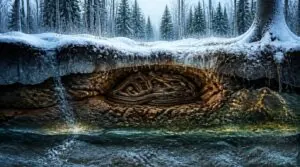
Water moving beneath a den site does something rock alone can’t: it keeps temperature steady. Groundwater seepage near 4–6°C buffers dens against surface swings, thanks to subsurface heat exchange and thermal inertia in surrounding sediment.
This hyporheic zone stability matters most where permafrost limits other options, protecting boreal forest denning sites from lethal freezes during erratic winters.
Rotting Logs and Embankments
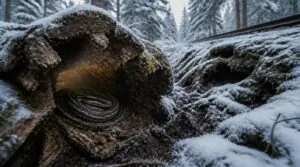
Not every den lies underground: rotting logs and railroad embankments offer surface-level backups when burrows run scarce, their decayed interiors trapping insulating warmth through active wood decay processes.
- Hollow logs shelter beetles, spiders, invertebrate foodwebs
- Decay releases nutrients, aiding nutrient cycling
- Damp microclimates support cold-adapted vegetation
- Logs enable seedling establishment nearby
- Embankments extend denning options, boosting environmental stability across boreal habitat
Shelter Scarcity Risks
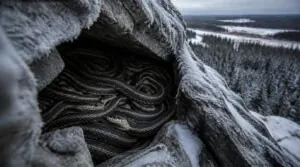
What happens when the dens run out? Habitat fragmentation across boreal forests shrinks available crevices, forcing snakes into overcrowded refugia where competition stress and injury rise sharply.
Fewer stable sites mean greater dehydration risks and thermal flux, undermining energy conservation.
This microhabitat loss threatens not just snakes but broader environmental health, the same northern latitude ecosystems supporting moose and wolves.
Communal Dens and Scent Trails
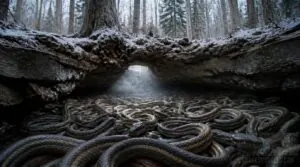
Finding shelter is only half the challenge—snakes also need to find each other. You’ll see why these dens rarely house just one species or a handful of individuals. Here’s what makes these communal gathering spots work, generation after generation.
Mixed Species Denning
Since a den can’t tell one species from another, several often end up sharing the same shelter, drawn by compatible thermal needs and complementary activity patterns. This creates real predation dilution effects and shared thermal buffering, bolstering biodiversity in boreal forests.
- Reduced individual predation risk
- Stable microclimate through numbers
- Cross-species scent trail reliance
- Support for northern latitude ecosystems
- Environment strength alongside moose and wolves
Garter Snake Aggregations
Garter snakes take mixed-species denning further, sometimes packing hundreds of individuals into a single hibernaculum. This isn’t random: kinship and familiarity shape nonrandom associations, forming lasting social networks.
| Benefit | Function |
|---|---|
| Shared warmth | Thermal buffering |
| Numbers | Predator defense |
| Familiarity | Social bonds |
| Density | Spring reunions |
These dens anchor habitat stability across the northern coniferous forest.
Reusing Successful Dens
Loyalty to a den isn’t sentiment—it’s survival math. Once a hibernaculum proves viable, snakes return year after year, reinforcing multi-season occupancy through scent trail navigation.
Loyalty to a den isn’t sentiment, it’s survival math—snakes return to what has kept them alive before
Reuse persists when:
- Entrances stay accessible, sediment-free
- Microclimate consistency holds steady
- Structural integrity resists collapse
This fidelity stabilizes boreal forest denning networks, supporting natural world endurance across generations of returning occupants.
Juvenile Navigation Cues
Adult fidelity depends on memory; juveniles have no prior den experience to draw on.
First-year snakes imprint on natal microhabitat odors, their olfactory receptors tuned sharply to soil and prey scent combinations that spring. They then follow conspecific scent trails, chemical breadcrumbs left by older snakes, to locate denning zones—learning the route before ever needing it.
Corridor Routes to Dens
Picture a snake’s route to its den as a hallway with warm rooms along the way. These corridors trace ridgelines and streams, using thermal microhabitat pockets—sun-warmed rocks, mossy seepages—to refuel body heat before continuing.
Substrate moisture and predator scent zones shape pace and caution, while vegetation cover offers concealment. In this boreal patchwork shared with moose, wolves, and migrating birds, these paths reflect true environment strength through ongoing forest succession.
Water, Fasting, and Winter Activity
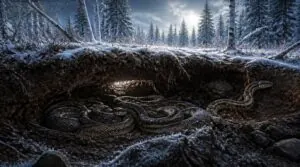
Not eating doesn’t mean not surviving—snakes have their own rules for getting through winter. You’ll want to know how they manage water, energy, and the occasional warm-day wander without breaking dormancy. Here’s what actually keeps them going below the frost line.
Digestive Shutdown in Cold
Why bother digesting when there’s nothing to digest? Below a certain threshold, gastric motility reduction stalls peristalsis entirely, while enzyme reaction rates plummet.
- Slowed gut contractions
- Reduced enzyme kinetics
- Shifting microbial communities
- Diminished nutrient uptake
- Weakened mucosal defenses
Gut microbial shifts and compromised mucosal barrier integrity accompany this shutdown, curbing nutrient absorption efficiency until warmth returns.
Low Body Weight Loss
Given how little energy a brumating snake burns, weight loss over five or six months stays surprisingly modest.
Metabolic rate shifts downward to match near-zero activity, so energy demand reduction aligns with what’s needed purely for cellular maintenance needs. This built-in efficiency achieves real body mass preservation and weight loss prevention, letting snakes emerge in spring still carrying enough reserves to hunt, breed, and resume normal life.
Drinking During Warm Spells
Even brumation has its coffee breaks: on mild days, snakes rouse to drink rather than forage. Surface moisture sources like snowmelt puddles and damp rock faces meet urgent needs, since sun exposure raises evaporative loss risks.
Three factors drive this:
- Snowmelt hydration near dens
- Humidity cycling in shelter entrances
- Substrate drinking behaviors on wet leaf litter
Climate change’s warming pulses may expand these windows, subtly altering boreal forest hydrology.
Moisture From Substrate
Not every drink comes from open water. Wet leaf litter and rotting wood absorb moisture over weeks, letting skin absorption meet hydration needs directly.
Soil moisture gradients around rock crevices buffer humidity near 85–95%, while groundwater seepage keeps dens stable.
Too much moisture invites fungal growth and anaerobic pockets, though—balance matters more than abundance when your skin is the only tap available.
Flooded Den Dangers
Water can turn a safe den deadly fast. Rising floodwater triggers oxygen depletion risks, while silt causes entrance blockage and structural burrow collapse. Contaminated runoff brings pathogen exposure and mold growth, stressing skin and lungs alike.
As permafrost thaw reshapes boreal regions, altered hydrological cycles and soil moisture change threaten den stability—demanding stronger habitat toughness for snakes facing an increasingly unpredictable winter.
Boreal Threats to Winter Survival
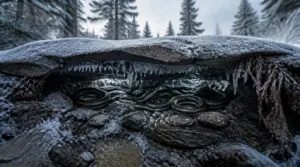
Winter doesn’t hand boreal snakes an easy pass, even inside a well-chosen den. Cold, ice, and a shifting climate all test their limits in different ways. Here’s what stands between them and spring.
Snow Cover Insulation
Beneath a blanket of snow, boreal snakes catch a break they didn’t earn but desperately need. Snow Density Impact matters most: fresh, powdery snow (0.1–0.3 g/cm³) traps air far better than compacted layers. Three factors govern insulation:
- Crystal lattice heat resistance from ice microstructure
- Snow cover duration through the coldest months
- Snow age effects, as metamorphosis raises density and cuts insulating value
Permafrost Ground Temperatures
Snow’s insulation only goes so deep.
Below it, permafrost governs the real story: subsurface thermal stability depends on soil ice content, since frozen ground conducts heat differently than thawed layers.
Thermal conductivity shifts and surface temperature offsets create a ground temperature lag, meaning warming at the surface takes months to reach denning depths — a slow-motion buffer boreal environment hardiness quietly depends on.
Climate Change Warm Spells
That thermal lag doesn’t hold forever against a warming trend reshaping boreal winters. Mid-winter warm spells now melt snowpack early, disrupt insect diapause, and shift soil microbial activity and nutrient cycling.
Plant dormancy signals shift too, risking phenology mismatches.
For denning snakes, this climate change impact means unpredictable microclimates, soil moisture swings, and eroding environment strength — precisely when stability underground matters most.
Extreme Freezing Events
Polar vortex shifts can plunge boreal snake habitat into deep freezes lasting weeks, while ice storms coat dens under glaze ice accumulation. Rapid temperature drops threaten:
- Den entrance blockage
- Infrastructure freeze risks near corridors
- Vegetation damage in cold-adapted taiga
- Permafrost-linked ground destabilization
For snakes relying on stable microclimates, these extremes strain survival margins across the northern biotic area.
Den Protection for Conservation
Given how narrow winter survival margins already run, protecting den sites matters as much as the biology itself.
Wildlife fencing limits livestock and human disturbance, while citizen science monitoring and Indigenous knowledge incorporation guide seasonal access decisions. Corridor habitat connectivity and erosion control measures stabilize approaches to dens.
Together, these forest management strategies strengthen environmental capacity to recover, sustaining the environmental services boreal snakes provide through responsible environmental stewardship.
Frequently Asked Questions (FAQs)
Is there a snake that can survive the cold?
Ever wonder how something cold-blooded outlasts a frozen winter?
Yes — species like the European adder and garter snakes survive using brumation, slowed metabolism, and protective dens, tolerating near-freezing temperatures without true hibernation or feeding for months.
Can garter snakes survive being frozen?
Yes, briefly.
Rising glucose acts as cryoprotectant, restricting ice to extracellular spaces and stabilizing proteins.
Survival hinges on controlled thawing and strict time limits—hours, not days—since prolonged freezing beyond that window brings near-certain tissue damage.
Which snakes can survive in the winter?
Like nature’s own cold-storage units, certain species tuck themselves below the frost line and wait out winter. Garter snakes, European adders, and massasaugas all manage it, relying on cold-tolerant, species-specific strategies suited to their particular boreal dens.
Can a snake freeze in the winter?
A snake absolutely can freeze if its den fails as thermal buffer; below lethal freezing thresholds, ice crystals cause cellular damage, so boreal species instinctively seek frost-line shelter, preventing subzero exposure that overwhelms their limited internal temperature regulation.
What do Canadian snakes do in the winter?
Picture a burrow beneath the snow, dozens of garter snakes coiled together, hearts barely beating. That’s winter survival in miniature.
Canadian snakes head below the frost line, drop their metabolic rate, share body warmth in communal dens, and occasionally emerge to drink during thaws.
Can salamanders survive winter?
Absolutely—by producing cryoprotectant chemicals, using supercooling, and shrinking digestion. They shelter in moist substrate, absorbing moisture directly, though repeated freeze-thaw stress and drying soils remain deadly risks despite these impressive cold-tolerance adaptations.
What role do snake predators play in winter?
Ever wonder why snakes vanish into the same crevice every year?
Predator-driven denning pushes them toward concealed, predator-free microclimates below the frost line—shaping shelter selection trade-offs and seasonal movement patterns that support broader environment stability across the boreal forest.
How do snakes find hibernation sites?
Timing matters most: they move in late summer using scent trail navigation and philopatry, returning to remembered dens.
Substrate selection cues, groundwater depth, and microclimate assessment guide final choices, favoring stable, insulated chambers below the frost line within the boreal forest.
What is the frequency of snake hibernation?
Most snakes brumate every year, once annually, usually for two to six months depending on regional climate. Northern populations settle in earlier and longer than southern ones. Many return to the same den site annually, though mild days can trigger brief activity.
How does diet affect snake winter survival?
A single fall season of heavy feeding can double a snake’s body mass, and that stored fat, not protein, powers brumation. Lipid-rich prey builds reserves that prevent dehydration, sluggish arousal, and the energy depletion that shortens survival through winter’s dormancy.
Conclusion
Still waters run deep, and nowhere is that truer than beneath frozen boreal soil, where dormant snakes wait out winter’s grip.
Boreal forest snake winter survival isn’t about enduring cold; it’s about outsmarting it, through precise den selection, metabolic restraint, and communal trust built over generations.
You won’t witness the struggle, but it’s unfolding in every quiet crevice below the frost line. That silence is survival, written in patience and cold blood.