This site is supported by our readers. We may earn a commission, at no cost to you, if you purchase through links.

Pick up a snake and you’re holding somewhere between 200 and 400 vertebrae, more than four times what runs down your own back. So yes, do snakes have bones? Absolutely, and that’s exactly why they’re so wiggly.
Every one of those tiny bones forms its own flexible joint, stacking up into a spine that bends, twists, and ripples in ways your rigid skeleton never could. That coiling, gliding motion you can’t look away from isn’t magic. It’s pure engineering, built bone by bone, and it’s about to make a lot more sense.
Table Of Contents
- Key Takeaways
- Do Snakes Have Bones? Yes—Hundreds
- Snakes Are Wiggly Because Their Spines Bend
- How Snakes Move Without Legs
- How Flexible Snake Jaws Swallow Prey
- How Snakes Evolved Long, Limbless Bodies
- Frequently Asked Questions (FAQs)
- Why do snakes wiggle their body?
- Which smell do snakes hate?
- Do snakes feel pain when cut?
- What body parts do snakes not have?
- How long do snakes live?
- Do all snakes lay eggs?
- What is the largest snake species?
- Why do snakes flick their tongues?
- Do snakes have good vision?
- Do snakes feel pain when theyre injured?
- Conclusion
Key Takeaways
- Snakes are true vertebrates with anywhere from 200 to over 400 vertebrae, each forming its own flexible ball-and-socket joint that lets the spine bend, twist, and ripple far more than your rigid backbone ever could.
- Snakes get around without legs using four distinct movement styles—lateral undulation, straight-line rectilinear crawling, sidewinding across sand, and concertina squeezing through tight spaces—all powered by that same super-flexible spine.
- A snake’s loosely connected skull bones and unfused lower jaw (held together by stretchy ligaments, not a dislocating hinge) let it swallow prey much wider than its own head.
- Snakes evolved from limbed ancestors, gradually losing their legs through genetic changes while gaining hundreds more vertebrae, and some species like boas and pythons still carry tiny vestigial leg spurs as proof of that history.
Do Snakes Have Bones? Yes—Hundreds

Ever wonder how something with zero legs still has a skeleton? Snakes aren’t just muscle and skin stretched into a noodle shape—they’re built on a genuine bony framework, just rearranged in a wild way. Here’s what’s actually holding that slithery body together.
That same bendy spine also packs sensory tricks worth knowing about, like how snakes detect prey through heat and vibration despite lacking limbs or ears.
Snakes Are Vertebrates
Picture a snake and legs probably aren’t what comes to mind, yet it’s still a full-blown vertebrate, just like you. That means a backbone, a spinal cord, and a body plan shaped by embryonic development that builds vertebrae from the start. Snakes even share Hox gene regulation with other vertebrates, the genetic blueprint dictating skeletal anatomy from head to tail.
This flexible backbone also gives snakes their signature movement, since a vertebral column with numerous vertebrae provides the flexibility needed for locomotion.
Snake Skeleton Structure
So what’s actually holding a snake together? Snake skeletons run head to tail: a mobile skull, hundreds of vertebrae, and ribs at nearly every joint, all working like a chain of ball and socket joints. Muscles anchor to each neural spine, ribs meet vertebrae at flexible articulation points, and near the tail, vertebrae shrink and simplify, trading ribs for pure bend.
The interplay between bone and muscle that makes all this possible is explored in depth in this guide to snake skeletal structure and how serpent bones work.
Vertebrae and Rib Counts
Ready for a number that’ll bend your brain? Some snakes pack over 400 vertebrae, each trunk segment pairing with its own ribs, adding up to roughly 400 ribs total.
This vertebral range variation ties directly to species count correlation: burrowers stay short and stubby, constrictors stretch long. Thoracic vertebrae dominate the count, while caudal rib patterns thin out near the tail, where ribs simply vanish.
How Bones Protect Organs
All those ribs aren’t just for bending, they’re armor. The rib cage wraps around essential organs like a flexible cage, absorbing hits from predators or rough terrain.
Up top, the skull provides its own skull shock absorption, with dense cortical bone resisting dents and cranial sutures cushioning tiny impacts, protecting the brain, eyes, and nasal passages within snake skeletal anatomy.
Snakes Are Wiggly Because Their Spines Bend
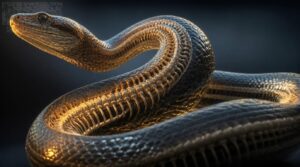
Ever wonder how a snake ties itself into a knot without snapping in half? The secret’s hiding in its spine, built from parts that work together in ways your own back could never pull off. Here’s what actually makes that legendary bendiness possible.
Hundreds of Flexible Vertebrae
Some snakes carry over 400 vertebrae stacked end to end, more bones in one spine than your entire skeleton holds. That’s the secret behind their signature wiggle.
Constrictors lean toward this high end thanks to evolutionary vertebral proliferation, while burrowers get by on fewer, stockier segments, proof that skeletal flexibility scales with lifestyle, not just length.
Ball-and-Socket Spinal Joints
Picture a tiny ball nestled in a cup, repeated hundreds of times down a spine. That’s ballandsocket connections at work.
Each joint allows just enough rotation to bend without breaking, a design detail explored further in this guide to snake skeletal anatomy.
Each vertebral articulation allows rotation, bending, and sliding, while a load distribution mechanism spreads stress across curved surfaces.
Joint ligament support and proprioceptive feedback keep movement coordinated, giving snake skeletal anatomy its notable axial rotation capability and signature flexibility.
Stabilizing Zygapophysis Joints
Ever wonder why a snake’s spine doesn’t just buckle under all that bending? Small zygapophysis joints interlock like handshakes, and thick face joint ligaments plus joint capsule reinforcement prevent overrotation.
- Synovial fluid lubrication keeps things gliding
- Cartilage thickness norms cushion each vertebra
- Neural sensory fine-tunes movement
- Vertebral articulation stays stable, not floppy
That’s spinal mobility without collapse.
Muscles Connecting Ribs and Skin
A snake’s bones don’t move alone. Deep intercostal muscle fascia links each rib, creating a rib lever mechanism that translates tiny muscle twitches into visible motion. This fascial rib layer even connects to the skin, so rib skin linkage produces subtle cutaneous chest expansion.
That muscle coordination across the muscular system is the real secret behind snake flexibility, not just bendy bones.
Flexibility Differences Between Species
Not all serpentine bodies bend the same way. Vertebral count variation shapes everything: burrowers pack fewer, stiffer vertebrae for tight tunneling, while climbers carry more for reach.
- Fewer vertebrae, tighter tunnel turns
- More vertebrae, longer climbing reach
- Aquatic spines bending for underwater sweeps
- Rib attachment patterns preventing chest collapse
- Tail length shifting balance near the tip
Your backyard garter snake and a python don’t move alike, and that’s the beauty of it.
How Snakes Move Without Legs
No legs, no problem—snakes have turned their entire body into a highly capable walking system. They just swapped feet for physics, using their spine, ribs, and belly scales in some clever combinations. Here’s how they pull off four totally different styles of legless travel.
Lateral Undulation

That ribbon-like glide through grass? Pure lateral undulation, the most common gait in snake skeletal anatomy.
Vertebrae connected by ball-and-socket joints send waves head to tail, pressing against surfaces for grip.
- Wave Speed Variation shifts with terrain
- Body Curvature Patterns intensify at higher speeds
- Neural Control Mechanisms coordinate each bend
This Environmental Adaptation, paired with careful Energetic Cost Analysis, makes flexible spines the true engine behind serpentine locomotion.
Straight-Line Rectilinear Movement

Big-bodied snakes like boas ditch the wave entirely. Rectilinear movement sends ribs and belly scales rippling straight ahead, no sideways bend needed.
Think constant velocity motion: steady, quiet, almost eerie. Displacement calculation here is simple, since the position function tracks a straight path. Flexible spines and vertebrae connected by ball-and-socket joints still do the work, just linearly.
Sidewinding Across Loose Sand

Hot sand burns, so snakes get creative. Sidewinding mechanics lift the midsection while head and tail anchor down, minimizing sand interaction and preventing sinking.
This desert locomotion trick relies on vertebrae connected by ball-and-socket joints, creating diagonal loops instead of lateral undulation’s steady wave. The payoff? Serious energy efficiency and a signature serpentine flow, leaving those unmistakable J-shaped track patterns behind on the dunes.
Concertina Movement in Tight Spaces

Ever tried squeezing through a gap barely wider than yourself? Snakes do it with coil anchor mechanics: tail grips, midsection folds, head presses forward. This concertina locomotion depends on ball-and-socket joints stacking tight bends through segment rotation.
Following the energy lever principle, small muscle efforts create big thrust, letting obstacle negotiation tactics turn narrow crevices into manageable, inch-by-inch victories.
Friction and Surface Contact

That inch-by-inch concertina crawl works because of friction and surface contact, not just muscle. Rough ground boosts grip; smooth surfaces need bigger real contact area.
Snake scales exploit contact area mechanics and friction coefficient variability, using microscopic ridges the way sidewinding uses reduced sand contact, turning surface texture into forward push rather than wasted energy.
How Flexible Snake Jaws Swallow Prey

Ever watched a snake swallow something bigger than its own head and wondered how on earth that’s possible? The secret isn’t magic, it’s engineering, built right into the skull and jaw. Here’s exactly how that wide-open bite comes together, piece by piece.
Loosely Connected Skull Bones
Picture a skull built like a puzzle, not glued shut. Snake skulls rely on loose bone connections and stretchy sutures, similar to a baby’s soft spot before it fuses.
This suture flexibility absorbs impact shock and, in reptiles, lets skull bones shift independently, an adaptation for engulfing prey that’s practically an appetizer-sized meal by human standards.
Unfused Lower Jaw Structure
Here’s a myth worth busting: snakes don’t unhinge their jaws. What actually happens involves an unfused mandible, two dentary bones joined only at the chin, never fused across the middle. This dentary bone movement, paired with loose jaw articulation at the skull, boosts gape width dramatically. No snake jaw dislocation required, just clever snake mandible structure doing its job.
Snakes don’t unhinge their jaws—an unfused mandible and loose skull joints widen the gape instead
Stretchy Jaw Ligaments
So what’s holding that unfused mandible together? Stretchy elastic fibers, not bone. Snake ligament elasticity comes from collagen woven with elastin, letting the jaw widen without tearing.
- Feels like nature’s own bungee cord
- Stretches wide, then snaps back
- Never overloads one weak spot
- Grows stronger as the snake matures
Jaw expansion mechanics rely entirely on this flexible jaw structure, not dislocation.
Expanding Around Large Prey
Ever watch a snake eat something wider than its own head? That’s flexible jaw structure at work, not magic. The skull loosens, ligaments stretch, and vertebrae ripple to guide prey inward.
| Adaptation | Function |
|---|---|
| Loose skull bones | Widens gape |
| Stretchy ligaments | Prevents tearing |
| Rippling vertebrae | Guides prey down |
| Flexible ribs | Expands cavity |
| Elastic esophagus | Eases swallowing |
Habitat influence and growth patterns shape each snake’s prey size limits.
Why Jaws Do Not Dislocate
So how does that gaping mouth never pop out of place? A snake’s mandible joint hinge works like a sturdy door hinge, not a loose ball-and-socket joint. Ligament tension limits stretch without tearing.
Muscle ring support and skull bone reinforcement absorb the pull, while skin anchor forces spread stress evenly, so jaw dislocation just doesn’t happen.
How Snakes Evolved Long, Limbless Bodies
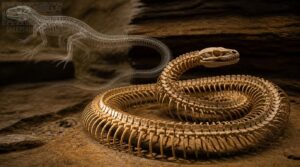
Snakes didn’t start out legless, so what happened to their limbs? The answer stretches back millions of years, written right into their bones and their DNA. Here’s the story of how they lost their legs and gained a whole new way of getting around.
Evolutionary Limb Loss
Snakes once had legs. Fossils prove it, showing transitional forms with shrinking hindlimbs as ancestors traded walking for slithering into burrows.
- Sonic Hedgehog Pathway disruptions stalled limb bud growth
- Hox Gene Shifts rewired body-segment blueprints
- Limb regression genes silenced pectoral girdles first
- Homeotic genes repurposed leftover tissue
- Vestigial pelvic bones lingered as quiet proof
Increasing Vertebrae Over Time
Losing legs was only half the story. As those limbs shrank, Hox gene shifts kept adding vertebrae, one segment at a time, through growth plate processes that ossify cartilage into bone.
Species-specific patterns emerged too: burrowers kept it lean, while constrictors piled on hundreds more, an ecological vertebral adaptation shaping snake evolutionary history ever since.
Fossils With Ancestral Limbs
More vertebrae didn’t erase snake ancestry. Fossilsnake ancestry. Fossils like Nagini mazonense show hindlimb buds still clinging on, proof of a slow, stepwise fin to limb story stretching back to Tiktaalik.
- Tiktaalik change: wrist-like bones foreshadowing limbs
- Pelvic girdle changes supporting weight, then shrinking
- Vestigial limb bones fading from ancestral fossils
- Hox genes rewriting skeletal evolution over millions of years
Vestigial Spurs in Modern Snakes
Ancient hindlimbs didn’t vanish completely. Boas and pythons still carry pelvic spurs, tiny claw-like nubs near the cloaca formed from vestigial leg bones and a leftover femur, floating free from the spine.
Spur size varies by species and sex, males often sport longer, sharper hooks used to grip females during mating, a quirky nod to legs long gone.
Benefits of Limbless Movement
Those pelvic spurs are cute, but ditching legs altogether paid off big. No limbs means energy savings locomotion, less snagging, and true terrain versatility, from sand to tunnels via concertina locomotion.
Vertebrae and joint articulation spread stress evenly, boosting injury resistance, while low, quiet bodies aid stealth predation with reduced obstacle contact everywhere they slide.
Frequently Asked Questions (FAQs)
Why do snakes wiggle their body?
Your snake’s spine bends because hundreds of vertebrae create joint articulation at every segment. Muscle wave propagation drives body curvature behavior, generating propulsive force for lateral undulation, concertina locomotion, or rectilinear movement, depending on the surface and environmental stimulus response guiding its neural control patterns.
Which smell do snakes hate?
No single scent sends every species fleeing, but strong ones overwhelm their chemoreception. Vinegar, citrus, garlic, pepper oil, and the mothball effect irritate the Jacobson’s organ, the sensory system snakes rely on more than their eyes.
Do snakes feel pain when cut?
Yes. Nociceptors in skin and tissue send signals through nerves to the spinal cord and brain, triggering withdrawal, guarding, and faster heartbeats, proof that even with hundreds of flexible vertebrae, snakes genuinely register injury.
What body parts do snakes not have?
Missing limbs top the list, along with a lack pelvic girdle and no shoulder joints. Add absent eyelids, no external ears, tail rib absence, and independently moving jaw bones, plus tiny vestigial leg bones.
How long do snakes live?
Most species stick around 10 to 30 years, but that number swings hard: garter snakes may only see 8 wild years, while a pampered ball python can reach 30, even 60, in captivity.
Do all snakes lay eggs?
Nope, snake motherhood splits down the middle. About 70 percent lay eggs in warm, sheltered nests, while the rest, like garter snakes, skip the shell entirely and give birth to live, wiggling young.
What is the largest snake species?
Picture a rope thick as your torso: the green anaconda claims heaviest honors near 250 kilograms, while the reticulated python stretches longer, sometimes past 9 meters, both ruling their wetland and forest territories as top predators.
Why do snakes flick their tongues?
That flicking tongue isn’t random, it’s stereo smelling. Each fork tip gathers scent molecules, delivering them separately to the Jacobson’s organ. This directional input helps snakes track prey, sense danger, and read their world in three dimensions.
Do snakes have good vision?
Good vision depends on lifestyle. Nocturnal hunters lean on infrared detection and smell over sharp visual acuity, while daytime species show strong color perception.
Their eye anatomy, paired with flexible vertebrae for striking, matches whatever hunting style keeps them fed.
Do snakes feel pain when theyre injured?
Like a warning light flashing on a dashboard, nociceptors in a snake’s spine and muscles signal damage instantly, triggering avoidance, stress hormones, and real relief from pain management, proving these animals genuinely feel injury.
Conclusion
You might picture a snake as one smooth, boneless ribbon, but that image just doesn’t hold up.
So do snakes have bones why they so wiggly comes down to one elegant answer: hundreds of vertebrae, each one a tiny hinge working together. That’s not chaos, it’s precision engineering, refined over millions of years.
Next time you watch one glide across a rock, you’re not seeing magic. You’re watching a spine do exactly what yours never could.